Pam Webb

a writer's journey as a reader

Archive for the category “Books”

Ten Sites for Book Lovers


It’s time to contribute my own top ten list. Of course it’s related to books!

1. NY Times: what books are top sellers?

2. GoodReads: a community of like-minded bibliophiles where we share, compare, review, and discuss the books we read. I most appreciate the site for its book list feature.  I have been able to track down books I’ve read since childhood.  This has solved many of those “What was the name of that book?” questions.  Another feature I use is to bring up similar lists of interests when I am shopping for another read.

3.Wikipedia : ssh, don’t tell my students, but I refer to Wikipedia to get background information on authors and their works. I often get behind the scenes info and author history that helps me better understand and appreciate what I am reading, plus there are external links to adaptations (gotta see the flick after reading the book).

4. Book Crossing: this site proves the saying, “If you love something you will let it go.” The concept is to register a book with the site and then attach the registration marker in a book. And then…leave it.  The idea is someone will pick it up, go to the site, plug in the registration number, leave a few words about the book, and it’s hoped they will leave it for someone else. If you have ever come across the “Where’s George?” stamped on a dollar you have discovered the serendipty of the moment.  Who else has read this book? What travels has it seen?

5. Shmoop : looking for summary, theme, symbolism, the why-should-I-care factor for reading your book? This is the site.  Witty literary analysis provided by PhD students and other smarties, helps shed a flashlight on those hard to fathom passages.

6. Bookspot: what books have earned awards?

7. The Gutenberg Project: a  digital library with over 42,000 full texts of public domain books.

8. Amazon: buy your book right here. I often rely on it as a means for finding authors and their books, and similar subjects.

9. Overbooked: Overbooked’s mission is to provide timely information about  fiction (all genres) and readable nonfiction for ravenous and omnivorous readers (from the site).

10.  Bibliomania: reading and study guides galore and then some

Other recommendations:

Ellyssa Kroski created a worthwhile list of her own: 10 Websites for Book Lovers

Laura DeLeon provides a list of free book reads:  Web Reading 

Saratoga Springs Library:  Websites for Readers 

Just Swallow the Leader


Summer wouldn’t be the same without those plucky little backyard aereo acrobats–the swallow.

Although I have never been to San Juan Capistrano, I would surely like to be there when they make their yearly return.  The MEPA has related how spectacular the event is, and so it’s been placed on THE B.I.G. LIST. For now, I still thrill to seeing the few swallows that  swoop and dive and line twitter in our neighborhood. They are such cheeky little things with their bombing straifs if we get too close to their nest, and I always glance up upon hearing that endless parakeet chittering as they zip through the air on their bug runs.  Gosh, I just love ’em!

image: vickiesvintage.blogspot.com

Growing up, my dad had constructed a row of birdhouses, nailing them to the back of the house which faced the sidewalk leading to my playhouse and the garden. I had to pass in front of this airport of activity if I wanted to go to either of these favorite hangouts. The frantic commuter flights both enthralled and frightened me, and I distinctly remember the cacophony of the endless tweets and peeps of fledglings and parents.

Moving to Northern California for continued college, I can’t tell you how ecstatic I was to discover swallows galore. Maybe they got confused or liked the area better than San Juan Capistrano. These guys weren’t the shiny, futzy glossy white shirted swallows, these were the raucous barn swallows who much preferred making nests of mud in the most inconvenient places.  Whole apartment duplexes of them! As much as I loved them, I did not like the mess they made on the stairs which I had to use everyday.

image: pedestrian.com

Once we got settled in our own house I convinced, begged, and bothered the MEPA to install three birdhouses.  Great guy that he is he did so.  It’s taken almost four years for swallows to rent out one of the bungalows. The middle remained unoccupied and a family of chickadees moved into the other end house.

The chickadees have been long gone, but those swallows, my oh my, talk about failure to launch! They’ve been keeping mom and dad busy for these past few weeks. But today was the day they finally moved out.  Like most kids, they blew this small town and mom and dad must have fallen deep into empty nest syndrome, because they seem to have moved on as well.

The robins never returned from last year, and there just doesn’t seem to be as many birds at the feeder this year.  The progeny tease us how we’ve turned into old folksies with our bird books, binocs, and have our chaise chairs aimed towards the feeder.

“Look, hon, a chickadee–or is it a junco?”

“Ohmigosh, it’s an oriole. Lookitlookit.”

“Two o’clock. Nuthatch.”

I got birding love from my dad, and I now I got the MEPA hooked on birds. He’s taken it to a far higher level than me, however. He’s got a telescope trained on the feeder, has at least two bird books on hand for identification, and he talks and whistles to them.  He even gets them to land on him when he’s changing the feeder.

That’s a bit over the top for me and I get a little snippy with comments about nutty about nuthatches.  I kind of feel like Lucy when she catches Linus petting the birds on their heads and yells at him to knock it off.  Don’t know why it makes me crabby when he talks to the birds.  I best watch out. I wouldn’t want a Hitchcockian adventure in the backyard.

image: lecinemadreams.blogspot.com

My bird book of choice (from a college birding class I took):

image: amazon.com

Ain’t Is Too in the Dictionary.


image: nytimes.com

The Story of Ain’t by David Skinner isn’t so much about the word itself, rather it’s more about the dictionary that elevated its use from barely tolerated to denounced celebrity status.  It’s difficult to believe that a dictionary could rock the nation, but Merriam-Webster’s Third Edition achieved that claim back in 1961.

Why care about a dictionary? Simple. As writers, words are what define us.  Pun very much intended.  Before technology made referencing a simple thumb click or flip check, a person had to physically grab a dictionary off the shelf and flip through the pages and ease down the page for the answer.  A somewhat time-consuming process, yet it proved oh so satisfying when the answer yielded the “See, I knew it!” answer.  There was also the resounding “thwack” of the cover-to-cover closure vent of being caught wrong.

On-line access has made dictionary referencing such a ready convenience that reading about the controversy about a dictionary that has been out for over fifty years seems inconsequential.  Yet, writers are wordsmiths and learning about lexicographical history is as revealing as reading up on the Wright brother to perfect piloting skills.

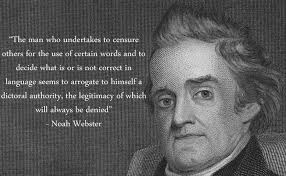
Noah Webster, long associated with the dictionary, left his legacy in the hearts, hands, and minds of capable descendants who continued the craft of prescribing proper word usage for all, that is until the 1961 Third Edition came out. A couple of wars, some cultural changes, and a few major historical events like the Depression not only changed the world, the language had noticeably been impacted.

Enter Philip Gove, the new editor who rattled the paradigm with the new (disturbing) descriptive instead of prescriptive format.  Merriam-Webster had to make room for all the new entries which meant remodeling the model so long held up in esteem.  No longer would it be the go-to reference for correctness of letter writing, titles, names, and places and other encyclopedic information; it would settle down and become a tome of how a word is used versus how it should be used.  More or less a Joe Friday approach, “just the facts, m’am.”

While at times digressive, Streeter nevertheless leads readers along his winding path of explanation as to why the Third Edition alienated newspapers, associations, and academics, irked the public and changed the manner of dictionary presentation forever.  The Story of Ain’t may not be a first pick read in terms of how-to’s and polishing writing skills; however, knowing how this particular dictionary came to be and the absolute furor it caused somehow causes pause, especially since plans for the fourth edition were announced in 2009.  Who knows how long, what, or if, any impact will be made once it hits the bookstores, since there are less and less bookstores to sell it in, now that users frequent screens instead of paper for their lexicon needs.  Now–ain’t that a shame?

Notable quotes:

Page 7:

And Merriam was very much in the business of authority.  In its own pages, Webster’s Second was “the Dictionary,” with a capital D and the definite article as if no other existed.

 Page 11:

The press release quoted Dr. Gove saying that the English language had become less formal since 1934. For an example the PR hands chose the new dictionary’s surprisingly tolerant, though oddly worded, entry for ain’t, which said ain’t was “used orally in most parts of the U.S. by cultivated speakers.”

image: sparklepony.blogspot.com

Page 30:

In those days the National Council of Teachers of English still observed Good Grammar Week, when children were called on to go seven full days without splitting an infinitive. As a reward they were treated to entertaining skits in which Mr. Dictionary vanquished the villain Ain’t. At home, however, as radios in the 1920s went from being a rare possession to a basic appliance, children might hear “Ain’t We Got Fun,” a popular foxtrot, “Ain’t Misbehavin’,” a Fats Waller song, or perhaps even “Ain’t She Sweet,” another hit song of the time.

image: yesterhair.wordpress.com

Page 49:

In the 1920s, Shall I? was still a common usage, but it would not be for long.  A few years after Fries’s study [Charles Carpenter Fries] was released, Bell Telephone allowed a researcher to listen in and count words spoken in the phone conversations of its customers. In the course of 1,900 conversations, will as an auxiliary term was used 1,305 times. Shall  appeared only six times. The long-term trend was obvious.  Twenty-five years hence, Alfred Hitchcock fans would leave the theater with the voice of a very proper Doris Day singing in their heads, using will in the first person to ask, “Will I be rich? Will I be pretty?”

Page 175:

In one instance, he said [Gove], the Webster’s Second board had spent at least an hour discussing whether hot dog should be in the dictionary. (In the end hot dog had won admission: “a heated wienerwurst or Frankfurter, esp. one placed in a split roll;–used interjectionally to express surprise or approval. Slang.”) 
Page 191:

Racy was often used to describe American English: H. L. Menchken more than once called it that. Webster’s Second defined racy as “manifestating the quality of a thing in its native, original, genuine, most characteristic state,” citing a weirdly fitting phrase from the Victorian thinker Walter Pater: “racy morsels of the vernacular.”

Page 213:

The comedian Fred Allen said, “Television is called a new medium, and I have discovered why they call it medium—because it is neither rare nor well done.” Yet its presence in the living room continued to redirect household activity, setting the table for TV dinner, dated 1954 in the Merriam-Webster files.  But one year later, another phrase was making the rounds: idiot box.

image: xk9.com

Page 230:

Said Gove: “Five basic concepts set forth in the English Language Arts supply a starting point.” Then he listed them:

1. Language changes constantly

2. Change is normal

3. Spoken language is the language

4. Correctness rests upon usage

5. All usage is relative

The concepts had been endorsed by the National Council of Teachers of English, Gove noted, “but they still come up against the attitude of several generations of American educators who have labored devotedly to teach that there is only one standard which is correct.”

image: lili.org

Page 241:

The dictionary [Merriam’s Third] weighed thirteen and a half pounds and featured 100,000 new words and senses, a massive amount of new language that Merriam called “the greatest vocabulary explosion in history,” While new words were being added, a quarter million entries were subtracted, and all remaining entries were revised.  “Every line of it is new,” Gove wrote in the preface.  With 450,000 total entries, the new dictionary contained 100,000 quotations from more than 14,000 authors. The foundation for Merriam-Webster’s lexicography comprised some 10 million citations, and the new edition had cost $3.5 million to make.

Page 266:

[James] Parton quoted the dictionary’s critics, the Washington Star calling it “literary anarchy”; the Library Journal calling it “deplorable”;  the New York Times saying, “a new start is needed”; the American Bar Association complaining that Webster’s Third was “of no use to us”; Wilson Follett, in the Atlantic, calling it “sabotage,” a “scandal,” a “calamity,” a “disaster”; a recent Times article calling it a “gigantic flop.”

Page 272:

[Bergen] Evans’s broadest point was his most persuasive: that the language itself had changed profoundly since 1934. “It has had to adapt to extraordinary cultural and technological changes, two world wars, unparalleled changes in transportation and communication, and unprecedented movements of populations.” And, he continued, “more subtly, but pervasively, it has changed under the influence of mass education and the growth of democracy.” Whatever its faults might be, Evans argued, Webster’s Third was an enormous effort to capture and describe, in sufficient detail and without undue prejudice, this great shifting thing called contemporary standard American English.

image: nytimes.com

Personae:

□       Asa Baker: president of G & C Merriam Company

□       Bergen Evans: television host and co-author of a significant dictionary of usage

□       Wilson Follett: professor of English and author of a guide to modern usage—most furious critic of third edition.

□       Charles Carpenter Fries: scourge of old-fashioned grammar and evangelistic scholar who sought to bring American English teachers around to the scientific view of language.

□       Philip Gove: editor of Webster’s Third

□       H.L. Mencken: famed newspaper columnist and magazine editor

□       Robert Munroe: successor to Asa Baker and uncomfortable with Gove’s plans for Webster’s Third.

□       James Parton: journalist and president of American Heritage publishing company who sought to use the controversy over Webster’s Third to take control of G. &C. Merriam Company.

The Merriam-Webster logo.

The Merriam-Webster logo. (Photo credit: Wikipedia)

Treaured Tomes


bookbooster

While I tend to pass up most blog challenges, I couldn’t resist the one passed on by Reading Interrupted by another blogger: show us your bookshelves.

Last year I posted an entry about bookshelves and it really resonated with readers, and to date it ranks among my highest hits and responses posts.  What is it about peering at someone else’s bookshelves. Reading Interrupted believes it’s a way to look into our literary soul, which makes me nervous.  However, being a Book Booster, how can I not show off some of the books I own?

I have bookshelves all over the house: kitchen for the cookbooks, living room holds the eclectics ranging from Calvin and Hobbes to bird identification guides, the bedroom has my stack of bible references and current reads, the office is filled with review favorites (mostly children’s books) and tools of the trade, and the back bedroom is the MEPA’s storehouse of ruggedness, all those pursuits of fishing, hunting, politics and such. And then there are  my pretties, my treasures which are displayed on the table next to my inherited piano from my great aunt.  I was fortunate enough to receive her wonderful collection of books. My iPhone photo does not show the titles well, but you must admit they are gorgeous in binding.  They just about shout, “Open me, read me, all who enter these pages will be satiated.” I’ve been dipping into them over the years, savoring them for I do not want to go through them too quickly. Also, I confess, some are rather daunting.

bookshelf

For example, The Notebooks of Leonardo da Vinci, The Works of Tolstoi, a study on Ralph Waldo Emerson, selected works of Matthew Arnold.  There are also Ibsen plays, poem collections by Browning, Dickinson, and selected verse from Canadian poets, along with stories from Dumas.  As you can see if I were to consume too quickly such a rich collection I might go by way of gout.

My fave librarian, ET, knowing I am a Book Booster, surprised me one day with a gifting of more of these finely bound treasures. She passed on a blessing to me and I, of course, was thrilled with the serendipity of new friends. You must admit it is a handsome collection.  To think, this is how books used to be, all stately and elegant back when reading books was the prime entertainment and erudition pursuit of most people.

Although these aren’t personally selected favorites, they are indeed treasures.  I suppose I treat them more as my book museum as I respect them and the fragile condition they are in. Does anyone else have a treasure of books they have inherited or perhaps picked up along their travels in life?

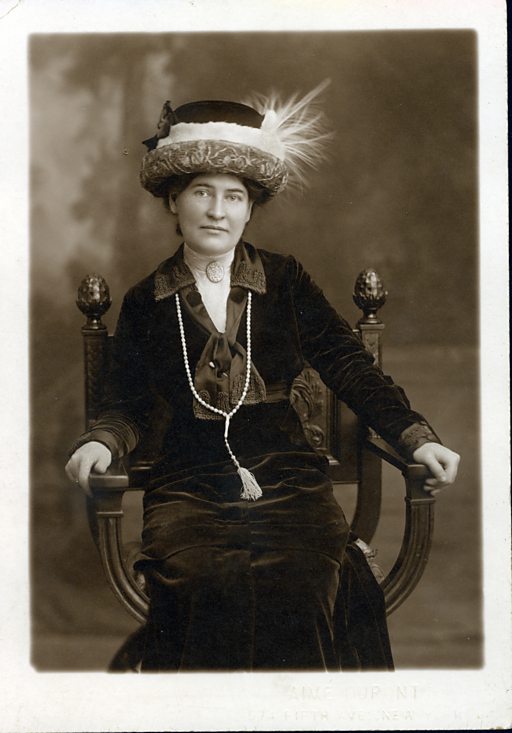
Willa You Let Me Read Your Letters?


intr.v. snoopedsnoop·ingsnoops

To pry into the private affairs of others, especially by prowling about.

Looking where we shouldn’t seems to becoming more and more acceptable or at least it’s becoming more prevalent. I don’t know about you, but I got in BiG trouble if I got caught snooping. Parents, siblings, friends, even strangers don’t appreciate having their hidden stuff exposed. And face it, we all have stuff we want to remain hidden.

This is why I am having such difficulty with my latest selected tome of erudition.

image: Oprah.com

Right there. It says it right there. Willa Cather’s letters were hidden.  She didn’t want them hanging out in the public eye.  In fact, it’s taken about seventy years after her death to get these letters out.  Why?  Cather expressly stated in her will that she did not want her correspondence bandied about. Aren’t last wishes significant? Apparently not. If the agenda and credentials are proper enough it is deemed in everyone’s best interest to snoop and reveal.* No shame attached. In fact, no contrite apologies. Furthermore, the editors, Andrew Jewell and Janis Stout, justify their snooping in the book’s introduction:

Before Willa Cather died, she did what she could to prevent this book from ever existing. She made a will that clearly forbade all publication of her letters, in full or in part. And now we flagrantly defy Cather’s will in the belief that her decision, made in the last, dark years of her life and honored for more than half a century, is outweighed by the value of making these letters available to readers all over the world. [highlights are mine]

Hmm, “forbade” means to me “don’t do that.”  What about “flagrantly defy”? Do I hear a little self-righteousness bragging, as in “I know it’s wrong, but I’m going to be proud out loud anyway”? Tsk.

As interested as I am in Willa Cather, I feel it’s wrong to snoop her letters.  Just because they are published by a reputable and respected publisher doesn’t mean it’s ethical. Literary vultures waited until the will expired in 2011 and swooped down for the feast.  Here is a paradox: if these two editors so respect Willa Cather, why aren’t they respecting her last wishes? Don’t get me started about trotting out King Tut’s burial goods for the paying public.  I guess celebrities are open season dead or alive.

Granted, the letters represent only 20% of the entire collection, and none are present that might tarnish or stain Cather, (says  the editors). I still feel mighty uncomfortable reading her private correspondence. There are family matters, personal matters, circumstances and situations that  reveal too much of a peek behind the privacy curtain.

As much I appreciate learning about Cather’s background, which helps provide more depth to enjoying and understanding her prairie trilogy (Song of the Lark, O Pioneers, My Antonia), I have  shut the book after about 200 pages, right about the third section, about when she left her editor position at McClure’s to pursue writing full time. The best is yet to come, yet sorry, I’m gonna pass. I respect Willa as an author too much to rummage around in her personal life.

Maybe, it’s me. Snooping for the cause of erudition is still snooping.

What do you think, readers?  Should Willa Cather’s wishes been respected? Should her letters have been left alone, should they not have been dusted off and printed up, even if it’s in the quest  harkening the light of “literary illumination”?

Willa is not amused.

*This could easily segway into a Snowden blog,, couldn’t it?

A Woolf in Read’s Clothing


photo: imdb.com

My first vague acquaintance with Virginia Woolf is associated with Elizabeth Taylor. Both are pivotal influences in their chosen professions.  As a last wave baby boomer cI recall a bit of a fuss when the movie Who’s Afraid of Virginia Woolf? came out.  Not being a Disney-generated flick my parents did not take me to see it.  In my childhood bliss of perceptual naiveté I believed Elizabeth Taylor to be Virginia Woolf and from the TV trailers she appeared to be a daunting person.  I could see why some might be afraid of her.

image: aroom.org

My second encounter with Virginia Woolf came way later when I began teaching high school English. Woolf’s essay “A Room of Her Own” was part of the senior lit curriculum, a prelude to a brief study in feminist writing.  Still getting my bearings about Shakespeare, I discovered through Woolf’s essay Shakespeare had a sister! I thought him to be like Atlantis, known but unknown, shrouded in mystery, waiting to be actually proven.  A sister?  It sent me scurrying to dedicated research and though Woolf got it all wrong about Willie’s sis, I now know much more about the Bard.

image: etsy.com

The third encounter came way of Meryl Streep.  She’s a fave, so I couldn’t resist picking up The Hours at the library.  Fascinating film (I admit some parts tweaked my comfort zone and my daughter squeaked, “you watched The Hours!”–my prudery is too well-pegged by family members). What truly fascinated me was Nicole Kidman as Virginia Woolf.  No wonder she received the Academy Award for her performance. A tortured artist always leaves me wondering  the why/what behind the reason of taking his or her  life instead of living it.

image: notreciinema.com

Finding Virginia a bit overwhelming I didn’t do my usual research and read on her. To be honest, although she intrigued me,she also made me nervous, much like James Joyce.  So much, almost too much in their writing for me to comprehend and absorb.  I felt unprepared to read her works.

At present I am a tiny bit more confident having an AP Institute training and one year of AP Senior Lit and Comp seated firmly on the resume.  I thought, “Okay, Ginny, let’s give it a whirl.”  I pulled down Orlando off the shelf and settled in for my summer chaise in the shade read.

Sigh.

I wonder if her writing would have been published if her husband had not set up Hogarth Press expressly for that purpose? Her writing is amazing, this is true. It’s rich, masterful, and paradigm pushing. Deemed ahead of its time, both Virginia and her writing nevertheless appeared to be respected and applauded.  Overall, I will have to pass on Virginia Woolf and her modernist approach to literature.  She and James Joyce are just enough of a different cup of tea to not be on my reread list.

I followed through on my research since I did not do my read on her.  I will definitely include her in my overviews on modernists. Virginia Woolf  may not be among my chosen authors; however, I do acknowledge her place in the literary hall of fame.

image: standrewsrarebooks.wordpress.com

Summer Read n Eat Poetry


Food and summer.  Yup.

Besides barbecue, picnics, reunions, vacation binges, craft fair nibbling, beach concession splurges and the like, there is also food found in our reading.  Take poems, for example.

This is just to say by William Carlos Williams

Watermelons by Charles Simic

Peach Blossoms by Carl Sandburg

A Ballad of Nursery Rhyme by Robert Graves

Orchard by Hilda Doolittle

Plums, watermelons, berries, peaches, oh my. Time to browse the Farmer’s Market!

For more summer foodie poems try this delightful site: TasteArt

Prairie Love


image: oceanliteracy.org

Growing up with the ocean ever present in my life, I couldn’t  fathom living  without it. The salty tang of the air, the lullaby rhythm of the waves, the restoring sandy walks–I couldn’t imagine or even desire living apart from its presence.

And yet, for the past twenty years I have done so. I traded the ocean for trees and mountains. The ocean is still a part of me, though we are now parted. There are aspects of my adopted environment that have also become woven into my person. I call this the sense of setting.

image: wallstickeroutlet.com

Because of my familiarity and connection with the ocean, forests, and mountains, I find myself drawn to reading about unfamiliar landscapes, and for some reason my list of setting interests includes an abundance of stories about the prairie.

Initially, I don’t think I could bear the flatness, the unyielding run to the horizon from end to end, nor bear the extremes of seasons and the monotony of view. This is where the marksmanship and craft of writing happens. Writers, poets, authors portray the prairie in such a way I find myself surrounded by the grass, the wind, and witness vicariously the openness and beauty through another’s eyes. The sense of place.

Recently two writers have presented their sense of place, their love of the prairie so profoundly, my paradigm has shifted. I now understand the fullness of this unique setting, and respect it and perhaps even admire it, which replaces my former disdain. True writing,  the skill of a wordsmith can do this.

While I have read many prairie pioneer books in my life, Laura Ingalls Wilder being the first, my most recent read is Willa Cather. She provided readers with a portrait of the midwest through her trilogy Oh Pioneers, My Antonia, and Song of the Lark. A memorable passage from My Antonia:

Presently we saw a curious thing: There were no clouds, the sun was going down in a limpid, gold-washed sky. Just as the lower edge of the red disc rested on the high fields against the horizon, a great black figure suddenly appeared on the face of the sun. We sprang to our feet, straining our eyes toward it. In a moment we realized what it was. On some upland farm, a plough had been left standing in the field. The sun was sinking just behind it. Magnified across the distance by the horizontal light, it stood out against the sun, was exactly contained within the circle of the disk; the handles, the tongue, the share—black against the molten red. There it was, heroic in size, a picture writing on the sun.
Even while we whispered about it, our vision disappeared; the ball dropped and dropped until the red tip went beneath the earth. The fields below us were dark, the sky was growing pale, and that forgotten plough had sunk back to its own littleness somewhere on the prairie.
Cover of "My Ántonia (Dover Thrift Editio...

Cover of My Ántonia (Dover Thrift Editions)

Cather presents both the starkness of the prairie and the greatness. The plough represents the solitary efforts of those who tried to tame the vastness of that flat, grassy expanse, and while the abandoned plough could have been viewed as sad or even tragic in its loneliness, Cather displays it as heroic.  And this is the view I now have of the prairie. It is like the ocean in its vastness, its grasses the tide upon the land. Those who worked it by tilling the land, navigating its immensity with their ploughs, horses, and tractors are much like those who navigated the ocean with their own crafts of boat, steamers, and ships. Both land and sea represent the need to explore the unknown and forge a living  from it.

Another view comes from today’s Poem-a-Day offering:

Poppies on the Wheat
by Helen Hunt Jackson
Along Ancona’s hills the shimmering heat,
A tropic tide of air with ebb and flow
Bathes all the fields of wheat until they glow
Like flashing seas of green, which toss and beat
Around the vines. The poppies lithe and fleet
Seem running, fiery torchmen, to and fro
To mark the shore.
The farmer does not know
That they are there. He walks with heavy feet,
Counting the bread and wine by autumn’s gain,
But I,–I smile to think that days remain
Perhaps to me in which, though bread be sweet
No more, and red wine warm my blood in vain,
I shall be glad remembering how the fleet,
Lithe poppies ran like torchmen with the wheat.
English: , located on west side of just north ...

English: , located on west side of just north of the Nebraska-Kansas border in southern . (Photo credit: Wikipedia)

I smile, too, grasping the juxtaposition of frivolity of the simple flower merged the purpose of the land.

I may never go to Kansas or Nebraska, but I can say I have traveled to their prairies.


The Guilt-Free Read


One of the first items of my “I’m-finally-on-summer-vacation” list is to trot down to the local library and leisurely select a few novels to enjoy without guilt. During the year I am either guilty of sneaking my reading in between grading essays or I feel guilt because I am not reading.  With no papers in sight for the next couple of months I shall enjoy reading at all hours of the day guilt free.

I tend to mix up my reading,  and although I don’t like to make lists, here are a few goals I plan on to accomplish while lounging in the hammock this summer:

1. Room with a View (a reread, the first time I read it too fast determining if I would teach it for AP–the verdict? A resounding “Yes!” The subtle humor and digs at Brits and their habits are delightful–the film caught the spirit well, also.)

2. A really good mystery series–I haven’t found one since I finished my Inspector Evans series by Rhys Bowens.  I’m picky though–no bedding, no swearing, no gratuitous violence–limiting, isn’t it?  Take it up as a challenge 🙂

3. Classics yet to read:  The Sound and the Fury; Middlemarch; Faust (really, I never have); some Dickens, more Shakespeare, and perhaps a Hemingway, and of course a revisit with Austen.

4. Look up current YA–I discovered Hunger Games before the masses did, and hope to find a new trend-setter.

5. Kid Lit: what’s going on in picture books these days, and it never hurts to look up old friends for an afternoon of revisiting.

I’m open to suggestions. Got a good read to recommend? My schedule is wide open until end of August.

image from guardian.co.uk

Billy Collins captures the guilt-free read so very well in his poem “Reading in a Hammock”. An excerpt:

Around the edges of the book
is the larger sky,
dotted with clouds,
and some overhanging branches
that appear to be slowly swaying
back and forth,
as if I were the one lying motionless…

Dandelion Summer


It’s always a pleasure to discover a new author, especially one who is prolific. Such is the case with my discovery of Lisa Wingate and her novel, Dandelion Summer.

Set in contemporary Texas, this is a character-rich story  with two polar opposites.  Imagine Henry Fonda from his role in On Golden Pond and a teenage Queen Latifah, you then would have Norman Alvord and Epiphany Jones, better known as J. Norm and Epie. Thrown together against their will, they reluctantly form a truce of temperaments as they launch out on a journey of discovery together.

One of the more delightful aspects of the novel is how Wingate swings the viewpoint from J.Norm’s to Epie’s, allowing the reader to fully realize the entire picture. Norman is a recent widower, ailing not only in health, but in regrets.  He is at odds with his only child, Deborah, a resentful professional woman who believes her efforts to run her father’s life is merely a way to honor her promise to her deceased, beloved mother. Epiphany is a troubled biracial sixteen year old who has it tough at home and at school. Both Epie and J. Norm want to break free of their circumstances and solve the mystery of who they really are.  The varying viewpoints provides the balance of age and youth, and it isn’t long before it’s clear that no matter a person’s age, status, or experience the basic need of family is foremost.  Epie and J. Norm form a family bond of sorts and what could have become oversweet in outcome turns into a realistic story of two hurting individuals who learn to rely on someone they least suspect of being a means of help to their situation.

My biggest takeaway from the novel is Norman’s letter to his daughter, Deborah.  He knows he wasn’t there for her when she was growing up and his letter is an apology, yet it is also an instructive that all fathers can learn from.  I plan on slipping this to my sons someday (never mind there aren’t married, or even have serious girlfriends yet), and maybe I can convince my pastor to read it for next Father’s Day. Here is an excerpt:

Dear Deborah,
Words do not come easily for so many men. We are taught to be strong, to provide, to put away our emotions. A father can work his way through his days and never see that his years are going by. If I could go back in time, I would say some things to that young father as he holds, somewhat uncertainly, his daughter for the very first time. These are the things I would say:
When you hear the first whimper in the nights, go to the nursery and leave your wife sleeping. Rock in a chair, walk the floor, sing a lullaby so that she will know a man can be gentle.
When Mother is away for the evening, come home from work, do the babysitting. Learn to cook a hotdog or a pot of spaghetti, so that your daughter will know a man can serve another’s needs.

The letter continues with sound advice and lyrical admonition to be all a man can be by being the best father a daughter can have and remember.  I read this to my writing compadres and the “oohs” and “aahs” circled around the table.

Dandelion Summer is definitely a book for perfect for the summer read list, yet  its warmth resonates long after the last word is read.

Post Navigation