
The Writer’s Life: Got the Room to Write
April 23 is Shakespeare’s birthday, which falls around the time in my blog schedule in which I voice some thoughts about the writing life. I’m in the midst of reading different biographies of Shakespeare, while juggling a few writing projects. In the middle of all this I feel fortunate I have a room of my own in which to write, unlike some women writers my reading has uncovered.

First of all, what I’ve uncovered about Shakespeare:
My reading has added to what is known about Shakespeare with some additional sidenotes. For instance:
Robert Greene casts a snide asperity upon Shakespeare by referring to him as an “upstart crow” in 1592. This is supposedly the first verified appearance of Shakespeare in London. Greene died shortly after that verbal attack. Hmm.
Prior to his London debut, it’s well-known Shakespeare married Anne Hathaway in 1582, became a father in 1583 and again in 1585. His only son, Hamnet, died at age 11. Several facts came to light about his family, such as his father sliding into financial ruin, several of his siblings dying young, his shrewd real estate purchases. Sifting information held within the plethora of tomes about Shakespeare, a few nuggets come sparkling forth.
- He was a profound businessman, buying houses and acreage to pad his retirement funds. Let alone that he went from a nobody London hopeful to a respected playwright, actor, and part owner of the most popular theatre in London.
- He visited Stratford more than people give him credit for, allaying the idea he forsook wife and family for the glittering lights of London. It’s recorded he stayed at The Crown Tavern, an inn owned by the Davenants. He became so close to the Davenants that paternity rumors swirled about, mostly by the Davenant’s son who (it is thought) wanted to grab a bit of Shakespeare fame.
- He helped arrange a marriage between his landlord’s daughter, and her father’s apprentice, and later appeared in court concerning a domestic matter, namely the nonpayment of the daughter’s dowry.
- His acting troupe performed at both Queen Elizabeth I’s and James I’s court numerous times, becoming the most successful among the numerous players in London.
- With his success Shakespeare was able to purchase a coat-of-arms, something his father had wanted, which made him a gentleman, earning him the title of “Mr. Shakespeare.”
- He outlived all his brothers, and regarded his last surviving sister, Joan, well enough to provide her and her family the means to stay in the cottage he owned after his death.
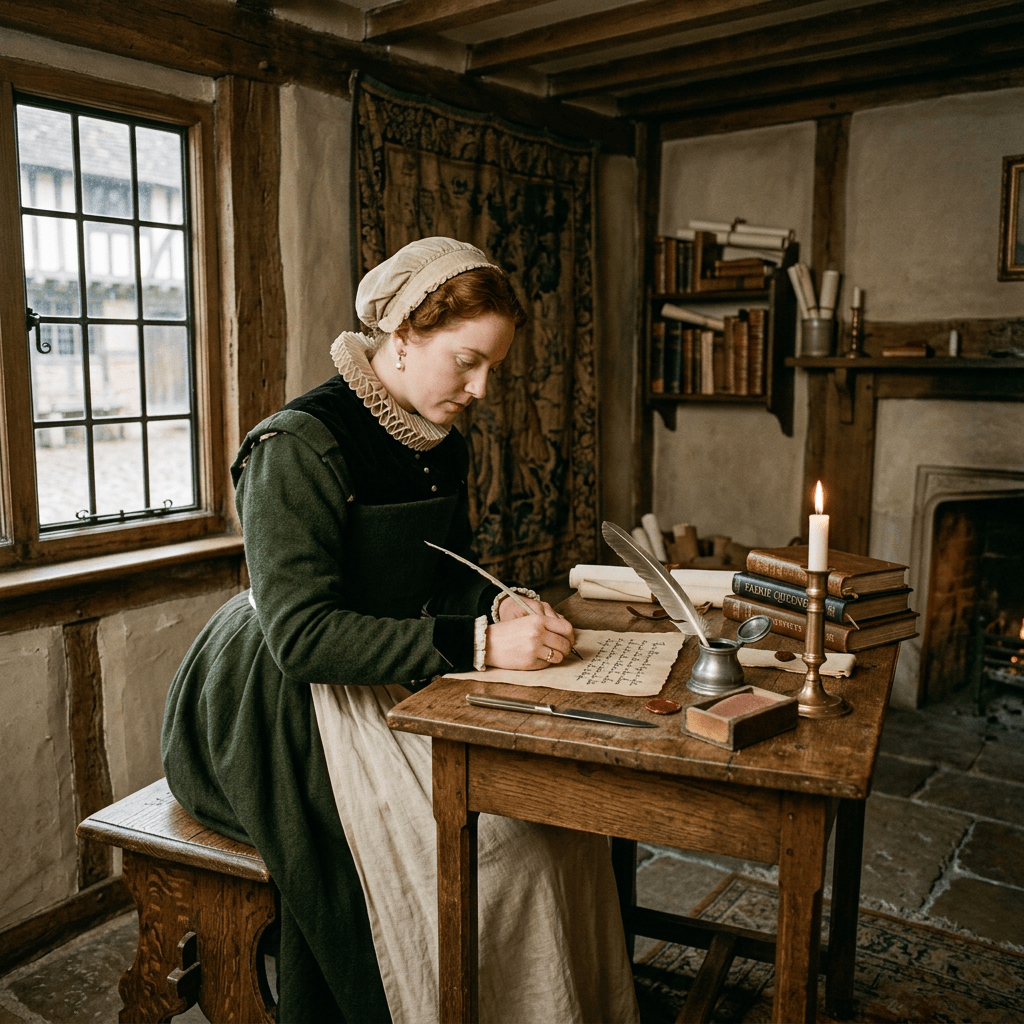
As fascinating as Shakespeare is, how interest in him continues, as in the adaptation of Maggie O’Farrell’s Hamnet, there is a new focus on the Stratford bard through his sister Joan. It has recently come to light that a religious tract was found hiding in the rafters of Shakespeare’s family home. Signed “J. Shakespeare” it was once attributed to John Shakespeare, the father; however, new research is learning towards Joan, Shakespeare’s younger sister, being the probable author. This indicates the following:
- She was literate during a time women did not receive a formal education.
- She felt strongly enough about her Catholic beliefs to put them to paper in an era when papists (as they were called) could be severely persecuted.
- More attention is needed in learning about Shakespeare’s sister who lived to be 77 years old, quite a feat thousands, since so many died of ailments ranging from simple infections to the devastating plague.
As for my recent thoughts about writing, as prompted by the recent discovery about Joan Shakespeare Hart:
Virginia Woolf created an interesting premise about Shakespeare’s sister with her classic feminist essay “A Room of One’s Own,” exploring the relationship of women and creativity. It did not end well for Shakespeare’s sister in Woolf’s story; on the other hand, it did for the real sister. Joan married, had four children, lived a long life, and was favored by her successful brother. More than that, the discovery that she authored a tract, and is receiving notice some 400 plus years after it was written, shows she has earned a name for herself as a writer.
How many other creative works of sisters, wives, daughters will be found that have just been waiting for credit and discovery? In the meantime I will plonk away in my own little room, thankful I don’t have to hide my efforts in the roof timbers.





Will power❣
Indeed! Nice one, Mitch.
It’s daunting to think of the trials of women throughout history. I feel so very privilege, indeed, to be living at the moment in time, despite the state of the world.
I just finished The Frozen River, which is inspired by a midwife’s journal. Was a troublesome read due to how women had very little rights.
The stereotype we’ve developed of poets over the years is that they’re dreamers. I found it fascinating to learn that Shakespeare was a respected businessman. That blows away the image of the poor vagabond who sits around penning words.
I was also surprised at his business acumen. There is more to him than previously thought. His sister Joan living to 77 years is impressive.
I so enjoyed this post, Pam. Thanks for tidbits about Shakespeare. We women are lucky to live now and not then.
Thanks, Jennie. I’m learning that the women in Shakespeare’s life were significant.
😀