Pam Webb

a writer's journey as a reader

Archive for the tag “Virginia Woolf”

The Writer’s Life: Got the Room to Write


April 23 is Shakespeare’s birthday, which falls around the time in my blog schedule in which I voice some thoughts about the writing life. I’m in the midst of reading different biographies of Shakespeare, while juggling a few writing projects. In the middle of all this I feel fortunate I have a room of my own in which to write, unlike some women writers my reading has uncovered.

Man in historical clothing smiling at a birthday cake with candles and inscription 'HAPPY BIRTHDAY W.S. - 1599' in a warmly lit tavern.

First of all, what I’ve uncovered about Shakespeare:

My reading has added to what is known about Shakespeare with some additional sidenotes. For instance:

Robert Greene casts a snide asperity upon Shakespeare by referring to him as an “upstart crow” in 1592. This is supposedly the first verified appearance of Shakespeare in London. Greene died shortly after that verbal attack. Hmm.

Prior to his London debut, it’s well-known Shakespeare married Anne Hathaway in 1582, became a father in 1583 and again in 1585. His only son, Hamnet, died at age 11. Several facts came to light about his family, such as his father sliding into financial ruin, several of his siblings dying young, his shrewd real estate purchases. Sifting information held within the plethora of tomes about Shakespeare, a few nuggets come sparkling forth. 

  • He was a profound businessman, buying houses and acreage to pad his retirement funds. Let alone that he went from a nobody London hopeful to a respected playwright, actor, and part owner of the most popular theatre in London.
  • He visited Stratford more than people give him credit for, allaying the idea he forsook wife and family for the glittering lights of London. It’s recorded he stayed at The Crown Tavern, an inn owned by the Davenants. He became so close to the Davenants that paternity rumors swirled about, mostly by the Davenant’s son who (it is thought) wanted to grab a bit of Shakespeare fame.
  • He helped arrange a marriage between his landlord’s daughter, and her father’s apprentice, and later appeared in court concerning a domestic matter, namely the nonpayment of the daughter’s dowry.
  • His acting troupe performed at both Queen Elizabeth I’s and James I’s court numerous times, becoming the most successful among the numerous players in London.
  • With his success Shakespeare was able to purchase a coat-of-arms, something his father had wanted, which made him a gentleman, earning him the title of “Mr. Shakespeare.”
  • He outlived all his brothers, and regarded his last surviving sister, Joan, well enough to provide her and her family the means to stay in the cottage he owned after his death. 

As fascinating as Shakespeare is, how interest in him continues, as in the adaptation of Maggie O’Farrell’s Hamnet, there is a new focus on the Stratford bard through his sister Joan. It has recently come to light that a religious tract was found hiding in the rafters of Shakespeare’s family home. Signed “J. Shakespeare” it was once attributed to John Shakespeare, the father; however, new research is learning towards Joan, Shakespeare’s younger sister, being the probable author. This indicates the following:

  • She was literate during a time women did not receive a formal education. 
  • She felt strongly enough about her Catholic beliefs to put them to paper in an era when papists (as they were called) could be severely persecuted.
  • More attention is needed in learning about Shakespeare’s sister who lived to be 77 years old, quite a feat thousands, since so many died of ailments ranging from simple infections to the devastating plague.

    As for my recent thoughts about writing, as prompted by the recent discovery about Joan Shakespeare Hart:


    Virginia Woolf created an interesting premise about Shakespeare’s sister with her classic feminist essay “A Room of One’s Own,” exploring the relationship of women and creativity. It did not end well for Shakespeare’s sister in Woolf’s story; on the other hand, it did for the real sister. Joan married, had four children, lived a long life, and was favored by her successful brother. More than that, the discovery that she authored a tract, and is receiving notice some 400 plus years after it was written, shows she has earned a name for herself as a writer.

How many other creative works of sisters, wives, daughters will be found that have just been waiting for credit and discovery? In the meantime I will plonk away in my own little room, thankful I don’t have to hide my efforts in the roof timbers.
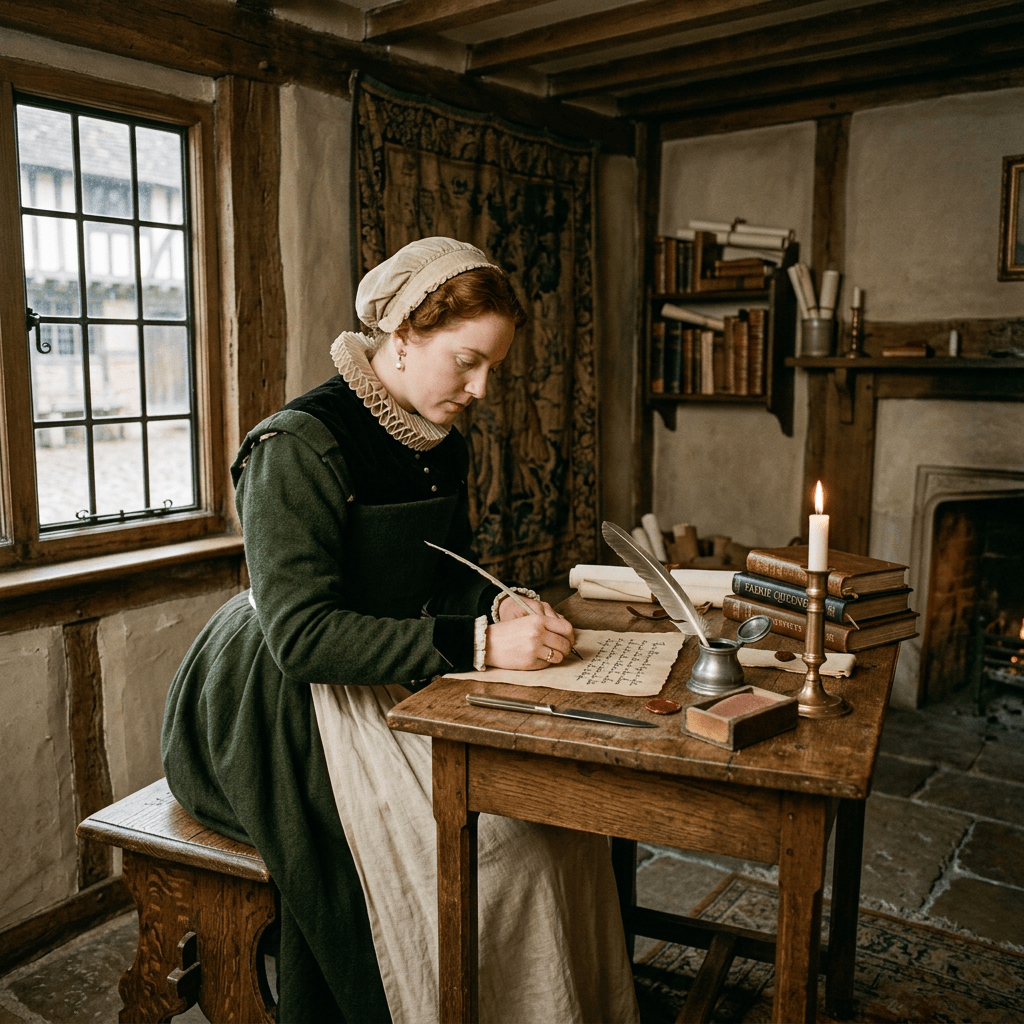
Woman in historical clothing writing a letter with a quill pen at a wooden table

A Room Of My Own or a Writer In Woolf’s Clothing


image: amazon.com

While I’m not particularly a fan of Virginia Woolf, I do appreciate her unspoken contributions to women and writing. She once penned an essay discussing the need to have a room to create in, the desire to close out the responsibilities of mother and wife in order to be alone with self and creating. Rather a revolutionary idea in her time.
Though not so confined to the stove of domesticity these days, as a woman and a wife, mother, teacher, library trustee, GiGi–assorted other hat wearer, I too crave a room of my own. Carving out a space for personal creative endeavors has had its own set of challenges involving space and guilt.
We’ve tended on the small side of houses and squeezing out an area for a desk meant getting creative to find a creative corner. A door placed on top of filing cabinets worked for a time, but definitely cramped the bedroom and so we moved it out to the living room.  Still squishy. Ugly to boot.

When I switched to laptops, I got rid of the desk arrangement and I splurged, buying a loveseat the color of eggplant. I eked out a coveted thinking space in the bedroom, approximating nanoseconds of creative corner. The kids loved the idea that my office was purple.
Now, as an empty nester, I’ve commandeered one of the back bedrooms, I forget which progeny actually had it since they switched around so much. None of them can complain I’ve stolen their room. They know my standard reply anyway, “Your room? It was on loan for eighteen years.” My desk is an Ikea chair complimented by matching footstool to accommodate my two laptops (I still like my antiquated Dell, as I am trying to get used to my touch screen Lenovo). I have a rocking chair for when the MEPA wants to pop in and chat and a futon for the occasional overnight guest. This is where the guilt comes in: it feels a bit me-centric to devote one entire room towards my endeavors.

I know, I know–lots of people, lots of women have sewing rooms, craft corners, workshops, man caves and suffer not a twinge of remorse. I, on the other hand, do feel a bit bad about eradicating all traces of the progeny’s room. No beds, posters, old clothes, trophies remain; they truly are a guest when they visit.

Then again, I nudge away those nipping little guilts and conclude I should have no dilemmas about acquiring a room of my own. And this is where I have my moment of truth. Possessing a room of my own means I should make use of it, shouldn’t I? Then why am I writing this in the living room?

A Woolf in Read’s Clothing


photo: imdb.com

My first vague acquaintance with Virginia Woolf is associated with Elizabeth Taylor. Both are pivotal influences in their chosen professions.  As a last wave baby boomer cI recall a bit of a fuss when the movie Who’s Afraid of Virginia Woolf? came out.  Not being a Disney-generated flick my parents did not take me to see it.  In my childhood bliss of perceptual naiveté I believed Elizabeth Taylor to be Virginia Woolf and from the TV trailers she appeared to be a daunting person.  I could see why some might be afraid of her.

image: aroom.org

My second encounter with Virginia Woolf came way later when I began teaching high school English. Woolf’s essay “A Room of Her Own” was part of the senior lit curriculum, a prelude to a brief study in feminist writing.  Still getting my bearings about Shakespeare, I discovered through Woolf’s essay Shakespeare had a sister! I thought him to be like Atlantis, known but unknown, shrouded in mystery, waiting to be actually proven.  A sister?  It sent me scurrying to dedicated research and though Woolf got it all wrong about Willie’s sis, I now know much more about the Bard.

image: etsy.com

The third encounter came way of Meryl Streep.  She’s a fave, so I couldn’t resist picking up The Hours at the library.  Fascinating film (I admit some parts tweaked my comfort zone and my daughter squeaked, “you watched The Hours!”–my prudery is too well-pegged by family members). What truly fascinated me was Nicole Kidman as Virginia Woolf.  No wonder she received the Academy Award for her performance. A tortured artist always leaves me wondering  the why/what behind the reason of taking his or her  life instead of living it.

image: notreciinema.com

Finding Virginia a bit overwhelming I didn’t do my usual research and read on her. To be honest, although she intrigued me,she also made me nervous, much like James Joyce.  So much, almost too much in their writing for me to comprehend and absorb.  I felt unprepared to read her works.

At present I am a tiny bit more confident having an AP Institute training and one year of AP Senior Lit and Comp seated firmly on the resume.  I thought, “Okay, Ginny, let’s give it a whirl.”  I pulled down Orlando off the shelf and settled in for my summer chaise in the shade read.

Sigh.

I wonder if her writing would have been published if her husband had not set up Hogarth Press expressly for that purpose? Her writing is amazing, this is true. It’s rich, masterful, and paradigm pushing. Deemed ahead of its time, both Virginia and her writing nevertheless appeared to be respected and applauded.  Overall, I will have to pass on Virginia Woolf and her modernist approach to literature.  She and James Joyce are just enough of a different cup of tea to not be on my reread list.

I followed through on my research since I did not do my read on her.  I will definitely include her in my overviews on modernists. Virginia Woolf  may not be among my chosen authors; however, I do acknowledge her place in the literary hall of fame.

image: standrewsrarebooks.wordpress.com

Post Navigation