I’m pretty sure I’ve expressed my appreciation for Jasper Fforde from time to time. He’s right up there with Douglas Adams in literary wit and as for style? I’m not sure who comes close to his genre-tweaking way of getting his point across. Playful, knowledgeable, and quite entertaining.
I was introduced to Jasper Fforde by a librarian who knew I taught Brit Lit. “You will definitely enjoy him.” Of course, with those words I felt a)obligated to try him out b)a bit hesitant–whenever someone tells me I will like something I inevitably don’t. Happens to you as well? Must be that human nature thing.
The first in the series. I do adore Jane Eyre. I’m drawn to capable women protagonists. I relish clever wordplay. And I’m hoping Thursday Next will become a series.
I didn’t care as much for the Nursery Grimes series. I also felt Mother Goose a bit grisly for my tastes, same for Grimm fairy tales. I waited for another Fforde to interest me.
Then I picked up his , which I started reading about the same as that other Grey novel came out. I shocked one of the progeny when he happened to see the title upon first glance. “Mother!”
After reassurances, accompanied by a quick summary, my son’s relief became evident when he learned the plot involved dystopian ideology based on quirkiness. He understood it to be my kind of book after all.
While fretfully awaiting the next in the series, Fforde pulls a fast one and comes out with another series The Last of the Dragonslayers. Although aimed at YA readers, I’m thinking it is really Thursday Next vacationing as a sixteen year old foundling who is coping with dysfunctional magicians.
First one just read this one and now awaiting this one…
If you haven’t come across Jasper Fforde and you do appreciate a writer who wittily pokes fun at politics, literature, and popular culture, you might want to try one of his series.
Plus, it’s difficult to resist a writer who appreciates Volkswagen Beetles like I do. They are the car of choice. I came soooo close to spending my inheritance check on a bright red convertible Bug. Caving into family concerns who convinced me into buying something more sensible (I don’t regret my choice of buying a Honda Civic) I now live vicariously through heroines who drive VW Bugs as they dash about taxiing futzy magicians to and fro.
I’m still waiting for my next installment of Shades of Grey…ahem…
When the progeny were young enough to tote to the grocery store I used to dread the inevitable trial of the checkstand gauntlet: the Last Chance Rack. You know, the racks of candy, toys, geegaws, magazines that all whimper at worn out consumers to be taken home. Their whimpering frequency is especially tuned to children’s ears. “Pluheeze, Mom?” I did have a stock phrase for surviving the ordeal which consisted of “Sorry, I don’t have money for (fill in the blank) today.” No arguing with that. And very true–I tended to stick to the budget because I had to back then. Actually, I still should as an empty nester. Never mind that.
The Last Chance Rack I refer to today does not promote cavities or wasteful spending. This is a positively good rack in that it promotes reading. This is the LCR of the library. Our library has prominently planted two double-sided racks near the checkout area. They probably meant it as a way to display new titles as a greeting for patrons. On the flip side, the racks serve another purpose, one I think of more significance. While patrons await their turn to check out their basket of literary goodies they find themselves next to the LCR and can’t help but browse titles. I usually end up taking home an extra yummy or two. Who can resist? The books are especially trained to Book Booster frequency.
This last week I went in for my one hold–akin to going in for that one quart of milk. I came out with two extra books. No complaints about the extra calories needed to read my found treasures. Thought I would share my finds:
image: amazon.com
As a Book Booster it’s difficult to pass up a book about making books. Like any conniseur, I appreciate the art and skill that goes into making something I so regularly consume. The books contained within this palm-sized tome focus on the artisans and their craft. Flipping through the pages and savoring the renderings of featured artists inspire me to try my hand at making my own book or two. There are handy directions included. Sounds like Christmas presents to me…
Another LCR item practically jumped into my arms as I passed the rack. This little goodie knew a Bardinator was in hailing distance. I need to subscribe to the NYT bestseller list. I always hear of these amazing books waaay after they’ve been out and then feel so silly when I find them and gush about them. No wonder I get those looks of–“That was so yesterday’s book.” or “You are just now hearing about that one?” I’m so glad the Book Booster Brigrade is disbanded. I might be in violation of section 31-A (best seller awareness).
Ready for this companion to the NYT bestseller? (just roll your eyes if you are already oh-so-aware of it):
How can you resist a book from a publisher called Quirk Books?(from which this image cometh)
Without slavering too much about how it’s so absolutely genius to mash-up Shakespeare with Star Wars, I will say Ian Doescher manages to pull off the feat of presenting *the best episode* of the Star Wars trilogy in iambic pentameter with dextrous aplomb. Not that I’m an expert at iambic pentameter, but I do appreciate how tough it is to write it. I teach it as the “heartbeat” meter and the students understand that. Shakespeare understood that writing his works in a meter close to the essence of being alive meant his words would be as easy to remember as breathing. Doescher gets that concept too, and understands the devotion of Stars Wars fans. Bringing Shakespeare into our century in a new and absolutely true and original way always gets a round of applause from me. What I really appreciated about Doescher’s mirthful approach is how he skillfully inserted references to the Bard’s other works. Here is my unabashed shopping list of “Where’s Willy?” finds:
Leia’s rant about Han’s ego is reminiscent of Beatrice
Hamlet’s “A hit! A very palpable hit!” uttered by Luke as they attack AT-ATs
C-3PO’s parts with sorrow from his loyal R2-D2 is so R&J
As Luke wings his way to learn the ways of the Jedi from Yoda he speaks of the affairs of mean
And Leia swoons upon discovering her nice scoundrel kisses by the book–that Han, he’s such a bad boy Romeo
The book trailer is as delightful as the book:
Anyone else have a library with a tempting Last Chance Rack? Don’t resist the Force of a good book that needs to go home with you…
Confession: I am a reformed annoying little sister. One of my annoying habits involved sneaking into my brother’s room and get into his stuff. When he wasn’t looking, I crept into his room and stole furtive sneak reads of his comic book collection. He fussed quite loudly whenever he caught me, but I couldn’t resist. What little girl could resist feasting on Disney comics, for those were my brother’s faves. He mainly bought Uncle Scrooge along with those mini-comic books (comics are actually magazines not books, if you think about it).
Uncle Scrooge made sense to me as a kid–I saw through his skinflinty ways and saw a softie. Image: wikipedia
My comic passion ignited I am hooked and remember summer afternoons binging on comic book reads with friends in our backyard. Years pass and my brother graduates and I move on from Disney to Peanuts to Archie and the gang. Flash forward and I’m in college and I’m still reading cartoons, although they are now sophisticated commentary: Doonesbury.
From Doonesbury I easily switched to Far Side and Calvin and Hobbes and Zits. I introduced my own kiddos to the joy of comics, buying the big treasury collections which I read as well. They didn’t bat an eye about their mother reading a Better or for Worse collection with her own bowl of cereal in the morning.
Cereal and comics–best times. Image: stockfreeimages.com
Oh yeah, in high school my research paper was “What’s So Funny About the Comics?” I wrote about the history of the comics from their beginnings clear up to modern-day offerings. I prefer Snoopy over Garfield any day.
This weekend my youngest progeny visited for his monthly Mom Meal. I dragged him along on errands, one of which being the library. Besides picking up a couple of movies we picked up some books. Actually that’s an understatement. We staggered out of the library with mixture of graphic novels (Beowulf rocks), Herge Tin Tins, Marvel Encyclopedias, Batman, Zombie stuff, and DMZ. About twenty books. My son, who is all grown up, living on his own, and is a responsible adult, holed up on the couch the rest of the afternoon and feasted on his found treasures.
Forget surfing the Internet–surf through a comic book instead! Image: slj.com
I’m okay with that. I’d be a bit of a hypocrite if I was, wouldn’t I? Reading comic books didn’t warp my mind, didn’t ruin my kiddos to read “real” books and I’m quite glad to see them legitimized and sitting on their own shelf in the library.
Anyone else still reading the comics page? I only wish I could manage to do so without feeling so silly to see how Luann is doing these days when I’m in the staff room.
Recently I attended a writing conference and I will freely admit I attended primarily because I knew my time had arrived. Yes, this time I would be discovered. My critique editor would be so impressed with my submission that she would pat the chair next to her and state, “I’ve waited all day to finally meet you. I adore this * points to my pages* and we need to talk about contracts.”
This, of course, did not happen and I doubt it will. Or if it does I hope the actual moment will not be as corny as my version.
I didn’t always used to be conference goer. I used to be a conference nayer. “Pfft–I don’t need to spend money, drive miles, and sit and listen to people who have made it. I have my books and magazines to tell me what I need to know.” That’s me turning down a suggestion to attend a SCBWI conference. My critique group sagely retorted, “You go because it’s all about networking.” And she was right. Making connections is primary, and gaining knowledge is secondary for me.
When conference invites drop into my mailbox I first check the line up–who is going to be there? Getting to hear a favorite or well-known author or to glean industry insights from a respected editor, publisher, or agent might entice me to reach for the calendar. Yet, what gets me actually going to the conference is the critique, having the opportunity to learn and to receive an assessment of my writing from an industry professional. If I can get a renowned publisher, editor, or agent to look over my work and get their attention for 12 minutes, I’m all in. Critiques range in price and my pocketbook can handle the $60 variety, which translates to roughly $5.00 a minute . I consider this a good value since I willingly pay a dollar a minute for my ten minute chair massage at the farmer’s market. Both are invigorating focused sessions, yet only one is beneficial towards my career.
Once at the conference I diligently sit through the various speakers, deftly mining worthy industry nuggets. Admittedly I’m only half tuned into the program because I keep glancing at my at my watch after continually rechecking my critique appointment slip. Bad form, really. It would be much better to relax and relish while waiting.
This year I did do just that.
My appointment was probably the last one of the day which meant I needed to pass the time. I actually decided to really listen to the speaker presentations and not just flick through the bin of offered treasure trove of advice but to really savor the meal before me. Yes,a muddle of metaphors. As for the actual conference I had a productive meeting with a publisher of a respected, well-known publishing house. She liked my approach, style, and even appreciated my humorous bits in the manuscript. She had prepared an amazing critique page–the best organized I’ve ever received. No, she did not offer a contract. However, she did hand me her personal business card and invited me to send my proposal for another project to her directly *no slush pile*. And she said I could resubmit the piece she had critiqued. Better than six chair massages, I’d say.
So, if are on the fence about attending a writing conference I would give you a bit of a nudge and so “Zip out the credit card and go absorb and mingle and learn.”
Oh–I would appreciate some good thoughts towards the project I just emailed her. Having just received a rejection for a manuscript, I wouldn’t mind some good news around the corner.
While I’m not particularly a fan of Virginia Woolf, I do appreciate her unspoken contributions to women and writing. She once penned an essay discussing the need to have a room to create in, the desire to close out the responsibilities of mother and wife in order to be alone with self and creating. Rather a revolutionary idea in her time.
Though not so confined to the stove of domesticity these days, as a woman and a wife, mother, teacher, library trustee, GiGi–assorted other hat wearer, I too crave a room of my own. Carving out a space for personal creative endeavors has had its own set of challenges involving space and guilt.
We’ve tended on the small side of houses and squeezing out an area for a desk meant getting creative to find a creative corner. A door placed on top of filing cabinets worked for a time, but definitely cramped the bedroom and so we moved it out to the living room. Still squishy. Ugly to boot.
When I switched to laptops, I got rid of the desk arrangement and I splurged, buying a loveseat the color of eggplant. I eked out a coveted thinking space in the bedroom, approximating nanoseconds of creative corner. The kids loved the idea that my office was purple.
Now, as an empty nester, I’ve commandeered one of the back bedrooms, I forget which progeny actually had it since they switched around so much. None of them can complain I’ve stolen their room. They know my standard reply anyway, “Your room? It was on loan for eighteen years.” My desk is an Ikea chair complimented by matching footstool to accommodate my two laptops (I still like my antiquated Dell, as I am trying to get used to my touch screen Lenovo). I have a rocking chair for when the MEPA wants to pop in and chat and a futon for the occasional overnight guest. This is where the guilt comes in: it feels a bit me-centric to devote one entire room towards my endeavors.
I know, I know–lots of people, lots of women have sewing rooms, craft corners, workshops, man caves and suffer not a twinge of remorse. I, on the other hand, do feel a bit bad about eradicating all traces of the progeny’s room. No beds, posters, old clothes, trophies remain; they truly are a guest when they visit.
Then again, I nudge away those nipping little guilts and conclude I should have no dilemmas about acquiring a room of my own. And this is where I have my moment of truth. Possessing a room of my own means I should make use of it, shouldn’t I? Then why am I writing this in the living room?
I do my best writing while out walking. There is something about the synced coordination of brain and body both exercising at the same time–I now understand the trend towards the new kinetic desks.
After an hour of sitting down at the laptop I get antsy and start moving around, tidying up, doing laundry, futzing and such. Writing in lock down mode doesn’t work well for me. Writers who state they sit down and work office hours have my admiration. This is why I appreciate Ray Bradbury’s short story “The Pedestrian.”
Set in the future a man is out walking one night, his accustomed habit, when he is pulled over by the metro police–suspicious behavior since no one walks anymore, especially at night. The pedestrian ends up being taken in for “further questioning” when he reveals he is a writer–no one reads anymore either.
Fortunately, my walking habit is not deemed odd in our own days and times. Our little town has a refreshing diversity of walking paths and I do relish my times of walking briskly, revving up the muse and muscles. The exercise unknots plot stoppage, uncramps stiff dialogue passages, and opens up new avenues of thought, like blog posts. This one, matter of fact.
How can you not want to read a blog with this as its banner?
This is Mike Allegra, aka HeyLookAWriterFellow. Think of Steve Martin and Billy Crystal as children’s book writers. A little scary but Mike promises he keeps it clean. In fact he insists on it, even though he has been known to trot out some potty jokes now and then. Besides writing an absolutely this-is-really-funny stuff blog, he is a very talented writer, doodler, and all around good guy. He loves to show off his cute kid, who I need to figure out how to bribe so he’ll pull my entry out of the next doodle hat round.
I don’t even know how I found Mike’s blog. I think we started frequenting the same blogs with our commentary and I popped in. Mike and I now banter until I get him to cry “uncle, already.” Yes, Mike, I am keeping score. But I should stay on his good side because I am really hoping to get a cow on a pogo stick doodle out of him one of these days. And, no–this is not a butter up attempt. There have been at least three blog spotlights prior to Mike (I’m going by who trades the most comments with me or who I’ve known the longest in the blogosphere).
So, if you are looking to connect with a talented published children’s author, or like witty writing, or hope to win a doodle (there is a batch of us petitioning for him to run his doodle drawings at least once a month) you need to pop in and visit Mike, who is more than just another writer fellow.
image:: pintrest.com Jane Eyre Silhouette Black and White Book Cover by Pendantmonium,
I am preparing myself early this year for when I announce we will be studying Jane Eyre.
“Do we have to?”
“Is that our only choice?”
“Isn’t that a chic lit selection?”
And that’s the question I shall endeavor to answer. Because the first two questions both can be answered with “no.” But we won’t go there for now.
So, is Charlotte Bronte’s famous classic novel of being true to oneself, of overcoming adversity, of embracing family over riches really a chic lit because it centers on a romance, intrigue, and a woman who is victimized more than once.
Chick lit is smart, fun fiction for and/or about women of all ages. Many of these books are written from a first-person viewpoint, making them a bit more personal and realistic. The plots can range from being very light and fast-paced to being extraordinarily deep, thought-provoking and/or moving.
At this point Jane Eyre could be considered smart, fun? probably not so much. First-person viewpoint–yes. Personal and realistic–maybe. The plot is not very light and could be considered deep, thought-provoking and moving. It does appeal to women and does contain a romantic theme. Perhaps it is chic lit. Then again, let’s explore “classic.”
Mark Twain’s definition is universally accepted: “A book which people praise and don’t read.” However, Jane Eyre is read evidenced by it still being in print, let alone being studied in AP courses. Plus, look at all the film versions of JE.
I put the question to the guy students in class and most said the novel held their interest. The language, the setting, the intrigue, the cousin plot, the bitter aunt, and of course that underplot of a possible vampire living upstairs–wait, that’s a different novel (or is it?)
The verdict? How about JE is a classy literary novel focusing on a woman who overcomes her unjust circumstances. Oh, yes, let’s not forget Mr. Rochester.
Any thoughts?
Did you dread reading Jane Eyre in high school and roll your eyes or embrace the story of a strong young woman who finds happiness after much travail? (yes, I am slanting the vote).
Returning back to school goes beyond getting back into a routine because it means I also have to make adjustments to my practicing for retirement.
No more rolling over and going back to sleep, no more schlepping around in jammies, no more naps, no more odd eating hours, or meals for that matter.
And worst of all, no more diving into books for an entire day and barely coming up for air. Responsible English teachers don’t partake in any of the above behaviors. At least not during the school year. Yet, summer vacation does allow me to practice the art of retirement and one of those skills is thoroughly enjoying a really good read. I was fortunate this year and enjoyed more than my usual share of really good great reads:
All the Light We Cannot See by Anthony Doerr
Breathtaking in its flow and style, I absolutely devoured Doerr’s novel about two lost children. Set in WWII, Doerr portrays the war in a way I’ve not encountered before. One perspective is through the blind eyes of Marie, a young French girl whose indomitable spirit carries her beyond the war’s cruelties. The other perspective is that of Werner, a German youth whose talents land him in the Hitler Youth. The parallel stories eventually telescope down to a satisfying denouement. Doerr, already an award-winning author, will do doubt increase his presence with this amazing tale of how the spirit can overcome its surroundings.
Mr. Penumbra’s 24 Hour Book Store by Robin Sloan
Sometimes I simply have to take a break from the pedantic pace of classics, or step away from serious literary excursions. Mr. Penumbra helped me to once again find the wit in wordsmithing. This foray into classic literature name dropping reminds me of Jasper Fford’s Thursday Next series, which is a delight in how it metafictionally pokes fun at how serious we tend to take our literature. Robin Sloan not only lovingly jabs at academia, he embraces our wanderings over to the dark side of technology via Google (those villains). Yet, bad guys (technology) aren’t so bad, once you understand them, and often they prove helpful overall because they are just misunderstood.
Remains of the Day by Kazuo Ishiguro
My first introduction to Ishiguro and of the three novels I read of his over the summer, this one is certainly the best in my opinion. The voice of nationalistic pride and misguided directive is so artfully penned in this memoir of a proper English butler. The bonus being how well the film adaptation captured the slow realization of how corrupted Steven’s outlook was after all.
The Mockingbird Next Door by Marja Mills
As a TKAM devotee I jumped on ordering Mills’s account of her time with Harper Lee faster than freckles popping out during a July heat wave. Lee has become such a recluse over the years it has been feared this national treasure will leave little behind in way of knowing who she really was. Fortunately, Marja Mills went beyond her journalistic assignment and got to know Harper Lee as friend and neighbor allowing fans and readers a delightful glimpse into what Scout might have been like in the real.
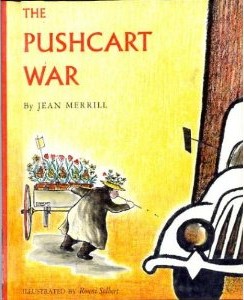
The Push Cart War by Jean Merrill
This cannot possibly be a kids’ book! The wit is droll in delivery and its lampooning so adroit I don’t see how children could appreciate it fully. Maybe I’m only bereft in my opinion since I missed this one growing up. I think I got sidelined by Encyclopedia Brown. Just like The Phantom Tollbooth or Alice in Wonderland is not strictly for children, neither is Merrill’s classic. I’m ever so glad I found it and I made up for lost time.
image: Wikipedia
One Whole and Perfect Day by Judith Clarke. A Printz Honor Award
YA reads are hit and miss for me. There tend to be riveting and noteworthy like Hunger Games and Divergent or fall into high school drama–been there done that and see it everyday. Now and then I do get to pick up a YA which should be in what I call the YA+ category, meaning it’s more towards literary then temporal contemporary (I think it has lasting merit, not trendy, and an adult shouldn’t be embarrassed reading it). Clarke’s novel concerning a girl’s desire to have one day where her family is not dysfunctional fills that YA+ bill. Set in Australia, Lily does indeed have an odd family and what is even more odd is Clarke’s approach to the Point of View–it’s omnipotent, which has fallen out of favor. With almost Dickensian flair for characters and situations, Clarke provides a plot that slowly builds to the becoming a whole and perfect story–pretty nearly.
What’s really the wonder of these summer reads is that they were all recommends found on blogs I perused. Following other Book Boosters definitely has its benefits and I no longer have to forlornly drift the stacks hoping to uncover the newest hot read or find a lost treasure.
How about you? Any really good reads found and savored over the summer? Any great recommends discovered while catching up on your blogs?
I grew up with Reading Rainbow. Well, kinda sorta. The MEPA and I were fairly strict about television (that and we didn’t want to pay for cable) and pretty much the only TV the kiddos watched came via PBS programming. Reading Rainbow won out over Sesame Street and Mister Rogers. I didn’t want the television to be their babysitter so I would plunk myself down on the couch with them and we would relish our R&R time together.
image: geocaching.com “Take a look. It’s in a book. Reading Rainbow.”
The Grammy Award winning program aired from 1983 to 2009–that’s a lot of books! Levar Burton became as recognized and as trusted as Big Bird and Mr. Rogers in guiding children towards enrichment.
When Reading Rainbow went off the air, the world seemed a bit dimmer. Even though I hadn’t watched the show for years since the progeny grew up and moved to other entertainment *sniff* I still nurtured a soft spot for Levar’s brand of book boostering; if an episode aired and I happened to have the time I would watch it. With the passing of Reading Rainbow I thought “Well, there goes that wish.” You see, I harbored the secret wish of writing a book that might be selected as a Reading Rainbow feature read.
All is not lost, because Levar has fulfilled one of his secret wishes and has purchased the Reading Rainbow brand and is creating an app for this generation. He initially hoped to raise one million dollars on Kickstarter–that amount was achieved in only one day. He recently ended his campaign with a staggering amount of over five million dollars.
For more information go directly to the website. I’m looking forward to introducing Reading Rainbow to the grandkiddo. Heck, I might download the app for myself.
Are you nostalgic for a little Reading Rainbow. Check this out:
Or maybe this one:
It’s easy to see Reading Rainbow made an impact on one generation. I foresee its impact on this one.

 The first in the series. I do adore Jane Eyre. I’m drawn to capable women protagonists. I relish clever wordplay. And I’m hoping Thursday Next will become a series.
 , which I started reading about the same as that other Grey novel came out. I shocked one of the progeny when he happened to see the title upon first glance. “Mother!”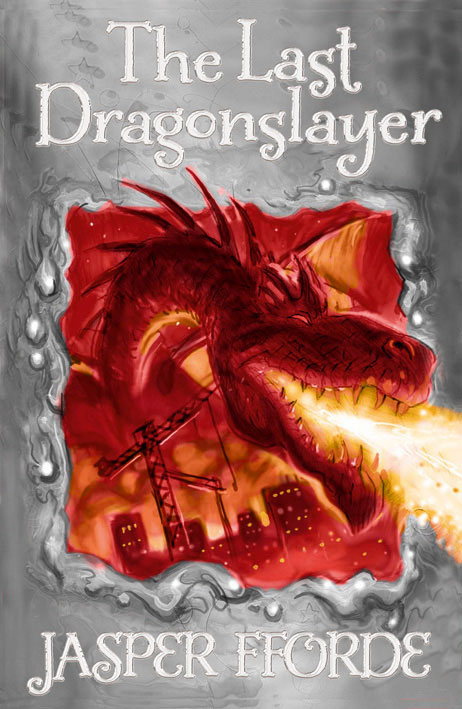
 just read this one and now awaiting this one…
 If you haven’t come across Jasper Fforde and you do appreciate a writer who wittily pokes fun at politics, literature, and popular culture, you might want to try one of his series.