Sorry, this isn’t a post about Steve Carrell and his team. This post is a rumination about desks and what is expected when sitting behind one in the pose as a working writer. I like the sound of saying “I’ll be in my office if you need me.”
I would call this an office. Yet, she doesn’t look happy.
I will say this about having an office—I don’t actually have one but I do have a room that I attempt working in. It also functions as a guest bedroom and the movie den. It’s nickname is Mom Cave.
When I am in my office, i.e. the Mom Cave, my office is actually an Ikea chair and a footstool with a side table. Conventional is not my forte.
Once upon a time I did have a desk but didn’t have an office. This desk was built by my resident MacGyver and housed my enormous Tandy computer (remember Radio Shack?) and printer and two small filing cabinets, plus the TV. Some great stories were written there, but being in the central room, not a lot of quiet was had.
The next office was again not an office but a desk. It was set up in our bedroom. A bit more privacy; however, with three children in the household, privacy was at a premium. I did learn not to let my son and his friend play games on my computer unless I wanted the frustration of corrupted memory and glitches. It was time for my own computer. Enter laptops.
Think deep purple and this is my temporary office.
A laptop meant the filing cabinets could go. Same with the desk, which was actually a door on top of the cabinets (we’ve all done that type of economy desk, right?). I still needed a place to work so why not a small loveseat? Eggplant plush moved into my bedroom. Some really great stories were written there. Plus, I could sneak into my room and watch a movie on my laptop and say I was working.
Once the kids started to empty the nest I was able to claim a bedroom. A real office was on the horizon. Children do return now and then for visits so a bed is needed. Not a real office, although close enough.
Long winters and a stimulus check turned the pseudo office into a den aka the Mom Cave. Got my smart TV, sound bar booster, a sweet recliner loveseat. Oh yeah, my Ikea chair for when I do decide to write. Lots of great stories written there.
Wait, I only watch TV after a day at the office. Honest.
This past week, with the Artic Express chugging into town, I have relocated to the living room recliner as the Mom Cave is too cold for comfort. I’m finding I am getting a lot of work done out here. Surprisingly. When typing tedium takes over I look out the window and watch the birds forage and frolic at the feeder. I stay longer and work. I might be on to something.
Oh deer, he chased the birds away.
Over time I have decided the office is a mindset, not so much a place. I still like saying I have an office though.
Shakespeare’s stated politics are not overtly known; however, some ideas can be gathered from his plays with some sleuthing, and a small bit of supposition.
For instance, his thoughts on the ruling class come through as somewhat mocking in the Henry plays, with the heir apparent, Henry IV, carousing with rowdies and hanging out in taverns, while portraying King Lear as being irresponsible with his power by dividing it before he is done with the throne (and see where that got him). Then again, Henry and Lear did end up redeeming themselves, but at high cost: loss of friendship, loss of loved ones, and even loss of sanity.
image: folder.edu
Shakespeare also mocks hardened, pompous rulers evidenced in Richard III, Coriolanus, Hamlet, The Winter’s Tale, and even The Tempest. It’s true he does his fair share of mocking commoners, with Bottom as the poster boy of ridiculous in A Midsummer Night’s Dream.
Then, is he considered a proponent of politics or simply an observer of human nature?
During Shakespeare’s reign on the stage he served Queen Elizabeth I and King James. He came close to sharing a cell with the Essex instigators against the queen when they requested Richard II be played out for the deposition scene. The Bard escaped judgement. The Earl did not. Footnote: the 1597 version omitted the abdication scene.
Shakespeare knew not to bite the hand that paid him, which accounts why his portrayal of Henry VIII, Elizabeth’s father, is toned down. What he thought of King Henry privately did not necessarily make it to the stage, and the history books are mute on William’s opinions on the monarchs beyond his plays.
Several of his plays deal with seizing the crown or regicide, sometimes the two being combined. This could be interpreted two ways. One way is that Shakespeare is emphasizing how chaos erupts when the ruler is violently taken–see Julius Caesar. The second way could be postulating that he understood how his fellow common folk were sometimes tired of their rulers and it was time for a change. The stage allowed for historical reenactment with artistic license–give the paying crowd what they want.
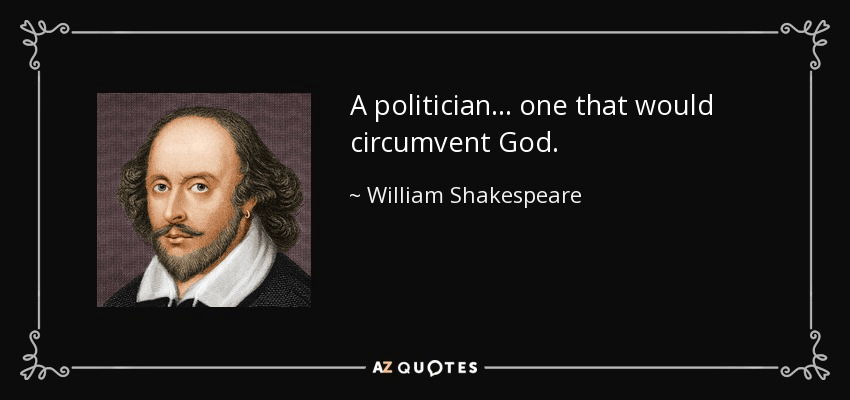
It looks like Shakespeare played both sides by pleasing the monarchy (thus protecting his life), and pleasing the audience (thus protecting his income).
Sounds like Shakespeare could have run for office himself.
image: AZ quotes
Then again he was smart enough to use the stage to present his politics in the guise of entertainment, and aren’t the majority of politicians merely players?
THE DETAILS: Pages read: 29,532 Books read: 102 Shortest book read: 40 pages
So inspiring!
Longest book read: 1,008 pages
A bounty for Bardinators
Average book length: 289 pages Most popular: Matt Haig’s The Midnight Library–over 1 million reads (although I did not favor it) Least popular: Lucius Adelno Sherman’s What is Shakespeare: An Introduction to the Great Plays (not everyone appreciates Shakespeare) Average book rating: 4.3 (I must be particular) Highest rated by Goodreads readers:
Captured a 4.51 rating–a likable read, no doubt a movie is in the making
First review of the year:One Hundred Years of Children’s Books in America, Decade by Decade edited by Jane Yolen and Marjorie N. Allen. An underrated and overlooked sampling of books and the history of America from the early 1800s to the 1990s–would like to see a more current edition. Five star rated books: 11 (I really am particular discerning)
Hitting my reading goal of 101 (the year isn’t over yet) creates a fine sense of accomplishment, especially since it became increasingly more difficult to sit down and focus on reading. After school started I found myself with a certain lassitude that gravitated towards passive viewing of animal shows, Western movies, and of course, my old standby of Dr. Who reruns.
Your Turn: Did you hit your reading goal for the year?
Any stand out reads? I’m always looking for the next TBR item.
Even if you are not familiar with Hamlet you are probably aware of Hamlet’s anguished soliloquy of questioning his existence. It’s such a well-known speech that it is almost a cliché. It’s ripe for parody.
A “B” by any other name…
However, there is a wee bit of scholarly doubt if the “To Be” speech that is proffered in plays is the “To Be” that Shakespeare intended. The problem being (yes, a bit of play on the play’s speech) is that Shakespeare’s plays were published without him having proofed the final copy, and most of his plays were published after his death. That’s another post.
When his plays were sent to the printer, they might have been copies taken from someone’s memory, such as an actor or an audience member—accuracy wasn’t exactly sound. These manuscripts came in three forms: good (from the theatre company and with permission), bad (someone’s recall), and dubious (another version of recall, but even worse in content).
The printer would create “quartos,” which were pages folded twice to create four leaves, or eight pages. Scholars have divided the available found quartos in “good” and “bad.”
Bad quartos have no authority and the manuscript content is suspect. Here is an example of a “bad” quarto line:
To be, or not to be, Ay, there’s the point,
To Die, to sleepe, is that all? Ay all:
No, to sleep to dreame, I marry there it goes.
Compared with the standard, recognized lines:
To be, or not to be–that is the question:
Whether ’tis nobler in the mind to suffer
The slings and arrows of outrageous fortune
Or to take arms against a sea of troubles
And by opposing end them. To die to sleep–
Some scholarly squabbles exist concerning if “bad” quartos are really all that bad.. The lines might have been rough drafts and since Shakespeare isn’t about for consultation, it’s suggested to leave the matter be.
Find me on #SCBWIBookStop! From now until November 30, you can check out my book Someday We Will here 👉 SCBWI BookStop. Thanks for supporting your #kidlit community!
#SCBWIBookStop is a great place to find a new book to love. Go to 👉 BookStop
The journey began with a thought tickle, “If visiting with my granddaughter is this much fun when she’s a baby, what will our future someday visits be like?”
That tickle grew into a smile of ideas: “Someday we will—“
Which eventually became a story-
Which eventually became polished enough to catch the eye of a publisher-
Who believed enough to coach the manuscript into a book that is laugh out loud delightful, at least those who have read the story seem to think.
Someday will be here in April 2020!
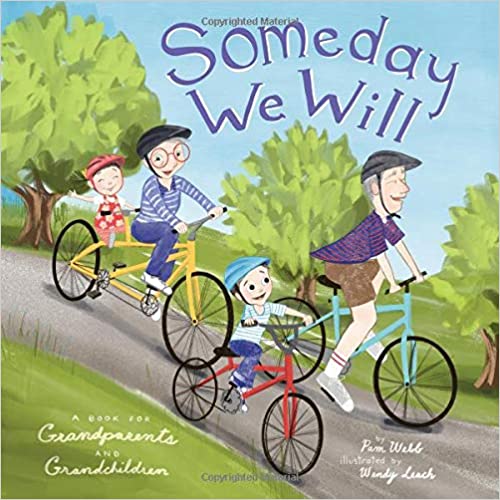
And in four months my debut picture book , Someday We Will: A Book for Grandparents and Grandchildren will arrive.
Laughter is contagious and I am inviting you to share in the joy of my first published book by being part of my launch team. For now, all that is required is to go to Amazon and place Someday on your wish list. No purchase obligation required. This simply indicates Someday is an anticipated book. And, yes, of course, you can certainly buy it when it goes on sale April 7th.
You can also tag Someday We Will “want to read” on Goodreads which boosts up anticipated reading status.
I am excited about this book as it fills in the overlooked niche of anticipating that visit grandparents and grandchildren look forward to so much.
Someday—Someday a book will be published with my name on the cover—and that someday is almost here!
Thanks for cheering me on this journey, and as copies become available I will have giveaways—stay tuned…
For now, I look forward to getting the word out and I appreciate your support.
During my weekly library stop I loaded up book titles and found some possibilities on the free rack. Now to find the time for them all. Stocking up on movies for the weekend I focused on the “G” section at our library pulling old favorites such as The Giver and found Genius next to it. Realizing it was about the friendship between an author and an editor I added to my fare. Good choice.
I know nothing about Thomas Wolfe beyond him being a well-known writer who couldn’t go home again. Oh yes, he was also tall enough (6’6″) to use the top of his refrigerator as his writing desk. I also recall something about wearing a white suit. I later discovered there are two writers by name of Thomas Wolfe. This Thomas Wolfe is the writer from the Jazz Age, not the writer of The Right Stuff. This Wolfe did not wear white, but he proved fairly distinctive in his own way.
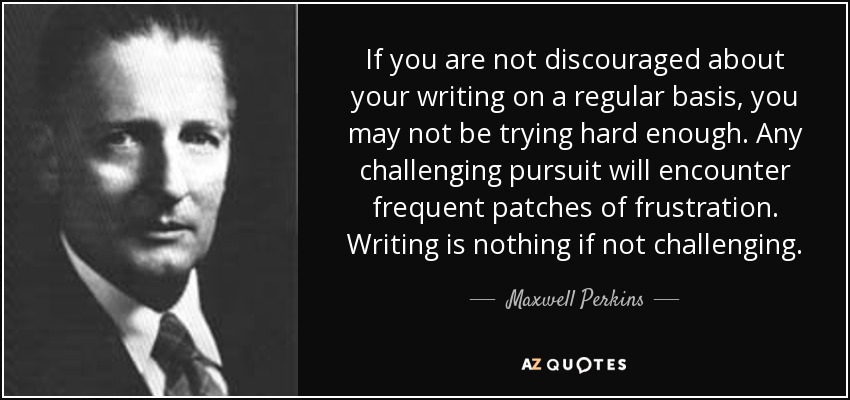
The 2016 film Genius added much more to that knowledge. Yet, the film isn’t so much about Tom Wolfe (played by Jude Law) as it is about Max Perkins (Colin Firth), his editor at Scribner’s. Apparently Maxwell Perkins was a legend amongst the publishing community having discovered Hemingway and Fitzgerald, among other writers.
As the movie unfolds we understand that Max and Tom form a bond that goes much deeper than a working relationship. Max loved his five daughters, yet wanted a son. Tom, losing his father earlier in his life, needed another father figure. For a time these two men met each other’s needs and also produced some brilliant books that are still referred to today.
Often books are sourced to become movies and less often a movie inspires a book. In the case of Genius, I am intrigued enough to find the books of Thomas Wolfe and read about the man who encouraged an undisciplined writer to produce laudatory prose. It makes one wonder who the true genius is in this film.
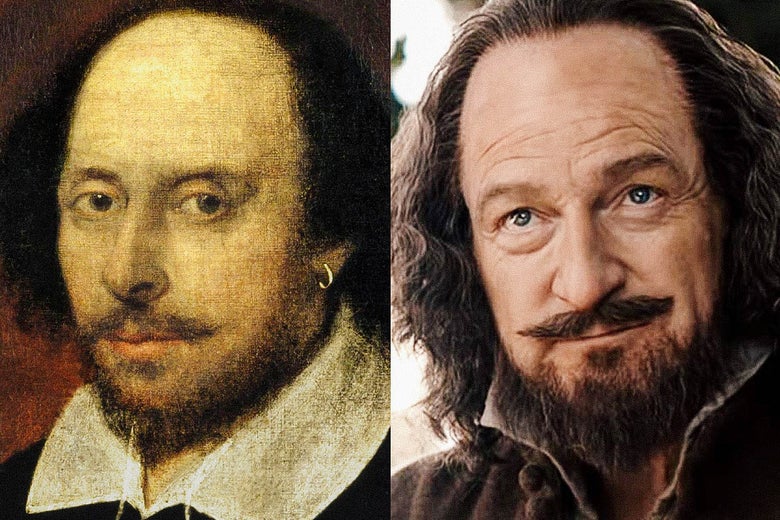
As a bona fide Bardinator I look forward to new or new-to-me versions of Shakespeare’s plays. I also appreciate Shakespeare-ish films, those films, shows, and specials that speculate about the Bard of Avon, because in actuality we really don’t know much about him or his family. Kenneth Branagh, noted Bardolator, attempted to cast some (perceived) truth on Shakespeare’s life after retiring to Stratford.
If you missed All Is True it’s no doubt because it wasn’t playing in a theatre near you. It certainly wasn’t in my secluded part of the world. Fortunately I found a copy in the local grocery DVD corner. The hubs would have preferred a Tom Cruise flick and almost checked out yet another watching of a Mission Impossible. He acquiesced. This is one of the reasons he is such a keeper–plus he owed me for my relenting to watch The Italian Job yet again.
Kenneth Branagh has provided a marvel of a supposition: what happened after Shakespeare retired in 1613 to Stratford? We don’t know, historians don’t know, but Branagh sets forth what he perceives might have, could have happened based on the tiniest scraps of historical information.
Facts: The Globe Theater burnt to the ground in 1613 and William Shakespeare retired from the theatre to live out his remaining days (three years) in his hometown of Stratford-Upon-Avon where he had a family: Anne, his wife, Susanna, his eldest daughter (married with a young daughter) and Judith (unmarried and the surviving twin). Shakespeare’s heir, Hamnet, died at age 11 (attributed to plague, but no one really is sure). There was some scandal connected with each of Shakespeare’s daughters. Shakespeare died on his birthday.
Fancy: From those facts Branagh provides a family drama of a man who has been more absent than present for the past twenty years, and apparently has never recovered from the loss of his only son and heir. Branagh has Shakespeare creating a memorial garden for his son and battling out resentments with his wife and daughters.
Kudos: The acting is superb. How could it not with Judi Dench as the long-suffering Anne, Ian Mckellen as the larger than life patron come to visit his favorite poet, and Kenneth Branagh, who has brought Shakespeare to the general public in bold and creative ways? The supporting actors hold their own as well, especially Susanna and Judith. The hubs did not even recognized Branagh as Shakespeare, being impressed when he saw his name as the director, but stunned to learn he was playing the Bard. Yes, the make up is that well done. He looks like the portrait we are all so familiar with. The costumes and time period setting is excellent–they even filmed in candlelight.
Concerns: I am a stickler for historical accuracy and get a bit distracted when adaptations go too far afield in interpretation. I don’t mind Henry IV being set during WWI or gnomes becoming Romeo and Juliet, but hey, taking liberties with actual history and presenting it “all is true” goes beyond artistic license. The hubs finally shuushed me during the movie, indicating he didn’t care for my pointing out of inaccuracies and inserting corrections. He said, “I liked it.” But, but, not all was true.
Takeaway: This is facfic in extreme. It is a love letter done with excellence. It is worthwhile to hunt up a copy and watch it, not just because for its production quality. Do it because it keeps Shakespeare alive, even though he has been gone for over 400 years.















 Pam Webb