Pam Webb

a writer's journey as a reader

Archive for the category “creativity”

Writer Life: The Art of Name


Names can be a real stumper. Selecting the right name for a place, character, or in my current writing dilemma, a magazine.

Vogue is a hard act to follow

Names and places aren’t usually a problem when writing a story. I have dictionaries and other resources that inspire me. Yet, coming up with an invented name for a magazine is proving difficult. The frustrating part is that the magazine is only mentioned by the character a couple of times, yet it will set up more about the character if readers can associate the magazine with its connotative style. I’m a basic person when it comes to clothing (go Old Navy) so fashion magazines aren’t my usual read; however, my character, Carla, works for a fashion magazine in New York, and she is all about style. Coming up with a magazine about fashion without it actually being a real world magazine has taken far too much of my creative time.

Here are some titles I have come up with that got nixed after doing some fact checking:

Style–out there

In Style–out there

View–out there

Modus–out there

Mode--out there

Mirror–out there

Preview–out there

Clique–out there

Allure—out there

Then there is associated terms, like what The Devil Wears Prada did emulating Vogue by calling the magazine Runway. Maybe I could go there, although some terms have connotations:

Lipstick–nah

Blush–that’s leading somewhere I don’t want to go

Reflect or Reflects–sounds like a mindfulness posssibly

Today–TV show

Now–too demanding

I’m running out of ideas. Just need one word, maybe two, that both entices the reader to pick up the magazine and to understand what it is about. These are possibilities

Regard-kind of like En garde, as in the directive when fencing (being on one’s toes, being ready)

Prev–a bit like “preview” as in getting in on new fashion before everyone else—possibility Preva?

Esteem-too much bragging

Sass and Saz--unbelievably are out there

Nouvo—a twist on nouveau, as in new

Maybe go with a single letter

M–oops, out there

Q–as in quest for fashion, yet too much like GQ

Z–too generational

W—yup, out there

So–I encourage you, I implore you–please help me out with possible magazine names. Think fashion. Think New York. Think chic. As incentive I will mention your contribution in the novel’s acknowledgements.

Word Nerd: Places


Oh, the places you’ll go or at least get to know with this batch of terms.

firth: a long, narrow indentation of the seacoast.

wynd: a narrow street or alley.

Wind your way down a wynd

peregrinate: to walk or travel by foot; journey.

saltigrade: move by leaping.

Nothing like saltigrade by the sea

natant: swimming.

wampish: to wave about or flop to and fro.

estivate: to spend the summer, as at a specific place or in a certain activity.

Natant, wampish, estivate: water wonderful words

Bard Bits: Shakespeare Is For Everyone? (That is the question…)


As an AP English teacher, Shakespeare is naturally part of the curriculum and it’s expected my students adore the Avon man as much as I do. Not usually the case. As for my regular sophomores? The groans when we approach Julius Caesar can discouraging. Yet, it is often in how Shakespeare is taught that makes a difference. This is a separate topic. The main topic is the assumption that Shakespeare is for everyone and they are going to like it. That’s like saying exercising is for everyone. It should be, but face it, not everyone embraces a push-up or a run around the block. Some like the idea of exercising and others have tried it, and many let others revel in it. So it goes with Shakespeare.

AUSTIN TICHENOR is the creator of The Shakespereance; co-artistic director of the Reduced Shakespeare Company. He contributed a thought-provoking article about Shakespeare. Here is the gist of his rhetorical stance:

Is Shakespeare for everyone? Of course he is! Absolutely!

I just wish people would stop saying it.

In Shakespeare’s day, his plays — and plays by others, and theater generally — really were for everyone. All levels of society congregated to see and hear plays in performance, to share gossip and news, and to rub literal and metaphorical elbows. Not just a source for entertainment, Shakespeare’s theater was the internet of its day.

But beginning in the 19th century, theater (and opera and symphonies) became co-opted by the upper class who wanted to keep socially — often meaning ethnically and economically — “unacceptable” people out of the theater, turning what was originally popular culture into “high” culture and using the arts as a tool of status and exclusion.

Worse, as a by-product of imperialism, Shakespeare was imposed on non-English speakers in different countries, held up as the best playwright in the world with the understanding that only by learning his plays and accepting his greatness — and, by extension, the greatness of the English language and Anglo-European culture — could one become truly civilized.

So I get it: “Shakespeare is for everyone” is an important correction, a reminder that Shakespeare’s plays were written to be popular entertainments, designed to appeal to everyone from the groundlings to the nobility.

But I worry that “Shakespeare is for everyone” nowadays feels less like a promise and more like a threat; the implication being that if you don’t like him, there’s something wrong with you..

Because the truth is, Shakespeare isn’t for everyone, and it’s disingenuous to suggest that it is. Nothing is for everyone: Personally, I don’t like opera, baseball, or video games, and in London at the turn of the 17th century, there were tens of thousands of people who undoubtedly preferred to skip another one of Shakespeare’s epics and head to the bear-baiting pits instead.

So what’s the alternative? I prefer saying “Shakespeare is for anyone who wants him.” For many reasons (i.e., the comedies aren’t funny, the language is incomprehensible, the kings and their nobles are confusing, the references archaic), Shakespeare is demonstrably not for everyone. And that’s okay. But I’ll argue till my dying day that he can and should be made available to anyone who wants him, with many different entry points for people of all levels and interests, whether they be live productions, fascinating lectures, compelling museum exhibitions, excellent films and videos, or even, dare I suggest, pop-up books. One of the first steps in appreciating Shakespeare, it seems to me, is being honest about his output, for we can only truly appreciate his greatness by being discerning enough to recognize the parts that don’t measure up, and understanding that no matter what we do, he still won’t be everyone’s cup of tea.

How Cliché: The “B” List


The “B” section is booming with cliché phrases. All these are from Christine Ammer’s Have a Nice Day–No Problem: A Dictionary of Clichés.

The worst backseat drivers | Insurance.com
A backseat driver can be found anywhere

Backseat driver: unwanted advice.
In the 1920’s, those who could afford to do so, engaged a chauffer to drive them. The chauffer sat up front and the passenger or employer sat in the back and gave their driver instructions. Today the term applies to someone giving what they perceive as helpful advice, usually to the chagrin to the person doing the task. Other applicable phrases are Armchair General and Monday-Morning Quarterback.

Back to square one: back to the beginning
Though it sounds like a math problem, thoughts on this one are related to games where the start is a square, as in hopscotch or in a number of board games. Putting in hard work only to start over is frustrating and this term goes with back to the drawing board when the blueprints don’t pan out.

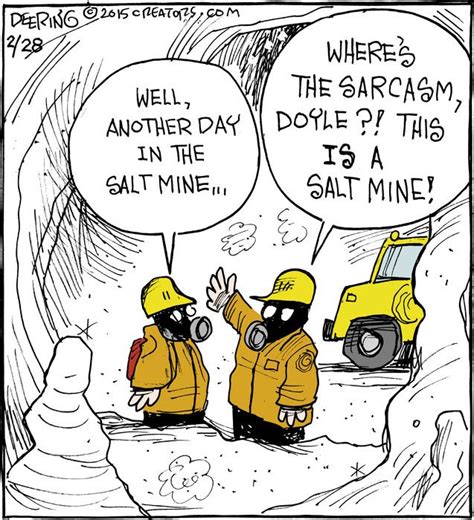
Salt mine Memes
And put some pepper in your efforts…

Back to the salt mines: returning to work
At one point in history, Russian prisoners during communist times were sent to work in the Siberian salt mines. While coming off of break can be tough, it probably is easier going that chipping away at rocks.

(The) ball is in your court: take your turn
A current expression from sports, which is attributed in the mid 20th century which is said when one person is a)being polite b)pushing the other person to take their turn c)a strategy to get the other person to reveal their intentions through action or words.

Bald face or barefaced liar/lie: an obvious, if not bold untruth.
Bare could be brazen, but it is likely is related to “beardless” which connects to only the young (not old enough to grow a beard yet) could so unashamedly tell such outrageous lies.

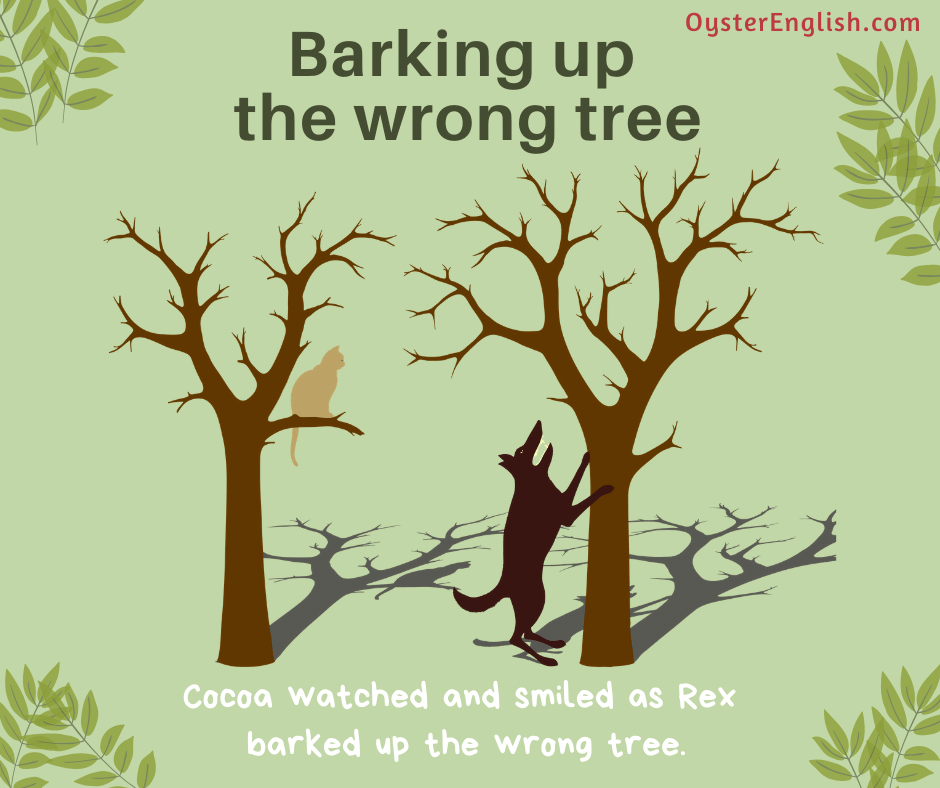
Idiom: Barking up the wrong tree (meaning & examples)
Categorically funny to Cocoa

(To) bark up the wrong tree: waste time or effort going in the wrong direction
Once when hunting racoons with dogs was prevalent, sometimes dogs, so pleased with themselves, would bound up to a tree so sure they had caught the varmint, would bark to their owners their success. Raccoons, being the clever creatures that they are often led the dogs astray by jumping to another tree or applying some other witty escape strategy. For those out there thinking they have solved the problem through what seems to be a long and productive chase, they might find themselves baying at empty branches and must go back to square one.

(To have) bats in one’s belfry: deemed slightly crazy
Bats in flight fly in a more irregular than regular pattern. At one time people watching bat flight thought the irregular flight reflected how bats thought–erratically. Since then it has been proven bats have a sophisticated flying system that employs sonar which keeps them from bumping into obstacles. While belfrys are not much in current use, one might be considered batty if their thoughts or speaking seems random, which might at first seem like an insult, yet it’s actually a compliment since bats are considered sophisticated creatures.

(To) beard the lion: to take a risk
If you haven’t heard this term recently, that makes two of us. Considered cliché for over a century, this phrase has Biblical roots coming from when David related how by grabbing a lion by its beard he slew him. Facing danger and vanquishing it is one thing, grabbing lions is quite another. Granted, David showed his bravery. Look how this lion’s beard–that’s up close and personal.

Why do men have more facial hair than women? - Quora
Bearding the lion (looks more like a goatee)

Beat (scare) the living daylights out of: to punish or scare someone tremendously
A 19th century American colloquialism for a person’s internal organs was “daylights.” To punish or scare someone so severely that there innards would fall out is indeed severe.

Bed or roses: an implied place of comfort
Metaphorically, lying in a bed of roses sounds pleasant, being surrounded by the fragrant petals. However, there are thorns to consider. And a literal bed of roses demands constant care, so this phrase implies the opposite, as in the situation is not comfortable.


BookStop is Here!


Word Nerd Confessions: Random Exploration


Instead of a theme-oriented post I thought I pull out at random what I have collected over the last couple of months. Hope you find a few you can use.

  1. furphy: a false report; rumor

2. mellifluous: flowing with honey; sweetened with or as if with honey

3. yare: quick; agile; lively

4. desideraturm: something wanted or needed

5. supercilious: haughtily disdainful or contemptuous, as a person or a facial expression

6. mal du pays: homesickness

7. perfervid: very fervent; extremely ardent; impassioned

8. garboil: confusion

9. lagniappe: a small gift given with a purchase to a customer, by way of compliment or for good measure; bonus

10. friable: easily crumbled or reduced to powder; crumbly

Ten words that can zip up the most mundane of conversations. Think of the possibilities.

“He seemed to enjoy the lagniappe he received for spending so much money in the store.”

National Poetry Month: Introduction to Poetry by Billy Collins


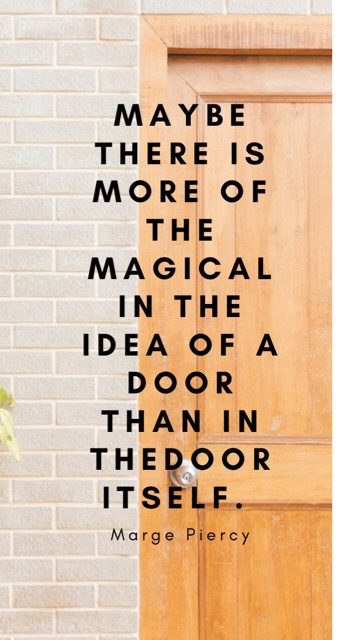
National Poetry Month: Doorways


Word Nerds: Contronyms


I was quite chuffed, having received quite a positive response from my Kangaroo Words post.

And there it was—another strange lexiconical usage of a word. You see “chuffed” (British slang) can mean one is pleased or displeased. It becomes its own antonym. These words are known as “contronyms.”

Here’s a list to get a better idea:

bolt – to secure; to run away

cleave – separate, adhere

clip – fasten, detach

custom- usual, special

dust – add fine particles, remove fine particles

enjoin – prescribe, prohibit

fast – quick, unmoving

fix – restore, castrate

garnish – enhance (e.g., food), curtail (e.g., wages)

give out – produce, stop production

handicap – advantage, disadvantage

left – remaining, departed from

mean – average, excellent (e.g., “plays a mean game”)

out – visible (e.g., stars), invisible (e.g., lights)

put out – extinguish, generate (e.g., something putting out light)

quite – rather, completely

ravel – tangle, disentangle

sanction – approve, boycott

screen – show, hide

table – propose (in the United Kingdom), set aside (in the United States)

unbending – rigid, relaxing

weather – withstand, wear away

Talk about shades of ambiguity! Then again it keeps people on their toes to pay closer attention to the context to better understand the content.

Reader Round Up: June


Sometimes a novel stands out from the others. It shines out its brilliance so noticeably that it deserves an entire post. Leif Enger’s Virgil Wander is such a read.

Five Star–most def

Halfway through the book Virgil , out titular hero, and Rune, think Gandalf with kites, are drinking a Nordic spirit, apparently possessing the kick similar to sake, and Rune makes the philosophic observance “…that just because a thing was poetry didn’t mean it never happened in the actual world, or that it couldn’t happen still.”

This is what is so noteworthy about Virgil Wander as a novel. It is not exactly real-world in scope, neither is it magical realism, but neither is it so unbelievable as to be dismissable. The naysayer critics argued that Enger’s engaging tale is stretching unbelief a bit too much. Like Rune noted, just because it didn’t happen, doesn’t mean it couldn’t happen.

It seems storytellers, the ones like Garrison Keillor who come from Minnesota are the ones who take the ordinary and lean it somewhat so that you have to tip your head to get it all in focus. Or at least I do. I took it with a grain of salt when Keillor spun his hometown stories of seemingly average citizens and transformed their lives and situations into above average. Enger does the same with his own Minnesota tale. He takes a small town on the banks of the Lake Superior and tips its inhabitants a bit sideways and creates intriguing situations out of the mundane. For instance, a sturdy sturgeon that is repudiated to be the cause of death for one fisherman takes on menacing qualities akin to Moby Dick. That homey festival that every small town hosts, the one with corn dogs, a parade, face painting, and a band? Enger turns into an event celebrating the hard luck days of the town, complete with children dressing up as frogs to replicate the day it indeed rained frogs upon the fair town. There may or may not be a bomb threat involved. There is even a raven who becomes mildly domesticated of his own volition.

If the novel sounds odd in highlighting aspects that caught my eye. Well, it is odd. Odd wonderful. Oddly captivating. Odd how I couldn’t stop reading it, being irritated when I had to stop periodically to eat or sleep.

I vastly relished Enger’s debut novel Peace Like a River, and so did the nation. It only took eighteen or so years for his third novel to appear (haven’t caught up to his second one yet), but it sure was worth the wait.

Looking for amusing, Keillor-style storytelling, winsome characters, unforgettable setting, and a couple of mysteries to sweeten the plot? Then I hope you locate a copy of Virgil Wander.

Let me know if you found a copy or if you have read it. Let’s dialog this five star find.

Post Navigation