I’m in Okinawa, Japan, meeting my new granddaughter and engaging in some grandmother time. It takes a household of adults to take care of a newborn.
As a break from grandma time my son took me sightseeing and here are the highlights:
The Botanical Gardens
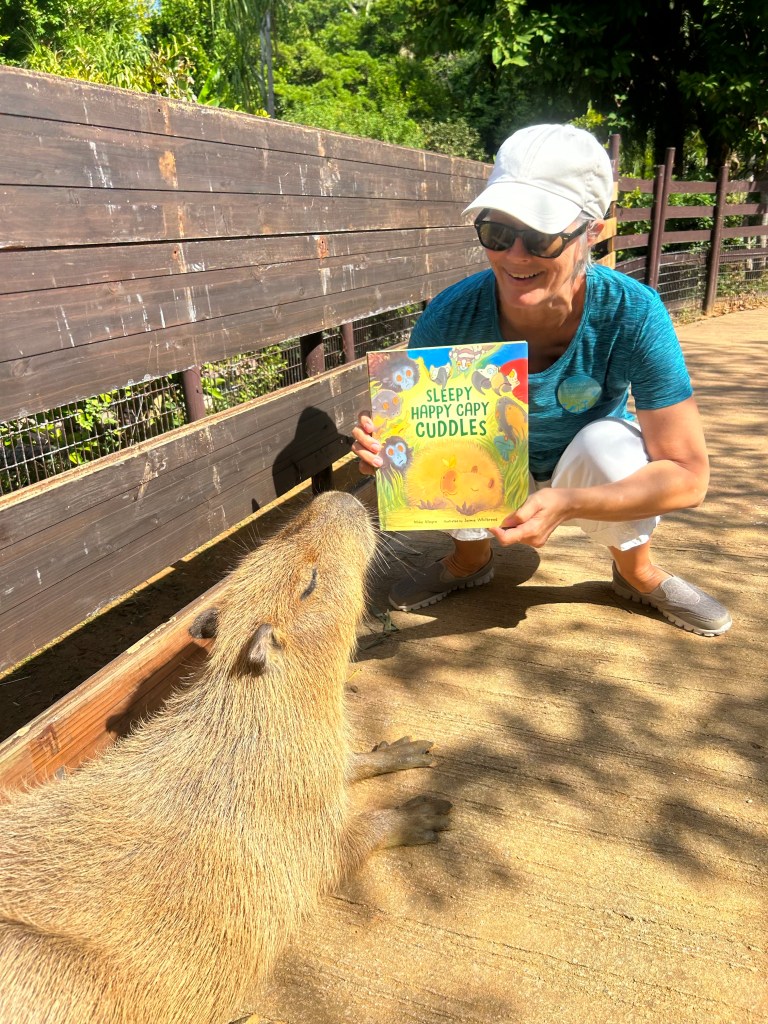
This a popular site with both locals and tourists. The gardens are interspersed with petting zoo exhibits. My very favorite was the capybara enclosure. As a favor to bloggy pal author Mike Allegra, I shared his book with a capy, who definitely showed an interest in a story about his fellow mellow rodent pals.
My son convinced me to feed the monkeys and not being enamored of these critters (thanks to PBS and Disney, I know what they are capable of doing) I went in with great hesitation. I was immediately mobbed for the sunflower seeds we purchased for them. There’s a monkey on my back proved quite true and then some.
Moving from beasts we fed some beautiful birds.
At least one typical tourist pose needed
We then traveled from the lush gardens to the other side of the island for lunch and a passing visit to the American Village. More to come in Part Two—stay tuned.
November weather is doing it’s usual thing of a stretch of rainy days followed by freezy nights and shivery days.
The birds and squirrels are coming in thick and fast stocking up before the snow flies. We keep the feeders going year round but having second thoughts about the birdbath. The birds appreciate the solar fountain, yet that was stored away due to lack of solar power. The best it could muster was an anemic dribble effect.
The birds still gather for a quick sip. No baths lately. One reason is because the water is freezing up. I have taken up the chore of pouring warm water in the birdbaths to loosen up the ice. The fun part is the monocle I pull out.
Backyard Science
I think of Woodstock running his Zamboni on his birdbath ice rink. And I did watch a starling skate around on the ice before I managed to do my defrosting chore. It was one puzzled bird.
As our backyard birding intrigues continue a new player has arrived on the scene, actually one player and two cohorts.
We have been used to our little feathered friends: juncos, chickadees, sparrows, finches, the odd guest of cedar waxwing, and obsequious robin.
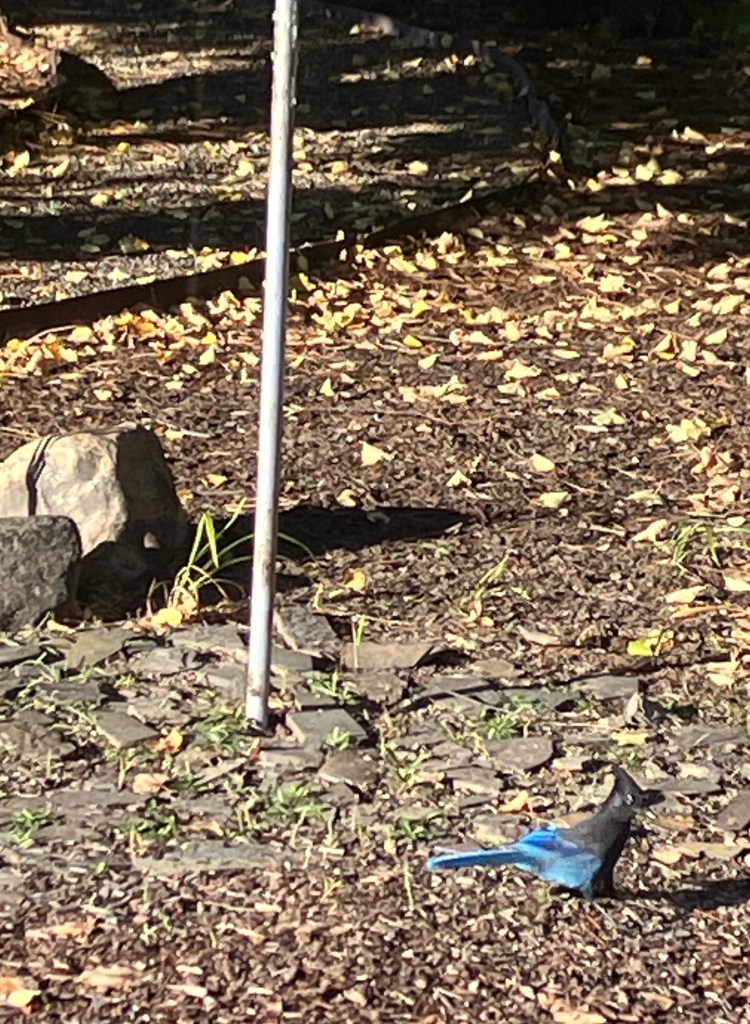
Then one day a raucous “shack shack shack” sounded from the front yard. Looking out the window revealed a flash of brilliant blue amongst the leaves. Further inspection showed a bird larger than the usual batch of birdies. I recognized the bird as a stellar jay from my Washington state childhood days.
Seeing one after so many years, and caring more about birds now, I observed how odd the stellar jay is in appearance and mannerisms.
First off, they are quirky. They jump about from branch to rock to feeder to birdbath all with flourish of squawk scattering all the feathered residents to safety.
Clearing the competition
Another aspect is their size. Compared to the diminutive chickadee the stellar jay, with its black top-notched hood, long tail, and considerable wingspan, is reminiscent of a pterodactyl.Sounds like one too.
The way it eats is worth a mention. It’s a gobbler. It snatches up the birdseed as if it is guilty of sneaking from the larder. Not a dainty eater it gulps down the food with head raised, moving quickly to secure the next mouthful.
Multiple these shenanigans with two more stellar jays and it becomes one entertaining circus. It’s especially amusing when these big blues try to clamber on top of the bird feeder. They flap their wings trying to balance and forage. It’s laughable.
Should they stay through the winter they will provide a colorful splash on the snowy landscape.
There is an unspoken rule that winter is not allowed to happen while autumn is still working on dropping leaves. And winter should hold off until November, preferably until after Thanksgiving. December is acceptable.
We all know winter doesn’t play by the rules.
Waking up to this while it’s still October set back my cheery outlook:
Insult to injury were the winds of 14+ mph all through the day. A few birds attempted to visit the feeder, like this persevering mourning dove.
Not being a winter fan (I don’t ski, walking is curtailed, and hammocking is postponed) snow is definitely a four-letter word in my realm.
Trying to recoup the day I tried to find some positives. A cozy fire was made, a cup of cocoa while I edited a manuscript, fave Pandora station in the background, a new jigsaw puzzle, and a stack of books from the library. Oh, leaf raking is on hold and the yard looks tidier with the leaves hidden by that fresh snow topping.
Okay, not so bad after all, especially since it all melted by 1 pm.
I can’t fight winter🥶
I can find ways of coping, and this winter preview made me realize that snow doesn’t have to ruin my outlook. Keep the cocoa coming and always have a few books on the ready and it will be April before I know it.
Labor of love: to do something for the joy of doing so instead of doing so for personal gain. This phrase is found in the New Testament in Hebrews 6:10 and in Thessalonians 1:3. Both scriptures refer to those who labor in the name of God, doing so in love.
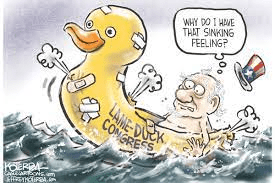
Lame duck: someone finishing out their term of office who will be replaced soon. Originally in 18th century Britain a broker who could not pay his debts were crossed off the membership and they would “waddle away” in shame. Moving to the USA in the 19th century the term was applied to congressmen who were not reelected yet had to serve out their term. perhaps causing them to “waddle away” in shame of losing their job.
Larger than life: appearing to be real. The original saying is from the Latin expression ad vivum, or “to the life.” In the 18th century the phrase appears, the 1799 Lame Jervas: “I see the puppets, the wheelbarrows, everything as large as life.” Other writers, such as Lewis Carroll and George Bernard Shaw began using the expression.
Last but not least: perhaps last but not not least in importance. It’s thought John Lyly originated the expression when he said, “Of these three but one can stand me in steede, the last, but not the least” in his 1580 Euphues and His England. It was also used by Shakespeare in his plays, including Julius Caesar and King Lear.
Last ditch effort: a desperate final attempt. In the 17th century the military term for last ditch applied to the last trench of defense. The 18th century saw the term used by Thomas Jefferson who said, “A government driven to the last ditch by the universal call for liberty.”
To lay an egg: to fail in an embarrassing manner. If a player or team does not score in the British game of cricket then a duck’s egg or zero is earned. Transfer this concept to America’s vaudeville and theater days when a performance failed to please the crowd or when a business fails the idea of laying an egg is applied, or in other words, an zero is achieved.
Left hand doesn’t know what the right hand is doing: taking an action that might indicate less than full knowledge. In Mathew 6:3 the passage indicates that a person should do good quietly instead of publicizing their action, basically keeping the action secret. Over time the secret aspect has taken to mean one department’s or organization’s action indicates a contrary action to another department’s or organization’s efforts, perhaps to the point of adding confusion or inefficiency to a situation.
Left-handed compliment: a statement that seems like praise, but is actually a disguised insult. Marriages between royalty and a commoner is known as morganatic and the ceremony involved the groom (the royal) giving the bride (the commoner) his left hand instead of his right as was done in conventional marriages. *This brings up the issue of the left hand being considered the “lesser” of the hands, which harkens back to superstitions about being left-handed.
Let one’s hair down: to behave informally, without constraint. Back in the day when women wore their hair up, the idea of wearing their hair loose and down around their shoulders was considered a breach of societal protocol. A woman let her hair down only in the privacy of her bedroom. P.G. Wodehouse had fun with this in his 1933 Heavy Weather: “We can take our hair down and tell each other our right names.” *I’m wondering why this only applied to men…
Let the cat out of the bag: to reveal a secret. In old-time open air markets people would purchase their goods and carry them home in bags and baskets. There existed the shady practice of placing a cat in the bag instead of the purchased pig. When the person got home the truth was revealed when the cat was let out of the bag.
There are lots of “L” phrases left. The one that surprised me most was the cat in the bag. I will probably think of pigs whenever I hear a secret revealed from now on.
Fall into reading. I think that was on a poster in the workroom of the library I worked in years ago. A book is fanned open and a child willingly, with a smile of joyful expectation, dives into the book. Falling into the adventure of reading is how I view the books I bring home.
Falling into reading takes on a different meaning as warm summer days morph into crispy cold mornings and evenings. The sun is is out but a light jacket is needed to stem off the occasional breeze. Reading outside in my hammock is diminishing as the days are often cloudy. I’m hoping October still has a few nice days for al fresco reading.
Overall the month held a diversity of good reads ranging from nonfiction to spy thrillers to historical mysteries. Here are my five star reads for September: ⭐️ ⭐️ ⭐️ ⭐️ ⭐️
What It’s Like to be a Bird: From Flying to Nesting, to Eating to Dinging—What Birds Are Doing, and Why by David Allen Sibley
image: Penguin Random
Having been brought up on Audubon’s field guides and turning to Cornell’s website for research and guidance, I’ve missed out on Sibley’s contribution to birding. What a find!
This book is a fine place for beginners to start or it is lovely visit for those familiar with birds. The illustrations are captivating and the info bits and trivia create a special experience. If I had a coffee table this book would be the prominent feature.
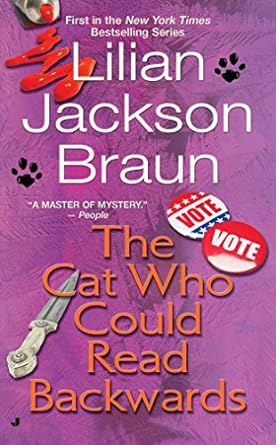
The Cat Who Could Read Backwards by Lilian Jackson Braun
image: Amazon
Having heard about this cozy cat series for some time I finally decided to try out the first one. Even though the sixties attitude is a bit off-putting with its gender roles, the mystery itself is surprisingly engaging. KoKo the cat is definitely the star of the show. Looking forward to the next book in the series.
The Minor Adjustment Beauty Salon by Alexander McCall Smith
image: Amazon
McCall Smith is back on track with this 14th installment to his No. 1 Ladies Detective series. He presents a combination of intriguing cases and interpersonal situations that harken back to earlier successes. The characters are changing and growing which keeps the plot fresh: Grace has her baby, Charlie begins to grow up, JLB attempts to become a “modern man”. Yet, Precious changes little, remaining content being “traditionally built” and remaining reflective as she approaches life and her cases.
Above Suspicion by Helen MacInnes
image: Thriftbooks
A spy thriller that is reminiscent of the old 1940s films (apparently this book became a film)—very 39 Steps in its “innocents-getting-involved-in-dangerous-espionage” plot. Set just prior to Germany invading Poland when Europe was on edge, a British couple is enlisted to locate an agent. They are to pose as typical vacationers, but become entrapped by the Nazi machinations when they attempt to complete their mission. Characterization of British, Americans, and Germans are evident, without being stereotypical. The author also provides strong opinions about the “new Germany” and how far various nations will go to prevent another war.
Considering the book was published in 1941 it is almost prescient some of the outcome in the story. As a side note, the author’s husband served in MI-6, which no doubt lends an authenticity to her action.
Swan Light by Phoebe Rowe
image: Amazon
Switching between 1913 and 2014, the saga of Swan Light, a lighthouse, is unfolded with impressive detail and lyrical energy. Silvestre Swan, at 83 years, has tended the lighthouse since its inception. His days are intertwined with it to the point of a symbiotic relationship. Yet, there is no record of Swan Light. Mari is a driven marine archeologist who is hired by a wealthy, (rumored to be 100+ years) to find the lighthouse that disappeared. This is a fascinating story of goals lost and found, of the past reluctantly revealed, and of the present celebrated. An impressive debut that has the elements of family drama, a heist movie, and a light romance.
As much as I enjoy reading by a cozy fire with a cup of cocoa nearby, I am so reluctant to give up reading outside and will strive to bundle and enjoy my remaining sunny days as long as I can.
Shakespeare. An enigma in my mind when I found out he was a rooted fixture in our English curriculum. He was just a name since I had never encountered a play or a sonnet during my formative schooling and was only vaguely aware that he wrote Romeo and Juliet, which I watched in the theatre in junior high. I had doubts about this English guy from Stratford. Who was he? If I had to teach his plays I needed to understand his background. The problem being is that the more I researched, the less credible Shakespeare became. Not much is known about his childhood, less about his schooling, and then there are those missing years before becoming cited as an “upstart crow.”
image: Amazon
However, over time I uncovered more information, learned more than the standard school fare of Romeo and Juliet and Julius Caesar and decided Shakespeare was amazing. I converted to a Bardinator and earned the reputation as the Shakespeare Lady at school.
Then my world rocked.
I learned there were those who did not believe Shakespeare wrote all those plays, sonnets, and penned 1,700 words into use. I learned of the Baconians and the Stratfordians (and a couple of other theory players). I watched the documentaries. I became irritated. I even became outraged (eh–more like really, really annoyed). I found it incredulous that people spent time decoding Shakespeare’s work to find anagrams, cryptic messages, and the like in order to prove/disprove Shakespeare’s authenticity.
I finally had to step away. I finally took on the David Tennant approach:
To care or not to care–that’s the real question.
What about you?
A. Yes, Shakespeare wrote everything.
B. No, Shakespeare’s authorship is one of those mystery conspiracies.
C. Sorry, I suffer from Shakespism (hives at the mention of his name)
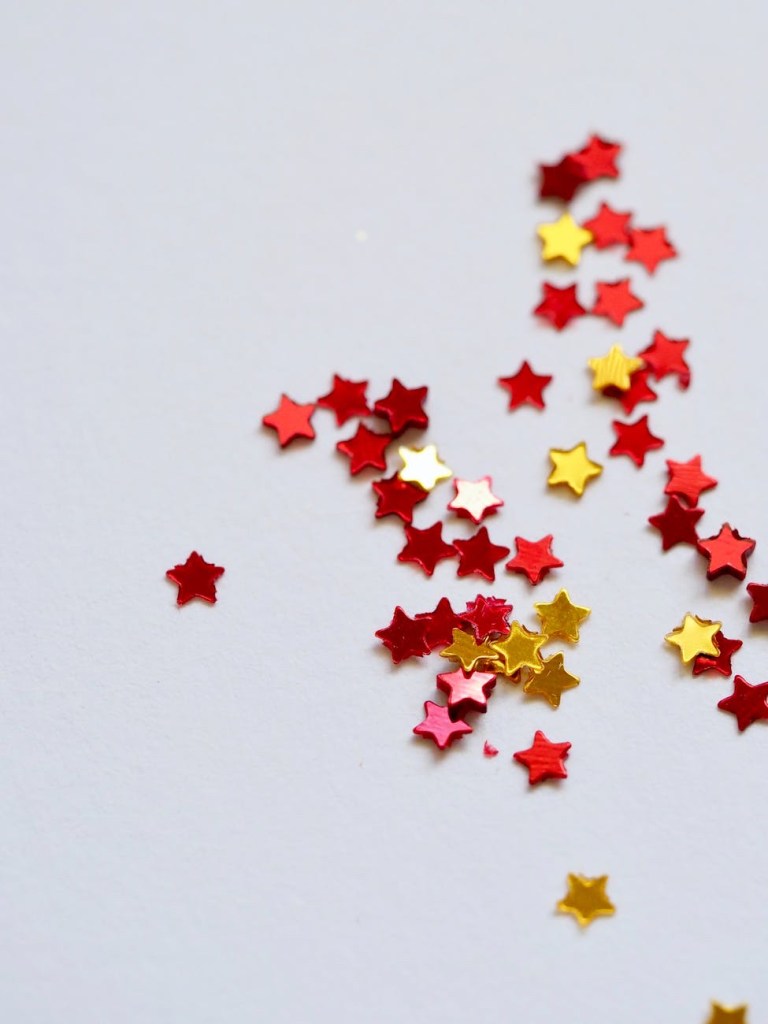
I used to collect stars. I built a wooden box and as I came across stars in everyday life I put them in the box. This was in college and it was a small box because I lived in small spaces and moved often. The point is that I collected stars because I liked them. Then one day I realized that I rarely used my collection. They simply sat in my box being appreciated.
Stars are special
I no longer have my star box and it’s contents. I do, though, collect words. And the same thing is happening: I appreciate them but rarely use all that I collect. Granted, some words manage to find their way into my everyday lexicon; however, most are just appreciated and acknowledged when I do come across them.
I hope my honesty is not off-putting.
Here is a list of words I have tucked away in my word nerd collection, and after some true reflection I realize it’s doubtful I will ever use them. I pass them to you as a gift. Enjoy.
agelast: a person who never laughs; a humorless person (often used attributively).
aggrandize: increase
outré: bizarre
soi-disant: self-proclaimed
perfidy: treachery
inculcate: to teach by frequent repetition
solipsistic: extreme egocentrism
froideur: extreme reserve in manner
badinage: light, playful banter
evince: to make evident; show clearly
sartorial: of or relating to clothing or style or manner of dress
olykoek: doughnut
risible: capable of causing laughter; ludicrous
Which word gift are you going to select? And if none of these appeal to you I totally understand. But they are pretty, aren’t they?
One absolutely appreciated bonus of retirement is enjoying the mellow fall sunshine. I call September weather my Goldilock Days: not too hot, not too cold—just right.
Previous to retirement (this is my second September!) I would look out of my classroom window and long to be outside. That was one commonality I shared with my students. Although I would try to tie up loose ends and get home to enjoy the remaining afternoon, I usually arrived home only to enjoy a sliver of sun before it slipped behind the mountain. My Verilux light is a poor substitute for that warm, comforting kiss of sunlight.
And so, in these fall days, these post-summer days, these halcyon days of retirement I am found sunning like a marmot on my morning patio, napping on my hammock early afternoon, and lounging on my other hammock in the late afternoon.
Lest you think all I do is lounge around, I am landscaping, cleaning, writing, reading, and stacking wood throughout the day.
Unfortunately my Goldilocks time is ending. I used to go for my morning walk by 7 am. Lately it’s 49 degrees at that time and the sun is barely up. By 9 am it’s 60 degrees which is acceptable. Just as the perfect temps of mid-seventies arrive the cold nights appear. By 6 pm there is a chill that sends me inside.
Nothing says summer is ending more than the delivery of our winter wood supply. I feel the calendar days tick down when those wood chunks fill the bins.
Two cords strong
One aspect of full wood bins is knowing I will be cozy warm by the fire reading books and sipping cocoa. For now I’m still reveling in late summer before I fall into winter.
handle with kid gloves: to treat very gently. Dating back to the nineteenth century this term refers to gloves made from young goats, known as kidskin. These gloves were considered fine wear and the wearer needed to treat them with care.
image: Etsy
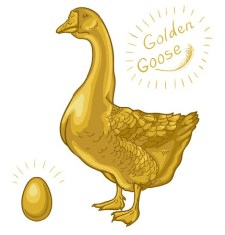
Kill the goose that lays the golden eggs: destroy a source of wealth through neglect. In one of Aesop’s fables a greedy farmer owns a fabulous goose that lays golden eggs. Wanting as many eggs as possible he believed that all the eggs were inside the goose. Killing the goose did not provide the eggs–he only gained a dinner entrée.
image: JD Supra
Kill two birds with one stone: to achieve two goals with a single effort. The saying goes back to Roman times when a person would be commended for killing two birds with a single rock. The saying was also traced to the 1600s when a writer by the name of Hobbes wrote, “”T.H. thinks to kill two birds with one stone, and satisfy two arguments with one answer.”
image: Forbes
Kill with kindness: to overwhelm someone with goodness. The original saying is thought to be, “to kill with kindness as fond apes do their young” is alluding to how an ape might squeeze its young in a smothering embrace of love. The saying moved forward in the sixteenth century and was used by Byron who said, “Don’t let them kill you with claret and kindness.”
image: IMDB
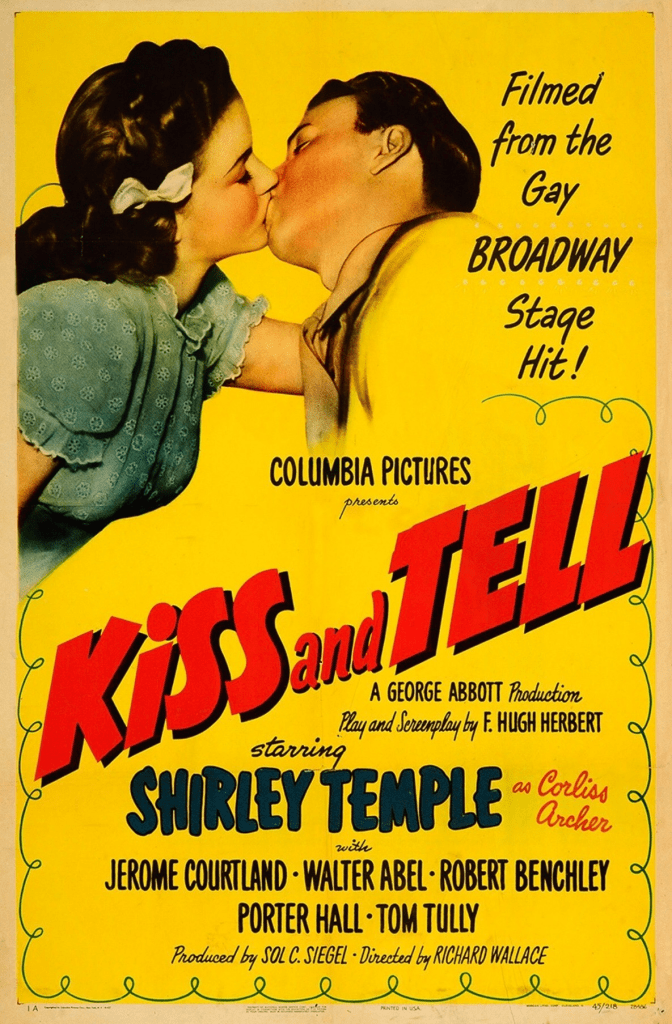
Kiss and tell: to betray a secret. Restoration England’s Charles Cotton is credited with saying, “And if he needs must kiss and tell, I’ll kick him headlong into Hell.” The expression has been used often in both literature and films, and even in everyday life.
The whole kit and caboodle: all of it. The word “caboodle” is thought to be related to the Dutch word “boedel” which means “household goods and possessions.” And “kit” means personal belongings. However, the Oxford English Dictionary says caboodle is an incorrect version of “kit and boodle.” Whatever it means, if someone says “grab your kit and caboodle” just grab your stuff and get going.
image: Facebook
Knight in shining armor: someone who is a rescuer. Dashing knights. Chivalry. Rescuing damsels. That’s what the expression brings to mind, right? That is the literal sense, probably dating from the sixteenth century. The figurative sense is about finding “Mr. Right,” that standout guy that fits a girl’s dream of her hero. Is the saying still being used?
image: Medieval Bride
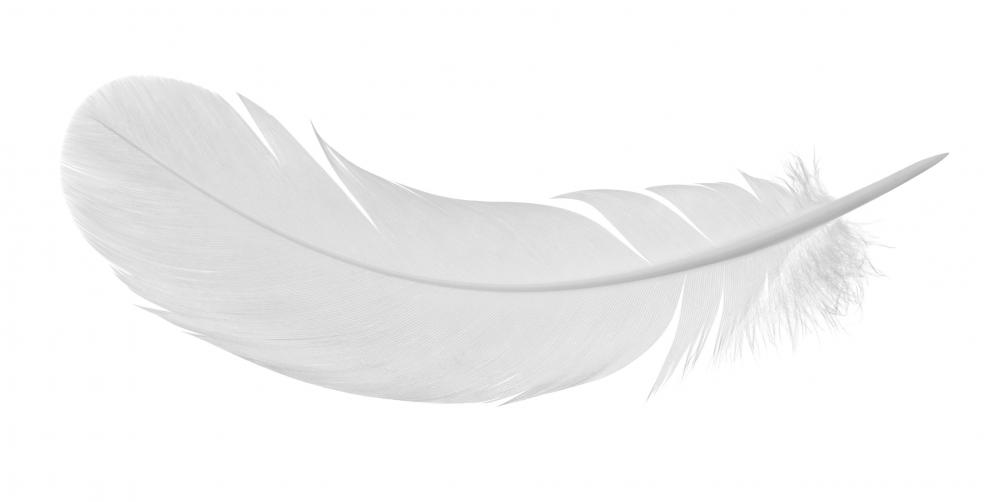
Knock someone down with a feather: to overcome a person with surprise. This goes back to the nineteenth century and appeared in print in Wiliam Cobbett’s Rural Rides “You might have knocked me down with a feather.”
image: Language Humanities
Knock on wood: a means of avoiding bad luck. In Great Britain touching wood is based on a superstition based on the saying “touch wood, it’s sure to come good.”
BONUS:
image: idioms 4you
To knuckle under: relenting under pressure. There are different thoughts on this one. It might stem from knocking under the table when someone has lost an argument. “Knuckles” also refers to the end of any bone at the end of a joint. “To knuckle” originally meant “to bend down” or “stoop” and was related to the phrase “to comply with” or “submit to.” So–either a person literally raps their bones in defeat or figuratively bends down in defeat.

















 Pam Webb