Pam Webb

a writer's journey as a reader

Archive for the category “Reading”

Dear Mr. Knightley


While the title sounds like yet another Jane Austen spin-off, Dear Mr Knightley, is actually an updated version of the classic epistolary coming-of-age novel, Daddy Long Legs by Jean Webster. Debut author, Katherine Reay, openly has the character borrowing both from Austen and Webster, which is either annoying or endearing. It’s the reader’s choice.  And that’s what the storyline becomes: annoying at times, yet also endearing at other times. It’s annoying to continually have Austen and company quotes tossed about throughout the storyline, yet, on the other hand, it’s also endearing to have a character who relies on literature as a means of survival. One of the stumbling blocks in determining audience appeal is pinpointing whether this is a YA novel or not. Although the protagonist is in her twenties, her lack of confidence and bevvy of relationship problems produce a character voice of someone closer to high school age. As for the storyline itself, there is intrigue and momentum as the plot eventually reveals the identity of Mr. Knightley.

17657649

image: GoodReads.com

Young protagonist Samantha Moore, has bounced in and out of foster care when younger, but life becomes better when she becomes a recipient of a foundation grant allowing her to enroll in a prestigious journalism program. One of the stipulations is keeping her mysterious benefactor, Mr Knightley, apprised of her academic progress. Straight up missives about tough professors would be boring, of course. Instead, through her correspondence with Mr Knightley, we learn all about Sam–her inability to have meaningful relationships, her doubts, her fears, her failings, her victories, and finally her accomplishments.
While the  beginning is a bit rough, the middle makes up for it. But the ending–though fitting for the plot direction, is a bit unrealistic. Then again, happy endings are one reason we select escape reading. And it is easy to escape into Dear Mr. Knightley–who wouldn’t want a mysterious benefactor, one who listens silently and produces a magic wand at the right moment to make life a bit easier?
Fans of Austen and other classics will relish the quotes liberally decorating the story throughout. And those who want a light romance with a hint of mystery will appreciate the story as well.

Disclosure of Material Connection: This book was provided, by BookSneeze®, in exchange for an honest review. No other compensation was received.

Oh Willa–Your Pioneers!


''The Song of the Lark ''Oil on canvas, 1884

”The Song of the Lark ”Oil on canvas, 1884 (Photo credit: Wikipedia)

As I continually research my own pioneer novel-in-progress, I return to favorites for inspiration.  Having reread most of Laura Ingalls Wilder’s Little House of the Prairie series, I am moving on to more grown-up fare such as Willa Cather’s Midwest trilogy of My Antonia, Song of the Lark, and O Pioneers!

Cather’s writing continually surprises me with its subtle acuity. She follows the nineteenth century omniscient style of narration that is no longer in vogue, yet as I read her seamless insights into each character, I realize I am easily visiting each character’s thoughts while still in the scene. That’s art.  It adds so much more dimension to the reading  that I find myself slipping from third person limited into omni in my own writing. *Sigh* Maybe I shouldn’t be reading Willa Cather–at least until I get my manuscript’s revisions tidied back up.

In that regard, unless you have your own concerns about being overly influenced while writing your own pioneer epic, I suggest rereading or experiencing Willa Cather’s O Pioneer!

Cover of "O Pioneers!"

Cover of O Pioneers!

Why?

It’s good stuff.  Really good stuff. Setting, for instance.  Turn to page 97 of your Random House Vintage Classic version and feast:

(Part III: Winter Memories: I)

Winter has settled down over the Divide again; the season in which Nature recuperates, in which she sinks to sleep between the fruitfulness of autumn and the passion of spring. The birds have gone. The teeming life that goes on down in the long grass is exterminated. The prairie-dog keeps his hole. The rabbits run shivering from one frozen garden patch to another and are hard put to it to find frost-bitten cabbage-stalks. At night the coyotes roam the wintery waste, howling for food. The variegated fields are all one color now; the pastures, the stubble, the roads, the sky are the same leaden gray. The hedgerows and trees are scarcely perceptible against the bare earth, whose slaty hue they have taken on. The ground is frozen so hard that it bruises the foot to walk in the roads or in the ploughed fields. It is like an iron country, and the spirit is oppressed by its rigor and melancholy. One could easily believe that in that dead landscape the germs of life and fruitfulness were extinct forever.

Personification, alliteration, imagery galore, tone, diction–it’s a banquet of literary delight.  Cather dedicates this full exposition to set up how this coldest of seasons affects the characters.  Steinbeck did much the same in Grapes of Wrath. Remember the turtle scene?

Sometimes I think we forget the importance of slowly revealing the story in our pressing need to “let’s get on with it” plot modernity mentality. Yet, there is an absolute pleasure in immersing oneself in the cadence of well-placed and balanced words.

Oh Willa–your pioneers keep singing to me of your prairie love through your song of fields, seasonal cadence, and your indelible tribute to those who left their mark upon the land.

The Morphing of the Omni Narrator


Right now we are toughing out poetry with my freshmen. *sigh* “We study poetry because oral storytelling came before the written language came into existence, plus many of the elements we study in poetry exist in fiction–you know, like imagery, diction, syntax, metaphors, analogies–so get to know poetry and you’ll understand and enjoy fiction that much more.”  And the question? (Jeopardy music, please)

Why do we study poetry?

Returning to the anticipated second quarter…(quick, quick, I’m losing them)

Once I get to short stories in the curriculum it’s pretty easy sailing, since my students are versed in plot, characters, setting, and such. Theme sometimes throws them; however, point-of-view gets them pondering. For instance, trying to explain the omniscient narrator is tricky these days. Back when, I used to say, “The Omniscient narrator is a lot like God–you know, everywhere and knowing everything about everybody.” I’m getting less comfortable about using that analogy in such a forthright manner.  I still believe it’s a valid analogy, yet don’t want to offend any of my students.  Let alone get the ACLU or other NSA types coming after me.

Cover of "The Long Winter"

Cover of The Long Winter

Another problem with trying to explain the omniscient narrator is that the old-fashioned version of the narrator filling into the details has changed into something quite different. For instance, I recently reread The Long Winter by Laura Ingalls Wilder (don’t snicker, it’s a great read, besides it’s for research–really) and Wilder includes in the story what’s happening to the town’s people and to Almanzo and Cap who are all caught up in a grueling blizzard, in an inclusive fluid manner.  I rarely come across this type of narrative style today. As Bob Dylan once said, “Times they are achanging.”

In the last few years I have noticed a trend where the omni narrative is now designated as separate chapters.  This at first proved quite annoying because the point-of-view kept changing. One chapter would be one character, the next a completely different one.  I felt like I was juggling characters to the point of wanting to run an Excel sheet to keep it all straight.

The last few novels I’ve read have run this narrative style, and every new book I’m pulling from my suggestion list and review newspapers seem to be pandering this new style. I keep checking them out though.  I’m either getting used to this new kaleidoscopic style of story-telling or I’m so starved to read I’m willing to put up with it.

Here are some examples of recent titles with the switch-hit character changing technique. Enjoyable reads all, but fret and nuisance, doesn’t anyone write in the old-time omni narrative style anymore?


Any thoughts, Book Boosters?

Biblio-ing


This week seems to be biblio week.  I’ve read a couple of different posts about loving books, but then that doesn’t seem too unusual when most of my post follows involve following other book lovers. Additionally, this week marks the 60th member join for the Book Boosters.  Say a “Hey! and Yay!” for  Radical Hope. Not a Book Booster yet? Well, if you fit these stringent requirements you should consider signing up:

  • Do you love books?
  • Do you have favorites you read, recommend, and even re-read?
  • Are you a frequent flyer at the local library?
  • Are you an on-line regular of book sites, be they promoting to buy, review, or boast books?
  • Perchance you operate on a need to read basis–you have to have a book in hand, by the bed, stashed in the car, or have one nestled in the backpack.

You then, my friend, are a Book Booster. And you are in good company. Request for your name to the list and then welcome to the shelf of those who appreciate and advance the cause of books. No dues, no newsletters, but I am working on a secret handshake.

Continuing on the theme of celebrating biblio-ing, here are some borrows form other book-toting bloggers:

Here are some pithy comments from Geeky Book Snob concerning things that book lovers dislike hearing:

Click to visit the original post

And if you aren’t totally clear on what constitutes biblio-ing then take a look at Cassie’s list, and then check out the rest of her post, because it’s a stunner of stream-of-consciousness:

Types of bookishness...and anti-bookishness

Ten Sites for Book Lovers


It’s time to contribute my own top ten list. Of course it’s related to books!

1. NY Times: what books are top sellers?

2. GoodReads: a community of like-minded bibliophiles where we share, compare, review, and discuss the books we read. I most appreciate the site for its book list feature.  I have been able to track down books I’ve read since childhood.  This has solved many of those “What was the name of that book?” questions.  Another feature I use is to bring up similar lists of interests when I am shopping for another read.

3.Wikipedia : ssh, don’t tell my students, but I refer to Wikipedia to get background information on authors and their works. I often get behind the scenes info and author history that helps me better understand and appreciate what I am reading, plus there are external links to adaptations (gotta see the flick after reading the book).

4. Book Crossing: this site proves the saying, “If you love something you will let it go.” The concept is to register a book with the site and then attach the registration marker in a book. And then…leave it.  The idea is someone will pick it up, go to the site, plug in the registration number, leave a few words about the book, and it’s hoped they will leave it for someone else. If you have ever come across the “Where’s George?” stamped on a dollar you have discovered the serendipty of the moment.  Who else has read this book? What travels has it seen?

5. Shmoop : looking for summary, theme, symbolism, the why-should-I-care factor for reading your book? This is the site.  Witty literary analysis provided by PhD students and other smarties, helps shed a flashlight on those hard to fathom passages.

6. Bookspot: what books have earned awards?

7. The Gutenberg Project: a  digital library with over 42,000 full texts of public domain books.

8. Amazon: buy your book right here. I often rely on it as a means for finding authors and their books, and similar subjects.

9. Overbooked: Overbooked’s mission is to provide timely information about  fiction (all genres) and readable nonfiction for ravenous and omnivorous readers (from the site).

10.  Bibliomania: reading and study guides galore and then some

Other recommendations:

Ellyssa Kroski created a worthwhile list of her own: 10 Websites for Book Lovers

Laura DeLeon provides a list of free book reads:  Web Reading 

Saratoga Springs Library:  Websites for Readers 

Ain’t Is Too in the Dictionary.


image: nytimes.com

The Story of Ain’t by David Skinner isn’t so much about the word itself, rather it’s more about the dictionary that elevated its use from barely tolerated to denounced celebrity status.  It’s difficult to believe that a dictionary could rock the nation, but Merriam-Webster’s Third Edition achieved that claim back in 1961.

Why care about a dictionary? Simple. As writers, words are what define us.  Pun very much intended.  Before technology made referencing a simple thumb click or flip check, a person had to physically grab a dictionary off the shelf and flip through the pages and ease down the page for the answer.  A somewhat time-consuming process, yet it proved oh so satisfying when the answer yielded the “See, I knew it!” answer.  There was also the resounding “thwack” of the cover-to-cover closure vent of being caught wrong.

On-line access has made dictionary referencing such a ready convenience that reading about the controversy about a dictionary that has been out for over fifty years seems inconsequential.  Yet, writers are wordsmiths and learning about lexicographical history is as revealing as reading up on the Wright brother to perfect piloting skills.

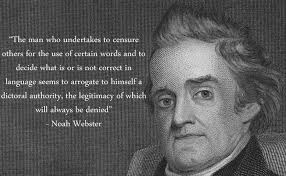
Noah Webster, long associated with the dictionary, left his legacy in the hearts, hands, and minds of capable descendants who continued the craft of prescribing proper word usage for all, that is until the 1961 Third Edition came out. A couple of wars, some cultural changes, and a few major historical events like the Depression not only changed the world, the language had noticeably been impacted.

Enter Philip Gove, the new editor who rattled the paradigm with the new (disturbing) descriptive instead of prescriptive format.  Merriam-Webster had to make room for all the new entries which meant remodeling the model so long held up in esteem.  No longer would it be the go-to reference for correctness of letter writing, titles, names, and places and other encyclopedic information; it would settle down and become a tome of how a word is used versus how it should be used.  More or less a Joe Friday approach, “just the facts, m’am.”

While at times digressive, Streeter nevertheless leads readers along his winding path of explanation as to why the Third Edition alienated newspapers, associations, and academics, irked the public and changed the manner of dictionary presentation forever.  The Story of Ain’t may not be a first pick read in terms of how-to’s and polishing writing skills; however, knowing how this particular dictionary came to be and the absolute furor it caused somehow causes pause, especially since plans for the fourth edition were announced in 2009.  Who knows how long, what, or if, any impact will be made once it hits the bookstores, since there are less and less bookstores to sell it in, now that users frequent screens instead of paper for their lexicon needs.  Now–ain’t that a shame?

Notable quotes:

Page 7:

And Merriam was very much in the business of authority.  In its own pages, Webster’s Second was “the Dictionary,” with a capital D and the definite article as if no other existed.

 Page 11:

The press release quoted Dr. Gove saying that the English language had become less formal since 1934. For an example the PR hands chose the new dictionary’s surprisingly tolerant, though oddly worded, entry for ain’t, which said ain’t was “used orally in most parts of the U.S. by cultivated speakers.”

image: sparklepony.blogspot.com

Page 30:

In those days the National Council of Teachers of English still observed Good Grammar Week, when children were called on to go seven full days without splitting an infinitive. As a reward they were treated to entertaining skits in which Mr. Dictionary vanquished the villain Ain’t. At home, however, as radios in the 1920s went from being a rare possession to a basic appliance, children might hear “Ain’t We Got Fun,” a popular foxtrot, “Ain’t Misbehavin’,” a Fats Waller song, or perhaps even “Ain’t She Sweet,” another hit song of the time.

image: yesterhair.wordpress.com

Page 49:

In the 1920s, Shall I? was still a common usage, but it would not be for long.  A few years after Fries’s study [Charles Carpenter Fries] was released, Bell Telephone allowed a researcher to listen in and count words spoken in the phone conversations of its customers. In the course of 1,900 conversations, will as an auxiliary term was used 1,305 times. Shall  appeared only six times. The long-term trend was obvious.  Twenty-five years hence, Alfred Hitchcock fans would leave the theater with the voice of a very proper Doris Day singing in their heads, using will in the first person to ask, “Will I be rich? Will I be pretty?”

Page 175:

In one instance, he said [Gove], the Webster’s Second board had spent at least an hour discussing whether hot dog should be in the dictionary. (In the end hot dog had won admission: “a heated wienerwurst or Frankfurter, esp. one placed in a split roll;–used interjectionally to express surprise or approval. Slang.”) 
Page 191:

Racy was often used to describe American English: H. L. Menchken more than once called it that. Webster’s Second defined racy as “manifestating the quality of a thing in its native, original, genuine, most characteristic state,” citing a weirdly fitting phrase from the Victorian thinker Walter Pater: “racy morsels of the vernacular.”

Page 213:

The comedian Fred Allen said, “Television is called a new medium, and I have discovered why they call it medium—because it is neither rare nor well done.” Yet its presence in the living room continued to redirect household activity, setting the table for TV dinner, dated 1954 in the Merriam-Webster files.  But one year later, another phrase was making the rounds: idiot box.

image: xk9.com

Page 230:

Said Gove: “Five basic concepts set forth in the English Language Arts supply a starting point.” Then he listed them:

1. Language changes constantly

2. Change is normal

3. Spoken language is the language

4. Correctness rests upon usage

5. All usage is relative

The concepts had been endorsed by the National Council of Teachers of English, Gove noted, “but they still come up against the attitude of several generations of American educators who have labored devotedly to teach that there is only one standard which is correct.”

image: lili.org

Page 241:

The dictionary [Merriam’s Third] weighed thirteen and a half pounds and featured 100,000 new words and senses, a massive amount of new language that Merriam called “the greatest vocabulary explosion in history,” While new words were being added, a quarter million entries were subtracted, and all remaining entries were revised.  “Every line of it is new,” Gove wrote in the preface.  With 450,000 total entries, the new dictionary contained 100,000 quotations from more than 14,000 authors. The foundation for Merriam-Webster’s lexicography comprised some 10 million citations, and the new edition had cost $3.5 million to make.

Page 266:

[James] Parton quoted the dictionary’s critics, the Washington Star calling it “literary anarchy”; the Library Journal calling it “deplorable”;  the New York Times saying, “a new start is needed”; the American Bar Association complaining that Webster’s Third was “of no use to us”; Wilson Follett, in the Atlantic, calling it “sabotage,” a “scandal,” a “calamity,” a “disaster”; a recent Times article calling it a “gigantic flop.”

Page 272:

[Bergen] Evans’s broadest point was his most persuasive: that the language itself had changed profoundly since 1934. “It has had to adapt to extraordinary cultural and technological changes, two world wars, unparalleled changes in transportation and communication, and unprecedented movements of populations.” And, he continued, “more subtly, but pervasively, it has changed under the influence of mass education and the growth of democracy.” Whatever its faults might be, Evans argued, Webster’s Third was an enormous effort to capture and describe, in sufficient detail and without undue prejudice, this great shifting thing called contemporary standard American English.

image: nytimes.com

Personae:

□       Asa Baker: president of G & C Merriam Company

□       Bergen Evans: television host and co-author of a significant dictionary of usage

□       Wilson Follett: professor of English and author of a guide to modern usage—most furious critic of third edition.

□       Charles Carpenter Fries: scourge of old-fashioned grammar and evangelistic scholar who sought to bring American English teachers around to the scientific view of language.

□       Philip Gove: editor of Webster’s Third

□       H.L. Mencken: famed newspaper columnist and magazine editor

□       Robert Munroe: successor to Asa Baker and uncomfortable with Gove’s plans for Webster’s Third.

□       James Parton: journalist and president of American Heritage publishing company who sought to use the controversy over Webster’s Third to take control of G. &C. Merriam Company.

The Merriam-Webster logo.

The Merriam-Webster logo. (Photo credit: Wikipedia)

Treaured Tomes


bookbooster

While I tend to pass up most blog challenges, I couldn’t resist the one passed on by Reading Interrupted by another blogger: show us your bookshelves.

Last year I posted an entry about bookshelves and it really resonated with readers, and to date it ranks among my highest hits and responses posts.  What is it about peering at someone else’s bookshelves. Reading Interrupted believes it’s a way to look into our literary soul, which makes me nervous.  However, being a Book Booster, how can I not show off some of the books I own?

I have bookshelves all over the house: kitchen for the cookbooks, living room holds the eclectics ranging from Calvin and Hobbes to bird identification guides, the bedroom has my stack of bible references and current reads, the office is filled with review favorites (mostly children’s books) and tools of the trade, and the back bedroom is the MEPA’s storehouse of ruggedness, all those pursuits of fishing, hunting, politics and such. And then there are  my pretties, my treasures which are displayed on the table next to my inherited piano from my great aunt.  I was fortunate enough to receive her wonderful collection of books. My iPhone photo does not show the titles well, but you must admit they are gorgeous in binding.  They just about shout, “Open me, read me, all who enter these pages will be satiated.” I’ve been dipping into them over the years, savoring them for I do not want to go through them too quickly. Also, I confess, some are rather daunting.

bookshelf

For example, The Notebooks of Leonardo da Vinci, The Works of Tolstoi, a study on Ralph Waldo Emerson, selected works of Matthew Arnold.  There are also Ibsen plays, poem collections by Browning, Dickinson, and selected verse from Canadian poets, along with stories from Dumas.  As you can see if I were to consume too quickly such a rich collection I might go by way of gout.

My fave librarian, ET, knowing I am a Book Booster, surprised me one day with a gifting of more of these finely bound treasures. She passed on a blessing to me and I, of course, was thrilled with the serendipity of new friends. You must admit it is a handsome collection.  To think, this is how books used to be, all stately and elegant back when reading books was the prime entertainment and erudition pursuit of most people.

Although these aren’t personally selected favorites, they are indeed treasures.  I suppose I treat them more as my book museum as I respect them and the fragile condition they are in. Does anyone else have a treasure of books they have inherited or perhaps picked up along their travels in life?

Willa You Let Me Read Your Letters?


intr.v. snoopedsnoop·ingsnoops

To pry into the private affairs of others, especially by prowling about.

Looking where we shouldn’t seems to becoming more and more acceptable or at least it’s becoming more prevalent. I don’t know about you, but I got in BiG trouble if I got caught snooping. Parents, siblings, friends, even strangers don’t appreciate having their hidden stuff exposed. And face it, we all have stuff we want to remain hidden.

This is why I am having such difficulty with my latest selected tome of erudition.

image: Oprah.com

Right there. It says it right there. Willa Cather’s letters were hidden.  She didn’t want them hanging out in the public eye.  In fact, it’s taken about seventy years after her death to get these letters out.  Why?  Cather expressly stated in her will that she did not want her correspondence bandied about. Aren’t last wishes significant? Apparently not. If the agenda and credentials are proper enough it is deemed in everyone’s best interest to snoop and reveal.* No shame attached. In fact, no contrite apologies. Furthermore, the editors, Andrew Jewell and Janis Stout, justify their snooping in the book’s introduction:

Before Willa Cather died, she did what she could to prevent this book from ever existing. She made a will that clearly forbade all publication of her letters, in full or in part. And now we flagrantly defy Cather’s will in the belief that her decision, made in the last, dark years of her life and honored for more than half a century, is outweighed by the value of making these letters available to readers all over the world. [highlights are mine]

Hmm, “forbade” means to me “don’t do that.”  What about “flagrantly defy”? Do I hear a little self-righteousness bragging, as in “I know it’s wrong, but I’m going to be proud out loud anyway”? Tsk.

As interested as I am in Willa Cather, I feel it’s wrong to snoop her letters.  Just because they are published by a reputable and respected publisher doesn’t mean it’s ethical. Literary vultures waited until the will expired in 2011 and swooped down for the feast.  Here is a paradox: if these two editors so respect Willa Cather, why aren’t they respecting her last wishes? Don’t get me started about trotting out King Tut’s burial goods for the paying public.  I guess celebrities are open season dead or alive.

Granted, the letters represent only 20% of the entire collection, and none are present that might tarnish or stain Cather, (says  the editors). I still feel mighty uncomfortable reading her private correspondence. There are family matters, personal matters, circumstances and situations that  reveal too much of a peek behind the privacy curtain.

As much I appreciate learning about Cather’s background, which helps provide more depth to enjoying and understanding her prairie trilogy (Song of the Lark, O Pioneers, My Antonia), I have  shut the book after about 200 pages, right about the third section, about when she left her editor position at McClure’s to pursue writing full time. The best is yet to come, yet sorry, I’m gonna pass. I respect Willa as an author too much to rummage around in her personal life.

Maybe, it’s me. Snooping for the cause of erudition is still snooping.

What do you think, readers?  Should Willa Cather’s wishes been respected? Should her letters have been left alone, should they not have been dusted off and printed up, even if it’s in the quest  harkening the light of “literary illumination”?

Willa is not amused.

*This could easily segway into a Snowden blog,, couldn’t it?

A Woolf in Read’s Clothing


photo: imdb.com

My first vague acquaintance with Virginia Woolf is associated with Elizabeth Taylor. Both are pivotal influences in their chosen professions.  As a last wave baby boomer cI recall a bit of a fuss when the movie Who’s Afraid of Virginia Woolf? came out.  Not being a Disney-generated flick my parents did not take me to see it.  In my childhood bliss of perceptual naiveté I believed Elizabeth Taylor to be Virginia Woolf and from the TV trailers she appeared to be a daunting person.  I could see why some might be afraid of her.

image: aroom.org

My second encounter with Virginia Woolf came way later when I began teaching high school English. Woolf’s essay “A Room of Her Own” was part of the senior lit curriculum, a prelude to a brief study in feminist writing.  Still getting my bearings about Shakespeare, I discovered through Woolf’s essay Shakespeare had a sister! I thought him to be like Atlantis, known but unknown, shrouded in mystery, waiting to be actually proven.  A sister?  It sent me scurrying to dedicated research and though Woolf got it all wrong about Willie’s sis, I now know much more about the Bard.

image: etsy.com

The third encounter came way of Meryl Streep.  She’s a fave, so I couldn’t resist picking up The Hours at the library.  Fascinating film (I admit some parts tweaked my comfort zone and my daughter squeaked, “you watched The Hours!”–my prudery is too well-pegged by family members). What truly fascinated me was Nicole Kidman as Virginia Woolf.  No wonder she received the Academy Award for her performance. A tortured artist always leaves me wondering  the why/what behind the reason of taking his or her  life instead of living it.

image: notreciinema.com

Finding Virginia a bit overwhelming I didn’t do my usual research and read on her. To be honest, although she intrigued me,she also made me nervous, much like James Joyce.  So much, almost too much in their writing for me to comprehend and absorb.  I felt unprepared to read her works.

At present I am a tiny bit more confident having an AP Institute training and one year of AP Senior Lit and Comp seated firmly on the resume.  I thought, “Okay, Ginny, let’s give it a whirl.”  I pulled down Orlando off the shelf and settled in for my summer chaise in the shade read.

Sigh.

I wonder if her writing would have been published if her husband had not set up Hogarth Press expressly for that purpose? Her writing is amazing, this is true. It’s rich, masterful, and paradigm pushing. Deemed ahead of its time, both Virginia and her writing nevertheless appeared to be respected and applauded.  Overall, I will have to pass on Virginia Woolf and her modernist approach to literature.  She and James Joyce are just enough of a different cup of tea to not be on my reread list.

I followed through on my research since I did not do my read on her.  I will definitely include her in my overviews on modernists. Virginia Woolf  may not be among my chosen authors; however, I do acknowledge her place in the literary hall of fame.

image: standrewsrarebooks.wordpress.com

Summer Read n Eat Poetry


Food and summer.  Yup.

Besides barbecue, picnics, reunions, vacation binges, craft fair nibbling, beach concession splurges and the like, there is also food found in our reading.  Take poems, for example.

This is just to say by William Carlos Williams

Watermelons by Charles Simic

Peach Blossoms by Carl Sandburg

A Ballad of Nursery Rhyme by Robert Graves

Orchard by Hilda Doolittle

Plums, watermelons, berries, peaches, oh my. Time to browse the Farmer’s Market!

For more summer foodie poems try this delightful site: TasteArt

Post Navigation