Pam Webb

a writer's journey as a reader

Archive for the category “Reading”

Stacking the Odds


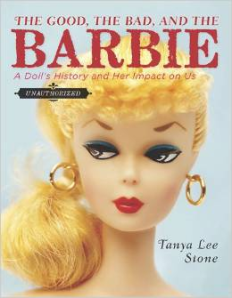
Barbie

image: Amazon.com

Now and then I try to squeeze in volunteer time at the library by shelving a cart or two of books.  Having worked at a couple of libraries I can do the Dewey sufficiently well.  In the future I should remember that the reason the non-fiction juvenile cart is up for grabs is because it takes a loooong time to do. I will have to say that it does involve quite a bit of aerobics stretching from whales to the Star Wars cookbook.

Besides the getting some calisthenics in and helping out the library, I volunteer shelve because I find all sorts of treasures for myself. And because I am on my own clock now I don’t suffer the guilt (and rebuke from my supervisor and coworkers) when browsing. Okay, I do feel a little bit of guilt.

Here  are some of the treasures I’ve discovered:


The Good, the Bad, the Barbie by Tanya Lee Stone
Being a Boomer girl I had quite the Barbie collection. I even had the one in the zebra one piece. Had Midge, Skipper, Ken complete with a kitchen set and canopy bedroom ensemble. Oh, yes, I do wish I still had them. No, not because I’m a Barbie fan, but I’m sure my retirement account would have been a bit healthier because there are LOTS of Barbie fans out there.

Lincoln Lawyer (this was a series before the movie!)

Limitless–having watched the movie I was intrigued enough to read the book. Go with the movie.

Monk? based on the series? How could a book do him justice?

Deadly Pursuit–a Christian thriller mystery? I’m game. Toss it on the TBR list.

I also made some observations:

If I look like I know what I’m doing people will think I do know something. I felt really, really good about helping a patron find a book she wanted. We didn’t find it but I gave her information how to place a hold or a search for the title.

I had no idea how prolific Christie, Cussler, Jance, Patterson are as authors until faced with trying to alphabetize their numerous titles. SIDENOTE: I found out it’s okay to get the titles in place by author (you know how that’s dratted patrons just mix them up anyway–wait, I’m a dratted patron).

People really do read Melville’s Moby Dick.

And To Kill a Mockingbird still rocks the shelves! Big yeah on this one.

So don’t be shy, trot right on down to your friendly local neighborhood library and see about volunteering for shelving. You’ll feel good, the library folk will be happy, and you’ll have an even fatter TBR list.

Let’s Stop With The Cloning Around


STOP: SPOILER ALERTS for the following
Never Let Me Go
The Island
Moon
I, Robot
Oblivion
Frankenstein
Robocop

“Four legs real, fake legs baaaad.” image: nature.com

What is this fascination with the humanity aspect of clones or artificial intelligence? Why do we want to inject a soul into something man has created? Or a more defined question is: why do we explore whether man-made creations have a soul?

Is it guilt? Afterall, creation is best handled by the Creator, the One who has the Master Plan. That statement could incite a whole firestorm of commentary in itself, which is fine, but I’m really after the literary and even film aspect of cloning/artificial intelligence.
For instance, having just finished Never Let Me Go by Ishiguro, I began thinking about other cloning works: The Island,Moon, Oblivion, and while there are other aspects attached to these films, the main takeaway: “cheated.” The clones are cheated because even though they look human, act human, they are not, which becomes a matter of concern because there is an investment of empathy for these characters, yet part of me says “Wait! They aren’t real.” I feel cheated because I am tricked (seemingly) into believing and caring about something I inherently don’t subscribe to: cloning.
Have you ever tasted imitation crab? Once–thank you very much. Looks like (mostly), tastes like it (kind of), smells like (a bit), same texture (not really). After being duped into eating it I came away with the same feeling: cheated.
Duplicating sheep, crab, humans–it’s not the same, and can never be. I believe in science; I do not subscribe to Luddite philosophies, but there are moral boundaries and these boundaries keep reappearing in novels and films as guilt and even revulsion. Why?
I think we try to justify the curiosity to recreate human life through the compassion for the Creature, as in the case of Frankenstein. The Wretch had initial goodness until it met up with repeated rejection. However, Shelley pointed out the disastrous results of man attempting to recreate man.
We root for Tom Cruise (Oblivion) and Sam Rockwell (Moon) as clones, only because we thought they were human. Upon realization they were clones I immediately reneged my emotional investment–I had been cheated, someone had switched in that imitation crab.
I have no problem with robots though. The A.I. component works for me. I liked R2D2, who didn’t? And Sonny, from I, Robot? A charmer. They were machines with heart; they did not have a soul. Machines are machines. On the other hand, that fuzzy line is not so warm and fuzzy when it comes to cloning: Humans with no soul? Are these simply sophisticated machines with feelings?
Which brings me to my latest Ishiguro read, Never Let Me Go. Having heard raves about it, and having read two other of his novels, I looked forward to this particular one. Ishiguro’s style of unreliable first person narrative and undercurrent, deceptively complex plot is very much evident. It wasn’t until about halfway through I realized I’d been cheated. Here I thought Ruth, Kathy, and Tommy were victims of a cruel government experiment, only to discover (oh so subtly) they are clones. Dissapointment. I finished the novel, although I felt a detached flatness. No joy in that one. I did feel a resonance with Robocop, but then has man trapped in a machine. And even though he was mostly machine I rooted for him because people I can relate to–fake crab, not.
Anyone else have thoughts on cloning in literature in regards to character empathy?

Book Booster Beckonings


Book Booster

I have been quite remiss in my blog hostessing. Usually I invite new followers to add their name to the Book Booster roster. If you are a recent follower, please accept my apologies for not having invited you sooner. What’s a Book Booster? This is the detailed link and here is the short version:
Read books? Recommend books? Buy or checkout books by the armload? Have a TBR list and stack longer and taller than Superman can leap over in a single bound? Consider yourself a Book Booster and consider this your invite.

What are the benefits?
If you are hoping for a Barnes and Noble discount, I’m afraid the details are still sketchy on that one.
And reserved parking at the library is still being negotiated.
I am still working on that secret handshake.
However, you can revel in the knowledge you are in great company and you can spend hours clicking to connect with other Book Boosters.

While I can’t guarantee all the links are still active I can ensure you will no doubt discover a few new blogs to follow, and in turn they will no doubt find and follow you and that Six Steps Separation thing gets one step closer to becoming a big blogging bunch of Book Boosters.

What? You’re not on the list and you thought you were? I can fix that…

So send me your “Of course add me to the roster” approval and then it’s happy browsing.

Blue Skies and Happy Reading,

C. Muse

Read Me a Story


One of my favorite classes in college involved learning how to read picture books out loud to children. Yes, and we did get credit for doing so. This class gave me real life skills. For true.

I learned there is a proper way to hold the book when facing the audience.

  • First of all, sitting down facing your audience, you hold the book’s bottom spine stretched out on your forearm.

*By the way if you are looking for a dazzling, scintillating meme-worthy Prezi, it ain’t happening*

  • You then read sidewise, yet facing your audience because eye contact is quite important. This is easier than it sounds because picture books usually have more illustration than words.
  • It is then important to properly turn the page. This is done by reaching over and across the top of the book, sliding the first two fingers done the present page and the next, and pulling the page over for the next spread. NOTE: though commonly practiced, it is not in the best interest in the book’s wear to turn from the middle bottom, especially towards the inside spine. Rippage and tearage can occur in doing so.
  • Proceed throughout the entire book in the proscribed method.
  • It is also important to use appropriate voices for characters, and it can be highly desirable to create separate voices for each given character. NOTE: characterization voices are best done by those who can do so without creating havoc among the audience. For example: if your Cockney mouse is such a smash hit your audience might laugh to the point of interfering with the story’s progress.
  • Body language is  also important. Leaning in to emphasize special junctures, or pausing for same can add a delightful amount of drama and dimension to the story.

I believe the course to be quite edifying and suggest signing up should the adult education flyer come through the mail. Today I utilize those skills reading to the grandkiddo, although I use my snuggle reading skills instead. I have read stories to my high school students. Yes, that is one reason I am known as the weird English teacher.

Then again, there are those who possess natural skill at reading and technique does not actually matter. Case in point is our boy Sherlock.

Have you a favorite technique for reading stories?  Or better yet–any famous readers you’ve come across? One of my most favorites is Meryl Streep’s audio book reading of Jeremy Fisher by Beatrix Potter.


A Little Birdie Told Me


One aspect of blogging that is a definite benefit is finding new titles to read. Goldfinch by Donna Tarrt is one of those titles. Considering it received the Pulitzer and had so many varied reviews–Loved it!” “Hated it!” I had to decide for myself. I will never truly know how I might have liked it. It’s been relegated to my rare “didn’t finish” designation on my Goodreads tab.  Why?  Admittedly, it takes quite a bit for me to *gasp* abandon reading a book.

image: nytimes.com


Here are my impressions:

  • Plot interesting although contrived. I work with teenagers and I have yet to come across any who talk like they are fourteen going on thirty-four.  I know. I know. It’s a novel and there are liberties called artistic license.
  • I’ve read BIG books; however, the story needs to justify the length. Melville or Dickens, this is not. Instead, I found myself getting more and more irritated as  Theo, the protagonist, reveled in TMI (too much information). It’s like being caught in a conversation with someone who keeps adding on instead of continuing on with their story.  I didn’t find all the extra detail to be that significant to moving the plot along.
  • I also found the stereotypes disappointing: the out-of-touch adults trying to counsel Theo; the genius, yet nerdy friend; the dysfunctional wealthy family; the unconventional adult who becomes Theo’s island of solace.
  • Here is the real clincher. I could have continued with the reading. There is enough intrigue and character investment that I had a desire to keep giving it a go, then the dreaded birdie kept flipping up unexpectedly. The boid, the random explosion of f-bombs finally annoyed me enough to say “done” and moving on. I understand profanity adds a certain aspect of verisimilitude; however, certain words remind me of pepper–sprinkle too much on and it actually hinders the flavor instead of enhancing.  The random f-bomb turned into a regular blasting zone and I began to wince. Here’s the deal: “Hey, Theo–you’re a nice enough kid, and you have a great vocabulary, so why the potty  mouth?”
  • I also wondered if this wasn’t  really a dressed out YA. A large portion of the book centers on Theo’s teen years. Then again, I didn’t mind reading Hunger Games; on the other hand, that IS considered YA.

Overall, I would have kept going to read the 700+ pages. It takes several elements for me to finally pull my bookmark and move on. I have way too many books I want to read to keep going with one that wears on me.

Twofold commentary requests here:

1. Anyone agree or disagree with my Goldfinch assessment?

2. How do you handle books that don’t live up to your expectations?  Do you continue or do you move on?

Remaining the Orphaned Narrator


It is always exciting to discover a new-to-me author. In this case it’s Kazuo Ishiguro. I know, I know. I’m a bit late in my discovering; however, better late than never in finding an author of mesmerizing style.


I knew the movie Remains of the Day, before finding the novel and didn’t realize the movie was the adaptation.
How could I possibly pass up a film starring Anthony Hopkins and Emma Thompson?
Flash forward five years later and I’m perusing the AP Literature list (“read that one, will never read this one, not reading this one again”), when I recognized the title Remains of the Day and connected it to the movie. Then I read the author’s name and I must admit I expected something like Adrian Smythe or Winston Greene, not Kazuo Ishiguro. After all, the novel is about a very proper English butler and his reflections of what it takes to become the best of English butlers. Wouldn’t one need to be English to understand that sort of nationalistic pride? I’m not getting points here for narrow-minded thinking, am I?

It turns out Ishiguro is quite well-suited to the task of writing about the English since he moved to England when he was around six years old. This gives him the ability to have an insider’s view with a somewhat detached perspective. The result is  basically a stream-of-consciousness narrative concerning the tunnel vision of a man’s quest for the unattainable. Trying to live a life that is beyond reproach, to achieve a status of perfection, requires sacrifice. Can sacrifice be made without regret? This is the hidden truth Stevens, the butler is searching for, except he does not realize it.
A quest novel of notice did not go unnoticed, for Ishiguro’s debut garnered him the Man Booker Prize and set a bar. Would he be a one shot wonder or would this be the first work of a noteworthy word smith?

image: goodreads.com This cover indicates the layers found within the story.

My literary taste buds curious for more, I trotted down to the library. Grabbing any title of his that caught my eye on the  shelf, I opened up his fifth novel When We Were Orphans. I immersed myself in reading it to the point the MEPA queried, “Still a good book?” Yes, thank you. Prognosis? After reading two novels, indications are Ishiguro is wordsmithing wonder.

Here are some bio facts and  stats:

  • Two novels have been adapted to the screen, Remains of the Day, and the more recent Never Let Me Go. Both have been received well, considering Ishiguro’s stories are mainly first person narratives, making them difficult to translate into a cinematic plot.
  • His novels are historical in nature, with attention to detail.
  • The stylistic viewpoint is that of the unreliable first-person narrator, one who is flawed in outlook.
  • Although born in Japan, he did not return until thirty years later.
  • He has received four Man Booker Prize nominations
  • The Times ranked him 32 on the list of the 50 most influential British writers since 1945.

As for an actual review of When We Were Orphans, I leave it to the more qualified:
New York Times
 review:

I plan on continuing my course of exploring Ishiguro’s work and look forward to introducing a contemporary author to my APters, who, I’m sure, would like a break from dead white folk now and then.

Any thoughts on Ishiguro’s writing? Any suggestions for the next title I should read of his?

The Peace and Quiet Found in Chicken Soup


Yes, I do hope you look inside.  Especially if you are a mom, know a mom, have a mom, know someone who will someday become a mom–that covers just about all of it, doesn’t it?
Moms.  Busy people. The “M” in “Mom” stands for “multi-tasking.” Let’s see: answer homework questions while checking the meatloaf in the oven after asking the table to be set amid soothing a sibling squabble–this all takes place in the span of heartbeat for many moms.  Yup, been there, done that.
This is why I submitted an essay to the Chicken Soup folk when they announced they were putting together a new book about moms and multi-tasking.  Like most submissions, I forgot about it as the months rolled by.  So–it was quite a pleasant surprise to receive the news my essay “A Little Piece of Quiet” (#10 in the TOC) had been accepted and would be included in the forthcoming book.
This is not my first publishing credit–and yet this one is extra-special since most people recognize the Chicken Soup series. What I especially like is being able to walk into a Barnes and Noble and find the book on the shelf. Even though my story is one of many, I still get that “YAY!” moment seeing my book keeping company with other ready-to-purchase selections.
This is a great mom present and Mother’s Day will be here before you know it.  On the other hand, this is a great gift for showing appreciation to any mom anytime of the year.
Although my kiddos are all grown up and out of the house now, I do remember those days when my longing for peace and quiet was turned around when I realized the blessing of having a little piece of quiet.
Hope you pick up the book for the certain mom-person in your life, and I hope you find your way to reading my contribution.
Blue Skies,
Cricket Muse

Way Too Cool Library(ians)


I am a bona fide bibliophile. I not only love (phile) books (biblio) I adore all that  is connected to them: writing, reading, bookstores, and libraries. If we go on vacation I seek out the library. Some seek out shopping, eating, beaching, hiking, or cycling–I seek out reading. My idea of the perfect vacation tour would be to visit libraries all around the world.  The cool part about libraries is the librarians. There are plenty of movies about super heroes as well as super agents, along with super smart folk who solve crime, save the world, etc.–but rarely is the librarian given credit where credit is due. Being a librarian at heart, I had a fair amount of fun watching The Librarian series–all that knowledge put to good use saving the world. Yeah, librarians do have skills.

image: pinterest.com

Libraries around the world preview:

  • clementinum int 10 of the world's most spectacular libraries

    This is in Prague. Oh, yes, I do want to go. I do. I do.

Neil Gaiman: Why We Need Libraries


  • image: greenbaywriters.wordpress.com

Neil Gaiman is one of those buzzword authors. Unfortunately, I have not harkened to becoming a reader of his works. I have tried, really I have. However, I do perk up when it comes to successful authors speaking up about reading, particularly about libraries. Last year, Gaiman spoke eloquently about the need for libraries and the lecture,  “Why Our Future Depends on Libraries, Reading and Daydreaming” was reprinted in The Guardian.  

Excerpt:

The simplest way to make sure that we raise literate children is to teach them to read, and to show them that reading is a pleasurable activity. And that means, at its simplest, finding books that they enjoy, giving them access to those books, and letting them read them.

Another excerpt:

Libraries are places that people go to for information. Books are only the tip of the information iceberg: they are there, and libraries can provide you freely and legally with books. More children are borrowing books from libraries than ever before – books of all kinds: paper and digital and audio. But libraries are also, for example, places that people, who may not have computers, who may not have internet connections, can go online without paying anything: hugely important when the way you find out about jobs, apply for jobs or apply for benefits is increasingly migrating exclusively online. Librarians can help these people navigate that world.

  • image: pinterest.com

Check out the lecture. You will be cheering by the end of reading it. You might even feel like running down to your library and say to it, “Thanks for being here.” Don’t forget to hug and a librarian and say the same.

The Book I Would Like to Write


Sometimes the rumblings of hunger manage to induce some amazing culinary renderings on my behalf.

“Let’s see–some rice, a dollop of pesto, assorted veggies, ooh a garnish of nuts, oh yeah there is that leftover sautéed chicken breast.”

Yes, it was tasty. No, didn’t snap a photo.

I wish I could do that with my writing. Here are the ingredients that are rumbling around in my writerly mixing bowl:
-an irrepressible protagonist who transcends time
-address a political issue in a manner that is neither knee jerk, condescending, nor didactic
-scatter in memorable minor characters who majorly affect the plot
-set the story in a picturesque small town of yesteryear
-provide a handful of quotes that will resonate long after the book has been reviewed, shelved, studied, and reread
-have one maybe two iconic symbols that shift paradigms
-explore old thoughts in a new way
-create a subculture that spans time, culture, and political decorum

Wait a minute…
This book is already available, attainable, and darn right delicious.

Harper Lee’s classic remains my ideal of perfect novel.  I have too many ideas rumbling around to only write one book, but oh what a book to have written as the one-claim-to-fame.
Do you have a ONE book that you feast on as a reader?  Or is there one special book that inspires your writer creativity towards boil, simmer, and serve?

Post Navigation