Perhaps it’s because I’m basically an old-fashioned kind of girl that I tend to toss out old phrases like “don’t count your chickens,” “look before you leap,” along with one of my catch alls: “six of one, half dozen of another.” I tend to add that one in when there is a stalemate to a discussion. I can see there is more than one way to approach a matter so for argument’s sake I acknowledge we agree to disagree.
I then realized there truly is a different way to see and do a lot of things which can head up some fairly heated debates. For instance:
Storing glasses: rim down or rim up in the cupboard?
Shoes and socks: put socks on first and then shoes or one sock one shoe one at a time?
Chilled water: store water in the fridge or water and cubes as needed?
Bedsheets: pattern down or pattern up?
Swimming: dash in or bit by bit?
And the age old toilet paper controversy
Over or under: click here for the definitive debate
Can you add your own “see it two ways” to the list?
I grew up with Reading Rainbow. Well, kinda sorta. The MEPA and I were fairly strict about television (that and we didn’t want to pay for cable) and pretty much the only TV the kiddos watched came via PBS programming. Reading Rainbow won out over Sesame Street and Mister Rogers. I didn’t want the television to be their babysitter so I would plunk myself down on the couch with them and we would relish our R&R time together.
image: geocaching.com “Take a look. It’s in a book. Reading Rainbow.”
The Grammy Award winning program aired from 1983 to 2009–that’s a lot of books! Levar Burton became as recognized and as trusted as Big Bird and Mr. Rogers in guiding children towards enrichment.
When Reading Rainbow went off the air, the world seemed a bit dimmer. Even though I hadn’t watched the show for years since the progeny grew up and moved to other entertainment *sniff* I still nurtured a soft spot for Levar’s brand of book boostering; if an episode aired and I happened to have the time I would watch it. With the passing of Reading Rainbow I thought “Well, there goes that wish.” You see, I harbored the secret wish of writing a book that might be selected as a Reading Rainbow feature read.
All is not lost, because Levar has fulfilled one of his secret wishes and has purchased the Reading Rainbow brand and is creating an app for this generation. He initially hoped to raise one million dollars on Kickstarter–that amount was achieved in only one day. He recently ended his campaign with a staggering amount of over five million dollars.
For more information go directly to the website. I’m looking forward to introducing Reading Rainbow to the grandkiddo. Heck, I might download the app for myself.
Are you nostalgic for a little Reading Rainbow. Check this out:
Or maybe this one:
It’s easy to see Reading Rainbow made an impact on one generation. I foresee its impact on this one.
Now and then I try to squeeze in volunteer time at the library by shelving a cart or two of books. Having worked at a couple of libraries I can do the Dewey sufficiently well. In the future I should remember that the reason the non-fiction juvenile cart is up for grabs is because it takes a loooong time to do. I will have to say that it does involve quite a bit of aerobics stretching from whales to the Star Wars cookbook.
Besides the getting some calisthenics in and helping out the library, I volunteer shelve because I find all sorts of treasures for myself. And because I am on my own clock now I don’t suffer the guilt (and rebuke from my supervisor and coworkers) when browsing. Okay, I do feel a little bit of guilt.
Here are some of the treasures I’ve discovered:
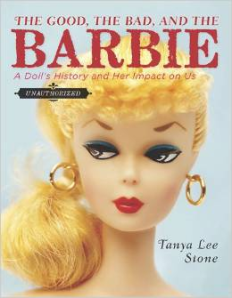
The Good, the Bad, the Barbie by Tanya Lee Stone
Being a Boomer girl I had quite the Barbie collection. I even had the one in the zebra one piece. Had Midge, Skipper, Ken complete with a kitchen set and canopy bedroom ensemble. Oh, yes, I do wish I still had them. No, not because I’m a Barbie fan, but I’m sure my retirement account would have been a bit healthier because there are LOTS of Barbie fans out there.
Lincoln Lawyer (this was a series before the movie!)
Limitless–having watched the movie I was intrigued enough to read the book. Go with the movie.
Monk? based on the series? How could a book do him justice?
Deadly Pursuit–a Christian thriller mystery? I’m game. Toss it on the TBR list.
I also made some observations:
If I look like I know what I’m doing people will think I do know something. I felt really, really good about helping a patron find a book she wanted. We didn’t find it but I gave her information how to place a hold or a search for the title.
I had no idea how prolific Christie, Cussler, Jance, Patterson are as authors until faced with trying to alphabetize their numerous titles. SIDENOTE: I found out it’s okay to get the titles in place by author (you know how that’s dratted patrons just mix them up anyway–wait, I’m a dratted patron).
People really do read Melville’s Moby Dick.
And To Kill a Mockingbird still rocks the shelves! Big yeah on this one.
So don’t be shy, trot right on down to your friendly local neighborhood library and see about volunteering for shelving. You’ll feel good, the library folk will be happy, and you’ll have an even fatter TBR list.
STOP: SPOILER ALERTS for the following
Never Let Me Go
The Island
Moon
I, Robot
Oblivion
Frankenstein
Robocop
“Four legs real, fake legs baaaad.” image: nature.com
What is this fascination with the humanity aspect of clones or artificial intelligence? Why do we want to inject a soul into something man has created? Or a more defined question is: why do we explore whether man-made creations have a soul?
Is it guilt? Afterall, creation is best handled by the Creator, the One who has the Master Plan. That statement could incite a whole firestorm of commentary in itself, which is fine, but I’m really after the literary and even film aspect of cloning/artificial intelligence.
For instance, having just finished Never Let Me Go by Ishiguro, I began thinking about other cloning works: The Island,Moon, Oblivion, and while there are other aspects attached to these films, the main takeaway: “cheated.” The clones are cheated because even though they look human, act human, they are not, which becomes a matter of concern because there is an investment of empathy for these characters, yet part of me says “Wait! They aren’t real.” I feel cheated because I am tricked (seemingly) into believing and caring about something I inherently don’t subscribe to: cloning.
Have you ever tasted imitation crab? Once–thank you very much. Looks like (mostly), tastes like it (kind of), smells like (a bit), same texture (not really). After being duped into eating it I came away with the same feeling: cheated.
Duplicating sheep, crab, humans–it’s not the same, and can never be. I believe in science; I do not subscribe to Luddite philosophies, but there are moral boundaries and these boundaries keep reappearing in novels and films as guilt and even revulsion. Why?
I think we try to justify the curiosity to recreate human life through the compassion for the Creature, as in the case of Frankenstein. The Wretch had initial goodness until it met up with repeated rejection. However, Shelley pointed out the disastrous results of man attempting to recreate man.
We root for Tom Cruise (Oblivion) and Sam Rockwell (Moon) as clones, only because we thought they were human. Upon realization they were clones I immediately reneged my emotional investment–I had been cheated, someone had switched in that imitation crab.
I have no problem with robots though. The A.I. component works somewhat for me. I liked R2D2, who didn’t? And Sonny, from I, Robot? A charmer. However; they were machines with heart; they did not have a soul. Machines are machines.
On the other hand, that fuzzy line is not so warm and fuzzy when it comes to cloning: Humans with no soul? Are these simply sophisticated machines with feelings?
Which brings me to my latest Ishiguro read, Never Let Me Go. Having heard raves about it, and having read two other of his novels, I looked forward to this particular one. Ishiguro’s style of unreliable first person narrative and undercurrent, deceptively complex plot is very much evident. It wasn’t until about halfway through I realized I’d been cheated. Here I thought Ruth, Kathy, and Tommy were victims of a cruel government experiment, only to discover (oh so subtly) they are clones. Dissapointment. I finished the novel, although I felt a detached flatness. No joy in that one. I did feel a resonance with Robocop, but then he was a man trapped in a machine. And even though he was mostly machine I rooted for him because people I can relate to–fake crab, not.
Anyone else have thoughts on cloning in literature in regards to character empathy?
One of my favorite classes in college involved learning how to read picture books out loud to children. Yes, and we did get credit for doing so. This class gave me real life skills. For true.
I learned there is a proper way to hold the book when facing the audience.
First of all, sitting down facing your audience, you hold the book’s bottom spine stretched out on your forearm.
*By the way if you are looking for a dazzling, scintillating meme-worthy Prezi, it ain’t happening*
You then read sidewise, yet facing your audience because eye contact is quite important. This is easier than it sounds because picture books usually have more illustration than words.
It is then important to properly turn the page. This is done by reaching over and across the top of the book, sliding the first two fingers done the present page and the next, and pulling the page over for the next spread. NOTE: though commonly practiced, it is not in the best interest in the book’s wear to turn from the middle bottom, especially towards the inside spine. Rippage and tearage can occur in doing so.
Proceed throughout the entire book in the proscribed method.
It is also important to use appropriate voices for characters, and it can be highly desirable to create separate voices for each given character. NOTE: characterization voices are best done by those who can do so without creating havoc among the audience. For example: if your Cockney mouse is such a smash hit your audience might laugh to the point of interfering with the story’s progress.
Body language is also important. Leaning in to emphasize special junctures, or pausing for same can add a delightful amount of drama and dimension to the story.
I believe the course to be quite edifying and suggest signing up should the adult education flyer come through the mail. Today I utilize those skills reading to the grandkiddo, although I use my snuggle reading skills instead. I have read stories to my high school students. Yes, that is one reason I am known as the weird English teacher.
Then again, there are those who possess natural skill at reading and technique does not actually matter. Case in point is our boy Sherlock.
Have you a favorite technique for reading stories? Or better yet–any famous readers you’ve come across? One of my most favorites is Meryl Streep’s audio book reading of Jeremy Fisher by Beatrix Potter.
I glanced at the numbers clicking away the miles, rhythmically measuring off the coveted roll over. I envisioned the possibilities: fireworks, though it’d be daytime, a serendipitous cavalcade of singers and dancers ala Doris Day:
or at least the significant Beethoven four beat–da da da dum. None of these happen as I turn into my driveway. I am three miles shy of my goal. My anticipated day of Shazzam will not be happening today.
A bit dramatic, I know, but ever I was a little kid I held great significance in the reckoning of the great roll over. It only happens once in the lifetime, at least I have only witnessed it once. And it happened today. And I almost missed it. This is way the MEPA, the Most Excellent Personal Assistant, is valued beyond belief. He noticed the momentous occasion on the way to obtain yogurt and fresh bananas:
“Look, Hon–it turns over in one mile.”
“What?! Ack, I almost missed it.”
Fumbling for my iPhone I quickly recorded the event. Blurry, yes; however, it is recorded for always and forever.
What about you? Have you owned a car long enough to record the reckoning of the rollover?
My parents traded out cars regularly every five or so years (part of the old American dream, you know), so I never actually witnessed the event, although my kidmagination just assumed something significant happened at 100,000 miles–a second chance perhaps? All fibs erased? A sharper remembrance for the eights of the multiplication table? Something. I knew something had to happen.
Of course something had happened: I have saved $20,000 because I replaced the timing belt instead of buying a new Honda. I can’t wait for the next ($)100,000 miles and what it will have in store.
This set of 100,000 has seen the progeny through driver’s ed and high school graduation, trips to visit the grandkiddo, jaunts to do book research, vacation wanderings, Sunday drive escapes, and has ushered us into glad tidings of empty nestering. New car? No, not yet. This one still has a few more memories to accumulate.
My latest spotlight is on another blogger whom I’ve exchanged commentaries since the beginning of my blogging foray.
In his own words:
Everyone calls me Ste J. I am an obsessive book creature, in fact I spend more time between the (book) covers (I read in bed as well though) than I do with ‘real’ people.
Which means I probably spend more time with you guys than anyone else. Feel privileged.
Ste J is a bona fide bibliophiliac. He loves books. That’s a bonafide fact. Proof: he once read 100 books in 362 days, just to see if he could do it. His blog is neatly organized into genre and with a mere click, a person can investigate reviews and titles. His tastes are eclectic, his insights meaningful, and his replies clever.
Lately, his posts have wandered a bit off the original track of being primarily bookish in content and he writes on whim. I can relate. I too have strayed from my original intent of providing astute book reviews that would dazzle and benefit bookdom and have taken to writing as serendipity taps the muse.
So, I hope you will check out Book to the Future and meet the intrepid Ste J, where as his banner states “more book than a mad ‘orse.”
One aspect of blogging that is a definite benefit is finding new titles to read. Goldfinch by Donna Tarrt is one of those titles. Considering it received the Pulitzer and had so many varied reviews–Loved it!” “Hated it!” I had to decide for myself. I will never truly know how I might have liked it. It’s been relegated to my rare “didn’t finish” designation on my Goodreads tab. Why? Admittedly, it takes quite a bit for me to *gasp* abandon reading a book.
image: nytimes.com
Here are my impressions:
Plot interesting although contrived. I work with teenagers and I have yet to come across any who talk like they are fourteen going on thirty-four. I know. I know. It’s a novel and there are liberties called artistic license.
I’ve read BIG books; however, the story needs to justify the length. Melville or Dickens, this is not. Instead, I found myself getting more and more irritated as Theo, the protagonist, reveled in TMI (too much information). It’s like being caught in a conversation with someone who keeps adding on instead of continuing on with their story. I didn’t find all the extra detail to be that significant to moving the plot along.
I also found the stereotypes disappointing: the out-of-touch adults trying to counsel Theo; the genius, yet nerdy friend; the dysfunctional wealthy family; the unconventional adult who becomes Theo’s island of solace.
Here is the real clincher. I could have continued with the reading. There is enough intrigue and character investment that I had a desire to keep giving it a go, then the dreaded birdie kept flipping up unexpectedly. The boid, the random explosion of f-bombs finally annoyed me enough to say “done” and moving on. I understand profanity adds a certain aspect of verisimilitude; however, certain words remind me of pepper–sprinkle too much on and it actually hinders the flavor instead of enhancing. The random f-bomb turned into a regular blasting zone and I began to wince. Here’s the deal: “Hey, Theo–you’re a nice enough kid, and you have a great vocabulary, so why the potty mouth?”
I also wondered if this wasn’t really a dressed out YA. A large portion of the book centers on Theo’s teen years. Then again, I didn’t mind reading Hunger Games; on the other hand, that IS considered YA.
Overall, I would have kept going to read the 700+ pages. It takes several elements for me to finally pull my bookmark and move on. I have way too many books I want to read to keep going with one that wears on me.
Twofold commentary requests here:
1. Anyone agree or disagree with my Goldfinch assessment?
2. How do you handle books that don’t live up to your expectations? Do you continue or do you move on?
It’s been about a week since I’ve been back from my Road Trip. Along the way I jotted notes and here’s what I came up with:
Reader Board: “without ice cream all would be darkness and chaos”
Rest stop bathroom poster: “no one should force you to work”–immigrant worker rights poster
Parking lot: one legged-seagull and a choir of grackles.
Dairy Queen: girl to grandpa–“how do they get the swirl on top of cone?”
Wireless Connect Option: Drunkengiantgrogshop; dishonestdon–what neighborhood have I stopped in?
Window Shopping: seen on bib–“these fools have turned my super cape backwards.”
Coffee Shoppe: eclectic chairs and tables, tall ceilings, bookcase of children’s books, windowed playroom with dress up clothes, chalkboard walls, train set, kitchenette hutch. A brood of children frolicking while moms and dads read, deviced, paperworked. Lovely chocolate chip cookies too.
At the park: full out barbeques and families on a Saturday night
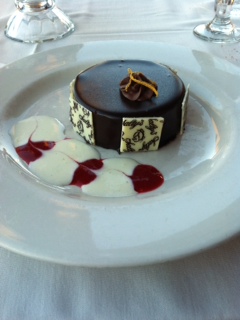
Any guesses what this deliciousness might be? Oooh, yummers. Dark chocolate wrapped around cheesecake with raspberry crème garnish sauce. Note the in-house signature chocolates decorating the sides. Caloric penance.
At the restaurant: a dessert so beautiful I actually took a photo
In the parking lot: grated fern, a statement of deeper naturalism versus industrialism that Keats, Byron, or any of the Romanticist poets would have found poignant.
This can be viewed as either a poignant expression of nature being trapped by encroaching society or how nature finds a way to bloom amidst the trappings of industrialization. Or–isn’t that weirdly cool?
On the highway: no way, amazing, sleek as a Woolworth counter grilled cheese sandwich on a pastel Bakelite plate, a blast from the past–an actual Greyhound bus sporting a “hundred years” sticker to boot.
image: greyhound.com What are your memories of Greyhound?
In the motel room: white noise box with ocean waves, complete with seagulls scree; forest dawn, crickets and birds quite charming,; rain pattering, too close to home; fan, buzzy hum. A novelty never before encountered and even available for purchase. Tried it on first night and grandkiddo, the one who needs a minimum of two-three books, some conversation, and a bit of snuggling was out within two minutes of being lulled by waves.
Return home: a road trip is not complete without road construction delay. At one section the two lane highway is down to one lane and nobody is moving. Not no way. Not no how. Behind a little red car which is behind a huge white truck, yet from strained sneak peeks the road looks clear ahead. The MEPA is quietly muttering for the car ahead to edge around truck. Finally it does, and like a cork popping from a bottle, traffic started flowing again. The problem? The exit ramp so full it flowed onto road. No flagger directing traffic, construction crew absolutely clueless to havoc below on highway.
Dinner stop: connection with youngest progeny for dinner. Roadside grazing produces guilt to eat lightly–salad bar. Yet when it’s $12.00 though all one can eat, I strive to get my monetary satisfaction. It is possible to overdose on greenery, especially when artichoke hearts and curried chicken salad are involved.
Rolling in late to home some 6 hours later than the Google Maps prediction: truly there is no place like home
image: writeonnewjersey.com. I don’t live in New Jersey, but a small town parade sings across America
Another perk of living in a small town is the Fourth of July celebration. The day starts off with the town parade. It starts at 9 am, rain or shine, and concludes around 10 am, depending on where you are sitting. There are options with this parade: watch or participate. I’ve done both several times. Both forms are fun. The past couple of years though, watching is much more my style.
In the past, I’ve hauled the kids and bikes to participate in our church’s parade theme entry. I think that year was patriotic. We dressed up in red, white, and blue and I attached the tandem bike trailer so the youngest progeny could ride with his mum. Flag waving, crepe paper streaming, and cycling along made for a great Kodak moment.
Another time (actually a couple of times) I marched with a group of teachers with our signs signifying our thanks to the community. I am blessed to live in a school district where parents and the school board actually love teachers. When I march along with my compadres I usually bring along my bubble wands and make a spectacle of myself. True, I am not the usual English teacher.
After the parade it’s breaking out the BBQ. Past years involve family or church get togethers. Since we are now empty-nesters and the chickadees have flown, a twosome BBQ just doesn’t hold the fun factor like a full out group gaggle. And we admittedly have become rather hermitish in our ways and avoid the big organized ta-dos. I do try to make a special supper, even if it means hauling the plates outside to eat al fresco.
I do love a good pyrotechnics extravaganza so I drag the MEPA out at night for the fireworks down at the beach. Looonnngg ago we would grab our blanket, chairs, and snacks and huddle with our group among the masses. Now as E-nesters we skulk among the secret backsides of buildings and empty lots to feast on the fireworks from afar so we can scoot out before the crowd disperses. The fireworks traffic tangle afterwards always lasts twice as long as the show so making a clean getaway involves strategy.
Somehow once the Fourth of July hits it seems like summer has really begun.
How about y’all? What are your memorable aspects for the Fourth?