William Shakespeare’s writing has provided some fairly memorable quotes, words, and expressions. While Billy Bard can take credit for most of what is tagged with his name, he doesn’t quite get all the credit.
Let’s play “How Well Do You Know Your Shakespeare?” You will be given two quotes. One or both quotes are presented. Decide which, or both, belong to Shakespeare.
1.A. “Bated Breath” B. “Breathlessly Waiting”
2. A. “A Blinking Idiot” B. “Foolish Ninny”
3. A. “Take Your Last Breath” B. “Breathe One’s Last”
4.A. “Give Them An Inch” B. “Budge An Inch”
5.A. “The Crack Of Dawn” B. “The Crack of Doom”
6. A. “Kindness Is A Cruelty” B. “Cruel To Be Kind”
7. A. “Fortune’s Fool” B. “A Fool And Their Fortune Is Soon Parted”
“Bated Breath” from The Merchant of Venice, 1.3.115-116, 123-129
“A Blinking Idiot” also from The Merchant of Venice, 2.9.54-62
“Breathe’s One Last” from Henry VI, 5.2.39-42
“Budge an Inch” from Taming of the Shrew, induction.1.7-15
“The Crack of Doom” Macbeth, 4.1.112-117
“Cruel to be Kind,” Hamlet, 3.4.173-179
“Fortune’s Fool,” Romeo and Juliet, 3.1.132-136
Bonus:
Who said “A fool and his money (fortune) will soon be parted?
Answer: Dr. John Bridges from Defence of the Government of the Church of England, 1587
And what was your score?
Next time–sayings Shakespeare really, really did not say…
Moving into the “k” section it is surprising how many clichés begin with “keep.” Here are ten of the top keepsakes of that section:
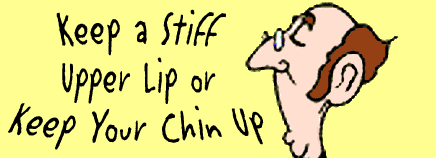
Keep a stiff upper lip: don’t show your true feelings. Oddly I tend to think of this being of British origin as it is uttered often enough in literature and films, especially in WWII period dramas. However, the book indicates it from early 1800s America, referring to not allowing the upper lip to tremble, an indication tears are about to fall. In actuality it is the bottom lip that usually does the trembling prior to crying.
Keep your chin up: don’t lose heart or courage. A well-established cliché since at least 1840, the original body part and due to its slang connotations was exchanged for chin to emphasize keeping one’s head up in adversity instead of other misconstrued meanings.
Keep a straight face: look appropriately serious for the occasion. Derived possibly from Henry Miller’s 1953 Plexus where a character states: “All felt called upon to do was keep a straight face and pretend everything was [all right].
Keep at arm’s length: to keep someone or something at a distance. A long time expression harking back to the sixteenth century when it began as keeping “at arm’s end” which then became “at arm’s length.”
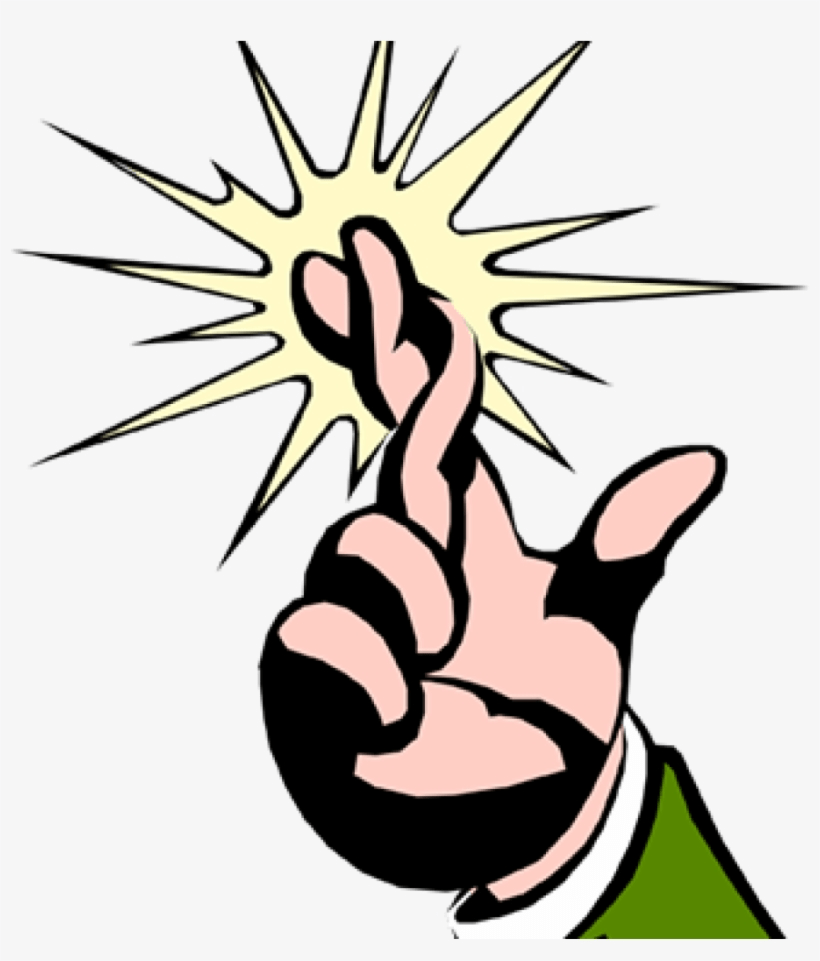
Keep your fingers crossed: hoping for the best outcome. An ancient belief of making the cross with avert harsh outcomes. It can also mean to keep from telling a lie, as in “xing” out the deed or what was said, a transfer from children’s games.
Keep under your hat: hiding a secret. In the old days, when hats were more predominantly worn, keeping items under one’s hat could be handy since it was hidden. A song from the 1920s sings out: “Keep it under your hat!” You must agree to do that. Promise not to breathe a word.”
Keeping up with the Joneses: living beyond one’s means. A cartoonist, Arthur R. Momand used the term in one of his cartoon titles as a reflection of living on a tight budget in an upscale New York suburb. While his cartoons may not be remembered the expression lives on.
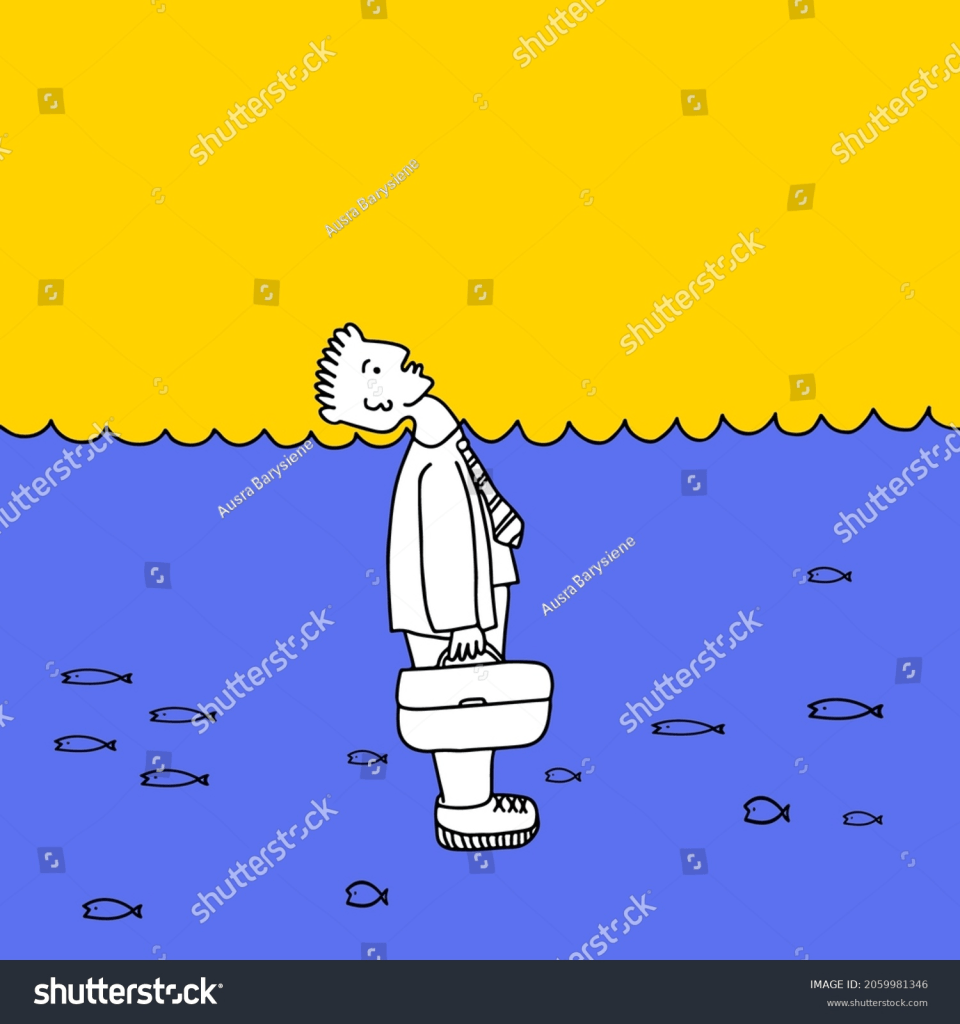
Keep one’s head above water: to avoid being overwhelmed. Going back to the eighteenth century writer John Arbuthnot wrote in the 1712 John Bull: “I have almost drowned myself to keep his head above water.”
Keep your eyes peeled: have your eyes wide open. A reference from as early as the 1840s when people were on the lookout for possible hazards, as in pioneers being watchful for trouble while scouting out in the woods.
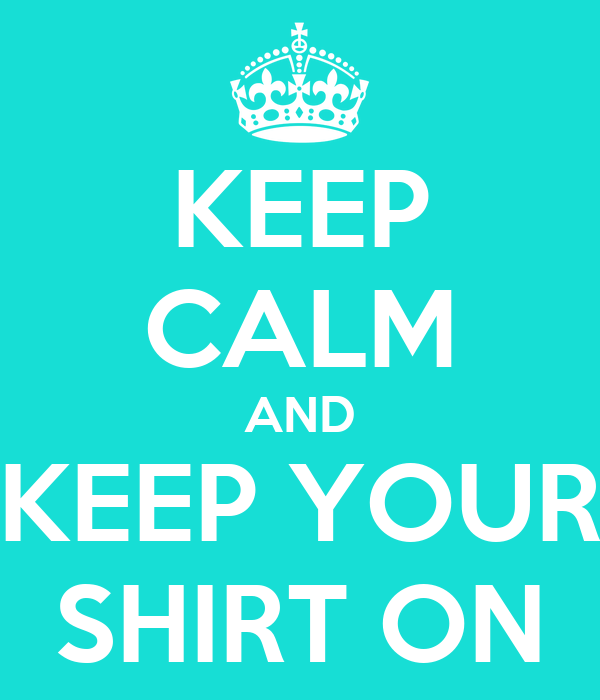
Keep your shirt on: don’t get upset. A nineteenth century American expression relating to the men removing their shirts before getting into a fistfight. It has since come to mean to not lose one’s patience.
When I was teaching I would consider July to be my true vacation month since June was wrapping up school for the year and August was preparing for the upcoming one.
Being retired means every month is a vacation month and for me that means I can read more without guilt of ignoring grading assignments or being too tired to read.
My usual Goodreads goal is 101 books and I would barely squeeze that in. This year I hit that target by the end of July. I didn’t break out the celebratory cheesecake but I did wonder how many books I can possibly read now that my reading time is unfettered and free. One year (2020, I believe, when school was abruptly shut down, along with the world) I read 165 books. We’ll see what happens in the remaining months.
Here are the top ⭐️ ⭐️ ⭐️ ⭐️ ⭐️ reads:
Warblers and Woodpeckers: A Father-Son Big Year of Birding by Sneed B. Collard III
Sneed B. Collard’s father-son record of their Big Year caught me by surprise. I thought it would be interesting, since I enjoy birds, and I thought it would be endearing, because how many thirteen year olds like birding and hanging out with their dad? It was both and it was also memorable. I had no idea birding could be so competitive. And I had no idea there existed something known as Big Year.
When Grandfather Flew by Patricia MacLachlan, illustrations by Chris Sheban
Patricia MacLachlan proves once again her ability to portray family moments in this tribute to a well-lived grandfather. Through a shared love of birds the grandchildren and grandfather experience the passing of the grandparent as he slips from vibrant to being bed-ridden. The accompanying illustrations complement the lyrical story with their surreal, dreamy presentation which mirrors the somewhat wistful, magical realism of the ending.
Enola Holmes #5: The Case of the Cryptic Crinoline by Nancy Springer
“I hoped, also, that I seemed considerably older than my fourteen years.”
This, stated by Enola, is the heartbeat of the series. At only fourteen Enola solves crimes, lives an independent life in London, and outwits her famous brother Sherlock. She does seem considerably older than her given age, and as implausible as it seems that this teenager can do so much at so young an age, it does make for fun reading. I look forward to watching the series and I am diligently waiting my turn to arrive. The holds list is a practice in anticipation.
In the Night Garden by Barbara Jose, illustrations by Elizabeth Sayles
Going to bed is not so easy when playing is preferred over sleeping. With a winsome combination of text, complete with fun onomatopoeia, and soft, dreamy illustrations, children are lulled into transitioning from romping in the garden into snuggling under the covers. A bedtime book that is both fun and easy to repeat read. A sure hit for storytime.
Teatime for the Traditionally Built (No. 1 Ladies Detective Agency #10) by Alexander McCall Smith
I put off reading this series for such a long time and I am becoming quite a fan. The books are short and deceptively simple in that there is more wisdom than mystery solving taking place in the plot. They are relaxing and refreshing to read and I fortunately have many more to look forward to since the #23rd is due out. The TV series is just as delightful.
It is difficult to avoid clichés. I am hyper-sensitive to them, yet I still insert them verbally into my sentences (when writing I tend to be a bit more editorial and catch them before they make it to the final version). Do you catch yourself saying any of these ubiquitous clichés? Which ones are difficult to excise from your stable of sturdy go to phrases?
image: Amazon a surprisingly fun read
Adding insult to injury: this one is covered more thoroughly in a previous post, but how else to best express that feeling of being doubly hurt? Keeper
Albatross Around Your Neck: credit Coleridge and his “Rime of the Ancient Mariner” poem in which a sailor has to wear the albatross he killed. Chicken-killing dogs were made to wear the dead bird around their neck to deter them from killing any further chickens–this must have been the strategy for Coleridge’s poor sailor. Talk about a fowl, unpleasant punishment! Associating dead, rotting birds around my neck with unpleasant tasks makes this a cliché unsavory. Avoid
Forever and a Day: Shakespeare is thought to have penned this phrase from Taming of the Shrew, yet it was found in earlier texts before the 1600s. Taking a long, long time isn’t as poetic as taking an eternity and then some, as in reference to those irritating traffic lights that seem endlessly red. I do use this one when the right occasion pops up. Keeper
Happily Ever After: a standard fairy tale ending that is credited to the fourteenth century Italian writer Giovanni Boccaccio. His stories usually ended with the phrase, “so they lived very lovingly, and happily, ever after.” This became shortened and when used today the speaker and listener is well aware of how cliché the phrase sounds. Avoid, though no harm, no foul
Little Did They Know: a phrase with tracings back into the nineteenth century and made popular by suspense writers in the thirties, forties, and fifties. Again, this one is easily identified as a cliché. No harm no foul
Not to Put Too Fine a Point on It: Charles Dickens is given credit for this one, which is derived from his novel Bleak House. Mr. Snagby liked to utter this phrase as a means of speaking plainly. Frankly I don’t use this one and don’t hear it much either. Moot
Pot Calling the Kettle Black: In Don Quixote there is a line where the frying pan insults the kettle, and since they are both made out of the standard black cast iron it is rather hypocritical for the frying pan to call out the pot being being relatively the same. I admit to using this one; however, do people know what a kettle is these days, let alone the obscure reference to black when there are so many choices in cooking ware available? Avoid, reluctantly (finding it tough to replace this one–calling out someone as a hypocrite is fairly blunt)
Well–how did you rate your own use of these clichés? Find some keepers, despite them being overused and eye roll worthy when mentioned? If they do slip out, no worries (which is becoming a cliché in its own right).
I am a huge fan of our local library. Great location, amazing staff, supreme layout, not to mention its splendid collection that even includes telescopes and seeds.
Last year the library increased its coolness factor by adding a garden. Did I mention the library also boasts a shady reading area with a waterfall?
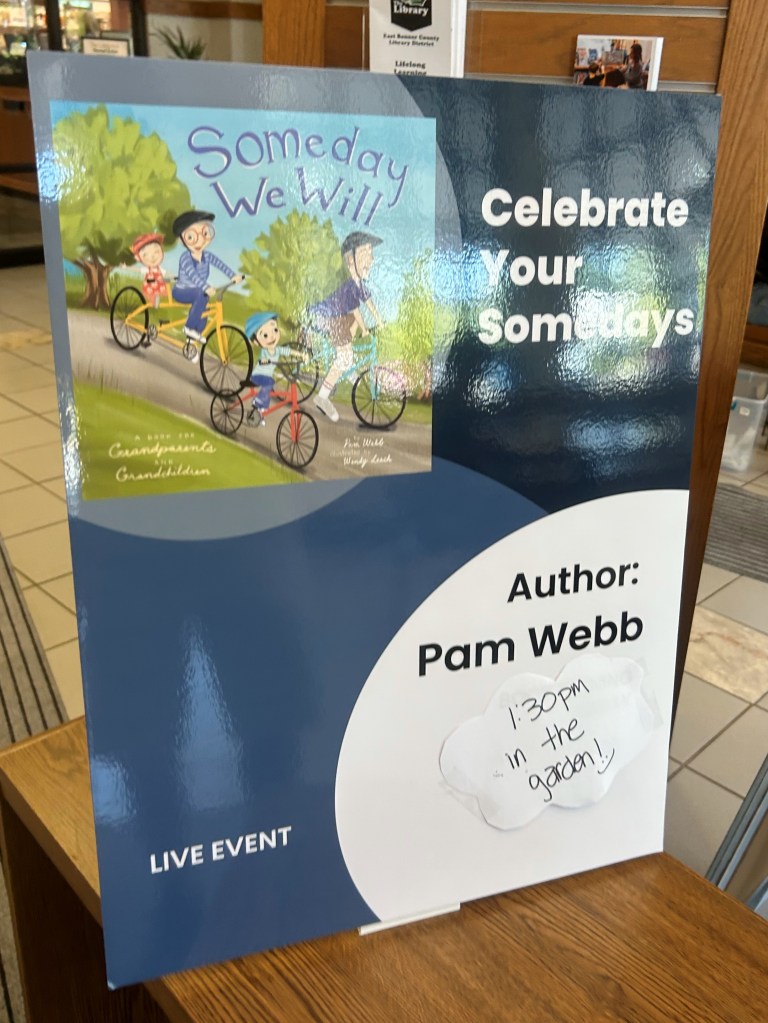
To get right to the point, the library garden is holding local author story time this summer, and yes—I am one of the authors. Below are a few photos from the event. I read my book last year in the garden, but this year was more amazing because of the addition of a pergola (such a nifty word).
Considering the temps were in the mid 80s with only a hint of a breeze, the turnout was encouraging and there were almost more kids than adults, which is always appreciated. After reading my book and going through the process how a book becomes a book we broke out popsicles, bubbles, and sidewalk chalk–all aspects found in the book.
I have yet to do any classroom visits, but now that I am retired that should be more doable. Reading my book in a garden setting is a memorable way to make connections with the community and I look forward to more connection time with other library events.
The junco is a common bird, true; however, it has plenty of personality. We learned about juncos this winter when we took to tossing out birdseed under the living room window to avoid trudging in the snow to fill the feeder. Daily a troop of birds ranging from sparrows to doves to juncos would pop by. The consistent crew was a group we referred to as the Jolly Juncos. They would merrily hop about foraging for food in their somber dark hoods and grey suits. They were determined and undeterred in their daily sweep for seed. They helped break the monotony of winter.
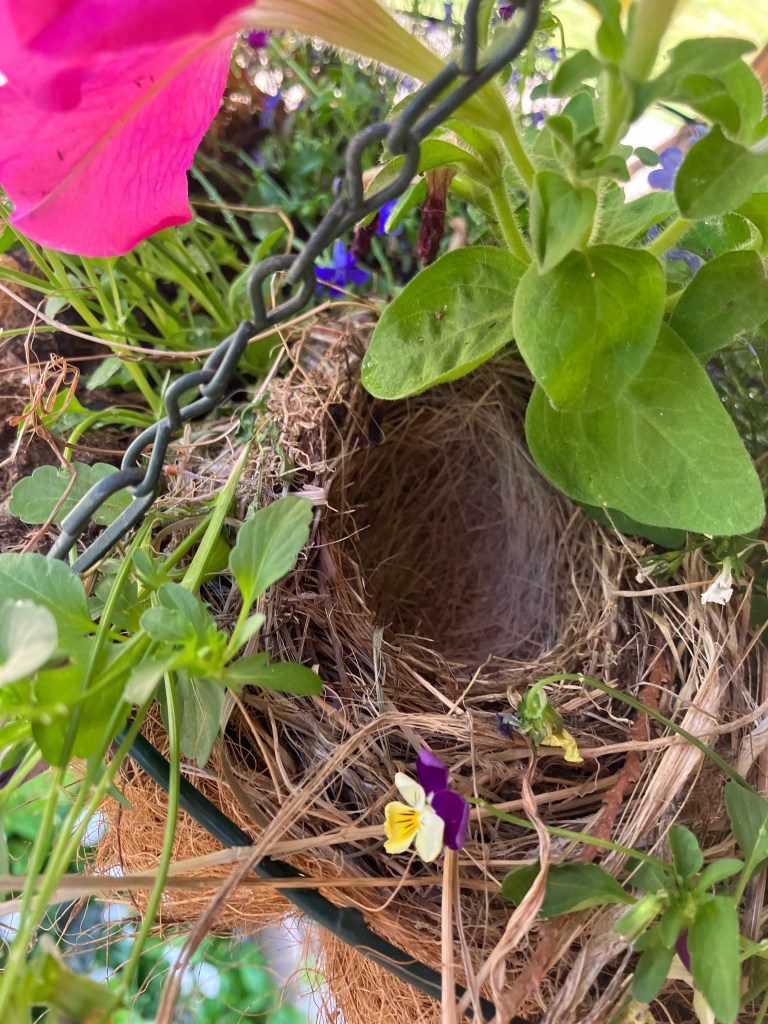
In spring we were delighted to find a junco had created a nest in one of my hanging flower baskets.
Leave for a long weekend and surprise!
Quite an artful rendering
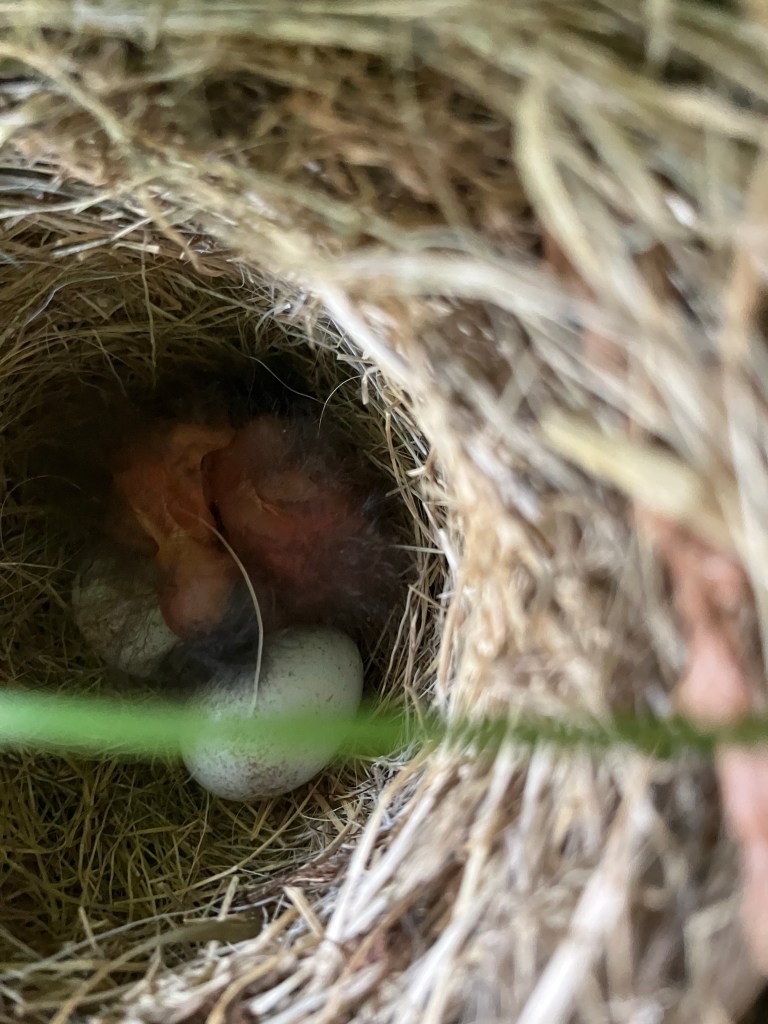
Yes, the eggs are tiny
Four eggs!
Mama bird settling in for sitting
Hatchling!
Feed me!
Feed me two!
Dad bird shows up with groceries
Mama bird takes a nest stretch
Unfortunately the birds flew the coop early, no doubt due to the fact that they nested in our patio area and we go through there multiple times a day. I felt terrible until I read about a ornithologist who runs into the same problem when studying juncos. The extra attention needed to band them for tracking can force fledglings to leave the nest early, but the good news is that the survival rate is high. This (I told myself) is what probably happened with our four little nestlings. Mama did return once or twice to the empty nest then disappeared.
I miss having our little junco family as neighbors and wonder if they will return next year.
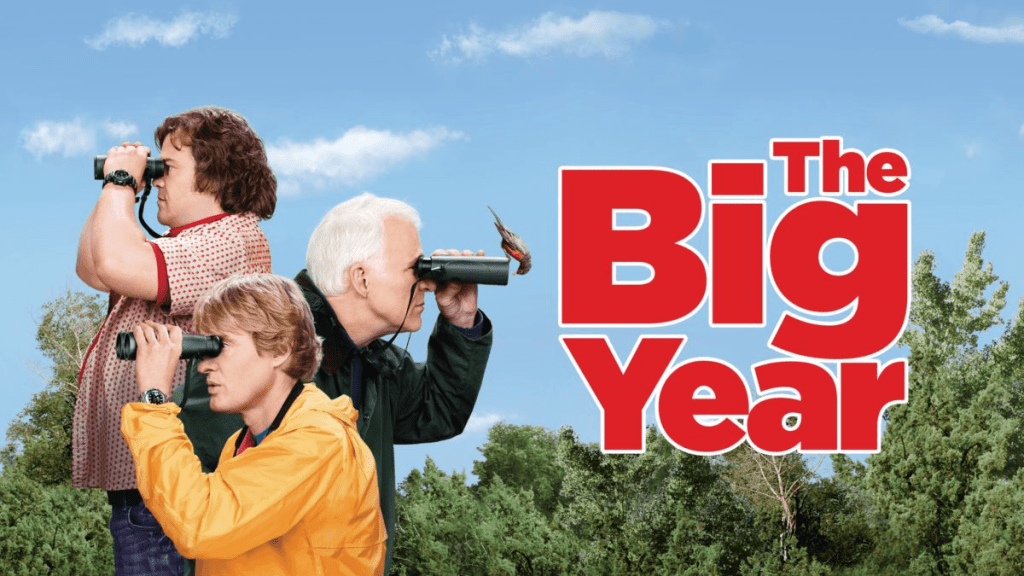
I had no idea there existed a birdwatcher Olympics. I learned of this by reading Sneed Collard III’s book Warblers and Woodpeckers, which is a journal of sorts how he and his teen son go for a Big Year.
The book is entertaining and illuminating as Sneed and his son bond over birding. This led me to watch the movie The Big Year. It was okay. I like birds but not enough to fly to Alaska to tick them off a list. Also, not a fan of Owen Wilson.
image: Whidbey Island Audubon Society
So I am inspired to do my own Big Year. There won’t be any extravagant trips planned which means the birds I count are ones mainly from my backyard. Granted, July is a bit late getting into the game yet looking for birds is different than at birds. I know there is an official list; however, I will work with what I have available.
So far:
Crow
European Starling
Mourning Dove
Swallow (Tree? Violet-Green?)
Robin
Chickadees (Black-capped and Chestnut-backed)
Hummingbirds (they are too fast to identify)
Nuthatch
Sparrows (I get them all confused)
Finches (ditto)
Hawk (no idea)
Bald Eagle
Golden Eagle
Junco
Western Tanager
Cedar Waxwing
American Goldfinch
Bullock’s Oriole
Question: Are you a birder (much more serious than a birdwatcher) or someone who simply enjoys birds?
I’m somewhere in between, but after watching Jack Black’s dedication in The Big Year–he listens to bird songs on his headphones?–I’m thinking I don’t know much about birds after all.
Thanks for the reader feedback on how you are enjoying the word selections. I enjoy finding them almost as much as I enjoy sharing them with you all. This past week has consisted of a multitude of words that cause me to say “There is a word for that?”
Splooting: a behavior that some animals use to cool their body temperature. Squirrels are finding cool surfaces and lying on their stomachs, legs spread, to cool off. For awhile we had a winsome little squirrel that would visit us and eat peanuts from our hand. In the summer she would come up to the patio and hang out. I thought she was being a companionable squirrel when she was actually seeking some relief from the heat by splooting.
image: NY Parks and Recreation
parapraxis: when you say one thing and mean another, especially when the words are close sounding. Would you care to call your mother—I mean brother?
catachresis: using what is thought to be the correct word because it sounds like the word you meant to say. “She was reticent about going to lunch.” Umm, she was reluctant about going to lunch? Or perhaps in her reluctance she wasn’t talking about it.
spoonerism: credit Reverend Spooner for the slip of the tongue that causes the transposition of consonants in a sentence. “Go hush your brat” is not the same as “Go brush your hat.” One directive will definitely cause a stir.
solecism: accidental or intentional misuse of grammar. “I am what I say I am; I is what I say I is.”
malapropism: close to a catachresis, this word is attributed to a character, Mrs. Malaprop, in a 1775 play, who unknowingly inserted incorrect words in her utterances. “She was the pineapple (pinnacle) of perfection.”
mondegreen : coined by writer Sylvia Wright who misheard a line in a poem as “Lady Mondegreen” instead of “laying him on the green”, the word refers to mishearing lines or words or lyrics. My nemesis mondegreen was Clearance Clearwater Revival’s line about a “bad moon rising” which I heard as “bathroom on the right” which made sense to me because knowing where the nearest bathroom is located is handy.
eggcorn: similar to mondegreen, an eggcorn replaces the original word, yet it still makes senses since the new meaning hasn’t rendered the original intent incorrect.
free reign” for “free rein”
“in one foul swoop” for “in one fell swoop”
“jar-dropping” for “jaw-dropping”
“old-timers’ disease” for “Alzheimer’s disease”
“on the spurt of the moment” for “on the spur of the moment”
mumpsimus: an insistent use of an eggcorn, being attributed to a monk Erasmus once knew who would say “mumpsimus” instead of the correct “sumpsimus” when reciting the liturgy.
“they’ve got another thing coming” —sorry Obama, that should be another “think” coming
“it’s a doggy dog world”—yeah, it can be ruff out there, but it’s actually “it’s a dog eat dog world”—ooh, it’s ruffer than we thought
“nip it in the …bud”—not the other (thinking gardening, not corporal punishment)
“first come, first serve”—not a Sunday buffet sign because it is supposed to be “first come, first served” (grammar can be tense, I know)
Cacology: when it’s said and done it’s how you said that could do you in—those Spoonerisms, malapropisms, solecisms—all those above, including incorrect pronunciation, could lead to a faux pa, a big mistake.
Splooting has nothing to do with speaking correctly, yet the next time you spot a squirrel doing the hot day sprawl you will know what you are talking about.
The all important Cow Appreciation Day just about snuck past me but my handy National Day calendar alert informed I needed to pay attention. Cows are beyond special—they are bovine.
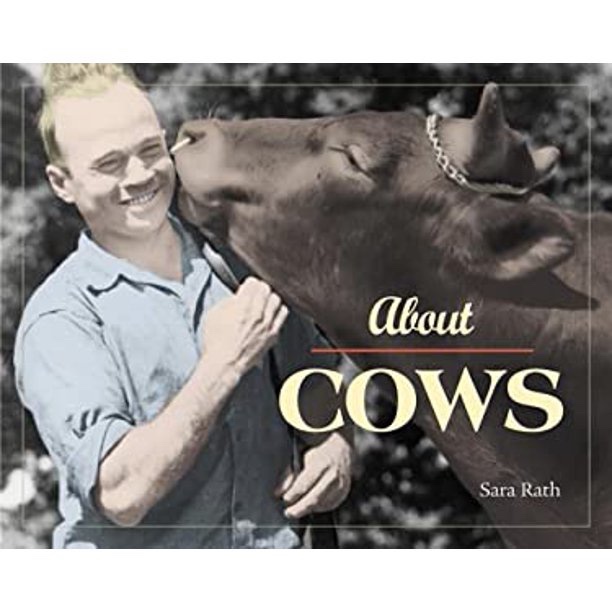
Having grown up around cows, and having lived across from a dairy farm for twelve years, I have an either an affection or a affectation for cows. I have gathered and created a plethora of cow jokes and cow facts and created a book that unfortunately no publisher is interested in at the moment. That doesn’t stop me from appreciating what Sandra Boynton has done for the cow with her winsome cowtoons and book. Gary Larson has also shown an affinity for cows. One of my other favorites is About Cows. There are scads of other books that regale cows from Dr. Seuss to meditative cows. Maybe the market isn’t ready for yet another tribute to cows.
Sandra Boynton knows her cows
Gary Larson goes to the Far Side about appreciating cowsEmbracing the love of cows
Then again, why not? I’m not giving in or giving up even because cows are cool and the world cud appreciate another udderly cow time.
Here are some of my favorite cow jokes I like to toss out to unsuspecting listeners:
Why are dairy farms so noisy? Too many cows have horns.
If good cows go to heaven where do bad cows go? The udder place.
Why did the farmer place bee hives in his pasture? He wanted to live in the land of milk and honey.
What goes “oom oom oom”? A cow walking backwards.
And my parting riddle—
What is the best way to make a milkshake? Have it jump on a pogo stick.
I would love to hear your thoughts on why cows are so cool or a really good cow joke—I have enough bad ones.
Of course I’m following the AI news. As a former English teacher I still have a vested interest in how students might tap into ChatGPT and all its marketplace cousins. I thought running herd on suspected cut and paste and plagiarism was challenging, now there is the matter if the assignments are student-produced or bot-generated. Did I mention I’m glad I’m retired?
Now that I am retired I am focusing on my own writing. I am beginning to notice publishers are posting their own AI cautionaries on their websites, about appreciating AI, but wanting original work. Yes, we’ll see how that turns out.
Then I read how someone created a picture book by plugging in prompt directives. This did not go over well in the comments. I have enough competition from humans, I don’t want any from machines.*
I decided to take ChatGPT for a test drive. I plugged in the prompt: Create an enthusiastic book review for Syria’s Secret Library.
I had just finished the book and was about to write up my Goodreads review and was curious what the ChatGPT approach would produce.
In less than a minute, more like 30 seconds, I was reading a seven paragraph review that was disconcertingly well-written. On first reading. Here is the first paragraph:
Prepare to be whisked away on a remarkable and inspiring journey as Mike Thomson takes us deep into the heart of Syria’s Secret Library. This is a truly exceptional work that not only sheds light on the power of literature but also showcases the indomitable human spirit in the face of adversity.
A decent introduction, a bit more enthusiastic in praise style than I would write, yet decent.
On second reading I noticed more glowing praise; however, it was what I refer to as “frosting” in that it looks good but has little substance. My AP students would write “frosting” essays when they weren’t fully knowledgeable about the topic prompt. They would write around the topic without truly addressing it. The AI result was much the same. It addressed the book in a very general way and the paragraphs became repetitive in its praise due to lack of detail. It’s as if it read the book jacket instead of the book:
The characters in this book are genuine heroes, ordinary people thrust into extraordinary circumstances, fighting to protect the essence of their culture and to safeguard the treasures of human knowledge. Their commitment and sacrifice are truly awe-inspiring, and their stories will stay with you long after you finish reading.
Which characters? What sacrifices? How were their actions awe-inspiring? These would be comments I would write on a student paper. Details. Give me the “so what?”—get me interested by providing specific details.
Then again, maybe it’s dependent on how well the prompt is formed. I revised my original prompt to read: Create a positive book review for Syria’s Secret Library including specific details from the book such as names, places, and events.
Here is a paragraph from the revised review:
The book eloquently captures the power of literacy and the profound impact it had on the people of Daraya. It was heartwarming to read about how children like Waleed and Reem found solace and inspiration in the pages of books, transcending the horrors of war. The author skillfully weaves their personal stories with historical and cultural references, painting a rich tapestry of the Syrian people’s resilience and unwavering thirst for knowledge.
It now mentions the place: Daraya, yet who are Reem and Waleed? And therein lies the problem with trusting bot research—it can get it wrong. There is no Reem and Waleed in the book. At least the the story I read.
I keep reading incidents where people, as in professionals such as lawyers, are getting into BIG trouble when it is revealed that their documents are flawed because they trusted what the AI produced. (Why they didn’t fact check is a question I had).
Overall, I am concerned where AI writing dependencies are taking us in both the creative and professional realm. From my brief forays though, I’m not too worried about my day job as a writer being threatened, especially after the results from my prompt concerning a young boy, a grandmother and feeding birds and squirrels in the park. AIiyiyi it was that bad.
*quick segue—my summer binge is “Person of Interest” which is an older series how a billionaire computer whiz invented a machine that watches the population for acts of terrorism, but he uses it to help prevent crime. I find this 2011-2016 series still relevant in how artificial intelligence becomes smarter than its programming.














 Pam Webb