Pam Webb

a writer's journey as a reader

Archive for the category “Poetry”

Take Your Next Poem to Lunch


poetry

Silently mulling over the words, she reflected in her repose as she drank deeply of the healing verse before her….

Stop–cut–

Really, poetry doesn’t have to be all artsy, angsty to be enjoyed. The reflective part is okay, but honestly, poetry can be much more rewarding as an outward expression through sharing. During Poetry Month try some of these verse interactivities:

1.  Randomly leave a poem around the office or break room.

2.  Pack poems in your lunch for at least a week–you know, a read ’em and eat kind of thing

3. Sign off your signature with a line from a favorite poem

4. Use a poem for a bookmark

5. Memorize a poem–one you don’t know (Robert Frost won’t mind this time)

6. Read up about a poet–most have led amazing lives

7.Watch a movie with poems–I suggest Dead Poets Society

8. Chalk poems on the sidewalk

9. Attach a poem to a balloon and release it

10. Revisit a poem–has it changed in meaning for you?

Frost Covered Spring


Robert Frost. My first meaningful encounter with poetry occurred in fifth grade when Mr. C (still my favorite teacher) had us memorize “Stopping By Woods” and then we chalked our impressions of the poem onto dark blue construction paper. These were then pinned all around the classroom as the border above the chalkboard. As I teach this poem to my students I learn more and more from it. Frost does that with his poetry. It appears so deceptively simple at first and then there is a realization of its depth. It can be almost embarrassing at times once the analytical epiphany hits.

But I can’t imagine Frost laughing at my denseness–no, he would probably only chuckle. I imagine he might even be amused at the fuss we make analyzing his commentaries on birches, walls, and the snowy woods.

Frost is one of my faves and thought it very appropriate to feature him first among the many poets I hope to spotlight this month.

Here are a smattering of favorite poems:
“Mending Walls”
“Acquainted With The Night”
“The Road Not Taken”
“Fire and Ice”
“Nothing Gold Can Stay”

What are your favorite Frost verses? For some reason whenever spring arrives I tend to think of Robert Frost. Maybe this is fitting–a bit of Frost helps us appreciate the warmth of spring. I think he realized that as well.

Happy Poetry Month!

20130401-215741.jpg

No Fooling It’s National Poetry Month


Although it’s April 1st, which means pranks, jokes, and teasing can occur, I am serious in my endeavor to post something poetical everyday in recognition of it being National Poetry Month. Be forewarned, prepared, and whatever measures you might have in mind as I bombard my blogging with a preponderance of verse, imagery, and meter.

20130401-211806.jpg

Pondering Poetry


1848 Daguerreotype of Edgar Allan Poe at 39, a...

1848 Daguerreotype of Edgar Allan Poe at 39, a year before his death (Photo credit: Wikipedia)

Poetry.  I sometimes hate to admit I love it.  It is misunderstood, mishandled, and would be missed should it ever be absent from our midst. As I teach AP I delve ever deeper in poetry and realize with some asperity I know nothing and have so much to learn.  Learning from the masters is a place to start.  May you also find solace and inspiration in these quotes found.

Poetry is serious business; literature is the apparatus through which the world tries to keep intact its important ideas and feelings.–Mary Oliver

I would define, in brief, the Poetry of words as the Rhythmical Creation of Beauty.
Its sole arbiter is Taste.
Edgar Allan Poe

A short poem need not be small.–Marvin Bell

A poem…begins as a lump in the throat, a sense of wrong, a home-sickness, a love-sickness…It finds the thought and the thought finds the words.–Robert Frost

Robert Frost NYWTS.jpg

image: Wikipedia.org


Genuine poetry can communicate before it is understood.–T.S. Eliot

For a man to become a poet…
he must be in love or miserable.
George Gordon, Lord Byron

I think like a poet, and behave like a poet.
Occasionally I need to sit in the corner for bad behavior.–Gary Soto

There is nothing wrong with a poetry that is entertaining and easy to understand.
Charles Bukowski

Poems reveal secrets when they are analyzed.
The poet’s pleasure in finding ingenious ways to enclose her secrets should be matched by the reader’s pleasure in unlocking and revealing secrets.
Diane Wakoski

#9: Poems to Know and Grow On


It’s been too long since I paid attention to my Musings of a Voracious Reader list.  Tidying up my files I discovered entry #9: Poems to Know and Grow On and it seems quite appropriate as a post-Valentine’s Day post, since poetry is the food of love (right next to chocolate).

As I teach poetry, especially as I prepare my AP students for their exams in May, I am reading more and more poets and poetry.  This is a good thing.  In fact, I am now taking on what I have deemed as the “Emily Project” which is discovering Emily Dickinson.  Understanding her would be another project in itself.

As I teach, read, and study poems I have gathered a few along the way.  I dearly wish I had a better knack for memorization because I would like to pull out a poem for any occasion and dazzle, delight, and demonstrate the power of poetry to any willing listener. I love it when that moment arrives in a movie when one character starts a poem and another finishes it.  Remember Willoughby and Marianne from Sense and Sensibility? *sigh*

This is simply a sprinkling of poems I have deemed worth knowing and to grow on:

1. My First Memory (of Librarians) by Nikki Giovanni–a Book Booster’s banner poem of delight

2. Harlem (A Dream Deferred) by Langston Hughes–his imagery is enviable

3.Introduction to Poetry by Billy Collins–enjoy poetry, don’t tie it to a chair and beat a confession out of it (love this)

4. Hope Is A Thing With Feathers by Emily Dickinson–hope wings its way into our hearts

5. The Road Not Takenby Robert Frost–almost clichéd by its overuse, it’s still a powerful statement about making choices

6. The Jabberwocky by Lewis Carroll–delightfully fun for any age

7. This Is Just To Say by William Carlos Williams–after I discovered this was actually a note to his wife I embraced the poem even more

8. The Tyger by William Blake–imagine seeing a tiger for the first time; how can something so exquisitely beautiful be also so incredibly deadly?

9. One Art by Elizabeth Bishop–the more I read Bishop the more I realize what talent she has for capturing life’s moments

10.I Hear America Singing by Walt Whitman–“a sweaty-toothed madmen” claimed Todd from Dead Poets Society, when asked what he thought of Uncle Walt; Whitman is clearly underrated (check out the Poem Flow when you hit the link or better yet check out this YouTube)

11. Sonnet 130 by William Shakespeare–the Bard employs his wit whilst he poketh funneth at the syrupy nature of sonnets

12. We Real Cool by Gwendolyn Brooks–no matter the era, youth’s self-destruction prevails

13. Fog by Carl Sandburg–its simplicity speaks volumes

14. The Daffodils by William Wordsworth–my heart gladdens of spring’s promise as the daffodils lift their golden heads above winter’s chilly grasp

And there are  fourteen poems, a drop of verses in the deep well of that which stirs the soul, as a nod to Valentine’s Day and the tradition of sweet rhymes, chocolate, and roses.

One last poem to know and grow on, not necessarily my favorite, but definitely memorable.  True love is memorable, as Poe so deftly renders in this tribute to his lost love. This one usually makes my ninth grade students pause, which is one reason I refer to it.

Annabel Lee

by Edgar Allan Poe
It was many and many a year ago,
   In a kingdom by the sea,
That a maiden there lived whom you may know
   By the name of Annabel Lee;
And this maiden she lived with no other thought
   Than to love and be loved by me.

I was a child and she was a child,
   In this kingdom by the sea:
But we loved with a love that was more than love--
   I and my Annabel Lee;
With a love that the winged seraphs of heaven
   Coveted her and me.

And this was the reason that, long ago,
   In this kingdom by the sea,
A wind blew out of a cloud, chilling
   My beautiful Annabel Lee;
So that her highborn kinsman came
   And bore her away from me,
To shut her up in a sepulchre
   In this kingdom by the sea.

The angels, not half so happy in heaven,
   Went envying her and me--
Yes!--that was the reason (as all men know,
   In this kingdom by the sea)
That the wind came out of the cloud by night,
   Chilling and killing my Annabel Lee.

But our love it was stronger by far than the love
   Of those who were older than we--
   Of many far wiser than we--
And neither the angels in heaven above,
   Nor the demons down under the sea,
Can ever dissever my soul from the soul
   Of the beautiful Annabel Lee:

For the moon never beams, without bringing me dreams
   Of the beautiful Annabel Lee;
And the stars never rise, but I feel the bright eyes
   Of the beautiful Annabel Lee;
And so, all the night-tide, I lie down by the side
Of my darling--my darling--my life and my bride,
   In her sepulchre there by the sea,
   In her tomb by the sounding sea.

Virginia Poe watercolor painted after her deat...

Virginia Poe watercolor painted after her death in 1847. From eapoe.org Category:Edgar Allan Poe (Photo credit: Wikipedia)

Bright Spots and Pass Alongs


When the world reveals too much darkness I tend to retreat.  I know I can’t just hide and pretend it will all go away, yet I don’t want to dwell on tragedies and troubling events.  So when the world is at its darkest I look up and out and around to find the bright spots.

Beautiful dramatic sky with sun rays  Blue Heavens Idyllic Wallpaper Broad Daylight  Stock Photo - 16019369

Whitetail doe eating with her twin fawns nearby a forest Stock Photo - 7770366
leaded glass dragonfly sticking to window with back light Stock Photo - 13175274
Sunset in autumn forest Stock Photo - 13041518
 The photo of beautiful beach and waves Stock Photo - 12003686
Cute little boy feeding ducks Stock Photo - 10488802
butterflies
readalonequote
And I escape by reading.
My love and prayers go out to those affected by the turmoil and troubles of the day.  I do encourage everyone to keep looking for the bright spots as I am reminded of Emily Dickinson who spoke of hope:

“Hope” is the thing with feathers

254
“Hope” is the thing with feathers— That perches in the soul— And sings the tune without the words— And never stops—at all—
And sweetest—in the Gale—is heard— And sore must be the storm— That could abash the little Bird That kept so many warm—
I’ve heard it in the chillest land— And on the strangest Sea— Yet, never, in Extremity, It asked a crumb—of Me

Getting Lively with Dead Poets


Poetry

Poetry (Photo credit: Kimli)

Tuesday marked the start of our AP Poetry Unit.  I am so excited we are finally onto poetry!! Poetry is the curry of prose.  It’s the sprinkles found in exposition.  It’s the center of the Tootsie Pop because it’s that delightful surprise unexpectedly found in the middle of the everyday. 

Poetry is not just rhyme.  It’s not just meter.  It’s not slavering on about metaphor and simile.  It’s bounce, giggles, shock, and awe.  Poetry is the dance of words.  Poetry is that note of praise found nestled in the staunch flow of sentences, paragraphs, and text.

It’s sing.

It’s song.

It’s the azure found in the sky.

It’s the You before I.

It’s older than the page before you.

It’s Homer before he became a Simpson.

And the Dead Poets are the best because their words formed the path for the rest.

Oh, hello Emily, Robert, William, Byron, Coleridge, Sylvia, Langston, Gwendolyn–I’d like you to meet my students.  I’ve been telling them about you.  I can’t wait for them to know you like I’ve gotten to know you.  And I can’t wait to learn more about you as I learn from my students.

Poetry. Word colors of our world.

when I said "I ate all your tootsie pops&...

when I said “I ate all your tootsie pops” (Photo credit: hmmlargeart)

Word Collecting


I collect words.  If possible I would display them in petite glass bell jars all about my house.  That would be cruel, though, since words are not meant to be imprisoned–they are meant to be freely used and must flap their serifs (I imagine them in Times Roman font) to be useful.

As I’ve collected words I’ve made use of them as a writer (you never know when defenestration will come in handy, eh, Eagle Eyed Editor?), as a reader (a wide vocabulary comes in handy when reading off the AP suggestion list), and as a teacher (“if I learned it, so can you”).  Words also help spice up conversations–yet, I must use them judiciously so as not to appear as a smarty-pants.

Fun stuff I’ve done with words:

Trivia Quiz: Words and Symbols

Wordles

Poems, Stories, Puzzles, Interviews–Writing, Writing, Writing

Vocabulary Games–Question 3:

►What are the four words in the English language that end in “-dous”?

And I search off the Internet:

25 Everyday Words You Never Knew Had A Name

Words.

Don’t leave home without them.

Try ’em, you’ll like ’em.

Take your favorite word to lunch.

Have you hugged a word today?

Words have a power all their own

Words have a power all their own (Photo credit: Lynne Hand)

One Shot Authors


Cover of "To Kill a Mockingbird: 50th Ann...

Cover via Amazon

This summer I have pledged to really, really get going on getting my manuscripts out and into the hands of editors, agents, and/or publishers.  It’s time for a published book.  After years of published articles and magazine stories I should be content, but I’m not.  One of my B.I.G. (Before I Get–too old, too tired, too complacent, etc) goals is to be able to walk into a bookstore or a library and find my book on the shelf.  Or better yet, watch someone reading my book while I am on a plane, train, or passing through the library.  I’m not looking for fame or even fortune–truly.  I’m merely looking for shelf status.

Then I start to wonder the “what if”? What if I do get a manuscript published and a novel is born? And what if it is the only book that bears my name?  That can be a disconcerting “what if.”  Who would want to be a one shot author? on the other hand, I would be in good company.  I found this post in a surfing session and it’s so well done I’m reprinting it. Giving credit where credit is due, click on the title to thorughly check it out.

10 Acclaimed Authors Who Only Wrote One Book

1.  Harper Lee, To Kill a Mockingbird: This notoriously reclusive author was terrified of the criticism she felt she would receive for this classic American novel. Of course, the novel didn’t tank and was an immediate bestseller, winning great critical acclaim, including the Pulitzer Prize for Fiction in 1961. While Lee spent several years working on a novel called The Long Goodbye, she eventually abandoned it and has yet to publish anything other than a few essays since her early success and none since 1965.

Cover of "Invisible Man (Modern Library)&...

2. Ralph Ellison, Invisible Man: Invisible Man is Ellison’s best known work, most likely because it was the only novel he ever published during his lifetime and because it won him the National Book Award in 1953. Ellison worked hard to match his earlier success but felt himself stagnating on his next novel that eventually came to encompass well over 2000 pages. It was not until Ellison’s death that this novel was condensed, edited and published under the title Juneteenth.

3. Boris Pasternak, Dr. Zhivago: Pasternak’s inclusion here by no means limits him as a one hit wonder, as he was and is known as one of the greatest poets of the 20th century. But when it came to writing novels, Pasternak was to only create one work, the epic Dr. Zhivago. It was a miracle that even this novel was published, as the manuscript had to be smuggled out of Russia and published abroad. Even when it won Pasternak the Nobel Prize in 1958, he was forced to decline due to pressure from Soviet authorities, lest he be exiled or imprisoned. Pasternak died two years later of lung cancer, never completing another novel.

Cover of "Doctor Zhivago"

Cover of Doctor Zhivago

Cover of "Gone with the Wind"

4. Margaret Mitchell, Gone With the Wind: Margaret Mitchell never wanted to seek out literary success and wrote this expansive work in secret, only sending it to publishers after she was mocked by a colleague who didn’t believe she was capable of writing a novel. She turned out to be more than capable; however, and the book won a Pulitzer and was adapted into one of the best known and loved films of all time. Mitchell would not get a chance to write another novel, as she was struck and killed by a car on her way to the cinema at only 49 years of age.

5. Emily Brontë, Wuthering Heights: As part of a family of women who enjoyed writing, Emily did work on a collection of poetry during her life, though the vast majority of her work was published under a more androgynous pen name at first. While Wuthering Heights received criticism at first for it’s innovative style, it has since become a classic and was edited and republished in 1850 by her sister under her real name. It is entirely possible that Emily may have gone on to create other novels, but her poor health and the harsh climate she lived in shortened her life, and she died at 30 of tuberculosis.

Wuthering Heights (1998 film)

Wuthering Heights (1998 film) (Photo credit: Wikipedia)

6. Anna Sewell, Black Beauty: Sewell didn’t start off her life intending to be a novelist. Indeed, she didn’t begin writing Black Beauty until she was 51 years old, motivated by the need to create a work that encouraged people to treat horses (and humans) humanely, and it took her six years to complete it. Upon publication it was an immediate bestseller, rocketing Sewell into success. Unfortunately, she would not live to enjoy but a little of it as she died from hepatitis five months after her book was released.

English: Cover of the novel Black Beauty, firs...

English: Cover of the novel Black Beauty, first edition 1877, published by London: Jarrold and Sons (Photo credit: Wikipedia)

These represent novels of authors whose work we tend not to associate beyond their books.  There are other writers, like Oscar Wilde and Sylvia Plath, whom we recognize for their other writings, such as poetry, which were spotlighted in the post. I thought how sad it must have been for Margaret Mitchell and Anna Sewell to have only produced one book.  Then again, what about Nelle?  I wouldn’t mind becoming a one shot author if my one lone book would have as much impact as Harper Lee’s has over time.

Of Verses, Lines, and Rhymes


April is definitely a busy month.  What with taxes, Easter, spring break, Script Frenzy, and watching for daffodils (because then I know spring has finally arrived) there is a lot to do.  Somehow I get around to celebrating poetry by gathering together various poem activities and presenting them to my students.  And I try to get a couple of new poems flowing out of the winter attic.

As for NPM there is a lot of ground to cover. Got a question?  Here are some answers:

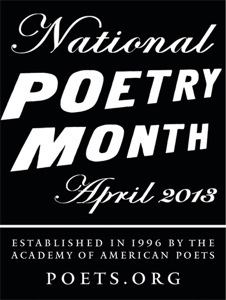
National Poetry Month FAQ
  1. What is National Poetry Month?
  2. Who started it?
  3. When is National Poetry Month?
  4. Why was April chosen for National Poetry Month?
  5. What are the goals of National Poetry Month?
  6. Shouldn’t we celebrate poetry all year round, not just in April?
  7. How does the Academy celebrate National Poetry Month?
  8. Do organizations need permission to participate?
  9. What can I do to celebrate NPM?
  10. How can teachers become more involved?
  11. How can librarians become more involved?
  12. How can booksellers become more involved?
  13. Does it cost anything to celebrate National Poetry Month?
  14. Can other organizations use the NPM logo?
  15. Do I need permission to use the NPM logo?
  16. How can I obtain a copy of the National Poetry Month poster?
  17. How can I support National Poetry Month?

Also, here are some really fun poetry videos to celebrate the diversity of poetry:

Adorable kid who loves poetry, reciting Billy Collins “Litany.  I’m inspired to memorize.

And if you want the real deal–here’s Billy Collins, himself.  I love how he pokes fun at the perceived seriousness of poetry.  I think he and Billy Shakespeare would have had a great friendship.

If you haven’t ever experienced Taylor Mali‘s poetry I hope you will be as enthralled with his tribute to teachers (because he is one) as I am:

April definitely is beautiful…

Blue Skies,

CricketMuse

Post Navigation