A healthy portion of my reading and viewing interest involves British ones, (or UK, since I like a good go at Scottish stories), and while I can mostly figure out context, there are times when the chosen vernacular requires clarification.
As a subscriber to Dictionary. com (you should if you haven’t yet–it’s a must for bonafide Word Nerds) I daily get delivered, warm and fresh, new ways to look at words. Recently the focus for the day was how some words look the same but are either pronounced differently or mean something differently depending which country the story hails from. Viva la difference UK and USA.
Some choice examples: American (Big Apple) British (Big Ben)
football=soccer
cotton candy=candyfloss
apartment=flat
french fries=chips
cookie=biscuit
cell phone=mobile
parking lot=car park
awesome=brilliant
Should the next time you read a PD James or tune in for a BBC show and if what the characters say leave you flummoxed, it’s hoped that you’ll be more on the uptake from getting the low down.
Naming a group of something is a job I wouldn’t mind applying for. Someone gets to do it and the results are pretty fun, especially when it involves animals.
People who say they don’t relate to or care for Shakespeare are unaware how he influences their lives. From everyday words from “assassination” to “zany” to common phrases such as “All that glitters is not gold,” Shakespeare is without a doubt one of the most enduring amongst influencers.
Even if Bard Bashers still won’t acknowledge Shakespearean influence, it’s difficult to ignore his sound life advice through some of his well-known quotes.
“We know what we are, but know not what we may be”
This Hamlet quote seems cryptic at first, yet deeper consideration initiates the idea that we may not truly understand our potential or that we see ourselves differently than how others see us.
“Love all, trust a few, do wrong to none”
This quote from “All’s Well That Ends Well” is a something one might hear in valedictorian speech or might see on a coffee mug. While it sounds trite, it’s actually a succinct guide to life.
“The course of true love never did run smooth”
A quote from A Midsummer Night’s Dream reminds us all how love’s journey is one that is traveled by experiencing a few potholes, speed bumps, and delays due to construction.
“All’s well that ends well”
This eponymous quote is an encouragement to trust in hope, to believe it will all work out for the best.
So, whether you be in the Bard Bravo bunch or find yourself more of a Bard Basher, you have to admit Shakespeare handed out advice that is useful in life.
The Early Bird Catches the Worm: the first one there enjoys success. In 1605 William Camden included this phrase in his book of proverbs and it’s become a standard.
Yummy for those who like their early worms
Easier Said Than Done: talking is sometimes more readily done than action. The phrase is also known as sooner or better said than done. The earlier expression appears in the Vulgate Bible and the latter in the 1546 proverbs of John Heywood.
Easy As Rolling Off a Log: not much effort required. Mark Twain gets the credit for this expression from his A Connecticut Yankee at King Arthur’s Court published in 1889. The expression is similar to Easy as Pie.
James makes log rolling easy
Eat One’s Cake and Have It Too: to have it both ways. Once again John Heywood has this in his collection of proverbs. There is something about how we want to eat our cake but to hang on to it as well. Insert something besides “cake” and it still makes sense.
Every Man for Himself: looking out for oneself. Chaucer coined this expression in The Knight’s Tale indicating if a person didn’t watch out for himself no one else would.
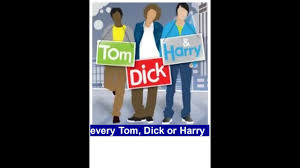
Every Tom, Dick, and Harry: Everyone, especially those in the lower classes. Shakespeare used Tom, Dick, and Francis in Henry IV. The expression can be found in the 1815 Farmer’s Almanac. Even John Adams tried it out in 1818, saying “Tom, Dick, and Harry were not to censure them.”
This exchange is usually related to someone feeling a bit ill, and someone noticing it. Why “under the weather” not “in the weather” or even “weathering through it?” The idea goes back to the situation of when a new recruit on a ship gets seasick. Hanging out and over the rail can involve facing the wind, so it makes sense to get out of the wind by crouching under the bulwarks or getting under the weather. Perhaps the next time you’re feeling queasy consider ducking down and nodding your head “yes.”
Who would have thought meeting someone’s expectations would have developed from not throwing a punch too soon. In older prize fighting days a line was marked on the ground and the fighters met there. However, if either one stepped over the line they would be disqualified since they were expected to meet up to the scratch.
Wikipedia image: these blokes are not up to scratch
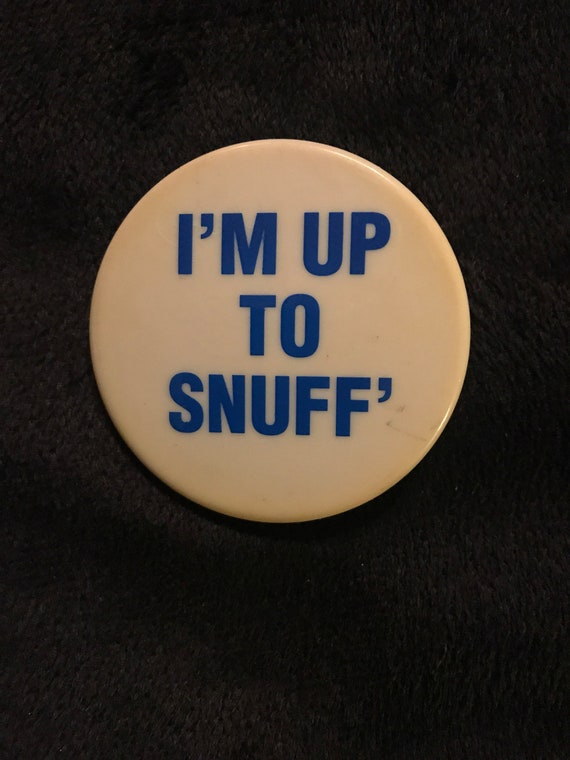
Up to Snuff
Speaking of being up to scratch, there is also being up to snuff–no fighting involved. This saying stems from how the sense of smell is one of our most sensitive senses. Think about when you have a cold, the sense of smell is dampened. Therefore, if someone is feeling well then it means they can sniff well or is that they are up to snuffing.
image: Etsy–the saying is cute as a button
Upper Crust
They say upper society is the upper crust. Crust of what? Bread. At that time in history the best part of the bread was the crust, so those of the upper class could afford the best, especially bread. And if the best of the bread is the top part of the bread then the upper class, the top of society is the upper crust.
Some say (including the hubs) “nerd” is derogatory. I’m of the opinion a nerd is less of an insult and more of an endearment, or at least an acknowledgement of pursuing a passion with zeal, that others might not embrace. For instance, the movie The Nutty Professor, had the singular inventor trying to prove his “flubber” invention. Deemed eccentric, the professor for all his nerdy qualities became a hero. All those computer geniuses (now CEOs and billionaires) were no doubt shuffled into the nerd nomenclature in their tinkering phase. I see “nerd” as an alternate spelling of “clever,” besides the assonance of “Word Nerd” is cool sounding.
Onward to this month’s batch of words—although if you want to jump in with your thoughts about nerds, I am much interested.
1. bight: a bend in the river or the shore of the sea.
2. limb: to portray with words; describe.
3. comity: mutual courtesy; civility
4. sobriquet: nickname
5. epizeuxis: a literary or rhetorical device that appeals to or invokes the reader’s or listener’s emotions through the repetition of words in quick succession. An example:
“Jane, Jane, Jane—you are my favorite epizeuxis.”
6. inanition: lack of vigor, lethargy
7. juberous: uncertain; undecided;dubious
8. aroint: begone as in “Aroint thy, scalawag!”
9. legerity: physical or mental quickness; agility
10. doddle: something easily done. Fixing the flat tire wasn’t a problem at all—it was a doddle.
11. blatherskite: someone given to empty talk.
12. spang: directly; exactly
13. butyraceous: containing or resembling butter.
14. cachinnate: to laugh loudly or immoderately.
15. illation: an inference; a conclusion
16. totis viribus: with all one’s might
17. ambivert: a person between an extrovert and an introvert*
18. caduceus: dropping off early as in The leaves were noticed to have a caduceus departure this autumn.
19. mardy: grumpy, sulky
20. clement: mild in disposition; compassionate
*this word, ambivert, solves the puzzle of designation. A few within my circle have often contemplated how to most accurately describe our situation of being known as social, even boisterous, yet reluctant at joining large gatherings. Suggestions have included “high-functioning introvert” or “gregarious hermit.” The classification of “ambivert” seems acceptable, although the desire to write with either my left of right hand suddenly becomes immediate.
What words leapt out at you as keepers this month?
May I get personal? An ambivert perhaps you are? (Yoda syntax is less intrusive)
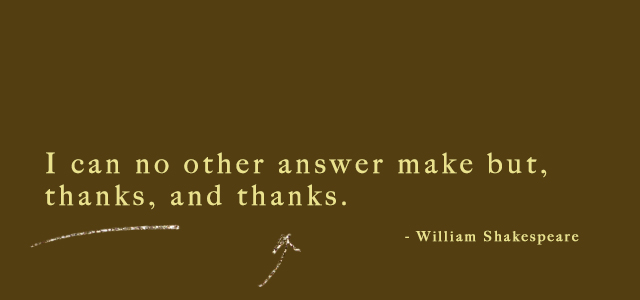
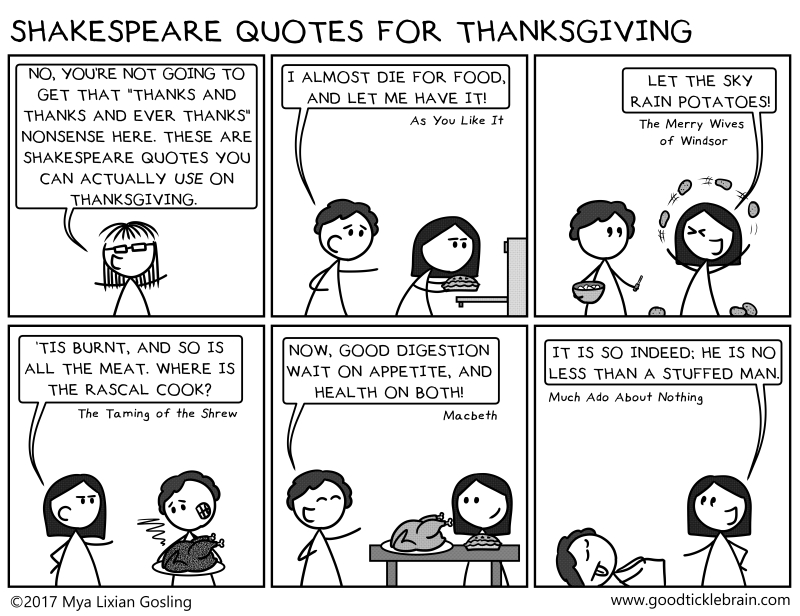
Shakespeare didn’t celebrate Thanksgiving, at least in the modern day sense, but he did know how to give thanks most eloquently:
Check out Mya’s amazing Shakespeare website!
I express my own thanks. It will be a quiet Thanksgiving, yet there is a joyful noise within my heart that as difficult as this year has been it has been one in which I appreciate how much I can count on the Lord to be my light on those dark days.
May the joy of thanks be a member at your table this year, for there is always something to be thankful for.
Lately I’ve been diligently working on developing Pam Webb, debut picture book author, but I do miss those Cricket Muse days of somewhat anonymously posting this and that. I especially miss sparring with Mike Allegra, famed children’s author and blogster of humorous doodle repartee. Mike—if you are out there, send me a sign all is well. Thanks—
Speaking of signs (and Mike would no doubt chortle)…
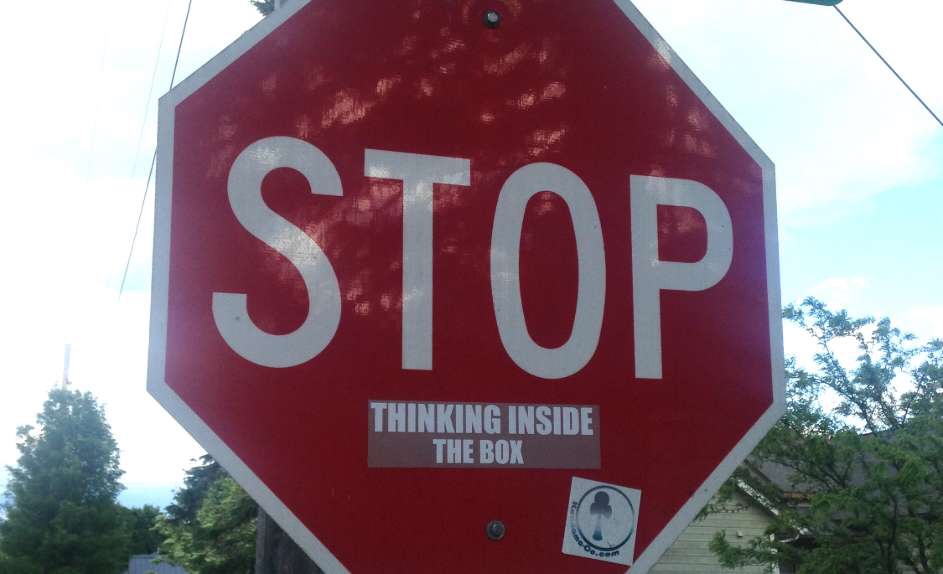
Someone or some persons over the last several years have taken to stop sign graffiti. Scattered throughout our fair town are numerous, and often hilarious messages added to the stop signs. Here are a few :
ClassicYou talking to me?Duking it out.We all need a reminder now and then Optimism is essential Yes, I have heard that one beforeWe asked that in June as we waited for summer to arriveNow I have that song in my headThen again the box is a quiet place to think about thingsYes, I don’t want summer to end quite yet
This is only half of the collection. Someone or persons have been busy. The police chief doesn’t seem that concerned about the vandalism, in fact, he gave the impression the messages are part of the greater picture of what makes our town unique. And who can stop people from expressing their opinion?
What stop expression would you sneak up on a sign?
I might have mentioned it before that my heritage harkens back to the Isle of Skye in Scotland. Since that discovery I have grown more aware of all that is Scottish. This month I favor words that have Scottish roots. I might have to dedicate a post to famous Scots. I do enjoy listening to David Tennant and his broguish wit.
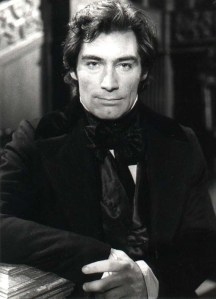
Who has the knack for Scottish wit and bravado? The Doctor, of course.
grumphie: a pig
hooly: gently
sennachie: a storyteller
blellum: an indiscreet talker
atweel: surely
shavie: a trick or a prank
I’ve come across other Scottish words in my readings of authors such as D.E. Stevenson and Allan MacKinnon that leave me puzzled to the point of setting my book down and searching out its meaning.
One of the words that stumped me was “ken.” Sentences like, “I ken your meaning,” really threw me. Context sleuthing pointed me towards understanding, but I finally looked it up and got this from dictionary. com:
verb (used with object),kenned or kent,ken·ning.
Chiefly Scot.
to know, have knowledge of or about, or be acquainted with (a person or thing).
to understand or perceive (an idea or situation).
Scots Law. to acknowledge as heir; recognize by a judicial act.Archaic. to see; descry; recognize.
To “ken” something means to have a deeper understanding that just a mere acknowledgement. It’s one of those words that doesn’t translate well out of its cultural context–I ken that some words do better in their home language.
What Scottish words have you come across? Better yet, which of the above is one you are adopting? I’m leaning towards grumphie, as I do enjoy Guinea pigs. Then again, tossing out hooly at the right instance could be satisfying.
























 Pam Webb