Your search for that precise descriptor has ended with this batch of discovered words. I must admit I am familiar with “twaddle” and have come across “quidnunc” no doubt due to those old English mystery novels from the forties that I favor.
kyoodle: to bark or yelp noisily or foolishly
gloze: to explain away
twaddle: silly, tedious talk or writing
otiose: serving no practical purpose or result
recondite: relating to, or dealing with something little known or obscure
parlous: full of danger or uncertainty
drouk: to drench
elucubrate: to produce (something) by long and intensive effort
opprobrium: harsh criticism or censure
quidnunc: person who seeks to know all the latest news or gossip
I need to find a way to work “kyoodle” into a conversation.
Let’s think for a moment about the 1990s. For some a moment might be too much for others it might be a welcome nostalgia nudge.
After all the nineties introduced fashion statements like grunge and the music genre hip hop. One influenced the other. TV shows and the workplace became more relaxed in attitude. But one, if not the biggest contribution to life, was the WWW. No, not World Wide Wrestling—the World Wide Web or what we mostly call the Internet (and now it’s such a ubiquitous aspect it’s not even capitalized anymore). The internet was still in its dial-up infancy.
some fashion statements are best left in the past
Since this is my Word Nerd post I’m going to focus on how the internet contributed to our cultural lexicon. Here are words that came out of the internet age:
viral: an infection that used to be related to health like how a cold can be spread, and in the same manner misinformation, memes, and other aspects can be quickly spread from one person’s computer to another.
catfish: it still refers to that strange whiskered fish but has taken on the meaning of being duped, usually when it comes to internet dating profiles. Read here for the backstory.
ghost: not like Casper, yet the term shares with the friendly entity the ability to disappear without warning or reason.
cookie: not the sweet treat you’re thinking of—instead it’s that little bit of information that websites use to keep track of user information. It’s not always so sweet to have personal data kept in a business file.
hallucination: not LSD related yet in the same sense that what you are looking at on the screen is not always real or to be trusted. Now that AI has entered our lives there is more hallucinations than ever before.
stream: relating to flow, like how water moves, information and more commonly, entertainment like movies, flow from our tech into our lives. No longer do we have to wait for our weekly episodes of our favorite sit-coms as some station no doubt is streaming Friends or The Dick Van Dyke Show 24/7.
24/7: the concept of easy access around the clock didn’t start with the internet, although it brought it to the forefront that information can be had at the push of a button at anytime day or night.
troll: these despicable creatures are found living under bridges in folklore and are all about harm and deception, which makes a perfect description of those who hide behind websites and do mischief with misinformation.
I could probably come up with a couple more but I really want to go stream another Death in Paradise episode and I’ve got to get an email out before being accused of ghosting, and I better clear out my cookies before a troll finds them.
Humans are prone to utter the most interesting interjections. Understatement, I know. Leaving aside those words that will get you making a deposit in the swear jar, let’s explore those odd guttural responses to surprise, getting hurt, and showing displeasure.
oof Surprisingly, “oof” is an invented word. It’s most connected with pain, dismay, or even sympathy. Apparently, there is connection to the game Roboblox and “oof” which is uttered when the Robos are hit or regenerated. Tommy Tallarico, the original creator, is surprised how “oof” has become such a popular utterance, that is has become a verb, as in “I oofed my driving test by running up on the curb when I tried parallel parking my Mom’s suburban.”
ew This one is traced back to the movie Clueless when a character expresses her disdain for immature teen boys, although it had been in use since the 1960s as “Ew, what’s that smell in your locker?”
aye yi yi Probably derived from the Spanish/Latin languages, “aye yi yi” is often found in song lyrics, although it is also used to express pain, dismay, or even shock. For example, “Aye yi yi, the cat got into the meatloaf I set out for dinner.”
oy Another interjection borrowed from a foreign language, “oy” is often teamed with “oy veh” and can express dismay, sadness, or grief. Once upon a time I lived way out in the country and the main road was a county maintained thoroughfare (please read in a dismissive tone) that was dented with potholes and washboarded to every vehicle’s detriment. Someone spraypainted an addition to the road sign “Vay” the word “Oy.” Yes, driving that road daily initiated that response of dismay.
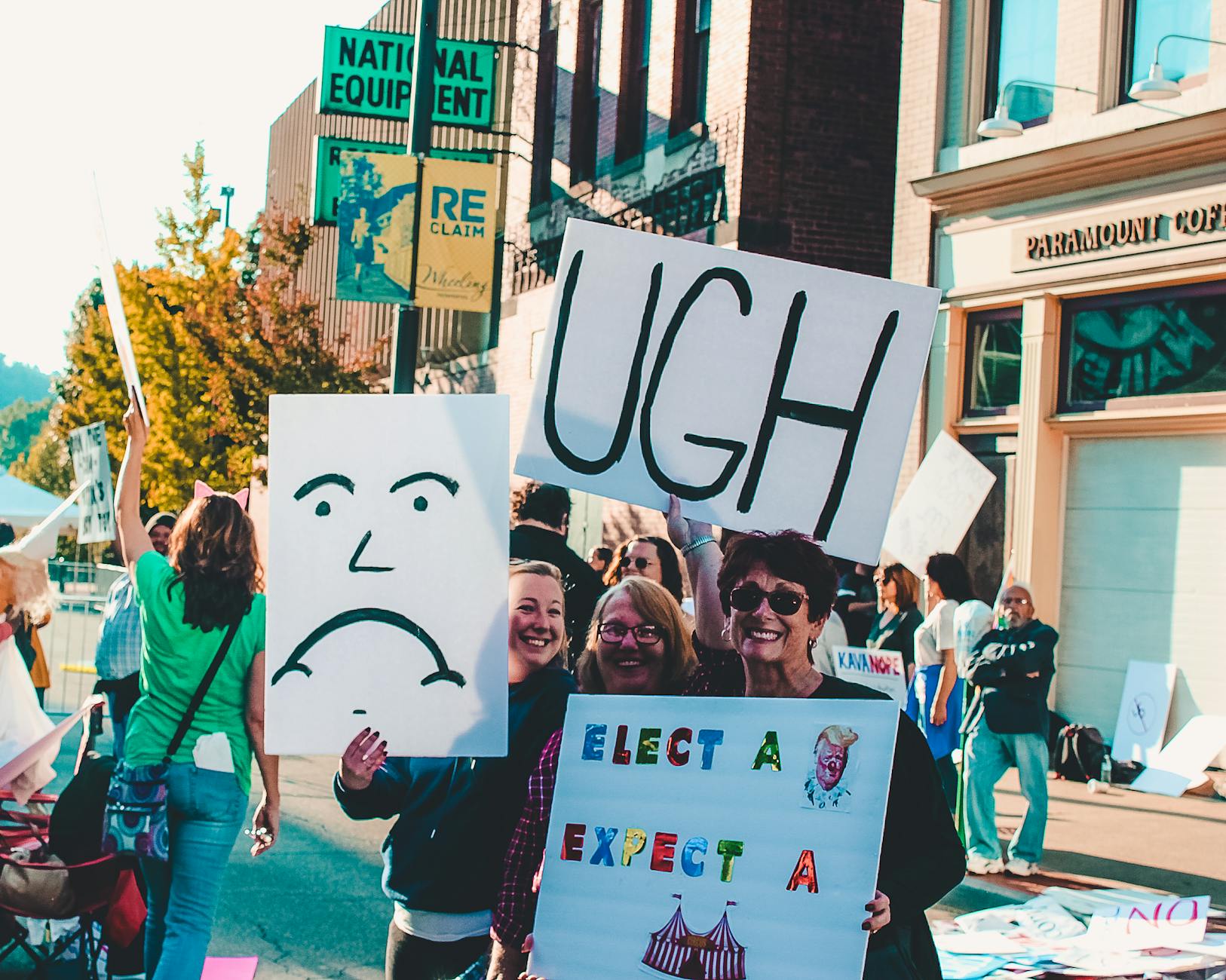
ugh Similar to “ew,” the interjection “ugh” was also made popular by Clueless; however, its use can be traced clear back to the 1670s. Trot this one when expressing disgust. “Ugh, we have a pop quiz today.”
yuck or yuk or yucky If it’s gross it’s usually deemed as “yuck” or “yucky.” Going back to the sixties, the Poison Control center’s warning label used to be skull and crossbones, but there was the thought children would be attracted to the pirate aspect of that emblem and so the green unhappy face with the tongue sticking out became “Mr. Yuk,” providing a clear message to steer away from the substance.
oops Then there is the ubiquitous “oops,” that interjection associated with making a mistake, a blunder, or being clumsy. Britney Spear’s gave “oops” some spotlight with album Oops!… I Did It Again.
As much as I am a fan of the new year because it provides a fresh start, I am not a fan of the cold weather January brings. Most of the first days have been in temperatures of single digits and in minus increments. And then there was those two four days of snow. Going outside has become a matter of great consideration and since cold weather is keeping me more inside than outside I’m looking for day brighteners. Words are often my go to happy place. There are some words that when I hear them bring a smile because of the way they sound, and sometimes their meaning is amusing:
hobbledehoy: an ungainly youth—I had a few of these in class
sklent: any slanting surface, such as a slope—noted, when it freezes after a snowstorm
feirie: healthy, strong—are fairies feirie?
cakeage: a few a restaurant charge for bringing in an outside cake—you can have your cake and eat it too, as long as you pay for it
kvetch: to chronically complain—the extra snow has me doing plenty of this
No more snow!!!
tintinnabulation: the ringing of bells—which gets tinnitus riled up
yestreen: during yesterday evening
elsewhither: in another direction; toward a different place or goal—I travel here often
nibling: a child of one’s sibling—a solution to gender identification?
quiddity: the essential nature of a thing—snowy days create this feeling that winter is essentially cold and annoying
pulchritudnious: physically beautiful—this one is baffling in that it is an unlovely sounding word to describe loveliness
skookum: large; powerful—can’t wait to try this one out
mountweazel: a decoy word used in a dictionary or encyclopedia to catch publishers who might try to copy the content—like paper towns
cromulent: acceptable or legitimate—reminds me of crumpets
And an appropriate word to end with is:
jollify: to make merry—when the snow fades and spring begins to be a reality
Labor of love: to do something for the joy of doing so instead of doing so for personal gain. This phrase is found in the New Testament in Hebrews 6:10 and in Thessalonians 1:3. Both scriptures refer to those who labor in the name of God, doing so in love.
Lame duck: someone finishing out their term of office who will be replaced soon. Originally in 18th century Britain a broker who could not pay his debts were crossed off the membership and they would “waddle away” in shame. Moving to the USA in the 19th century the term was applied to congressmen who were not reelected yet had to serve out their term. perhaps causing them to “waddle away” in shame of losing their job.
Larger than life: appearing to be real. The original saying is from the Latin expression ad vivum, or “to the life.” In the 18th century the phrase appears, the 1799 Lame Jervas: “I see the puppets, the wheelbarrows, everything as large as life.” Other writers, such as Lewis Carroll and George Bernard Shaw began using the expression.
Last but not least: perhaps last but not not least in importance. It’s thought John Lyly originated the expression when he said, “Of these three but one can stand me in steede, the last, but not the least” in his 1580 Euphues and His England. It was also used by Shakespeare in his plays, including Julius Caesar and King Lear.
Last ditch effort: a desperate final attempt. In the 17th century the military term for last ditch applied to the last trench of defense. The 18th century saw the term used by Thomas Jefferson who said, “A government driven to the last ditch by the universal call for liberty.”
To lay an egg: to fail in an embarrassing manner. If a player or team does not score in the British game of cricket then a duck’s egg or zero is earned. Transfer this concept to America’s vaudeville and theater days when a performance failed to please the crowd or when a business fails the idea of laying an egg is applied, or in other words, an zero is achieved.
Left hand doesn’t know what the right hand is doing: taking an action that might indicate less than full knowledge. In Mathew 6:3 the passage indicates that a person should do good quietly instead of publicizing their action, basically keeping the action secret. Over time the secret aspect has taken to mean one department’s or organization’s action indicates a contrary action to another department’s or organization’s efforts, perhaps to the point of adding confusion or inefficiency to a situation.
Left-handed compliment: a statement that seems like praise, but is actually a disguised insult. Marriages between royalty and a commoner is known as morganatic and the ceremony involved the groom (the royal) giving the bride (the commoner) his left hand instead of his right as was done in conventional marriages. *This brings up the issue of the left hand being considered the “lesser” of the hands, which harkens back to superstitions about being left-handed.
Let one’s hair down: to behave informally, without constraint. Back in the day when women wore their hair up, the idea of wearing their hair loose and down around their shoulders was considered a breach of societal protocol. A woman let her hair down only in the privacy of her bedroom. P.G. Wodehouse had fun with this in his 1933 Heavy Weather: “We can take our hair down and tell each other our right names.” *I’m wondering why this only applied to men…
Let the cat out of the bag: to reveal a secret. In old-time open air markets people would purchase their goods and carry them home in bags and baskets. There existed the shady practice of placing a cat in the bag instead of the purchased pig. When the person got home the truth was revealed when the cat was let out of the bag.
There are lots of “L” phrases left. The one that surprised me most was the cat in the bag. I will probably think of pigs whenever I hear a secret revealed from now on.
Thanks for the reader feedback on how you are enjoying the word selections. I enjoy finding them almost as much as I enjoy sharing them with you all. This past week has consisted of a multitude of words that cause me to say “There is a word for that?”
Splooting: a behavior that some animals use to cool their body temperature. Squirrels are finding cool surfaces and lying on their stomachs, legs spread, to cool off. For awhile we had a winsome little squirrel that would visit us and eat peanuts from our hand. In the summer she would come up to the patio and hang out. I thought she was being a companionable squirrel when she was actually seeking some relief from the heat by splooting.
image: NY Parks and Recreation
parapraxis: when you say one thing and mean another, especially when the words are close sounding. Would you care to call your mother—I mean brother?
catachresis: using what is thought to be the correct word because it sounds like the word you meant to say. “She was reticent about going to lunch.” Umm, she was reluctant about going to lunch? Or perhaps in her reluctance she wasn’t talking about it.
spoonerism: credit Reverend Spooner for the slip of the tongue that causes the transposition of consonants in a sentence. “Go hush your brat” is not the same as “Go brush your hat.” One directive will definitely cause a stir.
solecism: accidental or intentional misuse of grammar. “I am what I say I am; I is what I say I is.”
malapropism: close to a catachresis, this word is attributed to a character, Mrs. Malaprop, in a 1775 play, who unknowingly inserted incorrect words in her utterances. “She was the pineapple (pinnacle) of perfection.”
mondegreen : coined by writer Sylvia Wright who misheard a line in a poem as “Lady Mondegreen” instead of “laying him on the green”, the word refers to mishearing lines or words or lyrics. My nemesis mondegreen was Clearance Clearwater Revival’s line about a “bad moon rising” which I heard as “bathroom on the right” which made sense to me because knowing where the nearest bathroom is located is handy.
eggcorn: similar to mondegreen, an eggcorn replaces the original word, yet it still makes senses since the new meaning hasn’t rendered the original intent incorrect.
free reign” for “free rein”
“in one foul swoop” for “in one fell swoop”
“jar-dropping” for “jaw-dropping”
“old-timers’ disease” for “Alzheimer’s disease”
“on the spurt of the moment” for “on the spur of the moment”
mumpsimus: an insistent use of an eggcorn, being attributed to a monk Erasmus once knew who would say “mumpsimus” instead of the correct “sumpsimus” when reciting the liturgy.
“they’ve got another thing coming” —sorry Obama, that should be another “think” coming
“it’s a doggy dog world”—yeah, it can be ruff out there, but it’s actually “it’s a dog eat dog world”—ooh, it’s ruffer than we thought
“nip it in the …bud”—not the other (thinking gardening, not corporal punishment)
“first come, first serve”—not a Sunday buffet sign because it is supposed to be “first come, first served” (grammar can be tense, I know)
Cacology: when it’s said and done it’s how you said that could do you in—those Spoonerisms, malapropisms, solecisms—all those above, including incorrect pronunciation, could lead to a faux pa, a big mistake.
Splooting has nothing to do with speaking correctly, yet the next time you spot a squirrel doing the hot day sprawl you will know what you are talking about.
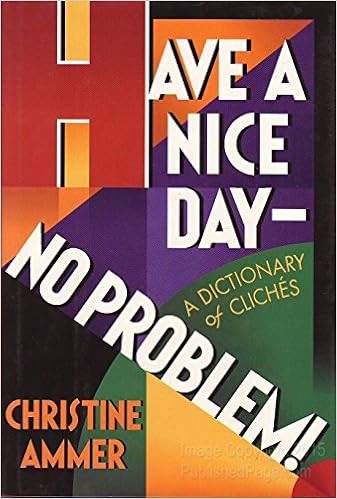
The “B” section is booming with cliché phrases. All these are from Christine Ammer’s Have a Nice Day–No Problem: A Dictionary of Clichés.
A backseat driver can be found anywhere
Backseat driver: unwanted advice. In the 1920’s, those who could afford to do so, engaged a chauffer to drive them. The chauffer sat up front and the passenger or employer sat in the back and gave their driver instructions. Today the term applies to someone giving what they perceive as helpful advice, usually to the chagrin to the person doing the task. Other applicable phrases are Armchair General and Monday-Morning Quarterback.
Back to square one: back to the beginning Though it sounds like a math problem, thoughts on this one are related to games where the start is a square, as in hopscotch or in a number of board games. Putting in hard work only to start over is frustrating and this term goes with back to the drawing board when the blueprints don’t pan out.
And put some pepper in your efforts…
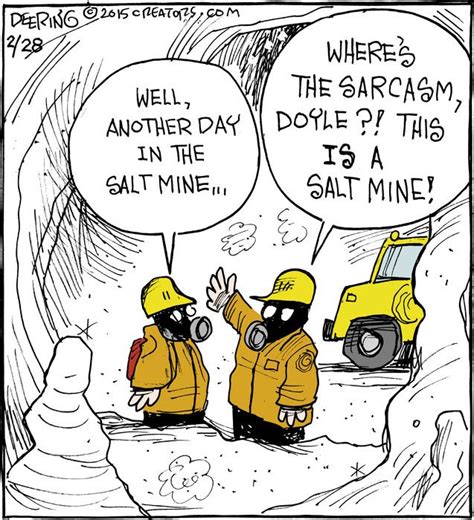
Back to the salt mines: returning to work At one point in history, Russian prisoners during communist times were sent to work in the Siberian salt mines. While coming off of break can be tough, it probably is easier going that chipping away at rocks.
(The) ball is in your court: take your turn A current expression from sports, which is attributed in the mid 20th century which is said when one person is a)being polite b)pushing the other person to take their turn c)a strategy to get the other person to reveal their intentions through action or words.
Bald face or barefaced liar/lie: an obvious, if not bold untruth. Bare could be brazen, but it is likely is related to “beardless” which connects to only the young (not old enough to grow a beard yet) could so unashamedly tell such outrageous lies.
Categorically funny to Cocoa
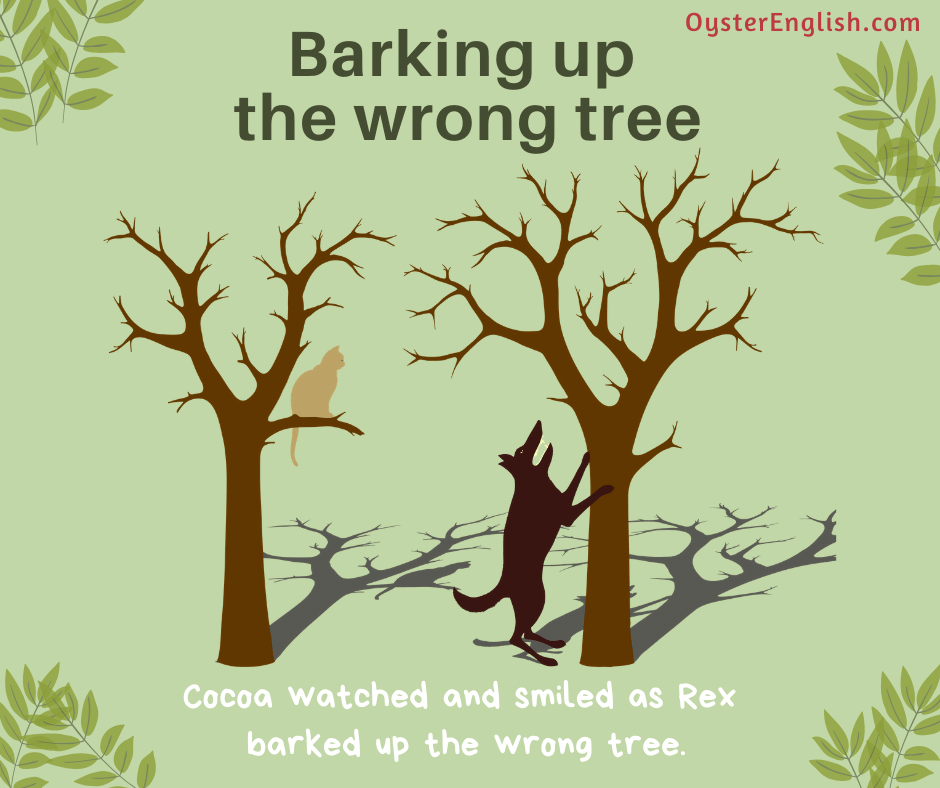
(To) bark up the wrong tree: waste time or effort going in the wrong direction Once when hunting racoons with dogs was prevalent, sometimes dogs, so pleased with themselves, would bound up to a tree so sure they had caught the varmint, would bark to their owners their success. Raccoons, being the clever creatures that they are often led the dogs astray by jumping to another tree or applying some other witty escape strategy. For those out there thinking they have solved the problem through what seems to be a long and productive chase, they might find themselves baying at empty branches and must go back to square one.
(To have) bats in one’s belfry: deemed slightly crazy Bats in flight fly in a more irregular than regular pattern. At one time people watching bat flight thought the irregular flight reflected how bats thought–erratically. Since then it has been proven bats have a sophisticated flying system that employs sonar which keeps them from bumping into obstacles. While belfrys are not much in current use, one might be considered batty if their thoughts or speaking seems random, which might at first seem like an insult, yet it’s actually a compliment since bats are considered sophisticated creatures.
(To) beard the lion: to take a risk If you haven’t heard this term recently, that makes two of us. Considered cliché for over a century, this phrase has Biblical roots coming from when David related how by grabbing a lion by its beard he slew him. Facing danger and vanquishing it is one thing, grabbing lions is quite another. Granted, David showed his bravery. Look how this lion’s beard–that’s up close and personal.
Bearding the lion (looks more like a goatee)
Beat (scare) the living daylights out of: to punish or scare someone tremendously A 19th century American colloquialism for a person’s internal organs was “daylights.” To punish or scare someone so severely that there innards would fall out is indeed severe.
Bed or roses: an implied place of comfort Metaphorically, lying in a bed of roses sounds pleasant, being surrounded by the fragrant petals. However, there are thorns to consider. And a literal bed of roses demands constant care, so this phrase implies the opposite, as in the situation is not comfortable.
Thanksgiving comes around in November and getting together with friends and family can be emotional for some. Needing a few choice words to express feelings might be handy.
verklempt: overly emotional and unable to speak.
velleity: a mere wish, unaccompanied by an effort to obtain it.
stultify: to render absurdly or wholly futile or ineffectual, especially by degrading or frustrating means
thrawn: contrary; peevish; stubborn
longanimity: patient endurance of hardship, injuries, or offense; forbearance
foofaraw: a great fuss or disturbance about something very insignificant
megillah: a lengthy, detailed explanation or account
brabble: to argue stubbornly about trifles; wrangle
fustigate: to criticize harshly; castigate
gasconade: extravagant boasting; boastful talk
nescience: lack of knowledge; ignorance
frumious: very angry
snollygoster: a clever, unscrupulous person
beamish: bright, cheerful, and optimistic
Let’s hope if someone should start a megillah at the table no one will fustigate or brabble should it lead to gasconade. Instead, the gathering be one that is beamish.
As a writing teacher I wince whenever my students add in “The author paints a picture…” *Sigh* I remind my students to strive for originality. I really feel for the essay readers since I only have thirty offenders and they must read hundreds of cliché-ridden essays.
Previous posts dealt with those everyday expressions that we have little idea what they mean through the monthly column of “Why We Say.” It ran its course and now it’s off to another dictionary of expression use: Have a Nice Day–No Problem by Christine Ammer.
Ammer scrutinizes over 3,000 sayings that have been used, and overused, to become relegated as cliché. She informs reads of the origin and whether the expression is obsolete or still acceptable. Considering the book is copyrighted in 1992, current use could be questionable, and there are no doubt new clichés that could be entered. There is also the consideration that not all clichés are questionable, and are actually appropriate, if not useful, to make a point. One person’s cliché, then, could be another’s coup de grace (to paraphrase a cliché).
We start in the “A” section:
Some truths must be faced
Absence makes the heart grow fonder: separation can create a longing The first line in an anonymous poem published in 1602 it then became the last line of a song by T. Haynes Bayly, “The Isle of Beauty,” in 1850. It has since been said and resaid. The opposite expression would be “Familiarity breeds contempt.”
Achilles’ heel: a person’s weak spot. Go back to Greek myths to find where the mother of the great warrior Achilles wanted to protect him. She held her baby boy by the heel and dipped him in the River Styx to supposedly make him invincible. However, during the battle of Troy, Paris, Hector’s brother, shot Achilles in the heel and brought him down to his death. Still current.
The Acid Test: a means of establishing the truth or validity of someone or something. This comes from the practice of determining true gold by applying nitric and hydrochloric acid, which dissolves the metal. It became a figurative term and is still current.
Actions speak louder than words: what a person does is more telling than what is said. A proverb stemming from ancient Greek and other cultures, it still applies aptly to today.
Add insult to injury: increasing harm caused. There is a Greek fable in which a bald man goes to smack a fly that landed on his head. He misses, which incites the fly to ponder what the man will do with the insult added to the injury. Well-used cliché.
Mickey in the Haunted House (1929)
Afraid of your shadow: extremely timid. This expression has been stated by Sir Thomas More as, “Who may lette her feare her owne shadowe,” although it can be traced back to Plato.
(To go) against the grain: going in the wrong direction of the natural wood fibers. While the actual meaning applies to wood, this expression has evolved to mean more towards something becoming an irritant. Shakespeare stated this expression eloquently in Coriolanus, “Preoccupied with what you rather must do than what you should, made you against the grain to voice him consul.” Dickens picked up the phrase and placed it in Edwin Drood–it might have be a cliché by then.
All in a day’s work: part of what one does for a living–expected. This expression is found in the 18th century and was used figuratively and literally, as it is now.
All over but the shouting: the outcome is determined, but it hasn’t happened yet. Thought to have originated in the 19th century as a phrase found in sporting events, yet it applies to other events as well and is used today.
This depends on one’s perspective–and what tactic is applied
All’s fair in love and war: all and any tactic is appropriate. Found in some form from Chaucer to Maxwell Anderson and has been paraphrased to suit occasions as in “All’s fair in love and war and politics.”
While some of these expressions could be considered everyday expressions or idioms or proverbs, others are allusions, and a couple are metaphors. Be they cliché? Chime in. The Acid Test is if upon hearing the saying you grit your teeth since its use goes against the grain to hear them used.
More “A” explorations next month. We are far from over, so don’t be shouting.













 Pam Webb