Pam Webb

a writer's journey as a reader

Archive for the category “education”

Lit One-Liners


BookRiot became another 2013 discovery, and I am hooked. How could I resist posts delivered free to my mailbox which concern all things books? I definitely found this one by Rachel Cordasco a saver. It will be incorporated into my AP warm-ups where I have students create micro-précis  statements as a ready-set-go for the May exam. Here are some pull-outs from Cardasco’s post:

    Posted by   Rachel Cordasco   from BookRiot            

30 One-Sentence Lessons from Literature

1. Hamlet by William Shakespeare: Just make up your mind already, dude.

2. Anything by Stephen Crane: It doesn’t matter what you do- the Universe still thinks you’re super lame.

3. Don Quixote by Miguel de Cervantes: You can never read too many novels…oh wait, maybe you can…

4. Sister Carrie by Theodore Dreiser: Cluelessness is not something you want to broadcast when you’re a young woman in strange new city, for you’ll just become a skeevy-guy magnet.

5. Dracula by Bram Stoker: If you have a choice between Count Dracula’s castle and the Holiday Inn, stay at the Holiday Inn.

6. Frankenstein by Mary Shelley: If you absolutely must create a freakish monster thing, be sure to make a girlfriend for it, cause if you don’t, he’ll be really, really mad.

7. The Metamorphosis by Franz Kafka: Sucks to be a bug.

8. Macbeth by William Shakespeare: You should treat your guests well by, you know, not murdering them in their beds.

9. Huckleberry Finn by Mark Twain: When you travel around in a boat with a friend, away from human civilization, when you do run in to people you realize just how crazy they all are.

10. Sense and Sensibility by Jane Austen: When it comes down to choosing between the hot guy who treats you like crap and the not-as- hot guy who treats you like a queen, it’s really not a choice at all.

11. Heart of Darkness by Joseph Conrad: Don’t frighten the natives.

12. The War of the Worlds by H. G. Wells: When the freaky alien things come swooping down on Earth and shooting lasers or whatever at everyone, run as fast as you can cause those aliens are mean.

13. The Great Gatsby by F. Scott Fitzgerald: Yeah, yeah, money can’t buy happiness- check.

14. Anything by e. e. cummings:

capital

letters

are for

losers.

15. King Lear by William Shakespeare: Don’t bother arguing with your parents. Or your children. Just don’t bother.

_________________________

My own contributions:

Beowulf by John Gardner: growing up in a cave with a fiendish mother definitely changes your perspective

Daisy Miller by Henry James: It’s true, when in Rome, or at least in Italy, as a single American girl, who should do as the Romans–Italians do–then again, maybe not.

Room with a View by E.M. Forester: what is about Italy and young women anyway?

“The Lovesong of Alfred J. Prufrock” T.S. Eliot: What if, What if, What if Hamlet hadn’t been your poster boy of decision-making?

The Strange Case of Dr. Jekyll and Mr. Hyde by Robert Louis Stevenson: getting in touch with your inner feelings definitely deserves a second thought

Verse for Wear


1st edition

1st edition (Photo credit: Wikipedia)

First word purging and now onto verse wearing.

Throughout the year I also collected poems from my daily feeding from www.poets.org. Daily offerings are contemporary, while weekends focus on past classics. I began subscribing for a couple of reasons:

1. Poetry appreciation came into my life later than sooner and I’m making up for lost time.
2. Since becoming an AP teacher I figure it’s best practice to move beyond my basic knowledge of Frost–doctors must keep up on new practices, so as a practicing English literature teacher I should as well.

After a year of daily dosing of poems I have found I’m still drawn more to the classic poets, yet still appreciate the “now” of poetry today and listen, for the most part, what is being said.
So, here are the poems that I keep in my “save” file. I plan to wear these verse offerings by pulling them out for discussion in class. And here, as well. Any comments? Are you more contemporary or classic in your poetry choices?

All poems and bio information are from poets.org

Edgar Guest:
Guest has been called “the poet of the people.” Most often his poems were fourteen lines long and presented a deeply sentimental view of everyday life. When his father died, Guest was forced to drop out of high school and work full time at the Detroit Free Press, eventually considering himself “a newspaper man who wrote verses.” Of his poetry he said, “I take simple everyday things that happen to me and I figure it happens to a lot of other people and I make simple rhymes out of them.” 

Only A Dad
Edgar Guest 

Only a dad with a tired face,
Coming home from the daily race,
Bringing little of gold or fame
To show how well he has played the game;
But glad in his heart that his own rejoice
To see him come and to hear his voice.

Only a dad with a brood of four,
One of ten million men or more
Plodding along in the daily strife,
Bearing the whips and the scorns of life,
With never a whimper of pain or hate,
For the sake of those who at home await.

Only a dad, neither rich nor proud,
Merely one of the surging crowd,
Toiling, striving from day to day,
Facing whatever may come his way,
Silent whenever the harsh condemn,
And bearing it all for the love of them.

Only a dad but he gives his all,
To smooth the way for his children small,
Doing with courage stern and grim
The deeds that his father did for him.
This is the line that for him I pen:
Only a dad, but the best of men.

From the book "A Heap o' Livin'" ©1916


Joyful Moments Web Designs Graphics © by Mary  (Garren) Morand © MARY MORAND WEB PAGE – ALL RIGHTS RESERVED Webmaster ~ E-Mail ~ Comments
I appreciate this poem because it gets a shout out to dads. There are so many poems that exult moms (which I don’t mind) and I think fathers get shorted on all they do and how we feel about them.
Radar Data #12
by Lytton Smith
 
It was in the absence of light
as when near new moon and 
no moonlight; as when a part 
of a picture is in shadow (as 
opposed to a light); as when 
in the condition of being 
hidden from view, obscure, 
or unknown–in concealment, 
or else without knowledge 
as regards to some particular; 
and of the weather, season, 
air, sky, sea, etc., characterized 
by tempest; in times, events, 
circumstances etc. subject to 
tempers; inflamed, indicative, predictive, or symbolical of 
strife (harbinger of coming 
trouble)-a period of darkness 

occurring between one day & 
the next during which a place 
receives no light from the sun, 

and what if it is all behind us? 
I no longer fear the rain will 
never end, but doubt our ability 

to return to what lies passed. 
On the radar, a photopresent 
scraggle of interference, as if 

the data is trying to pretend 
something’s out there where 
everything is lost.

About This Poem   
“People are always curious where a name like ‘Lytton’ comes from–and it’s not from modernist biographer Lytton Strachey, but gothic novelist Edward Bulwer-Lytton. He famously came up with the opening phrase (in Paul Clifford) ‘It was a dark and stormy night.’ But I’ve begun to feel guilty mentioning that; his opening sentence is actually pretty good, so I’ve begun writing a whole series of poems that try to translate, rework, recuperate it.”  Lytton Smith

This is My Life
by William Stanley Braithwaite
 To feed my soul with beauty till I die;
To give my hands a pleasant task to do;
To keep my heart forever filled anew
With dreams and wonders which the days supply;
To love all conscious living, and thereby
Respect the brute who renders up its due,
And know the world as planned is good and true-
And thus -because there chanced to be an I!

This is my life since things are as they are:
One half akin to flowers and the grass:
The rest a law unto the changeless star.
And I believe when I shall come to pass
Within the Door His hand shall hold ajar
I’ll leave no echoing whisper of Alas!

Over the course of his career, Braithwaite founded a publishing company and taught creative writing at Atlanta University. His poetic style was influenced by English Romantic poets John Keats, Percy Bysshe Shelley, and William Wordsworth.
This poem smacks of resolution for the New Year. It stirs a resolve to become better than I am and to leave no regrets at the passing of the day. Yup, that’s what a poem should do–get some soul stirring going.
My hopes are that your New Year will be filled with verse, be it created or found, and that the words will resonate in your life into others!

Vacuous Vocabulary?


The wonders of iPhonology have allowed me to copy and collect words throughout. I have a tidy little word zoo in my notes files and some words remain oddities to be gaped at, while others become part my lexicon. This year I have collected a list of vocabulary words that range from antiquated to techno lingual. Are these etymological critters known to you?
syllogism
Salmagundi
detritus
ameliorate
penury
tyros
averred
panegyric
chimera
dilatoriness
salubrious
ignominy
sophisms
opprobrium
insouciant
nepenthe
internecine
probity
chiasmus
insouciant
ineffable
eschatological
palimpsest
vitriol
frisson
perjorative
gentian
perspicuity
parousia
demotic
pellucid
obeisance
pelf
elegiac
ineluctable
effulgently
nimbus

These came from hither and thither through my lexiconic ramblings ranging from children’s books to devotional studies to contemporary and classic reads. Is it mindless (my title reference) to collect words? My hopes are to incorporate, refresh, and enfuse my personal dictionary with items from the collection. In actuality, I periodically scroll through the list and gloryosky at them. I like their looks, their sound, and some I like their meaning.

Any of you collect words? Any sharsies?

Titular Epiphanies


Foto einer Glühbirne (an),

(Photo credit: Wikipedia)

Sometimes I am embarrassed how lacking in literary enlightenment I really am. Here I am writer, reviewer, teacher, Book Booster extreme and I have to hang my head in embarrassment about my novel naiveté. Honestly, dunce cap time.

This has happened before, but really hit hard recently. Not once, but twice.

What do you notice about these two books?

  • author?
  • attractive illustration?
  • title?

All of these probably grab our attention. Granted there are different covers available, but the author and title remain the same.  Why then did it take me three or so reads, spread out over a few years, to finally get that light bulb-over-the-head moment of “OMY! This is what the title REALLY means?  Does it mean I’m dense or does it mean I’m getting my bearings as a reader finally?

With Room With a View I boldly (I mean in like SHaAZaM) I realized Lucy sees people as rooms, and how some people, like some rooms, provide a view or not. Views are important if you are going to spend time in them. Ditto for people.  It wasn’t about Italy. At least, not as much as I first thought. Silly, silly me.

Then we come to My Antonia. Such a magical book, how it transports me to the prairie pioneer era. Yes, it’s about Jim’s fond recollection of his childhood friend Antonia (that My part in the title)–but then the KA-TinK of the light chain which illuminates the additional meaning–Antonia is a metaphor for all those indomitable women of the prairie.  She is the collective My that Willa Cather so adeptly presented to readers in her trilogies and short stories.

Sigh. It’s a good thing I teach literature, because I still have a lot to learn. Because they so wisely say the best way to learn something is to teach it.  Now, I’m wondering how many other literary epiphanies are waiting for me on the shelf. I hope they aren’t giggling at me.  Maybe those are just giggles of anticipation as they await to pop up and say “SurPriSE!”

A Bit of Bard for the Kidlits


List of titles of works based on Shakespearean...

How well do your kids know this guy? (Photo credit: Wikipedia)

Shakespeare. He probably isn’t on most parental to-do lists when it comes to childhood enrichment items. Then again–why not? We trot our kiddos to soccer practice, piano lessons, and the library to enrich their lives, why not foster the love of the Bard at an early age?
Acclaimed playwright Ken Ludwig believes infusing the Bard into our children’s lives is an essential, endearing adventure to undertake. His How to Teach Your Children Shakespeare is both inspirational and inventive in its approach. Although I no longer have kidlits at home since my progeny are now building their own nests, I can still adapt Ludwig’s methods by amending them to classroom instruction, especially since the ninth grade Common Core curriculum has a Romeo and Juliet section.

Teaching Shakespeare to our children is a notable endeavour. Ludwig states a few of his goals as to why he taught Shakespeare to his children on page 11:

  • giving them tools to read Shakespeare’s works with intelligence for the rest of their lives
  • enriching their lives
  • exposing them to literature to inspire them toward achieving great lives as they grow
  • providing meaningful shared experiences

Cool. Those are pretty much my intentions when I teach Shakespeare to my classroom kiddos.
Ludwig hits all the essential values of the “why” of Shakespeare:
1. The richness of imagery
2. The lilt of rhythm
3. The nuances and playfulness of language
4. The importance of memorizing and tucking away forever a few exceptional passages to pull out and nibble on throughout life
5. The joy of exploring character

Shakespeare’s plays showcase poetry at its best. Why wait until the kinder are all grownup before relishing the richness of English language? I am always amazed when I get a ninth grader who states, “Shakespeare? Who’s Shakespeare?” Admittedly that confession is rare. Unfortunately, the only Shakespeare most students know is Romeo and Juliet. On the other hand, by the time they leave high school they will become acquainted with at least three plays and a a handful of sonnets.  Sadly, I didn’t have any Shakesperience until I began teaching it.  That’s nearly thirty years of being Bardless.  Shocking, I know.  Now I’m a professed Bardinator and hope to put my acquired knowledge to page, one of these days.  We’ll see.  I have too many books in want of writing as it is.

For now, I am thrilled to introduce Shakespeare to my freshmen and strive to induce appreciation for his words and wit.

Mass-produced colour photolithography on paper...

Anyone out there have the Bard on their parent list? Is it squeezed in with ballet and soccer?

Committed to Poetry or Was that Commentary of Poetry?


English: Former United States Poet<br /><br /> Laureate (2... Admit it–we like poetry
because for the most part it’s a quick commitment. Two to five
minutes we get our emotions stirred, we open up our imagery files,
and we tuck away a line to ruminate on.  This is not cynicism,
merely observation. We love, love, love poetry more than we love,
love, love short stories. At least, this is what I am beginning to
surmise as I dole out literary experiences to high school students.
Since I’ve been English literature teachering for the past
decade, I have discovered poetry is amazingly versatile in its
ability to stir up passion in students.  Students  run
the Richter scale of response of “Just hand me a dull spoon so I
can dig out my eyeball” (LOL–actual quote from a senior) to
“Poetry! I love poetry! Can we write our own poems!” (yet, another
true quote). There doesn’t seem to be much of the middle roading
when it comes to reading or writing poetry. Why is that, I wonder?
My students aren’t sure either.  Somewhere between Shel Silverstein and Shakespeare
sonnets the love of verse becomes irrevocably squashed.
I think Billy Collins presented oh so well:

Introduction To Poetry

I ask them to take a poem and hold it up to the light
like a color slide

or press an ear against its
hive.

I say drop a mouse into a poem

and watch him probe his way out,

or walk inside the poem’s
room

and feel the walls for a light
switch.

I want them to
waterski

across the surface of a

poem

waving at the author’s name on the

shore.

But all they
want to do

is tie the poem to a chair with
rope

and torture a confession out of
it.

They begin beating it with a
hose

to find out what it really
means.

Thank you,
Billy. I am trying to convert my rubber hose approach into one of
ski rope handles.
One of my goals as a teacher is to inject the love of
words into my students.  I want them to turn to poems like
they do to their tunes.  After all, song lyrics are mostly
poetry with infused music.  Once students realize that if they
actually unplugged their buds long enough to actually read
their play list lyrics out loud they will see all those
literary terms of assonance, imagery, rhythm, rhyme, simile,
allusion floating around.
I try not to have them beat the stuffing out of
poems.  I much prefer them waterski and wave in
acknowledgement as we launch out on poetry’s
waters.  Grooving on poetry is, I hope contagious. My
excitement at reading a really marvelous poem out loud causes me to
have physical reactions.  The other day I read Seamus Heaney‘s “Digging.”

English: Picture of the Irish poet and Nobel P...

English: Picture of the Irish poet and Nobel Prize winner Seamus Heaney at the University College Dublin, February 11, 2009. (Photo credit: Wikipedia)

 Between my finger and my thumb
The squat pen rests; snug as a gun.

Under my window, a clean rasping sound

When the spade sinks into gravelly ground:
My father, digging. I look down

Till his straining rump among the flowerbeds
Bends low, comes up twenty years away
Stooping in rhythm through potato drills
Where he was digging.


The coarse boot nestled on the lug, the shaft
Against the inside knee was levered firmly.
He rooted out tall tops, buried the bright edge deep
To scatter new potatoes that we picked,
Loving their cool hardness in our hands.
By God, the old man could handle a spade.
Just like his old man.
My grandfather cut more turf in a day
Than any other man on Toner’s bog.
Once I carried him milk in a bottle
Corked sloppily with paper. He straightened up
To drink it, then fell to right away
Nicking and slicing neatly, heaving sods
Over his shoulder, going down and down
For the good turf. Digging.
The cold smell of potato mould, the squelch and slap
Of soggy peat, the curt cuts of an edge
Through living roots awaken in my head.
But I’ve no spade to follow men like them.

Between my finger and my thumb
The squat pen rests.
I’ll dig with it.


When I finished reading the poem
out loud I sucked in my breath and danced a bit in
place, so moved was I with Heaney’s wordsmithing.  My AP
students benignly tolerate my antics. I’m hoping my
unfettered appreciation will one day stir them  into
showing me their unabashed admiration.
Considering I had minimal
exposure to poetry during my own K-12 school days, and didn’t
really discover its merits until college, I am continually amazed
at its power to stir my emotions.  I valiantly want to pass on
this joy to my students and even before the Common Core required a
unit on poetry, I taught it anyway.
My commitment to poetry is my
commentary on how words artfully placed meaningfully lend a
dimension to our lives that makes us linger to inhale the
fragrance of as Coleridges states, “the best words in the best
order.”
Do you have
any poems that cause you to dance a bit in place when you read
them? Oh, do share.

High Praise for Low Tech


Cover of "Six-Figure Freelancing"

Cover of Six-Figure Freelancing

Last month I had the pleasure of a lunch excursion of write-minded people with at least three different local writing groups being represented. Some of those at the table I knew and others I was glad to make acquaintance.  I hope we bump into each other while attending local and regional writer to-dos.

While it’s always a delight to mingle with other writers (because that gosh-it’s-lonely-in-the-garret thing does get tiresome after a time), it’s even more of a delight when the writerly get together involves eating and gnoshing with a known writer. In our case our writer-in-the-dining was Kelly James-Enger.

Kelly owns an impressive vita. A former lawyer, she’s also served a term as a contributing editor for Writer magazine, and has racked up some amazing credits such as:

  • written and published hundreds of articles appearing in over fifty national magazines
  • authored/coauthored/ghosted 12 books.
  • speaker at national writing conferences
  • blogger focusing on making money as a freelancer
  •  being a dedicated mother of two busy kids!

As much as I learned about the business side of writing from Kelly, my biggest take away was her lo tech savvy.

She and I share this nerdy joy of NEO. Not Matrix Neo, but the odd little wants-to-be-computer someday NEO. At first glance it resembles an overgrown calculator. At second glance it makes you wonder why a person would want to use it. At all.

Take a look at its amazing features:

  • no internet
  • no printer capability
  • no word processing
  • no large screen
  • no thumb drive save

I know–it’s a list of no nos. Why bother with such a low tech device?  That’s the beauty of it–it’s so low tech that it produces high results.  You know how easy it easy to fire up the laptop, iPad, MAC, whatever and go in with great intentions. Before long it’s rabbit trail time as social media is checked, updated, and read, meaningless research extranvagas commence, and general time wasting occurs.  The WWW really stands WhattaWastedWorktime. NEO won’t allow you to go there.  It can’t.

I first learned about NEO a few years ago when I offered to teach Creative Writing one semester. However,  computer labs at the school were not that readily available at that time.  I decided to get creative (desperation does this at times) so we could really get some writing done. By means of a grant I earned the use of a classroom set of NEOs. This proved to be a better solution than I initially thought. My students would practically squeal with delight when I announced “Grab your NEO.” Everyone had a dedicated NEO and they would merrily plunk away their stories and download them into my designated school folder on my laptop and I would print them later. I miss my NEO days. My former NEO students fondly reminisce about those days of low tech.

Unlike iPads and computer labs, there are no worries of diligently watching and waiting to sneak up on students sneaking in email messages, games, shopping, and stupid stuff.  NEO is happy to be low tech enough to simply take in words, m’am, just the words. It’s too humble to try and be pretentious.

So, after lunch I waited around by the fireplace lounge while I waited for the MEPA to arrive and whisk me away for some shopping. I happened upon Kelly who had also decided to take advantage of the quiet fireside setting and was diligently working on one of her many projects. She graciously allowed me to hang out with her and we had a great chat session about writing, being moms, and being busier than we know is better for us.  That’s when I noticed her NEO.  Expecting an iPad, or MAC, or even something really nifty because Kelly is after all, a writer who has made the magic six figure income, and would naturally use the best tech in her craft. Sha-zam was I shocked when I found a NEO propped up on her lap.  Even more amazing was her confession on how she  prefers her NEO for those times of serious writing. There is a lesson in this, I know there is.

Before you rush out to purchase your own NEO, I have to deliver the sad news that they are no longer going to be produced. Perhaps this is a rumor.  Perhaps I should check out Snopes and make sure.

At any rate, I recommend finding a NEO for those times when you need to just get the words down, when you simply need to focus. High tech has its place.  DO NOT even think about taking away my iPhone at this point. iPad maybe–but that’s another blog.

For now I’m all about  giving a High Five for the Low Tech NEO. I wonder if Kenau ever tried one out.

There is no rhyme nor reason to poetry…


at least according to some of my freshmen.  I can understand their point. Who wants to study grammatically incorrect phrasings and try to make sense of what they are talking about when you are doing all you can at trying to get a handle on whether it’s “A” day or “B” day and what lunch you have (“ummm, first lunch on “A” day or was that “B” day?). But we’ve made a commitment to Common Core and it’s full speed ahead.

Cover of "Dead Poets Society"

Cover of Dead Poets Society

Actually, I’ve always been a proponent of poetry.  I’ve brought cowboy poets into the classroom, Beatle songs, clips of Robin Williams doing his crazy wonderful teacher in Dead Poets Society, and provided recipes for poems.  I had football players writing love poems and entering contests, mud boggers writing sonnets about their trucks. We’ve explored performance poetry through Taylor Mali’s incredible YouTube videos and we’ve participated in a packed-out community program of youth performing their own poetry.

Common Core though, I’ve noticed, has dented my zing. I’ve been having students prepare for their SBAC (I should know what that means) by writing up reaction paragraphs to each poem as a means of them practicing their critical thinking skills. There is nothing wrong with understanding and recognizing how, or what, or why the poem works, yet poetry is so different from prose. It should encourage the soul to sing. I’m afraid in my zeal for my students to do well on their tests by getting their writing skills up to stuff I’ve lost my way towards my original goal of greeting me with “What’s the poem today?” with that anticipation of a new flavor to relish.

Hmm, some Walt  Whitman and Song of Myself might do it…

Cover of "Song of Myself (Shambhala Centa...

Cover via Amazon

Understanding and Using English


One of those Tome Treasures I own is an old grammar handbook: Understanding and Using English. It’s publish date is 1949 and it is by the Birks, Newman B and Genevieve B, respectively. I am always curious and interested in browsing old grammar books because grammar used to have more active precedence in prior years, especially in English courses.  Now, it’s more about writing, but how can one write well without knowing how to put words together?  It’s like requiring a person to cook without showing them where the spices are in the rack.

Usually old grammar books are a snore and a half.  I was proved wrong. The first chapter “Language and Meaning” introduction floored me with its eloquence:

Modern man lives in a world of words, and the kind of world he lives in depends to a surprisingly large extent on the words that he uses and hears. Words can make or prevent wars, solemnize marriages or invalidate them, form constitutions or destroy them, sell shoddy or superior products or ideas, justify man’s worst actions or express his highest ideals. Because of the immense power of language, or even a few words, advertisers pay large sums for the best phrase or slogan or jingle, and no responsible statesman feels free to depart from the letter of his carefully prepared speech. Lawyers may spend hours in court trying to fix the meaning of a single word, and one of the chief functions of our Supreme Court is interpreting the words of the law of the land.

I am considering opening my initial grammar session with this.  Words and their meaning are so important.  How they are portrayed is essential, and so it is essential we know the rules of the road. More good stuff:

Since language is so important, it is strange that in our society more people have a reasonably accurate idea of how an automobile works and how to handle it than of how their native language works and how to handle it.  Even poor drivers know what the accelerator and the steering wheel and even the brake are for, and have some knowledge of the relationship between the cylinders and the gasoline and the spark. They can use road maps to drive a car from New York to San Francisco and can arrive at Sand Francisco without difficulty.

Okay, when this book was written  cars and traveling was probably simpler. However, the analogy remains that people can learn to navigate a car down the road better than they can constructing a sentence.  Why?

For one thing, [students] have often been led to accept and to follow uncritically a large number of rules for the writing of “correct” English. Suppose we look, for example, at some of these “rules.”

1. “Never end a sentence with a preposition.” Must we always say, “On which chair do you wish me sit?” and never “Which chair do you want me to sit on?” Of course not.

2. “Don’t use contractions.” Many English teachers have written this as a comment on themes. Are the teachers using incorrect English?

3. “Avoid slang.” Does this mean that a sports writer or a person writing on jazz must avoid all use of slang?

4. “Never begin a sentence with but or and.” Never? But we are doing it at this very moment.

5. “Always use a comma between two independent clauses joined by and, but, for, or, nor.” In “I was there and he wasn’t,” what good would a comma after “there” do? Probably none at all.
6.”Every sentence must have a subject and a predicate.” If this is always true, why do so many able writers–Steinbeck, Dos Passos, Thomas Wolfe, to name just a few–frequently write sentences that are incomplete, and why do such sentences into English texts as models of style?

That came out of 1949!  I so applaud how the Birks poke at the conventions of stuffiness. My students come up with the above observations all the time! Here is one of the stellar gems of reflection:

Language has been called “the dress of thought”; like dress it needs to be appropriate. Formality and a certain type of correctness are sometimes necessary and desirable, but for everyday expression (written and spoken) a less formal language is usually appropriate, and a different and less formal standard of correctness apples.

All I can say is: Exactly!

The rest of the book is divided up sections of use: Conventions and Meaning; Exercising Intelligent Choice; Developing an Effective Style; Good Paragraphs; Language in Action plus Some Everyday Uses of English.

I think I will settle in with this as my primer for returning to school.  This fall begins the focus on Common Core Standards and last year as I piloted the ninth grade curriculum it became more than apparent that students didn’t give much credence to grammar and were often perplexed by it.  Maybe I can stretch out that car analogy since many of my freshmen will be driving by the end of the year *I always tell them to warn me when they get their permits-jk, jk*: “Hey kiddos, if you can read and memorize the driver’s ed manual in order to pass your test, I know you can do the same with grammar!”

Wait–I know. I will morph the sagacity of this little grammar tome with the unequivocal wisdom of The Beatles:

Grammar police

Grammar police (Photo credit: the_munificent_sasquatch)

Beep. Beep. Beep. Beep. Yeah. Put your pedal to the metal as you commit to your commas.

Then again, maybe I’ll just fall back on the help of Schoolhouse Rocky because, as you know, Knowledge is Power:

Ain’t Is Too in the Dictionary.


image: nytimes.com

The Story of Ain’t by David Skinner isn’t so much about the word itself, rather it’s more about the dictionary that elevated its use from barely tolerated to denounced celebrity status.  It’s difficult to believe that a dictionary could rock the nation, but Merriam-Webster’s Third Edition achieved that claim back in 1961.

Why care about a dictionary? Simple. As writers, words are what define us.  Pun very much intended.  Before technology made referencing a simple thumb click or flip check, a person had to physically grab a dictionary off the shelf and flip through the pages and ease down the page for the answer.  A somewhat time-consuming process, yet it proved oh so satisfying when the answer yielded the “See, I knew it!” answer.  There was also the resounding “thwack” of the cover-to-cover closure vent of being caught wrong.

On-line access has made dictionary referencing such a ready convenience that reading about the controversy about a dictionary that has been out for over fifty years seems inconsequential.  Yet, writers are wordsmiths and learning about lexicographical history is as revealing as reading up on the Wright brother to perfect piloting skills.

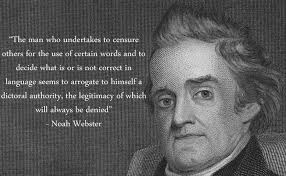
Noah Webster, long associated with the dictionary, left his legacy in the hearts, hands, and minds of capable descendants who continued the craft of prescribing proper word usage for all, that is until the 1961 Third Edition came out. A couple of wars, some cultural changes, and a few major historical events like the Depression not only changed the world, the language had noticeably been impacted.

Enter Philip Gove, the new editor who rattled the paradigm with the new (disturbing) descriptive instead of prescriptive format.  Merriam-Webster had to make room for all the new entries which meant remodeling the model so long held up in esteem.  No longer would it be the go-to reference for correctness of letter writing, titles, names, and places and other encyclopedic information; it would settle down and become a tome of how a word is used versus how it should be used.  More or less a Joe Friday approach, “just the facts, m’am.”

While at times digressive, Streeter nevertheless leads readers along his winding path of explanation as to why the Third Edition alienated newspapers, associations, and academics, irked the public and changed the manner of dictionary presentation forever.  The Story of Ain’t may not be a first pick read in terms of how-to’s and polishing writing skills; however, knowing how this particular dictionary came to be and the absolute furor it caused somehow causes pause, especially since plans for the fourth edition were announced in 2009.  Who knows how long, what, or if, any impact will be made once it hits the bookstores, since there are less and less bookstores to sell it in, now that users frequent screens instead of paper for their lexicon needs.  Now–ain’t that a shame?

Notable quotes:

Page 7:

And Merriam was very much in the business of authority.  In its own pages, Webster’s Second was “the Dictionary,” with a capital D and the definite article as if no other existed.

 Page 11:

The press release quoted Dr. Gove saying that the English language had become less formal since 1934. For an example the PR hands chose the new dictionary’s surprisingly tolerant, though oddly worded, entry for ain’t, which said ain’t was “used orally in most parts of the U.S. by cultivated speakers.”

image: sparklepony.blogspot.com

Page 30:

In those days the National Council of Teachers of English still observed Good Grammar Week, when children were called on to go seven full days without splitting an infinitive. As a reward they were treated to entertaining skits in which Mr. Dictionary vanquished the villain Ain’t. At home, however, as radios in the 1920s went from being a rare possession to a basic appliance, children might hear “Ain’t We Got Fun,” a popular foxtrot, “Ain’t Misbehavin’,” a Fats Waller song, or perhaps even “Ain’t She Sweet,” another hit song of the time.

image: yesterhair.wordpress.com

Page 49:

In the 1920s, Shall I? was still a common usage, but it would not be for long.  A few years after Fries’s study [Charles Carpenter Fries] was released, Bell Telephone allowed a researcher to listen in and count words spoken in the phone conversations of its customers. In the course of 1,900 conversations, will as an auxiliary term was used 1,305 times. Shall  appeared only six times. The long-term trend was obvious.  Twenty-five years hence, Alfred Hitchcock fans would leave the theater with the voice of a very proper Doris Day singing in their heads, using will in the first person to ask, “Will I be rich? Will I be pretty?”

Page 175:

In one instance, he said [Gove], the Webster’s Second board had spent at least an hour discussing whether hot dog should be in the dictionary. (In the end hot dog had won admission: “a heated wienerwurst or Frankfurter, esp. one placed in a split roll;–used interjectionally to express surprise or approval. Slang.”) 
Page 191:

Racy was often used to describe American English: H. L. Menchken more than once called it that. Webster’s Second defined racy as “manifestating the quality of a thing in its native, original, genuine, most characteristic state,” citing a weirdly fitting phrase from the Victorian thinker Walter Pater: “racy morsels of the vernacular.”

Page 213:

The comedian Fred Allen said, “Television is called a new medium, and I have discovered why they call it medium—because it is neither rare nor well done.” Yet its presence in the living room continued to redirect household activity, setting the table for TV dinner, dated 1954 in the Merriam-Webster files.  But one year later, another phrase was making the rounds: idiot box.

image: xk9.com

Page 230:

Said Gove: “Five basic concepts set forth in the English Language Arts supply a starting point.” Then he listed them:

1. Language changes constantly

2. Change is normal

3. Spoken language is the language

4. Correctness rests upon usage

5. All usage is relative

The concepts had been endorsed by the National Council of Teachers of English, Gove noted, “but they still come up against the attitude of several generations of American educators who have labored devotedly to teach that there is only one standard which is correct.”

image: lili.org

Page 241:

The dictionary [Merriam’s Third] weighed thirteen and a half pounds and featured 100,000 new words and senses, a massive amount of new language that Merriam called “the greatest vocabulary explosion in history,” While new words were being added, a quarter million entries were subtracted, and all remaining entries were revised.  “Every line of it is new,” Gove wrote in the preface.  With 450,000 total entries, the new dictionary contained 100,000 quotations from more than 14,000 authors. The foundation for Merriam-Webster’s lexicography comprised some 10 million citations, and the new edition had cost $3.5 million to make.

Page 266:

[James] Parton quoted the dictionary’s critics, the Washington Star calling it “literary anarchy”; the Library Journal calling it “deplorable”;  the New York Times saying, “a new start is needed”; the American Bar Association complaining that Webster’s Third was “of no use to us”; Wilson Follett, in the Atlantic, calling it “sabotage,” a “scandal,” a “calamity,” a “disaster”; a recent Times article calling it a “gigantic flop.”

Page 272:

[Bergen] Evans’s broadest point was his most persuasive: that the language itself had changed profoundly since 1934. “It has had to adapt to extraordinary cultural and technological changes, two world wars, unparalleled changes in transportation and communication, and unprecedented movements of populations.” And, he continued, “more subtly, but pervasively, it has changed under the influence of mass education and the growth of democracy.” Whatever its faults might be, Evans argued, Webster’s Third was an enormous effort to capture and describe, in sufficient detail and without undue prejudice, this great shifting thing called contemporary standard American English.

image: nytimes.com

Personae:

□       Asa Baker: president of G & C Merriam Company

□       Bergen Evans: television host and co-author of a significant dictionary of usage

□       Wilson Follett: professor of English and author of a guide to modern usage—most furious critic of third edition.

□       Charles Carpenter Fries: scourge of old-fashioned grammar and evangelistic scholar who sought to bring American English teachers around to the scientific view of language.

□       Philip Gove: editor of Webster’s Third

□       H.L. Mencken: famed newspaper columnist and magazine editor

□       Robert Munroe: successor to Asa Baker and uncomfortable with Gove’s plans for Webster’s Third.

□       James Parton: journalist and president of American Heritage publishing company who sought to use the controversy over Webster’s Third to take control of G. &C. Merriam Company.

The Merriam-Webster logo.

The Merriam-Webster logo. (Photo credit: Wikipedia)

Post Navigation