Pam Webb

a writer's journey as a reader

Archive for the category “creativity”

ReReReReally Rejected


Starting the month of March with four rejections shadowing me from the last week of February prompts a bit of reflection.

1. Perhaps I should check my email more often. This would prevent rejections from multiplying if left unattended.
2. One rejection is par for the course, two rejections is irritating, three rejections is laughable, four rejections is laughably ridiculous.
3. Repeating “It’s not me being rejected, it’s my writing,” is great only in theory because me I wrote it, right?
4. I’d rather have one big punch than several smacks. A bruise is a bruise.
5. Cheery demeanor: “Well, at least I know now and can move on to submit the piece elsewhere.”
6. Bad attitude: actually I don’t have one–rejections are part of the landscape of writing.
7. Overall takeaway: just one more story I get to store up for when I am keynote speaker at my award acceptance banquet.

Okay–back to updating my submission ledger…

Button, Button


My usual adage of “The original source is always better” went out the window after watching The Curious Case of Benjamin Button.
When the movie came out in 2008, I promptly avoided it. I thought the premise strange, that a baby would experience life backwards–going from old and decrepit to incapacitated infant. It especially seemed odd, even a bit creepy, since a romance was part of the plot.

Aging backwards. Not a new concept, apparently backwards aging is not a truly new trope. After all, Shakespeare hinted at our returning to our infancy state in his “Seven Ages” poem.

I also was a bit leery of Brad Pitt at the time. Fight Club isn’t exactly my type of genre. The male progeny tried to interest me (who can resist bonding with their sons via a movie?) but after a few minutes of gruesome artsy cinema, I deferred. However, since Fight Club Pitt has appeared in movies I do like, such as the Oceans triple, and Mr and Mrs Smith. Into the library basket went Benjamin Button as I gathered movies for the week. I didn’t realize I was committing to two and a half hours.

A sick day, and no energy for reading and in popped the movie. I sat spellbound. I even cried at the end. And was a bit indignant that Brad Pitt got passed over for an Academy Award. This trailer captures the heart of the movie well:

The most interesting part for me is that the movie is based on a F. Scott Fitzgerald short story. The fantasy genre intrigued me because I didn’t peg FSF for writing anything but brooding rebellious characters from the Roaring Twenties. The story’s biting satirical tone is very much Twain, and I learned that Fitz was indeed influenced by MT, who had made a comment about what a shame we don’t experience the best years, our older years, first. Interestingly enough, the only thing the movie and short story have in common is the title and premise. Here is the story link:


Any of you been surprised by the film being actually better than the written work?
Wish Me Well…


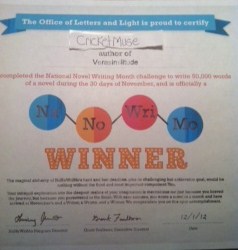
A couple of years ago I participated in NaNoWriMo and even have a manuscript and certificate to prove it. Day Two

Considering it took about two years to untangle the 1,600 words I wrote everyday for 30 days, I decided to pass on attempting NaNo this year. Instead, I entered the New Look Writing Contest sponsored by WestBow Publishing (connected to Thomas Nelson/Zondervan/Harper Collins).  The specifics couldn’t be resisted: at least 10,000 words, inspirational or positive message, YA acceptable, and it’s FREE to enter. Plus, the winner package had quite a few attractive options including publishing packages. I’m in. I have to admit I squeaked in under the deadline of 11/30 by submitting my manuscript on 11/29.

I hope to have good news to share with everyone!

Conference Crumbs


image: wordsharpeners.files.wordpress.com

Recently I attended a writing conference and I will freely admit I attended primarily because I knew my time had arrived. Yes, this time I would be discovered. My critique editor would be so impressed with my submission that she would pat the chair next to her and state, “I’ve waited all day to finally meet you. I adore this * points to my pages* and we need to talk about contracts.”
This, of course, did not happen and I doubt it will. Or if it does I hope the actual moment will not be as corny as my version.

I didn’t always used to be conference goer. I used to be a conference nayer. “Pfft–I don’t need to spend money, drive miles, and sit and listen to people who have made it. I have my books and magazines to tell me what I need to know.” That’s me turning down a suggestion to attend a SCBWI conference. My critique group sagely retorted, “You go because it’s all about networking.” And she was right. Making connections is primary, and gaining knowledge is secondary for me.

When conference invites drop into my mailbox I first check the line up–who is going to be there? Getting to hear a favorite or well-known author or to glean industry insights from a respected editor, publisher, or agent might entice me to reach for the calendar. Yet, what gets me actually going to the conference is the critique, having the opportunity to learn and to receive an assessment of my writing from an industry professional. If I can get a renowned publisher, editor, or agent to look over my work and get their attention for 12 minutes, I’m all in. Critiques range in price and my pocketbook can handle the $60 variety, which translates to roughly $5.00 a minute . I consider this a good value since I willingly pay a dollar a minute for my ten minute chair massage at the farmer’s market. Both are invigorating focused sessions, yet only one is beneficial towards my career.
Once at the conference  I diligently sit through the various speakers, deftly mining worthy industry nuggets. Admittedly I’m only half tuned into the program because I keep glancing at my at my watch after continually rechecking my critique appointment slip. Bad form, really. It would be much better to relax and relish while waiting.

This year I did do just that.

My appointment was probably the last one of the day which meant I needed to pass the time. I actually decided to really listen to the speaker presentations and not just flick through the bin of offered treasure trove of advice but to really savor the meal before me. Yes,a muddle of metaphors.  As for the actual conference I had a productive meeting with a publisher of a respected, well-known publishing house. She liked my approach, style, and even appreciated my humorous bits in the manuscript. She had prepared an amazing critique page–the best organized I’ve ever received. No, she did not offer a contract. However, she did hand me her personal business card and invited me to send my proposal for another project to her directly *no slush pile*. And she said I could resubmit the piece she had critiqued. Better than six chair massages, I’d say.

So, if are on the fence about attending a writing conference I would give you a bit of a nudge and so “Zip out the credit card and go absorb and mingle and learn.”

Oh–I would appreciate some good thoughts towards the project I just emailed her.  Having just received a rejection for a manuscript, I wouldn’t mind some good news around the corner.

A Room Of My Own or a Writer In Woolf’s Clothing


image: amazon.com

While I’m not particularly a fan of Virginia Woolf, I do appreciate her unspoken contributions to women and writing. She once penned an essay discussing the need to have a room to create in, the desire to close out the responsibilities of mother and wife in order to be alone with self and creating. Rather a revolutionary idea in her time.
Though not so confined to the stove of domesticity these days, as a woman and a wife, mother, teacher, library trustee, GiGi–assorted other hat wearer, I too crave a room of my own. Carving out a space for personal creative endeavors has had its own set of challenges involving space and guilt.
We’ve tended on the small side of houses and squeezing out an area for a desk meant getting creative to find a creative corner. A door placed on top of filing cabinets worked for a time, but definitely cramped the bedroom and so we moved it out to the living room.  Still squishy. Ugly to boot.

When I switched to laptops, I got rid of the desk arrangement and I splurged, buying a loveseat the color of eggplant. I eked out a coveted thinking space in the bedroom, approximating nanoseconds of creative corner. The kids loved the idea that my office was purple.
Now, as an empty nester, I’ve commandeered one of the back bedrooms, I forget which progeny actually had it since they switched around so much. None of them can complain I’ve stolen their room. They know my standard reply anyway, “Your room? It was on loan for eighteen years.” My desk is an Ikea chair complimented by matching footstool to accommodate my two laptops (I still like my antiquated Dell, as I am trying to get used to my touch screen Lenovo). I have a rocking chair for when the MEPA wants to pop in and chat and a futon for the occasional overnight guest. This is where the guilt comes in: it feels a bit me-centric to devote one entire room towards my endeavors.

I know, I know–lots of people, lots of women have sewing rooms, craft corners, workshops, man caves and suffer not a twinge of remorse. I, on the other hand, do feel a bit bad about eradicating all traces of the progeny’s room. No beds, posters, old clothes, trophies remain; they truly are a guest when they visit.

Then again, I nudge away those nipping little guilts and conclude I should have no dilemmas about acquiring a room of my own. And this is where I have my moment of truth. Possessing a room of my own means I should make use of it, shouldn’t I? Then why am I writing this in the living room?

Pedestrian Thoughts


I do my best writing while out walking. There is something about the synced coordination of brain and body both exercising at the same time–I now understand the trend towards the new kinetic desks.

After an hour of sitting down at the laptop I get antsy and start moving around, tidying up, doing laundry, futzing and such. Writing in lock down mode doesn’t work well for me. Writers who state they sit down and work office hours have my admiration. This is why I appreciate Ray Bradbury’s short story “The Pedestrian.”

Set in the future a man is out walking one night, his accustomed habit, when he is pulled over by the metro police–suspicious behavior since no one walks anymore, especially at night. The pedestrian ends up being taken in for “further questioning” when he reveals he is a writer–no one reads anymore either.
Fortunately, my walking habit is not deemed odd in our own days and times. Our little town has a refreshing diversity of walking paths and I do relish my times of walking briskly, revving up the muse and muscles. The exercise unknots plot stoppage, uncramps stiff dialogue passages, and opens up new avenues of thought, like blog posts. This one, matter of fact.

Blog Spotlight: Mike Allegra


How can you not want to read a blog with this as its banner?

Mike Allegra

This is Mike Allegra, aka HeyLookAWriterFellow. Think of Steve Martin and Billy Crystal as children’s book writers. A little scary but Mike promises he keeps it clean. In fact he insists on it, even though he has been known to trot out some potty jokes now and then.  Besides writing an absolutely this-is-really-funny stuff blog, he is a very talented writer, doodler, and all around good guy. He loves to show off his cute kid, who I need to figure out how to bribe so he’ll pull my entry out of the next doodle hat round.

I don’t even know how I found Mike’s blog. I think we started frequenting the same blogs with our commentary and I popped in. Mike and I now banter until I get him to cry “uncle, already.” Yes, Mike, I am keeping score. But I should stay on his good side because I am really hoping to get a cow on a pogo stick doodle out of him one of these days. And, no–this is not a butter up attempt. There have been at least three blog spotlights prior to Mike (I’m going by who trades the most comments with me or who I’ve known the longest in the blogosphere).

So, if you are looking to connect with a talented published children’s author, or like witty writing, or hope to win a doodle (there is a batch of us petitioning for him to run his doodle drawings at least once a month) you need to pop in and visit Mike, who is more than just another writer fellow.

Let’s Stop With The Cloning Around


STOP: SPOILER ALERTS for the following
Never Let Me Go
The Island
Moon
I, Robot
Oblivion
Frankenstein
Robocop

“Four legs real, fake legs baaaad.” image: nature.com

What is this fascination with the humanity aspect of clones or artificial intelligence? Why do we want to inject a soul into something man has created? Or a more defined question is: why do we explore whether man-made creations have a soul?

Is it guilt? Afterall, creation is best handled by the Creator, the One who has the Master Plan. That statement could incite a whole firestorm of commentary in itself, which is fine, but I’m really after the literary and even film aspect of cloning/artificial intelligence.
For instance, having just finished Never Let Me Go by Ishiguro, I began thinking about other cloning works: The Island,Moon, Oblivion, and while there are other aspects attached to these films, the main takeaway: “cheated.” The clones are cheated because even though they look human, act human, they are not, which becomes a matter of concern because there is an investment of empathy for these characters, yet part of me says “Wait! They aren’t real.” I feel cheated because I am tricked (seemingly) into believing and caring about something I inherently don’t subscribe to: cloning.
Have you ever tasted imitation crab? Once–thank you very much. Looks like (mostly), tastes like it (kind of), smells like (a bit), same texture (not really). After being duped into eating it I came away with the same feeling: cheated.
Duplicating sheep, crab, humans–it’s not the same, and can never be. I believe in science; I do not subscribe to Luddite philosophies, but there are moral boundaries and these boundaries keep reappearing in novels and films as guilt and even revulsion. Why?
I think we try to justify the curiosity to recreate human life through the compassion for the Creature, as in the case of Frankenstein. The Wretch had initial goodness until it met up with repeated rejection. However, Shelley pointed out the disastrous results of man attempting to recreate man.
We root for Tom Cruise (Oblivion) and Sam Rockwell (Moon) as clones, only because we thought they were human. Upon realization they were clones I immediately reneged my emotional investment–I had been cheated, someone had switched in that imitation crab.
I have no problem with robots though. The A.I. component works for me. I liked R2D2, who didn’t? And Sonny, from I, Robot? A charmer. They were machines with heart; they did not have a soul. Machines are machines. On the other hand, that fuzzy line is not so warm and fuzzy when it comes to cloning: Humans with no soul? Are these simply sophisticated machines with feelings?
Which brings me to my latest Ishiguro read, Never Let Me Go. Having heard raves about it, and having read two other of his novels, I looked forward to this particular one. Ishiguro’s style of unreliable first person narrative and undercurrent, deceptively complex plot is very much evident. It wasn’t until about halfway through I realized I’d been cheated. Here I thought Ruth, Kathy, and Tommy were victims of a cruel government experiment, only to discover (oh so subtly) they are clones. Dissapointment. I finished the novel, although I felt a detached flatness. No joy in that one. I did feel a resonance with Robocop, but then has man trapped in a machine. And even though he was mostly machine I rooted for him because people I can relate to–fake crab, not.
Anyone else have thoughts on cloning in literature in regards to character empathy?

Remaining the Orphaned Narrator


It is always exciting to discover a new-to-me author. In this case it’s Kazuo Ishiguro. I know, I know. I’m a bit late in my discovering; however, better late than never in finding an author of mesmerizing style.

http://www.youtube.com/watch?v=0nlyIvHY1Xw
I knew the movie Remains of the Day, before finding the novel and didn’t realize the movie was the adaptation.
How could I possibly pass up a film starring Anthony Hopkins and Emma Thompson?
Flash forward five years later and I’m perusing the AP Literature list (“read that one, will never read this one, not reading this one again”), when I recognized the title Remains of the Day and connected it to the movie. Then I read the author’s name and I must admit I expected something like Adrian Smythe or Winston Greene, not Kazuo Ishiguro. After all, the novel is about a very proper English butler and his reflections of what it takes to become the best of English butlers. Wouldn’t one need to be English to understand that sort of nationalistic pride? I’m not getting points here for narrow-minded thinking, am I?

It turns out Ishiguro is quite well-suited to the task of writing about the English since he moved to England when he was around six years old. This gives him the ability to have an insider’s view with a somewhat detached perspective. The result is  basically a stream-of-consciousness narrative concerning the tunnel vision of a man’s quest for the unattainable. Trying to live a life that is beyond reproach, to achieve a status of perfection, requires sacrifice. Can sacrifice be made without regret? This is the hidden truth Stevens, the butler is searching for, except he does not realize it.
A quest novel of notice did not go unnoticed, for Ishiguro’s debut garnered him the Man Booker Prize and set a bar. Would he be a one shot wonder or would this be the first work of a noteworthy word smith?

image: goodreads.com This cover indicates the layers found within the story.

My literary taste buds curious for more, I trotted down to the library. Grabbing any title of his that caught my eye on the  shelf, I opened up his fifth novel When We Were Orphans. I immersed myself in reading it to the point the MEPA queried, “Still a good book?” Yes, thank you. Prognosis? After reading two novels, indications are Ishiguro is wordsmithing wonder.

Here are some bio facts and  stats:

  • Two novels have been adapted to the screen, Remains of the Day, and the more recent Never Let Me Go. Both have been received well, considering Ishiguro’s stories are mainly first person narratives, making them difficult to translate into a cinematic plot.
  • His novels are historical in nature, with attention to detail.
  • The stylistic viewpoint is that of the unreliable first-person narrator, one who is flawed in outlook.
  • Although born in Japan, he did not return until thirty years later.
  • He has received four Man Booker Prize nominations
  • The Times ranked him 32 on the list of the 50 most influential British writers since 1945.

As for an actual review of When We Were Orphans, I leave it to the more qualified:
New York Times
 review:

I plan on continuing my course of exploring Ishiguro’s work and look forward to introducing a contemporary author to my APters, who, I’m sure, would like a break from dead white folk now and then.

Any thoughts on Ishiguro’s writing? Any suggestions for the next title I should read of his?

Wrap Up or Fall Flat


After five years of stop and go writing on my historical novel I’m nearing the end chapters. It’s rather intimidating. The ending involves the reuniting of a homestead mother with her family. The way I have presented the conflict is that there is some ambiguity of whether the mother left the family due to the grind of daily life as a pioneer women or if she wandered away due to fever delirium.
Here’s what I need to figure out:
-Is the husband readily accepting her leaving the family and not returning once she was better? (He’s a good guy overall, but was left with six children ages 3-15 to raise in her absence)
-How will the daughter (her POV) feel about her mama at this point? Anger, relief? This girl took on the task of raising her three ornery brothers and packed up her petticoats and put on pants to do so in order up keep up with them.

The right grab really counts… image: bodyresults.com


Reaching the end chapters is a lot like rock climbing. A cadence is developed in both–the reach and pull up towards progress. Just when the top is in sight, flat is sometimes hit, meaning no handholds and no way to go up. Finding a new path is sometimes the only direction left. Then again a risky move can be tried and what a sensation of exhilaration when it leads to success and pulling over the top.

Write now? I’m at that looking for a move that will pull me over the top.

So, writers–what do you do when you hit flat when the top ledge is in sight? Do you press on or look for a new route?

Post Navigation