Pam Webb

a writer's journey as a reader

Archive for the tag “writing”

Have you hugged a librarian lately?


Well, National Library Week is about done

To end it out, let’s have some fun.

Click on the link for a Famous First Lines quiz.

Have no worries–Book Boosters are a literary whiz.

Famous First Lines

(Rats, I missed three)

Drop a line why you love your library…

Happy Pages,

CricketMuse

A Little Frenzied About Writing


Contests.  Oh yeah, that challenge to produce something, be it a bit of athletic prowess or artistic flair, it is that little voice that queries: “Got what it takes?  Willing to try and show it?”

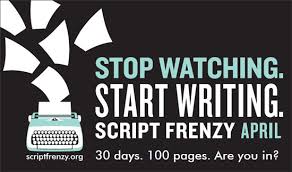
Not being much an athlete I mainly gravitate towards the artistic endeavors, especially writing contests.  While people meditate, fret, and procrastinate their taxes in April I am contemplating and playing with words.  Hello, Script Frenzy.

What I like about Script Frenzy (actually there is a lot I like about Script Frenzy) is that I am competing with no one but myself and that the real prize is meeting the set goal. Plus, the finished product is something tangible, something I can maybe even turn around and share with others.  Heck, I might even get a coin or two for it.  Script Frenzy is all about producing 100 pages within 30 days.  I like it.

If you aren’t familiar with Script Frenzy here you go:

Script Frenzy in a Nutshell

The Challenge
Write 100 pages of original scripted material in the 30 days of April. (Screenplays, stage plays, web series, TV shows, short films, and graphic novels are all welcome.)
When
April 1-30
Cost
Free. We run on donations.
Who
Everyone (worldwide) is welcome. No experience required.
Prizes
Happiness. Creative juices. Pride. Laughter. Bragging rights. A brand-new script.
How 
Sign up! Tell everyone that you are in the Frenzy. Get ready to start writing on April 1.

And you will be in good company:

Stats

Annual participant/winner totals

2011: 19,123 participants and 2,204 winners

2010: 21,008 participants and 2,078 winners

2009: 12,048 participants and 1,271 winners

2008: 8,526 participants and 968 winners

2007: 7,876 participants and 1,072 winners

You can see many participate, yet few actually “win”, meaning finish, which increases the motivation to be included in that final tally statistic number.

Two years I ago I participated in NaNoWriMo (National Novel Write Month) which is mungo craziness.  NaNo is writing a novel, 50,000 words in ONE month.  Basically, the calculations come down to producing about 1,700 words a day.  And it’s a bonus if they make sense.  It was tough because (tad bit of whine here) November is parent/teacher conferences as well as Thanksgiving, on top of the usual craziness of teaching high school English.  Yet, I persevered and got ‘er done.  Two years later I am still editing.  One can not take the time to write and edit a novel in 30 days.  It’s tippity-tappity, finger-flying for 30 days.  Produce in a hurry, edit at leisure.  When my novel, which turned out to be a teen girl writing a novel for NaNo (smacks of Escher, I know), is done I will let you know.  I am hoping to be done by summer and will try Smashwords.

Anyway, back to Script Frenzy.  This year I decided to get going on another stage play since I so enjoyed writing an adaptation of Julius Caesar last summer.  I’m making my creative writing students participate in Script Frenzy as well, or they need to produce some poetry.  April is National Poetry Month as well, you know.  Hmm, gotta get a post going to celebrate that as well.  What’s that? What am I writing?  It’s a spin-off of Alice in Wonderland

Jessie Willcox Smith's illustration of Alice s...

Jessie Willcox Smith's illustration of Alice surrounded by the characters of Wonderland. (1923) (Photo credit: Wikipedia)

I adore the word play in Carroll’s classic and wanted to try an update.  I know, I know, Alice has been done and redone.  But this time Alice meets Hamlet and Dorothy as she wanders in Wonderland.  Gotta go…she’s about to play croquet with the Duchess and her cronies.

Writerly Wisdom II


For those of you who are site stat checkers (I confess I check once, maybe twice a day) you will notice certain types of posts get more hits than others.  Such is the case with my Writerly Wisdom post.  Dunno.  I thought visitors would be wooed by my own words.  Ehh (shrug of shoulders) “if the people like it, serve it up”–C. Muse  So, here is Writerly Wisdom part II:

I try to leave out the parts that people skip.  ~Elmore Leonard

The act of putting pen to paper encourages pause for thought, this in turn makes us think more deeply about life, which helps us regain our equilibrium.  ~Norbet Platt

I’m not a very good writer, but I’m an excellent rewriter.~James Michener

The time to begin writing an article is when you have finished it to your satisfaction.  By that time you begin to clearly and logically perceive what it is you really want to say.  ~Mark Twain

The wastebasket is a writer’s best friend.  ~Isaac Bashevis Singer

The pages are still blank, but there is a miraculous feeling of the words being there, written in invisible ink and clamoring to become visible.  ~Vladimir Nabakov

Easy reading is d*mn hard writing.  ~Nathaniel Hawthorne [*mine–liberties, I know]

And the best for last

Proofread carefully to see if you any words out.  ~Author Unknown

Happy Pages,

CricketMuse

Sources: http://www.quotegarden.com and googleimages galore

Spring Came on Forever


Spring Came on Forever by Bess Streeter Aldrich

From the book:

This is the story of two midwestern families and the starnge way in which their paths crossed. It begins in Illinois in the year 1866, and end in Nebraska in the present one [1935], severed from all that went before and all that will continue beyond a thing of incompleteness.

Aldrich blends together a portrait of the harshness of prairie pioneer life and that of an unconventional love story.  Amalia Holmsdorfer, a sweet young girl of seventeen, finds herself attracted to twenty-one year Matthias Meier, the young clerk who sold her stern German father the soap-making kettle.  Matthias also finds himself attracted to Amalia and begins secretly courting her–even though she has been pledged in marriage to a man of her father’s choosing.  Amalia and Matthias plan to run away together, yet their plans meet up with the fury of flooded roads and even though Matthias attempts to meet her in Nebraska before she marries, he again meets up with one of nature’s blockades.  Matthias and Amalia miss each other by mere hours and she marries the wrong man.

So goes the begins a love story that will span three and four generations.  Aldrich, writing in the style prevalent of her time, reveals the story in an omniscient narrator fashion.  It’s as if we are sitting in a cozy living room and listening to a tale of long ago.  While the “tell” style of yesteryear may not got over well with the current “show” method of today, I have to admit I became so involved in the plot that by the last chapter I clutched the book and actually cried.  And I am not a crier when it comes to literature.  Movies, on occasion can induce some sniffling, but rarely can a book get me to sob.

The story is mainly about Amalia; her hopes and dreams of romance are forever changed when she is forced to leave with the rest of her family and the other members of her German community to build a new settlement in Nebraska. Though she appears complacent on the outside, she keeps her inner thoughts and desires to herself.  Aldrich captures this wonderfully:

pp. 9 & 10

But thoughts are acrobats, agile and quite often untrustworthy.  So now, with impish disregard of the command, they hopped about quite easily.  They asked Amalia innocently why the nice young man wanted to know where she lived.  They suggested with subtle art the possibility that he would try to find out.  And then when the gruff person at her side questioned their activities they urged her quickly to answer, “Nein.”

My interest in pioneer started long ago with the Laura Ingalls Wilder’s Little House on the Prairie books. There is a fascination in reading about how people created homes and towns out of the rough lands of prairie and wilderness, and through all this tremendous effort they had their own personal stories.   For the last five years I have labored on a novel about a family who follows the Oregon trail to turn off and make their claim in Idaho.  Historical novels require plenty of research to make the time period, setting, and characters come alive.  Aldrich’s Spring Came on Forever reminded me how moving pioneer stories can be.   I am also encouraged to someday write something that induces tears.

Sufficient Grace


Sufficient Grace by Darnell Arnoult

Listening to the voices in her head Gracie Hollman takes off her wedding ring, snips her credit cards, jumps in her car, and leaves everything behind.  Her husband Ed, a solid, everyday kind of guy who owns a tire shop, is at first concerned about her absence, thinking foul play at first, but the abandoned credit cards and wedding ring make him think she’s left him for another man.  He didn’t see that one coming, especially after thirty years of marriage

The story centers on Gracie and how her decision to leave everything behind causes a ripple through several families.  Each family, and each person will find that things have a way of working out because grace truly is sufficient.

Darnell Arnout has created a mesmerizing work which explores grief and healing with sensitivity, insight, and humor. Arnoult masterfully mixes together a variety of characters, who at first have separate stories, yet by the end of the book they are all connected.

One of Arnoult most distinguishable style attributes is taking the everyday and spotlighting it into something  of phenomenal clarity.    For instance, Mattie is becoming increasingly handicapped by her inability to get past her husband’s death. At her family’s insistence she begins to clean out his closet. During the process Mattie tries on her husband’s shoes, reminicsing about much she misses how their feet would lightly rest together at night when they slept.

p. 162:

Mattie will give up the clothes.  She can do that.  She’ll let Sammy put them in some bin and let some other needy soul have them.  but she needs to walk in Arty’s shoes for a while.  Feel her skin slide over the place where his feet have been.  Just for a while longer. She’s got to keep those feet.

This book gave me encouragement to take a batch of people and tumble them together to get a kaleidoscope of character mixing.  I also gained an insight on how levity lightens serious topics.  And food. Writing about food somehow makes painful stiuations like grief, discord, and mental duressl seem so much more palatable.

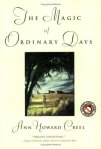
The Magic of Ordinary Days


The Magic of Ordinary Days by Ann Howard Creel

Olivia Dunne’s dreams of becoming an archaeologist are irrevocably changed after a brief interlude with a solider shipping out overseas. Her father arranges a marriage with a reputable bachelor farmer and Livvy accepts this arrangement. Leaving her married sisters behind in Denver, Livvy arrives in rural Colorado to become the wife of a man she does not know.

The book explores many topics: grief, betrayal, loneliness, trust, forgiveness, acceptance, and love. Livvy shows the readers her situation and how she adjusts to it in a voice full of angst. She mourns the recent passing of her mother, as well as the changes her mother’s death has brought her father. She stoically accepts the arranged marriage, for her baby needs a name. Ray, her new husband, knows Livvy carries another man’s child, yet he does not judge or resent Livvy for it. He patiently waits for Livvy to love him as he has come to love her.

Within this main plot is Livvy’s friendship with two Japanese-American sisters, Rose and Lorelei, who are residents of a local interment camp. Readers see the affects of WWII on Americans through Livvy’s eyes and through Rose’s and Lorelei’s.

As a reader I relished Creel’s use of imagery. I could feel the isolation Livvy suffered: the expanse of the fields, the lack of neighbors and family to break up the monotony, the need of useful purpose. Found on page 41: A clay-colored tumbleweed wedged between rows of green leaves caught my eye. Thorny, trapped, and out of place, it let me know the insignificance of any one, distinctive thing caught in a place so mapped with sameness. Aunt Eloise and Aunt Pearl had once accused me of hiding out in school. Instead Father had sent me into hiding here, where the openness of land and sky made hiding out about as unlikely as finding clover among the sage.

As a writer I appreciated Creel’s ability to use the first person narrator in such a way that all the characters were given dimension. The narration flowed so effortlessly that I often forgot the story was told from Livvy’s point of view. Another aspect of Creel’s writing is her use of prologue. Not being much of a prologue fan, I find myself inadvertently cringing whenever a book begins with one. Why not just start the story? Why the compunction to have extra exposition? However, Creel’s prologue is perfect; it reads as a visual movie trailer. It sets up the plot, the initial conflicts, the intrigue. It hooked me as a reader.

The Magic of Ordinary Days is far from ordinary. A compliment to Creel is that her book became an inspiration for a Hallmark Hall of Fame movie, which I had actually watched many years ago. As always, the book is better.

The Magic of Ordinary Days

The Magic of Ordinary Days (Photo credit: Wikipedia)

Post Navigation