Mark Twain (he would rent kittens when he went on a writing vacation since he had to leave his cats behind at home)
Ernest Hemingway (he built a cat tower for his brood of over 30 cats when he lived in Cuba)
Alice Walker (she developed a deep relationship with her cat)
L.M. Montgomery (she claimed grey cats were perfect and adored her cat “Lucky.”
James Herriot (while he loved dogs, he had a special place in his heart and writing for cats)
Edgar Allen Poe (he bonded with his “Catterina” who would sit on his shoulder while he wrote)
Cat Facts
cats can vocalize at least 100 sounds
cats were referred in ancient Egypt
cats can jump six times their body length
cats are known to sleep 12 to 15 hours a day
cats can run up to 30 mph
cat brains are 90% similar to human brains
Cat Poetry Authors through the centuries have eloquently expressed their appreciation for cats through verse. Here are some worthy poems to consider:
Emily Dickinson She sights a Bird—she chuckles— She flattens—then she crawls— She runs without the look of feet— Her eyes increase to Balls …
Edward Lear The Owl and the Pussy-cat went to sea In a beautiful pea-green boat, They took some honey, and plenty of money, Wrapped up in a five-pound note. The Owl looked up to the stars above, And sang to a small guitar…
Carl Sandburg The fog comes on little cat feet. It sits looking over harbor and city on silent haunches and then moves on
Famous Cats
Puss in Boots: good things come to those who trust a cat in stylish boots
Cheshire Cat: Alice learned how talking cats add sanity in a world crazy
Grumpy Cat: aka Tardar, who appeared less than impressed with aspects of life
Garfield: cousin to Grumpy cat
Sylvester: Suffering Succotash not the brightest feline in the basket
Morris: Discerning, not finicky, thank you
Cat in the Hat: such a troublemaker
Felix: the wonderful, wonderful cat
And there are some notable cat proverbs: Nigerian: “When the mouse laughs at the cat a hole is nearby.” Italian: “Happy is the home with at least one cat.” French: “The dog might be wonderful prose but the cat is wonderful poetry.” Irish: “Beware of people who dislike cats.”
As a voracious reader bookmarks are essential to keeping order as I travel through books.
Dogearing pages is simply not acceptable and will not be tolerated. Civilized readers do not crisp back page corners. Unless it’s the latest Costco flyer.
I’m on the fence about notes and highlighting. That’s a different topic and post.
Concerning bookmarks…
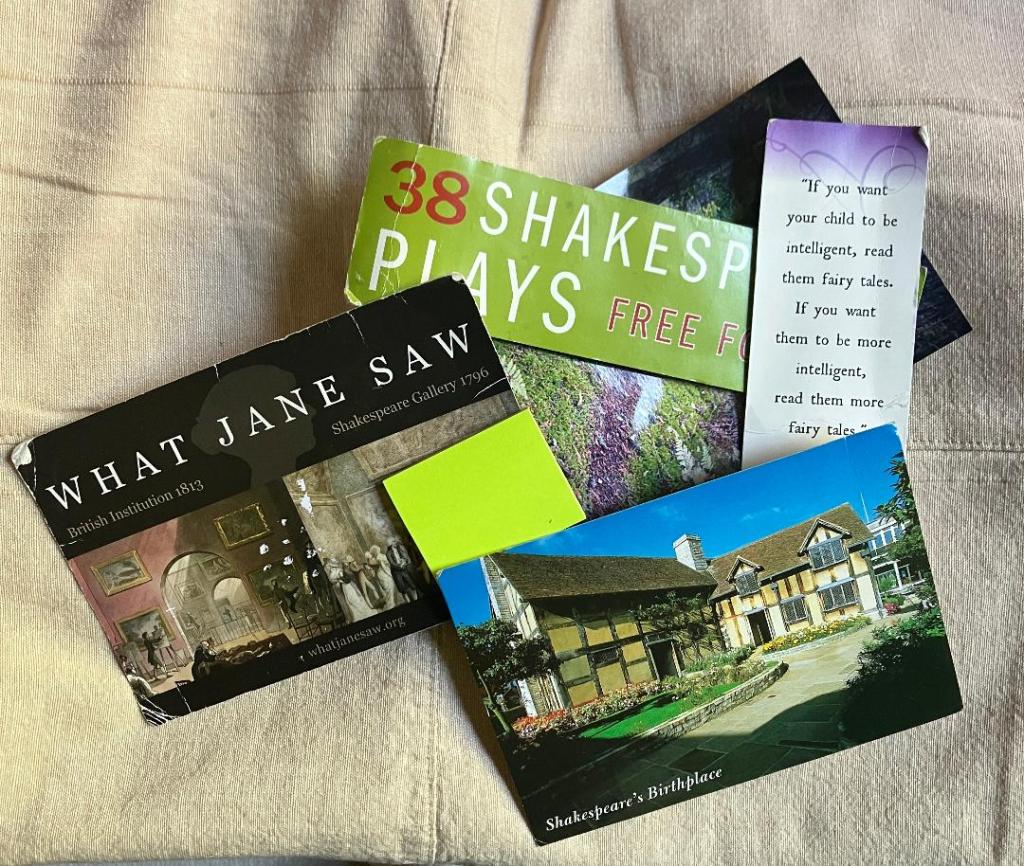
Yes, most of them relate in some manner to Shakespeare–good eye
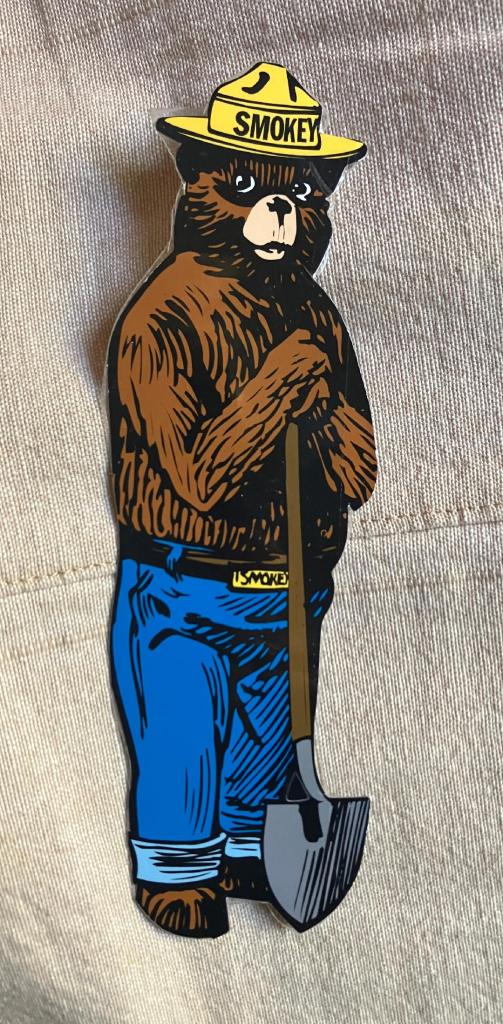
I have a brace of bookmarks ready for use spread through the house. Some are genuine bookmarks with various designs while others range from a ubiquitous fluorescent sticky note to a variety of postcards to my current favorite: Smokey the Bear.
Scored Smokey (and his twin at the Forest Dept booth at this year’s fair
There is something satisfying about firmly wedging a bookmark into my current read. It’s a decisive action signifying a promise to return. <Ooh, a feel the need to work this out as a PB story>
And sometimes the return is immediate; other times it takes it takes a bit longer. Like my Oxford Book of American Poetry. It has plenty of tiny bookmarks indicating favorite poems waiting to be reread. Other standby reads include Psalms, which I savor before going to bed. Like faithful sentinels these bookmards remain on duty, assuring they will easily guide me back to where I last left off.
The library recently displayed a collection of ephemera; those bits found in books that are donated. Photographs, receipts, tracts, love notes, clippings, leaves, as well as actual bookmarks. As I process donations, I collect these bits of personage, and save them, wondering about the stories behind them. Over the past year enough ephemera was collected to fill three poster boards. I wonder if people viewing the display recognize their lost bits, if they are saddened if they inadvertently gave away something cherished with that copy of Tom Clancy’s latest adventure novel.
Well, on to a new book. Smokey is already waiting for me.
P.S. As I opened my latest read these two bookmarks were waiting for me. Serendipity.
When the Montana Shakespeare Troupe arrives in August to our fair town, it is a generally accepted acknowledgement that summer is on the wane. Pleasant weather still lingers, although it is a bit chill in the early morn and evening. There remains the essence of summer.
And then the calendar chimes out its equinoxal announcement that summer is past and autumn is now upon us. I’m not quite ready to bring in the patio furniture yet.
Shakespeare eloquently presents a metaphorical passing of one’s age in his often quoted Sonnet 73:
That time of year thou mayst in me behold
When yellow leaves, or none, or few, do hang
Upon those boughs which shake against the cold,
Bare ruin’d choirs, where late the sweet birds sang.
In me thou see’st the twilight of such day
As after sunset fadeth in the west,
Which by and by black night doth take away,
Death’s second self, that seals up all in rest.
In me thou see’st the glowing of such fire
That on the ashes of his youth doth lie,
As the death-bed whereon it must expire,
Consum’d with that which it was nourish’d by.
This thou perceiv’st, which makes thy love more strong,
To love that well which thou must leave ere long.
Back when in my AP teaching days, this was a poem we studied for its rich imagery and underlying message of mortality. However, bypassing an analysis (I hear that sigh of relief), I do want to focus on the last two the lines, the ending couplet. In the previous lines the speaker has expressed his concern how he is aging to his lover (maybe even a child–oops, that’s analysis) and in the ending couplet we see the volta, or turn, that indicates a change of mood. Here the speaker interposes the thought that though he might be aging in his own eyes, and in perhaps his lover’s eyes, it is this very state of aging that should initiate an even deeper love for the narrator. In other words, though summer (his youthfulness) is diminishing and hints of winter are coming (touches of grey in hair), this season of in between, autumn, should be even more cherished as it is the in between time before winter is fully realized.
Yeah, what Shakespeare said.
I welcome spring, enjoy summer, and embrace fall. Fall or autumn still has the warmth of summer, yet it ushers in harvest and nature’s graceful transition into a foliage showcase of beauty. Since retirement I am taking advantage of the gentle warmth of September afternoons. Previously (20 years worth) I wouldn’t get home until after the shadows filled my backyard and I would mourn having missed out on the sunshine having been inside a building all day (okay, mourn is a bit extreme, but I really disliked having to wait until the weekend to enjoy the fall sunshine).
National Poetry Month is still among us for a few more days and I would be remiss not to mention Shakespeare and his sonnets. There–duly mentioned.
I am sorely tempted to give a brief lesson about the sonnet, something I miss teaching from my AP English Lit days. BUT (which is an indication of the turn in the sonnet mood or message known as the volta–see what I did there? Yes, I did squeeze in a brief lesson), I shall refrain and instead spotlight that other aspect of Shakespeare.
No–not him being a playwright. Did you know he started out writing sonnets and not plays? That he considered himself more poet that playwright and that he inserted many a sonnet into many of his plays? There are four sonnets in Romeo and Juliet alone. The prologue that introduces the play is a sonnet (watch for the volta–hint, hint “which” works as well as “but”):
Two households, both alike in dignity, In fair Verona, where we lay our scene, From ancient grudgeParenthesis break to new mutiny, Where civil blood makes civil hands unclean.
From forth the fatal loins of these two foes A pair of star-crossed lovers take their life
From forth the fatal loins of these two foes A pair of star-crossed lovers take their life; Whose misadventured piteous overthrows Doth with their death bury their parents’ strife. The fearful passage of their death-marked love, And the continuance of their parents’ rage, Which, but their children’s end, nought could remove, Is now the two hours’ traffic of our stage; The which if you with patient ears attend, What here shall miss, our toil shall strive to mend.
There I am talking about sonnets again. Well, it is National Poetry Month. And being such a famous, well-known poet it is difficult not to have spent at least a bit of time about how the Bard rocked sonnets.
Sonnets. Plays. He did write them supremely well. We still read them, watch them, recite them, discuss them and you know what? Just watch a master recite the master discussing April–very appropriate, wouldn’t you say?
The cat is a nice touch.
Here I meant to talk about the other aspect of Shakespeare, and sonnets distracted me. A worthy distraction, true that. Yet, (another word that works as a volta, since I am changing the direction of this focus), beyond the perfect prose and poetry Shakespeare is so admired for there is a darker, mmm, not quite the right word–ribald, yes, Shakespeare has a definite ribald side to him: his insults!
Throughout his plays his characters lob the cheekiest insults at one another. Keeping in mind the majority of those attending Shakespeare’s plays were of the down-to-earth crowd, known as “groundlings” because they pay a penny to watch the performance and stood for the entire time, often shouting out their commentary to the stage actors. Stands to reason then why Shakespeare inserted earthy lines into his plays. He knew how to play to the crowd.
Here are some examples. They start at mild and run the course from G to PG13.
“Neighbors, you are tedious. ” —Much Ado About Nothing, Act 3, Scene 5
“[You] peevish baggage.” —Pericles, Act 4, Scene 6
“[H]e has not so much brain as earwax.” —Troilus and Cressida, Act 5, Scene 1
“You are not worth another word; else I’d call you knave.” —All’s Well That Ends Well, Act 2, Scene 3
“Out of my sight! Thou dost infect mine eyes.” —Richard III, Act 1, Scene 2
Or you can create your own insults with this link. This is a classroom activity we used to do during our Shakespeare unit in English. It would culminate in an insult-off between a student and myself with the object of hurling such a created invective that the other person would cry–actually it usually ended up with everyone laughing.
So, a tribute to Shakespeare’s prowess with prose and poetry and a solid nod to his poison pen when it came to hurling insults.
In an effort to match the energy and joy of the season I’m springing into action in terms of my writing.
Book Signing If you live in or around Spokane Valley, Washington you can catch me at the Barnes and Noble store on Saturday, April 19th from 11 am to 3 pm.
Yes, I will be signing my picture book Someday We Will.
It’s been an amazing five years since it was published in 2020–right when COVID locked down schools, libraries, and bookstores, which kind of kiboshed that whirlwind in person book tour originally hoped for.
Celebrating Five Years!
Since then Barnes and Noble and my local library have provided lovely support. This will be my third signing with Barnes and Noble and I’ve done a few storytime sessions with the library.
And thanks for your support! Readers of this blog have purchased Someday We Will through online sources. I still offer the deal of sending you a personalized bookplate. Just provide some details: where and when you bought the book, your address, and the message and I will send out a bookplate to you.
Projects The winter months kept me inside writing new stories and revising others. I also discovered a knack for collage and began illustrating some of my picture book manuscripts. Here are a couple of samples:
I also decided to create a separate page that highlighted completed manuscripts–a menu, so to speak–in case agents, editors, or publishers decide to stop by for a visit. Feel free to browse at my new page link: Project Pitches.
Of course not all my time is spent writing. Spring is here which means I’m outside more than inside. Yardwork, walking, biking, reading, and just plain sitting in the sun dozing in the sunshine. Winter is way too long and I am so enraptured the days are longer and warmer AND sunnier!
A combination of sayings involving those with P and Q.
Packed in like sardines:closely situated; crowded. Around the 19th century this phrase came into use, no doubt due to the crowded conditions found in city dwellings and public transportation. Spike Mulligan in his poem “Sardines” played with the idea: A baby sardine Saw her first submarine: She was scared and watched through a peephole.
“Oh come, come, come,” Said the sardine’s mum. “It’s only a tin full of people.”
image: Tudor
Par for the course: considered average. A golf derivative since “par” indicates the number of strokes expected for a certain hole. The term applied to other aspects around the 1920s with the added connotation of being slightly derogative, as in “Paul brought store bought muffins–which is par for the course. Other meanings attached to the phrase are “up to par” meaning to meet the standard and “below or sub par” expressing not meeting the standard. If Paul had stopped at that chic little bakery on the corner and brought in croissants he no doubt would have earned the accolade of “above par.”
Pay through the nose: being charged an exorbitant fee. The origin of this phrase is not readily found, although it appears to have been around since the 17th century. Some sources attribute it to the punishment of having one’s nose slit if late with tax payment. Thankfully today we can pay late fees without fear of such extremes, although some late fees do hurt.
Piece of cake: easily done. This is from the old tradition known as the cakewalk, in which whoever performed the most intricate dance steps upon the promenade received a cake as a prize. By the twentieth century the phrase became slang for something easily accomplished. For instance, after receiving so much ribbing from his co-workers about the sub par meeting treats, Paul decided to check out the new bakery near his apartment. It was a piece of cake to bring in a box of freshly baked cookies.
Pie in the sky: a false promise for a better life. This is a lyric taken from a song titled “The Preacher and the Slave (1911)” in which there is the promise of living in comfort, eating pie in the Glory Land. Joe Hill of the International Workers of the World or the Wobblies considered fair wages to be the “pie” in his version of the song. However, boxing champ Muhammad Ali is quoted in 1978 as saying, “You don’t want no pie in the sky when you die, you want something here on the ground while you’re still around.”
image: Gospel Coalition
Pride and joy: a prized aspect. Sir Walter Scott is attributed for this saying in his 1813 poem, “Rokeby.” In the poem he states children as a “mother’s pride, a father’s joy.” Today the term applies to anything from an accomplishment to a possession that evokes pride and joy. Back to Paul. That little bakery he began frequenting? He discovered their muffins were their pride and joy and he set up a running order for a baker’s dozen every Thursday.
Pull the wool over one’s eyes: to deceive someone. This saying does not involve sheep. Instead it involves wigs, the ones British judges and barristers wore (and wear). Apparently it refers to a clever barrister’s ability of momentarily blinding a judge with their argument, essentially slipping their wig (which were made from wool?) over their eyes. More figurative than literal. Today the reference applies to anyone who has been fooled by a person, whether knowingly or unknowingly.
Put one’s money where one’s mouth is: show intention with actions, not just by words. Thought to have started around 1930, around the time of WWII, being used in many English-speaking countries. In the 1970s the British government applied turned the phrase into an ad campaign to convince in the NSBAD (National Savings Bank Accounts Department. Another less polite associative phrase is “Put up or shut up.”
image: Peter Perlegas art
Put words into someone’s mouth: to credit someone saying something when they didn’t. This one is found in the Old Testament in 2 Samuel 14:3: “So Joab put the words in her mouth.” Paul again. “I did not say I made the muffins. I said I made a run to the bakery to get the muffins. Honestly, quit putting words in my mouth.”
Quantum leap: an notable advancement; a great improvement. Going with nuclear physics on this one, in which the abrupt transition from one energy state to another is considered a quantum leap (very simplified). That’s literal term. The figurative term refers to the size of the transition, usually an exaggeration, as in “Wow, Paul, two weeks in a row you’ve brought in freshly made muffins. That’s a quantum leap from the days of stale grocery rack cookies.”
image: LanGeek
Quick as a wink: instantly achieved. There are several analogies that are similar, such as “quick as bunny” or “quick as a bee” or “quick as lightning.” As early as 1546 these proverbs or maxims were found in sources. The expression is still in use.
Quid pro quo: something is received in exchange for something given. This one is also known as “tit for tat” which was used by Shakespeare in Henry VI Part 1 when Margaret tells the Earl of Suffolk, “I cry you mercy, ’tis but quid pro quo” (5:3).
Many, oh so many, cliches with P were left on the editing floor. So fill up the comments with the ones that didn’t make the post or check them out in Christine Ammer’s Have a Nice Day: A Dictionary of Clichés.
Having taught high school English for twenty years one of the biggest complaints my students voiced (besides writing essays) dealt with grammar rules. Well, as Bob Dylan sings, the times they are a-changing.
According to a recent Reader’s Digest article here are some grammar rules that are soon to be or are already changing going from missed to being acceptable (or is that mythed?).
Image: Tatiana Amazon/rd.com
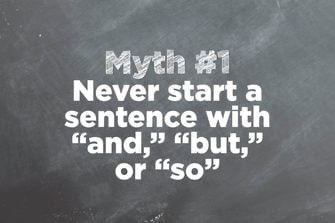
According to the grammar experts at the Chicago Manual of Style, there is no actual rule that states it’s an error to start a sentence with a conjunction. And I believe them.
Image: Tatiana Amazon/rd.com
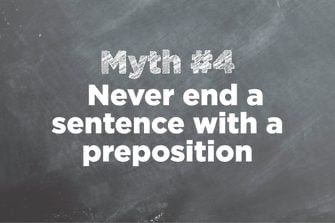
That age old rule of not ending a sentence with a preposition creates strange sentences such as, “What city from where did he travel?” instead of “What city did he come from?” Sometimes a sentence just has end naturally, like it’s supposed to.
Image: Tatiana Amazon/rd.com
Ah, the old discussion about splitting infinitives. First off know what an infinitive is before considering the need to split it. Says Wikipedia: An infinitive is a verb form that is used as a non-finite verb.
An example would be the well known tag line: “to boldly go where no one has gone before.” “To go” is the infinitive, and “boldly” splits it. No harm, no foul.
Image: Tatiana Amazon/rd.com
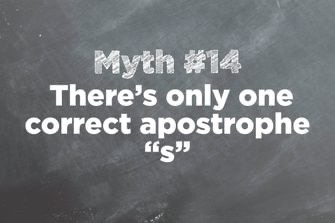
What to do when faced with the dilemma of adding that apostrophe “s” to a word ending in “s”? Which way is the write way (see what I did there?)
I’m going to go over to see Mr. James’s new car.
I’m going to go over to see Mr. James’ new car.
Trick question. They are both correct. It comes down to preferred style and consistency, using the same form throughout the writing is essential. Or it can be confusing to all those readers’ understanding of what your style is all about.
It’s here. The day you have been waiting for. Yes! It’s Talk Like Shakespeare Day, which happens to coincide with the day historians figure to be both William’s day of birth and day of death: April 23.
As an English teacher I had zero background in Shakespeare as somehow his works were never taught, presented, or discussed in my school days. And this took place in a modern school district!
This meant I came to the classroom on the same playing field as my students: zero knowledge and lacking comprehension. I dove right in and learned as much as I could in order to sound like I knew what I was talking about.
Something clicked because I am a professed Bardinator today and even attended Folger Library’s Hamlet Academy back in 2015. I am also adapting Shakespeare plays into reader’s theatre scripts and they are regular sellers on my Teachers Pays Teachers website.
All in all I’m quite pleased to have traveled the journey, transforming from Shakespeare zilch to Shakespeare rich over the years.
However, to talk like Shakespeare is a talent I am not quite conversant in yet. I did find this nifty website which takes randomly generated sentences and turns them into Shakespearean speech. I am having fun playing with it. Here are some examples:
Crouch before you jump or miss the mark. Our plans right now are hazy.
Becomes—
Crouch bef’re thee jumpeth ‘r misseth the marketh. Our plans even but now art hazy.
Or—
It was done before the boy could see it. Hop over the fence and plunge in.
Becomes—
T wast done bef’re the knave couldst seeth t. Hopeth ov’r the fenceth and plunge in.
This marks my 1000th post with WordPress. Wow! That snuck up fast.
I began a blog a few years back (2012?!?)as a means of diving into the social media pool, which was a strong suggestion from an editor at a writer’s conference. After some initial research WordPress seemed to be the best format to go with and I joined up creating my Cricket Muse persona. I wrote about life as a teacher, writer, reader, and reviewer. I’m sticking with the same routine, and have added monthly posts: Bard Bits (all about Shakespeare), How Cliché, (those overdone everyday sayings we use), and Word Nerds (awesome vocabulary choices). Although I am now retired, I still reference my days as a teacher. You know the saying–You can take the teacher out of the classroom but you can’t take the classroom out of the teacher.
Up until 2020 I wrote as Cricket Muse and then when my debut picture book hit the bookstores (timed around when bookstores, libraries, and schools shut down for the Pandemic–so much for a live book launch) I revealed my true identity as Pam Webb. I really did like that alter ego anonymity, but I had made a promise to myself that I would create a professional website once I became published. Here I am three years into being a published author and so far so good.
The perfect gift for grandparents and grandkids!
Along the way as a blogger I made some friends, bloggy pals, Mike Allegra ‘s term. To me a bloggy pal is someone who leaves commentary, going beyond just liking a post. Mike has plenty to say and is a longtime bloggy pal. He and I even had a fun little exchange for awhile called Debateables, where we debated on topics related to children’s literature. Check out this lively season-related Debateable concerning reindeer versus penguins.
Other bloggy pals collected along the way are Chelsea Owens, who runs a bad poetry contest–her term, not mine (and thank you for being a Someday supporter, Chel), Mitch Teemley, who is creative, prolific, and funny (thanks for featuring my blog, Mitch!), Tref, provider of unique perspective in his blog Trefology (thanks for popping in now and then with your punnery, Tref), Pete Springer, fellow retired teacher who keeps me posted about Humboldt life (thanks for your genuine insights, Pete), Jilanne Hoffmann, who shares a love of kid lit (thanks for the author support, Jilanne!).
Sadly, there are many posters who have disappeared over the years–supposedly the average life span of a blog is 100 days. I guess I’m just tenacious or I am not ready to give in to being a statistic. To those former bloggy pals, you are missed. On the other hand I have seen an uptick in new commentators, like Boo, Kimber Templin, Becky Ross Michael, Gary Anderson, Cathy Native Cain, Damyanti Biswas, Amy of Hearthridge, Tish Farrell, Rachel Mankowitz, Book Loving Grandma, and a few others.
I look forward to contributing at least another 1,000 blog posts. Thanks for stopping by and hope to add you to the bloggy pal list.
Names can be a real stumper. Selecting the right name for a place, character, or in my current writing dilemma, a magazine.
Vogue is a hard act to follow
Names and places aren’t usually a problem when writing a story. I have dictionaries and other resources that inspire me. Yet, coming up with an invented name for a magazine is proving difficult. The frustrating part is that the magazine is only mentioned by the character a couple of times, yet it will set up more about the character if readers can associate the magazine with its connotative style. I’m a basic person when it comes to clothing (go Old Navy) so fashion magazines aren’t my usual read; however, my character, Carla, works for a fashion magazine in New York, and she is all about style. Coming up with a magazine about fashion without it actually being a real world magazine has taken far too much of my creative time.
Here are some titles I have come up with that got nixed after doing some fact checking:
Style–out there
In Style–out there
View–out there
Modus–out there
Mode--out there
Mirror–out there
Preview–out there
Clique–out there
Allure—out there
Then there is associated terms, like what The Devil Wears Prada did emulating Vogue by calling the magazine Runway. Maybe I could go there, although some terms have connotations:
Lipstick–nah
Blush–that’s leading somewhere I don’t want to go
Reflect or Reflects–sounds like a mindfulness posssibly
Today–TV show
Now–too demanding
I’m running out of ideas. Just need one word, maybe two, that both entices the reader to pick up the magazine and to understand what it is about. These are possibilities
Regard–-kind of like En garde, as in the directive when fencing (being on one’s toes, being ready)
Prev–a bit like “preview” as in getting in on new fashion before everyone else—possibility Preva?
Esteem-too much bragging
Sass and Saz--unbelievably are out there
Nouvo—a twist on nouveau, as in new
Maybe go with a single letter
M–oops, out there
Q–as in quest for fashion, yet too much like GQ
Z–too generational
W—yup, out there
So–I encourage you, I implore you–please help me out with possible magazine names. Think fashion. Think New York. Think chic. As incentive I will mention your contribution in the novel’s acknowledgements.









 Pam Webb