Pam Webb

a writer's journey as a reader

Archive for the tag “Poetry”

Coming to Terms with Poetry


education

education (Photo credit: Sean MacEntee)

They say the best education we receive is that learned while teaching.  I found this to be especially true for poetry fundamentals.

I don’t recall studying poetry in jr. high English, unless studying Simon and Garfunkel’s “Sounds of Silence” counts.  As for high school, I remember short stories, yet nothing on the poetry radar comes up for remembrance. College yes, ohmagoodness, poetry aplenty. I do recall a cacophony of emotions as I partook in the banquet of poets found in my Norton Reader. I transversed from embarrassment to  gratitude as I feasted on William Carlos Williams, Ezra Pound, Sylvia Plath and others I had not known existed.  Why, oh why, did I feel the compunction to resell my Norton at the campus bookstore?  College students out there?  Think twice before reselling your textbooks.  All those annotations and well-visited markings really do become appreciated some day.

norton reader

norton reader (Photo credit: cdrummbks)

These days I’m teaching to Common Core Standards and have come to terms with poetry.  They are an absolute on the schedule of attained knowledge.  I also have my AP crowd to cater.  Although I have over 200 literary terms we learn over the course of  the year in AP, I start out my ninth graders with double dozen or so.  How many do you know or remember?

  1. accent: emphasis or stress given a syllable or a particular word.
  2. alliteration: the reiterated initial consonants in prose or poetry.
  3. anaphora: repetition of an opening word or phrase in a series of lines.
  4. assonance:  the repetition of two or more vowel sounds in successive words, creating a type of rhyme.
  5. ballad: a song which tells a story; also be a poem with songlike qualities which tells a story.
  6. blank verse: the most common meter of unrhymed poetry in English; it lacks stanza form and rhyme.
  7. caesura: a pause within the line of verse.
  8. conceit: a fanciful expression, usually in the form of an extended metaphor or an analogy that usually displays intellectual cleverness due to the unusual comparison being made.
  9. consonance: a close similarity between consonants or groups of consonants, especially at the ends of words, e.g. between “strong” and “ring.”
  10. couplet: two consecutive lines of poetry that rhyme, and often have the same meter
  11. diction: the selection of words in a particular literary work, or the language appropriate for a particular (usually poetic) work.
  12. doggerel: crude verse that contains clichés, predictable rhyme, and inept meter and rhythm.
  13. elegy: a poem which mourns the death of someone.
  14. enjambment: when one verse runs into another verse
  15. epic: a long narrative poem on a serious subject, usually centered on a heroic or supernatural person.
  16. epigram: a short poem, which can be comical.
  17. figurative language: language which goes beyond what is denoted (see denotation), and has a suggestive effect on the reader; a figure of speech is part of figurative language.
  18. free verse: poetry which lacks a regular stress pattern and regular line lengths (and which may also be lacking in rhyme). Free verse should not be confused with blank verse
  19. haiku: Japanese form of poetry of seventeen syllables with three unrhymed lines of five, seven and five syllables
  20. heroic couplet: a couplet with iambic pentameter
  21. iamb: a metrical foot of one short or unstressed syllable followed by one long or stressed syllable.
  22. imagery: often taken as a synonym for figurative language, but the term may also refer to the ‘mental pictures’ which the reader experiences in his/her response to literary works or other texts.
  23. kitsch: sentimentality, tastelessness, or ostentation in any of the arts.
  24. limerick: a five line humorous poem involving a fixed aabba rhyme scheme
  25. lyric: a short non-narrative poem that has a solitary speaker, and that usually expresses a particular feeling, mood, or thought.
  26. metaphor: a direct comparison–it does not use “like,” “as,” or “than.” In literature it is a figurative statement asserting one thing is something that it is not.
  27. meter: the recurrence of a similar stress pattern in some or all lines of a poem.
  28. ode: a relatively lengthy lyric poem, usually expressing exalted emotion in a complex scheme of rhyme and meter.
  29. onomatopoeia: a word or expression which resembles the sound which it represents, like the meow of a cat or the quack of a duck.
  30. pastoral: usually written by an urban poet who idealizes the shepherds’ lives. The term has now been extended to include any literary work which views and idealizes the simple life from the perspective of a more complex life.
  31. prosody: the rhythm of spoken language, including stress and intonation, or the study of these patterns
  32. repetition: the duplication of any element of language such as a sound, word, phrase, sentence, or grammatical pattern.
  33. rhyme: the identity of the sounds of the final syllables (usually stressed) of certain proximate lines of a poem.
  34. scan: to assign stress patterns to a poem.
  35. simile: a figure of speech that draws a comparison between two different things, especially a phrase containing the word “like” or “as,” e.g. “as white as a sheet.”
  36. symbol: a person, place, thing, or event that stands both for itself and for something beyond itself.
  37. syntax: how an author chooses to join words into phrases, clauses, and sentences; similar to diction which is focused on individual words, yet syntax is concerned with groups of words.
  38. theme:  the central idea or insight about human life revealed within the work.
  39. tone: the attitude, as it is revealed in the language of a literary work, of a personage, narrator or author, towards the other personages in the work or towards the reader.
  40. voice: the writer’s distinctive use of language, which is created through the use of a writer’s tone and diction.

 Okay, there is about a triple dozen and a dose for good measure here. Some terms crossover into prose which is why we start off with poetry before short stories. We’ve found our students grasp analyzing smaller chunks of literary concepts and then retain those terms and skills for the longer works.

So, how did you do?  I didn’t include the various types of poems in this set.  Stay tuned…

Happy Poetry Month

Poetry

Poetry (Photo credit: Kimli)


Poem Delivery Service


http://www.poets.org/poemADay.php

Wading through countless updates, newsletters, and ads can be annoying, if not time consuing.  Yet I signed up for one more inbox filler, and I am finding it not a nuisance, rather it’s a shot of morning freshness: I signed up for Poets.org Poem-A-Day. Granted it’s only my third day; however, it makes me stop and reflect on the power of verse, plus I get to discover new poets. 

During the week it’s contemporary and the weekends it’s classics. Definitely a perfect blend. So click on the opening link and wake up to the fragrance of verse delivered fresh daily.

Happy Poetry Month!


Take Your Next Poem to Lunch


poetry

Silently mulling over the words, she reflected in her repose as she drank deeply of the healing verse before her….

Stop–cut–

Really, poetry doesn’t have to be all artsy, angsty to be enjoyed. The reflective part is okay, but honestly, poetry can be much more rewarding as an outward expression through sharing. During Poetry Month try some of these verse interactivities:

1.  Randomly leave a poem around the office or break room.

2.  Pack poems in your lunch for at least a week–you know, a read ’em and eat kind of thing

3. Sign off your signature with a line from a favorite poem

4. Use a poem for a bookmark

5. Memorize a poem–one you don’t know (Robert Frost won’t mind this time)

6. Read up about a poet–most have led amazing lives

7.Watch a movie with poems–I suggest Dead Poets Society

8. Chalk poems on the sidewalk

9. Attach a poem to a balloon and release it

10. Revisit a poem–has it changed in meaning for you?

Frost Covered Spring


Robert Frost. My first meaningful encounter with poetry occurred in fifth grade when Mr. C (still my favorite teacher) had us memorize “Stopping By Woods” and then we chalked our impressions of the poem onto dark blue construction paper. These were then pinned all around the classroom as the border above the chalkboard. As I teach this poem to my students I learn more and more from it. Frost does that with his poetry. It appears so deceptively simple at first and then there is a realization of its depth. It can be almost embarrassing at times once the analytical epiphany hits.

But I can’t imagine Frost laughing at my denseness–no, he would probably only chuckle. I imagine he might even be amused at the fuss we make analyzing his commentaries on birches, walls, and the snowy woods.

Frost is one of my faves and thought it very appropriate to feature him first among the many poets I hope to spotlight this month.

Here are a smattering of favorite poems:
“Mending Walls”
“Acquainted With The Night”
“The Road Not Taken”
“Fire and Ice”
“Nothing Gold Can Stay”

What are your favorite Frost verses? For some reason whenever spring arrives I tend to think of Robert Frost. Maybe this is fitting–a bit of Frost helps us appreciate the warmth of spring. I think he realized that as well.

Happy Poetry Month!

20130401-215741.jpg

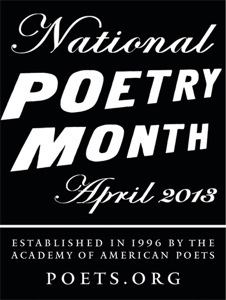
No Fooling It’s National Poetry Month


Although it’s April 1st, which means pranks, jokes, and teasing can occur, I am serious in my endeavor to post something poetical everyday in recognition of it being National Poetry Month. Be forewarned, prepared, and whatever measures you might have in mind as I bombard my blogging with a preponderance of verse, imagery, and meter.

20130401-211806.jpg

Pondering Poetry


1848 Daguerreotype of Edgar Allan Poe at 39, a...

1848 Daguerreotype of Edgar Allan Poe at 39, a year before his death (Photo credit: Wikipedia)

Poetry.  I sometimes hate to admit I love it.  It is misunderstood, mishandled, and would be missed should it ever be absent from our midst. As I teach AP I delve ever deeper in poetry and realize with some asperity I know nothing and have so much to learn.  Learning from the masters is a place to start.  May you also find solace and inspiration in these quotes found.

Poetry is serious business; literature is the apparatus through which the world tries to keep intact its important ideas and feelings.–Mary Oliver

I would define, in brief, the Poetry of words as the Rhythmical Creation of Beauty.
Its sole arbiter is Taste.
Edgar Allan Poe

A short poem need not be small.–Marvin Bell

A poem…begins as a lump in the throat, a sense of wrong, a home-sickness, a love-sickness…It finds the thought and the thought finds the words.–Robert Frost

Robert Frost NYWTS.jpg

image: Wikipedia.org


Genuine poetry can communicate before it is understood.–T.S. Eliot

For a man to become a poet…
he must be in love or miserable.
George Gordon, Lord Byron

I think like a poet, and behave like a poet.
Occasionally I need to sit in the corner for bad behavior.–Gary Soto

There is nothing wrong with a poetry that is entertaining and easy to understand.
Charles Bukowski

Poems reveal secrets when they are analyzed.
The poet’s pleasure in finding ingenious ways to enclose her secrets should be matched by the reader’s pleasure in unlocking and revealing secrets.
Diane Wakoski

#9: Poems to Know and Grow On


It’s been too long since I paid attention to my Musings of a Voracious Reader list.  Tidying up my files I discovered entry #9: Poems to Know and Grow On and it seems quite appropriate as a post-Valentine’s Day post, since poetry is the food of love (right next to chocolate).

As I teach poetry, especially as I prepare my AP students for their exams in May, I am reading more and more poets and poetry.  This is a good thing.  In fact, I am now taking on what I have deemed as the “Emily Project” which is discovering Emily Dickinson.  Understanding her would be another project in itself.

As I teach, read, and study poems I have gathered a few along the way.  I dearly wish I had a better knack for memorization because I would like to pull out a poem for any occasion and dazzle, delight, and demonstrate the power of poetry to any willing listener. I love it when that moment arrives in a movie when one character starts a poem and another finishes it.  Remember Willoughby and Marianne from Sense and Sensibility? *sigh*

This is simply a sprinkling of poems I have deemed worth knowing and to grow on:

1. My First Memory (of Librarians) by Nikki Giovanni–a Book Booster’s banner poem of delight

2. Harlem (A Dream Deferred) by Langston Hughes–his imagery is enviable

3.Introduction to Poetry by Billy Collins–enjoy poetry, don’t tie it to a chair and beat a confession out of it (love this)

4. Hope Is A Thing With Feathers by Emily Dickinson–hope wings its way into our hearts

5. The Road Not Takenby Robert Frost–almost clichéd by its overuse, it’s still a powerful statement about making choices

6. The Jabberwocky by Lewis Carroll–delightfully fun for any age

7. This Is Just To Say by William Carlos Williams–after I discovered this was actually a note to his wife I embraced the poem even more

8. The Tyger by William Blake–imagine seeing a tiger for the first time; how can something so exquisitely beautiful be also so incredibly deadly?

9. One Art by Elizabeth Bishop–the more I read Bishop the more I realize what talent she has for capturing life’s moments

10.I Hear America Singing by Walt Whitman–“a sweaty-toothed madmen” claimed Todd from Dead Poets Society, when asked what he thought of Uncle Walt; Whitman is clearly underrated (check out the Poem Flow when you hit the link or better yet check out this YouTube)

11. Sonnet 130 by William Shakespeare–the Bard employs his wit whilst he poketh funneth at the syrupy nature of sonnets

12. We Real Cool by Gwendolyn Brooks–no matter the era, youth’s self-destruction prevails

13. Fog by Carl Sandburg–its simplicity speaks volumes

14. The Daffodils by William Wordsworth–my heart gladdens of spring’s promise as the daffodils lift their golden heads above winter’s chilly grasp

And there are  fourteen poems, a drop of verses in the deep well of that which stirs the soul, as a nod to Valentine’s Day and the tradition of sweet rhymes, chocolate, and roses.

One last poem to know and grow on, not necessarily my favorite, but definitely memorable.  True love is memorable, as Poe so deftly renders in this tribute to his lost love. This one usually makes my ninth grade students pause, which is one reason I refer to it.

Annabel Lee

by Edgar Allan Poe
It was many and many a year ago,
   In a kingdom by the sea,
That a maiden there lived whom you may know
   By the name of Annabel Lee;
And this maiden she lived with no other thought
   Than to love and be loved by me.

I was a child and she was a child,
   In this kingdom by the sea:
But we loved with a love that was more than love--
   I and my Annabel Lee;
With a love that the winged seraphs of heaven
   Coveted her and me.

And this was the reason that, long ago,
   In this kingdom by the sea,
A wind blew out of a cloud, chilling
   My beautiful Annabel Lee;
So that her highborn kinsman came
   And bore her away from me,
To shut her up in a sepulchre
   In this kingdom by the sea.

The angels, not half so happy in heaven,
   Went envying her and me--
Yes!--that was the reason (as all men know,
   In this kingdom by the sea)
That the wind came out of the cloud by night,
   Chilling and killing my Annabel Lee.

But our love it was stronger by far than the love
   Of those who were older than we--
   Of many far wiser than we--
And neither the angels in heaven above,
   Nor the demons down under the sea,
Can ever dissever my soul from the soul
   Of the beautiful Annabel Lee:

For the moon never beams, without bringing me dreams
   Of the beautiful Annabel Lee;
And the stars never rise, but I feel the bright eyes
   Of the beautiful Annabel Lee;
And so, all the night-tide, I lie down by the side
Of my darling--my darling--my life and my bride,
   In her sepulchre there by the sea,
   In her tomb by the sounding sea.

Virginia Poe watercolor painted after her deat...

Virginia Poe watercolor painted after her death in 1847. From eapoe.org Category:Edgar Allan Poe (Photo credit: Wikipedia)

Getting Lively with Dead Poets


Poetry

Poetry (Photo credit: Kimli)

Tuesday marked the start of our AP Poetry Unit.  I am so excited we are finally onto poetry!! Poetry is the curry of prose.  It’s the sprinkles found in exposition.  It’s the center of the Tootsie Pop because it’s that delightful surprise unexpectedly found in the middle of the everyday. 

Poetry is not just rhyme.  It’s not just meter.  It’s not slavering on about metaphor and simile.  It’s bounce, giggles, shock, and awe.  Poetry is the dance of words.  Poetry is that note of praise found nestled in the staunch flow of sentences, paragraphs, and text.

It’s sing.

It’s song.

It’s the azure found in the sky.

It’s the You before I.

It’s older than the page before you.

It’s Homer before he became a Simpson.

And the Dead Poets are the best because their words formed the path for the rest.

Oh, hello Emily, Robert, William, Byron, Coleridge, Sylvia, Langston, Gwendolyn–I’d like you to meet my students.  I’ve been telling them about you.  I can’t wait for them to know you like I’ve gotten to know you.  And I can’t wait to learn more about you as I learn from my students.

Poetry. Word colors of our world.

when I said "I ate all your tootsie pops&...

when I said “I ate all your tootsie pops” (Photo credit: hmmlargeart)

Of Verses, Lines, and Rhymes


April is definitely a busy month.  What with taxes, Easter, spring break, Script Frenzy, and watching for daffodils (because then I know spring has finally arrived) there is a lot to do.  Somehow I get around to celebrating poetry by gathering together various poem activities and presenting them to my students.  And I try to get a couple of new poems flowing out of the winter attic.

As for NPM there is a lot of ground to cover. Got a question?  Here are some answers:

National Poetry Month FAQ
  1. What is National Poetry Month?
  2. Who started it?
  3. When is National Poetry Month?
  4. Why was April chosen for National Poetry Month?
  5. What are the goals of National Poetry Month?
  6. Shouldn’t we celebrate poetry all year round, not just in April?
  7. How does the Academy celebrate National Poetry Month?
  8. Do organizations need permission to participate?
  9. What can I do to celebrate NPM?
  10. How can teachers become more involved?
  11. How can librarians become more involved?
  12. How can booksellers become more involved?
  13. Does it cost anything to celebrate National Poetry Month?
  14. Can other organizations use the NPM logo?
  15. Do I need permission to use the NPM logo?
  16. How can I obtain a copy of the National Poetry Month poster?
  17. How can I support National Poetry Month?

Also, here are some really fun poetry videos to celebrate the diversity of poetry:

Adorable kid who loves poetry, reciting Billy Collins “Litany.  I’m inspired to memorize.

And if you want the real deal–here’s Billy Collins, himself.  I love how he pokes fun at the perceived seriousness of poetry.  I think he and Billy Shakespeare would have had a great friendship.

If you haven’t ever experienced Taylor Mali‘s poetry I hope you will be as enthralled with his tribute to teachers (because he is one) as I am:

April definitely is beautiful…

Blue Skies,

CricketMuse

Post Navigation