Pam Webb

a writer's journey as a reader

Archive for the tag “Poetry”

Shaping Up Poetry: Object Poem


Object Poem

1.  Select an object
2.  Explore it using the following questions:
What does it look like?
How or why does it look like that?
What colors do you see?
What do the colors remind you of?
What does it smell like?
What does it feel like?

3.  Here is a guide to help structure your Poem:
First it is….
And then it is like…
And now it becomes…
and now it is…
And now it is…
And now I am …

Here is an excerpt from Gift from the Sea by Anne Morrow Lindbergh.  Listen for the comparisons and descriptions based on the poem guide.

This snail shell, round, full and glossy as a horse chestnut.  Comfortable and compact, it sits curled up like a cat in the hollow of my hand.  Milky and opaque, it has the pinkish bloom of the sky on a summer evening, ripening to rain.  On its smooth symmetrical face is penciled with precision a perfect spiral, winding inward to the pinpoint center of the shell, the tiny dark core of the apex, the pupil of the eye.  It scares me, this mysterious single eye–and I stare back.

Find an object and explore it through imagery, seeing it for what it is through expanding vision.

Forming Poetry: Terse Verse


Terse: short or brief

Verse: associated with poetry, as in a line that rhymes

Terse Verse: a short poem in which the answer is a two-word rhyme definition of the presented word

Examples:

Kleenex–sneeze please
Perfume-swell smell
Bib–drool tool
Binder–holder folder
Pencil–school tool
Baker–flour power
Candy–sweet treat
Shakespeare–stage sage
Turkey–absurd bird

Submit your best (or worst–PG, please) Terse Verse.

Over the years I’ve collected quite a few, and the students keep amazing me with their ingenuity.


Shaping Up Poetry: Found Poems


Found Poetry is another one of those amazing forms that tweak our known ideas of what poetry should look like or what it should be. So, today let’s look at finding poetry in unexpected places.

What is Found Poetry? (thanks Wikianswers)

A found poem is one in which words and phrases are taken from various sources and then strung together to make sense.

It is named because the elements which compose the poem are “found”. The words or phrases “found”, although they were written in totally different contexts and not meant to be used together, all have some kind of common theme. When placed together, they make a poem that makes sense.

Directions:

1. Grab any prose source (newspaper or magazine articles, ad flyers, instructions, directions, even textbook passages) and select a passage of 100 words or less.

2. Go through and find words and short phrases that have a “poetical” sound or are unusual or simply seem unique or interesting.

3.  If possible cut these out from the source, and if this is not feasible (some schools and libraries are picky about cutting up their books and magazines) write them down.

4.  Collect about 50 words and set them aside (roughly “find” about half of the original count 100=50).

5. Begin moving them around until the poem finds its way on the page.  One idea is to create the basic idea of the original piece. Found Poems can be typed out or formed into a collage.

Of course, these are basic guidelines and there is lots of flexibility to finding your own poem.  Here are a few examples demonstrating the creativity of this form:

First of all, go to Poets.orgto read a “legit” Found Poem.

Now, for some collage styles:


This is an example of  blocking out the words in the source (be source it’s okay to do so!):

One other example is taking prose, in this case an excerpt of a short story,  and finding a poem within it: (my rendered interpretation)

From “the Osage Orange Tree” by William Stafford
On that first day of high school in the prairie town where the tree was, I stood in the sun by the flagpole and watched, but pretended not watch, the others.  They stood in groups and talked and knew each other, and standing near the corner looking everywhere but at the crowd.

First Day
She stood lonely
as the tree
in the school courtyard.
Everyone busily
moving
and
greeting
one another
bridging summer into fall.

She stood alone,
like the tree.
I saw her.
She didn’t see me.
As you can read I didn’t follow my own directions of cutting the words down to half.  That’s the loveliest aspect of poetry–it’s aching to have its own rules broken.

Hoping you will find your own poetry in whatever prose you come across.  Finding a poem hiding within the everyday stuff words are made up of is a bonus.

Happy Poetry Month!

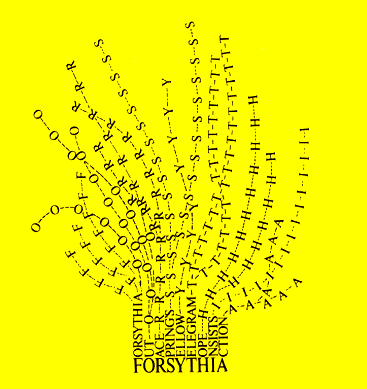
Shaping Up Poetry: Concrete Poems


One thing I truly enjoy about poetry is its diversity when it comes to form.  This week I’ll be featuring a variety of poem forms.  First up is concrete poetry.  Take it away Wikipedia:

George Herbert‘s “Easter Wings”, printed in 1633 on two facing pages (one stanza per page), sideways, so that the lines would call to mind birds flying up with outstretched wings.

Concrete poetry or shape poetry is poetry in which the typographical arrangement of words is as important in conveying the intended effect as the conventional elements of the poem, such as meaning of words, rhythm, rhyme and so on.

It is sometimes referred to as visual poetry, a term that has evolved to have distinct meaning of its own, but which shares the distinction of being poetry in which the visual elements are as important as the text.

Now that the definition is out of the way here are some examples.  Enjoy!

My students adore this form due to its playful nature, and I can often coax a poem out of them through shaping the words.  I encourage you to experiment or at least to look up more examples.

Happy Poetry Month!

Put a Poem In Your Pocket


Poem In Your Pocket Day

Although it’s National Poetry Month and poetry is being celebrated all month long, there is one special day of celebration:  Poem in Your Pocket Day on Thursday, April 18, 2013.

Simply select a special poem, one you enjoy or has a special meaning and share with co-workers, family, friends, and maybe even strangers. For those who  Twitter  share with the hashtag #pocketpoem.

Go to Poets.org to find out about special events planned around the day or how to organize your own.

Check out this amazing community event:

Poem Flow


From the “About Poem Flow”:

Poem Flow is a poem-of-the day application on the Apple app platform.

Each day a new poem flows to thousands of screens around the world. Everyone receives the same poem on the same day creating an instant, invisible community of simultaneous readers. The poems are from a mix of the greatest poems in English. Turned in your hand, each poem dissolves in a gentle reading animation. Turned back, the original poem returns.

 Poem Flow is mesmerizing in how it presents a poem. Instead of the poem being present in all its form, Poem Flow segments the words so that they words appear in digestible bits of anticipation.  The poem collection is a mix of contemporary and classics; receiving a new poem every day is like receiving a daily dose of serendipity.

You can check out the site: www.poemflow.com and experiment for yourself the wonder of a poem flowing gently across your screen.

feature 1

Spoken Poetry


Poetry is an...

Poetry is an… (Photo credit: liber(the poet);)

Have you ever attended a Poetry Slam?  This  is where poetry gets to break out of its stuffy stereotypical silently read and reflected mode.  A Poetry Slam is where poets perform their poetry.  Recitation is accompanied by dramatics and the audience gets in on the action through rating the performance.  It’s amazing.  It will forever change your opinion that poetry can only be recited in dull monotones from a podium in front of barely stirring, half-asleep listeners.

One of my favorite Spoken Poetry artists is Taylor Mali. Not only was he formerly a teacher, he is one of the few poets who is actually making a living as a poet.  Go to his website or type in his name on YouTube for any number of his videos.  Much of his poetry deals with his experiences, opinions, and outlook as a teacher.  I can definitely relate to the subject matter–yet, his words reach to a wider audience as well.

His most repeated poem is:

http://www.youtube.com/watch?v=fuBmSbiVXo0

We held a poetry slam at our local library a few years ago.  One of my students performed her work and left the audience, mainly middle-schoolers with a smattering of high schoolers, cheering and clapping.  She was supposed to go on the regionals and couldn’t due to her age (16). Who would have thought talent could be hemmed in by being too young?

Check out Poetry Slams and next time someone says poetry is boring you can plug in a Taylor Mali and then ask for their revised opinion.

Happy Poetry Month!

A Triptych of Daffodils


The Poem

The Daffodils (I Wandered Lonely As A Cloud)

by William Wordsworth

Portrait of William Wordsworth, by William Shu...

Portrait of William Wordsworth, by William Shuter, 1798. (Photo credit: Wikipedia)

I wandered lonely as a cloud
That floats on high o’er vales and hills,
When all at once I saw a crowd,
A host, of golden daffodils;
Beside the lake, beneath the trees,
Fluttering and dancing in the breeze.

Continuous as the stars that shine
And twinkle on the Milky Way,
They stretched in never-ending line
Along the margin of a bay:
Ten thousand saw I at a glance,
Tossing their heads in sprightly dance.
The waves beside them danced, but they
Out-did the sparkling waves in glee:
A Poet could not but be gay,
In such a jocund company:
I gazed—and gazed—but little thought
What wealth the show to me had brought:

For oft, when on my couch I lie
In vacant or in pensive mood,
They flash upon that inward eye
Which is the bliss of solitude;
And then my heart with pleasure fills,
And dances with the daffodils.

The Parody

http://www.youtube.com/watch?v=cv1L-8f2erg


The Possibility*

       JOY

Multicolored splendor
that’s just how my day has been
Confetti bits of happiness
round about me swirling
filled with
Dancing Bright Lights
of promise
Like spring after
a tedious winter–
a golden day filled
with pristine greens
The release of dark days
and the renewing
of earth’s
bounty
Liberating–
like the  spangle sparkle
of firecracker flickers punctuating
the night sky
Free–
grass blades shimmer emerald
tree leaves bud pink
robin song chuckle eloquent
Bright light points of promise
that dance out from the earth
tingling and jingling
into
smile
eyes
all in reach
catch that feeling
of delicious buoyant
bounce of new
and they, too
will become
Joyous like a chartreuse star
Confetti

Confetti (Photo credit: DuracellDirect)

*from the collection The Dance of Color (an exploration of synesthesia)

Imagery of Poetry


Poetry and imagery are synonymous. For fun I pulled a variety of images that celebrate National Poetry Month.

poetry

http://cabell.lib.wv.us/pages/bb-poetry09.html

Visit www.poets.ca to find out more about the League of Canadian Poets and National Poetry Month

http://lcpnationalpoetrymonth2013.wordpress.com/

From Poets.org poster gallery:

2012 Poster, designed by Chin-Yee Lai    2008 Poster  2006 Poster   2005 Poster

2004 Poster

2002 Poster                           2001 Poster

1998 Poster

1996 Poster   1997 Poster

I ordered my poster for this year, did you?

The Epicness of Poetry part three


Cover of "Paradise Lost (Penguin Classics...

Cover of Paradise Lost (Penguin Classics)

Paradise.  Lots of connotations. For some it is the place of perfection (Hawaii, for many), and for others it is the Garden of Eden, which is how Milton deemed the meaning in his epic poem Paradise Lost.

What makes this an epic poem?

For one thing it is like the other poems: BIG.  Milton transcribed a twelve book poem to his amanuensis, (he was blind at the time he “wrote” it), which came to over 10,000 lines.  He takes on the big topic of God’s way of doing things.  And there are the other  big characters of Adam, Eve, and Satan,. The theme of good and evil is a pretty big concept as well.

To understand the poem, let’s look at the poet.

File:Temple of British Worthies John Milton.jpg

image: wikipedia.org

During the 1600s in England, the government was undergoing change, which is definitely an understatement. John Milton got himself in trouble, and eventually into prison, due to his political beliefs.  As a writer, he considered himself among the upper echelon, but thought he could improve his game and be considered one of the truly big league guys (like Homer and Virgil) if he, too, wrote an epic poem.  Although he’d been planning to write Paradise Lost for some time, it’s thought his disenchantment with England’s government might have also been a catalyst for writing about a paradise (his country’s government) being lost.

The Poem
(thanks, Shmoop, you always say it so much better)

The other thing about epic poetry that you should know is that it always begins in medias res, or in the middle of things. This means that the poem begins, and then usually gives you a back-story before returning you to where you began, and then moving forward. For example,Paradise Lost begins with Satan already in Hell, but all the events leading up to it are narrated in Books 5 and 6. Similarly, the creation of the world, of Adam, and of Eve takes place sometime between Satan’s fall and the solidification of his plans for revenge (Books 1-2), but the creation is described in Books 7 and 8. In other words, the poem begins somewhere in the middle of the story, but then goes back and fills in the details. In medias res, baby.

Now, Milton’s poem doesn’t deal with war or the foundation of one of history’s greatest empires, and in this respect his epic poem is different from most of his major generic forebears (Homer, Virgil, and Spenser chief among them). While we do have a huge battle sequence in Book 6, something about it just seems funny. For example, it’s hard to take the battle seriously because we already know the outcome (Satan loses, which we learn in the very first book of the poem); if we’ve somehow forgotten the outcome, however, we always get the sense that God is going to win. The weirdness of Book 6 is explained at the beginning of Book 9, where Milton says flat out that he’s not interested in the type of martial heroism typical of epic poetry. He’s more interested in a type of internal, spiritual, Christian heroism, what he calls the “better fortitude/ Of patience and heroic martyrdom/ Unsung [i.e., not sung about in previous epics]” (9.31-33).

And he sticks to his guns: one could very well characterize Paradise Lost as an epic poem about “patience,” if only because it is Adam and Eve’s impatience that is the cause of their downfall. Now you might be asking yourself, what’s epic about patience, Adam, Eve, etc.? Well, for the Christian world, Adam and Eve’s story is of comparable significance as the founding of Rome or the Trojan War. According to the Judeo-Christian tradition, by eating the Forbidden Fruit, Adam and Eve introduced sin and death into the world, two very serious consequences. Seriously, who likes death?

Post-Thoughts

Paradise Lost is not light reading. Furthermore, it can be overwhelming to read, plus it addresses (for some) an uncomfortable topic. Nonetheless, Milton tackles the subject of choice (free will) in an eloquent manner, and his epic poem set a standard for tone and diction for English poets (probably all poets).  I have to admire a writer who dedicated so much time to one particular work. The results prove that tenacity and perseverance are part of a writer’s toolbox.

Post Navigation