A healthy portion of my reading and viewing interest involves British ones, (or UK, since I like a good go at Scottish stories), and while I can mostly figure out context, there are times when the chosen vernacular requires clarification.
As a subscriber to Dictionary. com (you should if you haven’t yet–it’s a must for bonafide Word Nerds) I daily get delivered, warm and fresh, new ways to look at words. Recently the focus for the day was how some words look the same but are either pronounced differently or mean something differently depending which country the story hails from. Viva la difference UK and USA.
Some choice examples: American (Big Apple) British (Big Ben)
football=soccer
cotton candy=candyfloss
apartment=flat
french fries=chips
cookie=biscuit
cell phone=mobile
parking lot=car park
awesome=brilliant
Should the next time you read a PD James or tune in for a BBC show and if what the characters say leave you flummoxed, it’s hoped that you’ll be more on the uptake from getting the low down.
Your search for that precise descriptor has ended with this batch of discovered words. I must admit I am familiar with “twaddle” and have come across “quidnunc” no doubt due to those old English mystery novels from the forties that I favor.
kyoodle: to bark or yelp noisily or foolishly
gloze: to explain away
twaddle: silly, tedious talk or writing
otiose: serving no practical purpose or result
recondite: relating to, or dealing with something little known or obscure
parlous: full of danger or uncertainty
drouk: to drench
elucubrate: to produce (something) by long and intensive effort
opprobrium: harsh criticism or censure
quidnunc: person who seeks to know all the latest news or gossip
I need to find a way to work “kyoodle” into a conversation.
Which three letter word sports the current title of having the most definitions?
A. lie
B. set
C. run
Lie?
Sorry—only two : to tell something that is untrue or to assume a horizontal position.
I’m not lying about not taking word knowledge lying down
Set?
Previously the champ, the Oxford English Dictionary (OED—THE leading dictionary) tagged it with 200 meanings, starting with the expected “put or lay something down” and then running on for another 32 pages with various meaning. Speaking of run—
Run?
Congratulations on this pick as the OED folk have determined that this little word carries a whopping 645 definitions. Impressive, right?
Here’s a sample (taken from RD.com)
When you run a fever, for example, those three letters have a very different meaning than when you run a bath to treat it, or when your bathwater subsequently runs over and drenches your cotton bath runner, forcing you to run out to the store and buy a new one. There, you run up a bill of $85 because besides a rug and some cold medicine, you also need some thread to fix the run in your stockings and some tissue for your runny nose and a carton of milk because you’ve run through your supply at home, and all this makes dread run through your soul because your value-club membership runs out at the end of the month and you’ve already run over your budget on last week’s grocery run when you ran over a nail in the parking lot and now your car won’t even run properly because whatever idiot runs that Walmart apparently lets his custodial staff run amok and you know you’re letting your inner monologue run on and on but, gosh—you’d do things differently if you ran the world. (And breathe). Maybe you should run for office.
And I have run the course on this post. Until next time.
With rowdy robins cheeruping all over the yard and bright green daffodils points bravely peeping up through the soil my vocabulary is attuned to springtime words.
nidificate: to build a nest–I’m seeing either last year’s nests populating the border hedge or there are some really early birds getting into that springtime feeling
kilig: a feeling of exhilaration or elation–that most excellent sense of “aah, yes” when the sun pops out and it is warm enough to sit outside and read and doze and doze and read.
wakerife: wakeful or unable to sleep–um, that would be related to DST…
psithurism: a whispering sound, as of wind among leaves–although lately it’s been more of a shout with wind gusts of 20 mph.
tootle: to move or proceed in a leisurely way–late afternoon walk around the block once the sun breaks through those cloudy skies.
sibylline: mysterious; cryptic–just how do the robins know when to return?
bagatelle: something of little value or importance; a trifle–my attitude towards housework when deciding to clean or read a book outside.
inveterate: settled or confirmed in a habit, practice, feeling, or the like–it is indeed my habit to spend as much time as possible once the snow vacates the yard and the temperature is edging towards the upper end of the forties.
When it is considered spring for you? And what word best describes your thoughts on this welcome season?
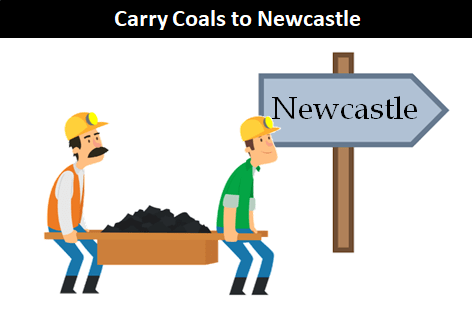
Carry Coals to Newcastle: to do something unnecessarily. The expression stems from Newcastle-upon-Tyne located in northeastern English. Henry III granted Newcastle a charter to mine coal. Becoming a major coal center, they would not be in need of coal as it would be unnecessary. Similar sayings are found in other countries, such as in French it is said to “carry water to a river.”
Image: grammarmonster.com
Cold Comfort: of little consolation. Although it is not known the origination of the expression, Shakespeare liked it enough to insert in a few of his plays such as The Tempest and The Taming of the Shrew.
Cold Hands, Warm Heart: just because someone seems unresponsive, that does not men they can’t express emotions. It’s thought Vincent Lean contributed the saying in a 1902 collection of sayings. Another interpretation is a person can be both rational and compassionate.
Image: desginbundles.net
To Pour Cold Water On: to discourage enthusiasm or pleasure. This saying dates back to Roman times from Plautus who said “They pour cold water on us.” Cold water can definitely dampen an otherwise good time.
Come Off It: be realistic, no fooling around. This American slang term comes from the 1900s and stem from the action of coming down from a higher place, such as dismounting from a horse, with the idea of being on the same level as the other person standing on the ground.
Cool As A Cucumber: composed, not rattled. It’s true: cucumbers are cool. It’s believed the inside of a cucumber is 20 degrees cooler than the outside air. Since this expression can be dated to 1732 writer John Gay, who wrote “I…cool as cucumber could see the rest of womankind,” one wonders how they figured, or even decided, to see if a cucumber was really all that cool.
Crazy As A Loon: unconventional behavior noted. There are different thoughts on this saying. Granted, the cry of a loon is quite unnerving. There is also the idea that the behavior of a loon is considered unconventional when flocks of loons seemingly fly erratically at each other over a frozen pond. This gives way to the expression of being “loony,” but in fact this loony refers to “lunar” or the phases of the moon. And we all know how a full moon can influence behavior.
Cry One’s Eyes Out: weep in extremity. Although it is not possible to actually cry until one’s eyes fall out, it may seem so in the throes of an emotionally draining situation. In a 1705 play, The Careless Husband, a line stated, “I could cry my eyes out.” The saying is sometimes referred to as “Crying one’s heart out.”
Image: Time.com
To Curry Favor: attempting to extract a means of getting ahead. In the sixteenth-century there was a satirical romance involving a horse named Fauvel who represented cunning. To groom or curry the horse indicated someone was hoping to enlist its use. Fauvel became “favel” and eventually became “favor” over time.
Cute As A Button: appealing in appearance. “Cute” is derived from the 17th century “acute” which meant, shrewd, ingenious, and even clever. Somehow, the word transferred to meaning “attractive in a dainty manner” perhaps being associated with buttons which are small and for the most part, attractive.
Image: Cardly.net
Stay tuned as the “D” section is set for next time another batch of clichés are explored.
It’s December, the last month of the year. Getting through another tough year might involve celebrating and celebrating might also involve some appropriate words.
nimiety: excess, overabundance
galimatias: confused or unintelligible talk
pharaonic: impressively or overwhelmingly large, luxurious, etc.
foozle: to bungle; play clumsily
effulgent: shining forth brilliantly; radiant
specious: apparently good or right though lacking real merit; superficially pleasing or plausible
brummagem: showy but inferior and worthless
encomium: a speech or piece of writing that praises someone or something highly
terpsichorean: pertaining to dancing
shivoo: a boisterous party or celebration
So, celebrate this last month of a challenging year, and let’s hope the new year brings new hope and healing.
I was quite chuffed, having received quite a positive response from my Kangaroo Words post.
And there it was—another strange lexiconical usage of a word. You see “chuffed” (British slang) can mean one is pleased or displeased. It becomes its own antonym. These words are known as “contronyms.”
Some say (including the hubs) “nerd” is derogatory. I’m of the opinion a nerd is less of an insult and more of an endearment, or at least an acknowledgement of pursuing a passion with zeal, that others might not embrace. For instance, the movie The Nutty Professor, had the singular inventor trying to prove his “flubber” invention. Deemed eccentric, the professor for all his nerdy qualities became a hero. All those computer geniuses (now CEOs and billionaires) were no doubt shuffled into the nerd nomenclature in their tinkering phase. I see “nerd” as an alternate spelling of “clever,” besides the assonance of “Word Nerd” is cool sounding.
Onward to this month’s batch of words—although if you want to jump in with your thoughts about nerds, I am much interested.
1. bight: a bend in the river or the shore of the sea.
2. limb: to portray with words; describe.
3. comity: mutual courtesy; civility
4. sobriquet: nickname
5. epizeuxis: a literary or rhetorical device that appeals to or invokes the reader’s or listener’s emotions through the repetition of words in quick succession. An example:
“Jane, Jane, Jane—you are my favorite epizeuxis.”
6. inanition: lack of vigor, lethargy
7. juberous: uncertain; undecided;dubious
8. aroint: begone as in “Aroint thy, scalawag!”
9. legerity: physical or mental quickness; agility
10. doddle: something easily done. Fixing the flat tire wasn’t a problem at all—it was a doddle.
11. blatherskite: someone given to empty talk.
12. spang: directly; exactly
13. butyraceous: containing or resembling butter.
14. cachinnate: to laugh loudly or immoderately.
15. illation: an inference; a conclusion
16. totis viribus: with all one’s might
17. ambivert: a person between an extrovert and an introvert*
18. caduceus: dropping off early as in The leaves were noticed to have a caduceus departure this autumn.
19. mardy: grumpy, sulky
20. clement: mild in disposition; compassionate
*this word, ambivert, solves the puzzle of designation. A few within my circle have often contemplated how to most accurately describe our situation of being known as social, even boisterous, yet reluctant at joining large gatherings. Suggestions have included “high-functioning introvert” or “gregarious hermit.” The classification of “ambivert” seems acceptable, although the desire to write with either my left of right hand suddenly becomes immediate.
What words leapt out at you as keepers this month?
May I get personal? An ambivert perhaps you are? (Yoda syntax is less intrusive)
Oops–forgot about November’s word collection. The best solution is to double up. Here we go:
scilicet: to wit, namely
2. doover: a thingamabob; thingamajig
3. unctuous: excessively smooth, suave, or smug
4. dilly: something or someone regarded as remarkable
5. withershins: in a direction contrary to the natural one, especially contrary to the apparent course of the sun or counterclockwise: considered as unlucky or causing disaster.
6. mondegreen: a word or phrase resulting from a mishearing of another word or phrse, especially in a song or poem.
7. bolide: a large, brilliant meteor, especially one that explodes; fireball.
8. egalitarian: asserting, resulting from, or characterized by belief in the equality of all people, especially in political, economic, or social life.
9. bellicose: inclined or eager to fight; aggressively hostile; belligerent; pugnacious.
10. fain: gladly; willingly.
11. whinge: to complain; whine.
12. fomet: instigate.
13. evanescent: vanishing; fading away; fleeting.
14. mirabilia: marvels; miracles.
15. obfuscate: to make obscure or unclear.
16. tome: a book, especially a very heavy, large or learned book.
17. plaudit: an enthusiastic expression of approval.
18. rodomontade: vainglorious boasting or bragging; pretentious, blustering talk.
19. sinistrality: left-handedness.
20. bight: a bend or curve in the shore of a sea or river.
I am delighted and amazed at the amount of words that are out there that I had no idea existed, but they say so well what needs to be said.
Favorites this round:
whinge–sounds like a combination of wind and whine, for those times when a simple sniffle just won’t do.
mirabilia: amazing wonders need such a word
tome: a big book needs such a term
rodomontade: bragging sounds like something worth bragging about with this word

















 Pam Webb