Your search for that precise descriptor has ended with this batch of discovered words. I must admit I am familiar with “twaddle” and have come across “quidnunc” no doubt due to those old English mystery novels from the forties that I favor.
kyoodle: to bark or yelp noisily or foolishly
gloze: to explain away
twaddle: silly, tedious talk or writing
otiose: serving no practical purpose or result
recondite: relating to, or dealing with something little known or obscure
parlous: full of danger or uncertainty
drouk: to drench
elucubrate: to produce (something) by long and intensive effort
opprobrium: harsh criticism or censure
quidnunc: person who seeks to know all the latest news or gossip
I need to find a way to work “kyoodle” into a conversation.
Recap: Part One addressed the situation of setting up a really boss BBQ area in the backyard only to have proximity issues with a new neighbor.
As Paul Harvey used to say: “Now for the rest of the story…”
Got the table-
Ready—-
Got the BBQ kettle-
Set
Got a lovely setting-
No go-
Yes-it was a No Go for the BBQ area because of the neighbors.
They had moved in right after we had arranged everything and set up their living space so close to ours it was going to be awkward to hang out in our backyard.
Plus, wanting to be good neighbors we accommodated their needs to raise a family so we moved the BBQ grill around to the other side of the yard and forwent using the cozy cafe corner so diligently decorated. The magnificent fern in the background (an annual volunteer) clinched the Feng Shui vibe and we were sad to forego the Feng Shui. We abandoned all of it for the sake of the neighbors.
Granted, we still used our backyard, and unfortunately we got into the habit of peeking over towards the neighbors before we utilized our yard. Just trying to be considerate but maybe our intentions were misunderstood.
I thought we were coexisting pretty well until we noticed it was pretty quiet on our neighbors side.
Then we realized overnight the neighbors had disappeared. Just like that. Barely a month in residence and vanished.
We wondered if it was something we did or said and then we realized that it really comes down to location, location, location.
And our new neighbors must have decided to raise their family in a more private area.
I have to say though they did overstep their sense of boundaries as I did catch them sometimes cutting through our yard.
“Don’t mind me-just passing through.”
Yes, our new neighbors were a pair of Pee Wees—no relationship to Herman. Delightfully cute little birds who decided to build their nest on top of a utility ledge just above our outdoor dining area.
Gone. No forwarding address.
Mama bird diligently stayed nest bound for a couple of weeks and though we tried to be courteous and reduce our backyard use our birdie neighbors abandoned their efforts to set up their family.
Now that they are gone we miss their presence. Isn’t that how it goes? Something that was once inconvenient becomes favorably reflected upon once absent? I haven’t seen them around in the neighborhood. I do hope their new place worked out for them.
Have you ever had to readjust your lifestyle to accommodate a bird nest?
A baker’s dozen read through July. Most were pretty good, a couple not so good, and a couple were really good reads.
Raising Hare by Chloe Dalton
This was my 100th read of the year!
An unexpected debut in that the author in all likelihood didn’t expect a book, a bestselling book at that, would be a result from her making the snap decision to rescue a leveret, a baby hare, seemingly abandoned in the February snows of the UK countryside.
By rescuing the leveret Dalton made a commitment to keeping it wild and not a pet, knowing that raising a hare in captivity is rarely successful. Hares haven’t been domesticated like rabbits, which Dalton acknowledged and respected. She changed her entire way of life to accommodate the leveret’s needs.
It’s a truly engaging story of how a wild animal can be nurtured by a human without becoming a Disney movie. Dalton writes with honesty and a poet’s eye as she describes her symbiotic life raising hare. She reflects on how it awakened her appreciation of nature, to take in the moment instead of pursuing her goals with blinders to the beauty surrounding her.
As for the hare? It lived an unusual life, benefitting from human companionship without obligation while keeping to its natural tendencies to raise a family and stretch its legs out about the countryside. Highly recommend for those who seek out positive reads involving nature.
The Cost of a Hostage by Iona Whishaw #12
Can’t Wait For the Next One
This twelfth entry of Lane Winslow and her adventures is a treat. The author places our plucky former SOE agent in Mexico with her inspector husband Frederick Darling. Kidnappings, bandits, nefarious war criminals are the main plot—meanwhile, in Nelson BC, Ames and Terrell man the police station, with the help of newly appointed April, and are caught up in their own crime situations of kidnapping and drug running. Both plots are well-paced. But what really stands out in this entry is the characterization,. Whishaw continues to develop and provide fully developed characters, each with their own distinctive personality.
It’s always difficult finishing one of these Lane Winslow books because it means having to wait at least another year for the next one.
I’m trying to par down my TBR list and yet so many tempting titles are out there! Anyone else have difficulty passing up a possible good read?
Well, it’s August 1st and at this point I used to see the hourglass sand of summer quickly slipping away.
the sands of summer slipping away
August would be the month that all the school supplies lining the aisles of stores and all those incessant reminders to get ready to go back to school would curb my enthusiasm to embrace the rest of summer vacation. A tiny spark of anticipation would form and increasingly grow larger as each day of August ticked by until the inevitable email would land into my inbox reminding me of all of my obligation to attend all the in-service meetings at school.
Ah–but that was then and this is now.
Three years into retirement and I welcome August and recognize summer is not over. So I shall celebrate with an original poem.
July by Pam Webb
July arrives in dragonfly fashion on star-spangled wings dancing in after June’s somewhat fickle days flitting here and wandering there. The days are full of hammock reads, lazy BBQs, and required air-conditioned nights. July is the true summer month. And when its fulsome days have dwindled down to rest
Suddenly–
July forsakes glad company and speedily zooms
into
August.
How do you view August? Is it your true summer month or the nudge that summer is ending?
I’m wondering how Robert Frost would react to these signs lately posted in my neighborhood:
First hint of decision making
Yet another hint for a serious response
Seriously, reconsider this particular road, dude
Yes, this means you
The county has had this road closed since June. Unfortunately it is a popular route to reach the local mountain where there is biking, hiking, eating, and other activities during the summer. It’s a popular tourist, and local, hot spot. People want to get there via the road most traveled. The road less traveled, sorry Robert, is causing some perplexed responses. BTW: There are two other alternative routes so a detour is not a big inconvenience.
However–
Even with all these signs that the times have changed people still drive up to the barricade as if concrete barricades don’t apply to them. Actually, cyclists, those pedaling and those zooming, have made that determination.
After nearly two months of watching people navigate this road of fair impossibility (refer to cyclist note) I have decided there are three categories of drivers:
Illiterate: obviously they can’t read and ignoring these signs serves as both a metaphorical and literal ignorance.
Determined: these are the ones that you watch on the Instagram clips, the driver you drives through the cascading, overflowing waters across the roadway because the desire to get to their destination overcomes common sense.
Entitled: as in the sign can’t possibly apply to them, so impervious ignorance sets the pace and I can’t help but snicker when they drive clear up to the barricade (which is clearly seen at the entrance of the road) sit there puzzled before making a U-turn and follow the detour sign.
Robert Frost’s poem may have spoken of the road less traveled, but I would reckon he would adhere to a detour if it deemed the better route. Then again, maybe he would have zipped through on his Harley, given the opportunity.
Poets are known to be wild when it comes to veering off the beaten path
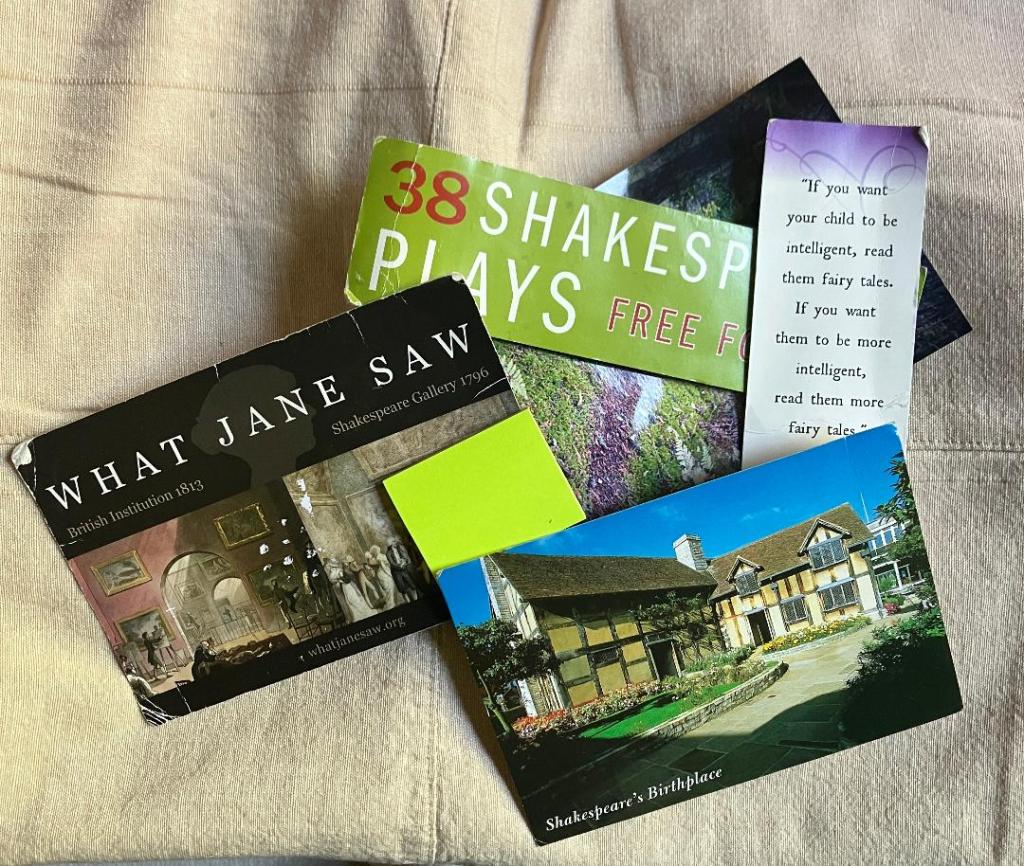
I always look forward to summer, and I especially look forward to the outdoor Shakespeare performance that comes round in August. It’s not easy waiting another month, so with the prompting of a recently vowed Folger Shakespeare Library post I will pass on some of Shakespeare’s best summer quotes because he must have really liked summer having mentioned summer over 80 times throughout his writing.
Thus sometimes hath the brightest day a cloud, And after summer evermore succeeds Barren winter, with his wrathful nipping cold; So cares and joys abound, as seasons fleet. —Gloucester, Henry IV, Part 2, Act II, scene 4
Now is the winter of our discontent Made glorious summer by this son of York, And all the clouds that loured upon our house In the deep bosom of the ocean buried. —Richard III, Act III, scene 1
And of course the most summery of his summer tributes is Sonnet 18.
Sonnet 18
Shall I compare thee to a summer’s day? Thou art more lovely and more temperate. Rough winds do shake the darling buds of May, And summer’s lease hath all too short a date. Sometime too hot the eye of heaven shines, And often is his gold complexion dimmed; And every fair from fair sometime declines, By chance or nature’s changing course untrimmed. But thy eternal summer shall not fade Nor lose possession of that fair thou ow’st, Nor shall Death brag thou wand’rest in his shade, When in eternal lines to time thou grow’st. So long as men can breathe or eyes can see, So long lives this, and this gives life to thee.
Here’s to you with a hope you can catch an outdoor summer Shakespeare performance. A wondrous season indeed exalted by a wondrous writer.
As we move on down the line of our cliché alphabet let’s get ready to take a running leap at a few “r” entries.
Raining cats and dogs:raining heavily. The origin of this common cliché isn’t certain, although it does possibly go back to Norse mythology and the obsolete word “catadupe” (waterfall) and was associated with it raining so hard that animals, most likely cats and dogs, were found drowned in the streets; hence, the logic being the skies must have released animals in the rainstorm.
Read between the lines:to understand what is being said without it being actually stated. Secreting messages within messages via code or invisible ink used to be common practice around the 19th century, which meant people might literally be reading between the lines to get the actual message. Modern day application involves listening to what is not being said to get the possible true meaning of a message.
Rags to riches:going from poverty to wealth. Fairly self-explanatory and who doesn’t appreciate a good old destitute to millionaire story? Horatio Alger was known for this particular theme in his stories and present day rags to riches real life examples include J.K. Rowling who went from welfare mom to millionaire author with her Harry Potter series. Movies and stories like The Great Gatsby and Slumdog Millionaire remain popular as audiences cheer for the underdog.
Rack your brain: to think very hard. Torture is not a means people voluntarily chose to recall some bit of knowledge, yet this was a method often employed to nudge a person into relaying some knowledge they had. The inquisitor would place the person with the needed knowledge on a device called the “rack” (refer to most medieval movies for the gruesome details) and applied pressure until the knowledge was revealed. One has to ponder if the revealed information was truly believable at that point.
Rain on your parade: to spoil someone’s enjoyment or ruin plans. It’s a common phrase but a relatively new one since parades came into popularity around the 18th/19th century, going from serious celebrations such a military pomp and circumstance to the traditional splendor of Macy’s annual Thanksgiving parade. Barbra Streisand popularized the phrase with her well-known song from Funny Girl.
Raise the roof:make a lot of noise. One origin story is how a community would come together and build a barn (aka a barn raising) and hefting up a barn roof took a whole lot of effort and was probably a bit noisy.
Raise your eyebrows:something that initiates a response of surprise or shock. It’s a human response to show surprise or shock with the facial expression of lifting up one’s eyebrows and the phrase came into popular use around the Victorian era when people had certain standards that when jeopardized might cause the subtle response of eyebrows indicating disapproval.
Raise Cain:to be disruptive or display rowdy behavior. Cain refers to the biblical brother story where Cain slays his brother Abel and it is thought the expression is to behave so unacceptably that one could raise the dead. Brotherly squabbling takes on a new context with this revelation.
Ring a bell:something sounding familiar. One origin story is how church bells have been employed through the centuries to toll time, honor the fallen, and to sound alarms—their use being a familiar part of life. While church bell ringing isn’t as common today, our familiar cell phone alarms do an adequate job of reminding us to get up and go to work.
Rake over the coals: to harshly scold. Another tortuous origin story. If the rack wasn’t enough to get someone talking there was always the method of dragging them over hot coals, perhaps giving way to the expression of hotly denying an accusation.
Rock the boat:disrupting an otherwise stable situation. This one makes absolute sense: don’t upset the boat otherwise you will end up in hot water (or maybe not, but that is an idiom that comes to mind).
Read the riot act:being chastised for unacceptable behavior. The British created the “Riot Act” of 1714, which involved reading a proclamation to dissemble any unlawful gatherings of 12 or more people or risk being charged with a felony. While riots still occur today, and with consequences, being read the riot act usually involves an unpleasant scolding.
Well, there “r” a few more clichés we could explore, but a dozen is fine without the need to rack up more Word Nerd points.
‘Tis backyard embrace time. Sunlight, flowers, birding, and BBQ. Summer is a favorable outdoorsy season.
Alas-lack of planning (and building funds) circumvented creating a deck or a patio and instead a large swath of pea gravel represents our lounging about area. Not ideal, but sufficient.
Over the years additions such as a fire pit, accompanying Adirondack chairs, flower pots, and hammocks (one for shade, one for the sun) have created a welcoming fair weather space (I stubbornly to acknowledge the coming of the long winter by not putting up the summer furniture until frost arrives and warm coat is necessary to sit outside with the fire pit becoming an essential instead of being decorative).
However, granted though all added comfortable touches created a welcome respite, what was lacking was a BBQ area.
Oh, we tried various methods. The ubiquitous red kettle tripod, even the standard propane range, but it came down to this tried and true:
my little dependable
Please no judging here with this observed statement: I thought men are born with a BBQ gene. I grew up with my Dad grilling steaks as often as he could get away with it, and my friends’ fathers also were grill kings, and in my college days the guys I knew worked the briquettes with aplomb even if they were lost in the kitchen otherwise. So I learned how to BBQ by osmosis simply because BBQ skills fell to me if my family wanted BBQ.
I will leave it at that.
So if I was to be the designated BBQer in my marriage it would be on my terms. Hence, I chose to BBQ with my trusty camping kettle. And it works well. Well, it works better now. In its previous life I would haul it to the beach and set it up on a picnic table and after a day of the kiddos playing all day we would wait for their dad to join us after work and we would enjoy a picnic. Fond memories are attached to that little BBQer. My reluctance to part with it even when tempted with other means of grilling should be understandable.
Just recently my little camping kettle got upgraded to having its own stand instead of being plonked on the ground. Empty nester funds do have a purpose. And now that there is a designated BBQ area there should be an actual dining area. Right?
That took a little more effort, yet it happened with panache. A cafe table with chairs and umbrella. No more schlepping over to the fire pit Adirondack chairs eating with plates on our laps.
Perfect.
And then trouble in BBQ bliss when the neighbors moved in.
Today is Cow Appreciation Day. And I really appreciate our bovine friends. They are noble, as well as humorous. They are inspiring with their ability to placidly spend their days grazing while they are producing milk for the masses.
Cows are so amazing they deserve the Pulitzer Prize for being outstanding contributors in their field.
Next time you quench your thirst with a cold glass of milk, or sprinkle some cheese on your pizza, or dip into that bowl of ice cream be sure to thank a cow.
Which three letter word sports the current title of having the most definitions?
A. lie
B. set
C. run
Lie?
Sorry—only two : to tell something that is untrue or to assume a horizontal position.
I’m not lying about not taking word knowledge lying down
Set?
Previously the champ, the Oxford English Dictionary (OED—THE leading dictionary) tagged it with 200 meanings, starting with the expected “put or lay something down” and then running on for another 32 pages with various meaning. Speaking of run—
Run?
Congratulations on this pick as the OED folk have determined that this little word carries a whopping 645 definitions. Impressive, right?
Here’s a sample (taken from RD.com)
When you run a fever, for example, those three letters have a very different meaning than when you run a bath to treat it, or when your bathwater subsequently runs over and drenches your cotton bath runner, forcing you to run out to the store and buy a new one. There, you run up a bill of $85 because besides a rug and some cold medicine, you also need some thread to fix the run in your stockings and some tissue for your runny nose and a carton of milk because you’ve run through your supply at home, and all this makes dread run through your soul because your value-club membership runs out at the end of the month and you’ve already run over your budget on last week’s grocery run when you ran over a nail in the parking lot and now your car won’t even run properly because whatever idiot runs that Walmart apparently lets his custodial staff run amok and you know you’re letting your inner monologue run on and on but, gosh—you’d do things differently if you ran the world. (And breathe). Maybe you should run for office.
And I have run the course on this post. Until next time.