Pam Webb

a writer's journey as a reader

Archive for the category “Libraries”

Ain’t Is Too in the Dictionary.


image: nytimes.com

The Story of Ain’t by David Skinner isn’t so much about the word itself, rather it’s more about the dictionary that elevated its use from barely tolerated to denounced celebrity status.  It’s difficult to believe that a dictionary could rock the nation, but Merriam-Webster’s Third Edition achieved that claim back in 1961.

Why care about a dictionary? Simple. As writers, words are what define us.  Pun very much intended.  Before technology made referencing a simple thumb click or flip check, a person had to physically grab a dictionary off the shelf and flip through the pages and ease down the page for the answer.  A somewhat time-consuming process, yet it proved oh so satisfying when the answer yielded the “See, I knew it!” answer.  There was also the resounding “thwack” of the cover-to-cover closure vent of being caught wrong.

On-line access has made dictionary referencing such a ready convenience that reading about the controversy about a dictionary that has been out for over fifty years seems inconsequential.  Yet, writers are wordsmiths and learning about lexicographical history is as revealing as reading up on the Wright brother to perfect piloting skills.

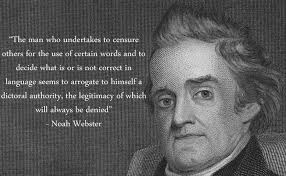
Noah Webster, long associated with the dictionary, left his legacy in the hearts, hands, and minds of capable descendants who continued the craft of prescribing proper word usage for all, that is until the 1961 Third Edition came out. A couple of wars, some cultural changes, and a few major historical events like the Depression not only changed the world, the language had noticeably been impacted.

Enter Philip Gove, the new editor who rattled the paradigm with the new (disturbing) descriptive instead of prescriptive format.  Merriam-Webster had to make room for all the new entries which meant remodeling the model so long held up in esteem.  No longer would it be the go-to reference for correctness of letter writing, titles, names, and places and other encyclopedic information; it would settle down and become a tome of how a word is used versus how it should be used.  More or less a Joe Friday approach, “just the facts, m’am.”

While at times digressive, Streeter nevertheless leads readers along his winding path of explanation as to why the Third Edition alienated newspapers, associations, and academics, irked the public and changed the manner of dictionary presentation forever.  The Story of Ain’t may not be a first pick read in terms of how-to’s and polishing writing skills; however, knowing how this particular dictionary came to be and the absolute furor it caused somehow causes pause, especially since plans for the fourth edition were announced in 2009.  Who knows how long, what, or if, any impact will be made once it hits the bookstores, since there are less and less bookstores to sell it in, now that users frequent screens instead of paper for their lexicon needs.  Now–ain’t that a shame?

Notable quotes:

Page 7:

And Merriam was very much in the business of authority.  In its own pages, Webster’s Second was “the Dictionary,” with a capital D and the definite article as if no other existed.

 Page 11:

The press release quoted Dr. Gove saying that the English language had become less formal since 1934. For an example the PR hands chose the new dictionary’s surprisingly tolerant, though oddly worded, entry for ain’t, which said ain’t was “used orally in most parts of the U.S. by cultivated speakers.”

image: sparklepony.blogspot.com

Page 30:

In those days the National Council of Teachers of English still observed Good Grammar Week, when children were called on to go seven full days without splitting an infinitive. As a reward they were treated to entertaining skits in which Mr. Dictionary vanquished the villain Ain’t. At home, however, as radios in the 1920s went from being a rare possession to a basic appliance, children might hear “Ain’t We Got Fun,” a popular foxtrot, “Ain’t Misbehavin’,” a Fats Waller song, or perhaps even “Ain’t She Sweet,” another hit song of the time.

image: yesterhair.wordpress.com

Page 49:

In the 1920s, Shall I? was still a common usage, but it would not be for long.  A few years after Fries’s study [Charles Carpenter Fries] was released, Bell Telephone allowed a researcher to listen in and count words spoken in the phone conversations of its customers. In the course of 1,900 conversations, will as an auxiliary term was used 1,305 times. Shall  appeared only six times. The long-term trend was obvious.  Twenty-five years hence, Alfred Hitchcock fans would leave the theater with the voice of a very proper Doris Day singing in their heads, using will in the first person to ask, “Will I be rich? Will I be pretty?”

Page 175:

In one instance, he said [Gove], the Webster’s Second board had spent at least an hour discussing whether hot dog should be in the dictionary. (In the end hot dog had won admission: “a heated wienerwurst or Frankfurter, esp. one placed in a split roll;–used interjectionally to express surprise or approval. Slang.”) 
Page 191:

Racy was often used to describe American English: H. L. Menchken more than once called it that. Webster’s Second defined racy as “manifestating the quality of a thing in its native, original, genuine, most characteristic state,” citing a weirdly fitting phrase from the Victorian thinker Walter Pater: “racy morsels of the vernacular.”

Page 213:

The comedian Fred Allen said, “Television is called a new medium, and I have discovered why they call it medium—because it is neither rare nor well done.” Yet its presence in the living room continued to redirect household activity, setting the table for TV dinner, dated 1954 in the Merriam-Webster files.  But one year later, another phrase was making the rounds: idiot box.

image: xk9.com

Page 230:

Said Gove: “Five basic concepts set forth in the English Language Arts supply a starting point.” Then he listed them:

1. Language changes constantly

2. Change is normal

3. Spoken language is the language

4. Correctness rests upon usage

5. All usage is relative

The concepts had been endorsed by the National Council of Teachers of English, Gove noted, “but they still come up against the attitude of several generations of American educators who have labored devotedly to teach that there is only one standard which is correct.”

image: lili.org

Page 241:

The dictionary [Merriam’s Third] weighed thirteen and a half pounds and featured 100,000 new words and senses, a massive amount of new language that Merriam called “the greatest vocabulary explosion in history,” While new words were being added, a quarter million entries were subtracted, and all remaining entries were revised.  “Every line of it is new,” Gove wrote in the preface.  With 450,000 total entries, the new dictionary contained 100,000 quotations from more than 14,000 authors. The foundation for Merriam-Webster’s lexicography comprised some 10 million citations, and the new edition had cost $3.5 million to make.

Page 266:

[James] Parton quoted the dictionary’s critics, the Washington Star calling it “literary anarchy”; the Library Journal calling it “deplorable”;  the New York Times saying, “a new start is needed”; the American Bar Association complaining that Webster’s Third was “of no use to us”; Wilson Follett, in the Atlantic, calling it “sabotage,” a “scandal,” a “calamity,” a “disaster”; a recent Times article calling it a “gigantic flop.”

Page 272:

[Bergen] Evans’s broadest point was his most persuasive: that the language itself had changed profoundly since 1934. “It has had to adapt to extraordinary cultural and technological changes, two world wars, unparalleled changes in transportation and communication, and unprecedented movements of populations.” And, he continued, “more subtly, but pervasively, it has changed under the influence of mass education and the growth of democracy.” Whatever its faults might be, Evans argued, Webster’s Third was an enormous effort to capture and describe, in sufficient detail and without undue prejudice, this great shifting thing called contemporary standard American English.

image: nytimes.com

Personae:

□       Asa Baker: president of G & C Merriam Company

□       Bergen Evans: television host and co-author of a significant dictionary of usage

□       Wilson Follett: professor of English and author of a guide to modern usage—most furious critic of third edition.

□       Charles Carpenter Fries: scourge of old-fashioned grammar and evangelistic scholar who sought to bring American English teachers around to the scientific view of language.

□       Philip Gove: editor of Webster’s Third

□       H.L. Mencken: famed newspaper columnist and magazine editor

□       Robert Munroe: successor to Asa Baker and uncomfortable with Gove’s plans for Webster’s Third.

□       James Parton: journalist and president of American Heritage publishing company who sought to use the controversy over Webster’s Third to take control of G. &C. Merriam Company.

The Merriam-Webster logo.

The Merriam-Webster logo. (Photo credit: Wikipedia)

Treaured Tomes


bookbooster

While I tend to pass up most blog challenges, I couldn’t resist the one passed on by Reading Interrupted by another blogger: show us your bookshelves.

Last year I posted an entry about bookshelves and it really resonated with readers, and to date it ranks among my highest hits and responses posts.  What is it about peering at someone else’s bookshelves. Reading Interrupted believes it’s a way to look into our literary soul, which makes me nervous.  However, being a Book Booster, how can I not show off some of the books I own?

I have bookshelves all over the house: kitchen for the cookbooks, living room holds the eclectics ranging from Calvin and Hobbes to bird identification guides, the bedroom has my stack of bible references and current reads, the office is filled with review favorites (mostly children’s books) and tools of the trade, and the back bedroom is the MEPA’s storehouse of ruggedness, all those pursuits of fishing, hunting, politics and such. And then there are  my pretties, my treasures which are displayed on the table next to my inherited piano from my great aunt.  I was fortunate enough to receive her wonderful collection of books. My iPhone photo does not show the titles well, but you must admit they are gorgeous in binding.  They just about shout, “Open me, read me, all who enter these pages will be satiated.” I’ve been dipping into them over the years, savoring them for I do not want to go through them too quickly. Also, I confess, some are rather daunting.

bookshelf

For example, The Notebooks of Leonardo da Vinci, The Works of Tolstoi, a study on Ralph Waldo Emerson, selected works of Matthew Arnold.  There are also Ibsen plays, poem collections by Browning, Dickinson, and selected verse from Canadian poets, along with stories from Dumas.  As you can see if I were to consume too quickly such a rich collection I might go by way of gout.

My fave librarian, ET, knowing I am a Book Booster, surprised me one day with a gifting of more of these finely bound treasures. She passed on a blessing to me and I, of course, was thrilled with the serendipity of new friends. You must admit it is a handsome collection.  To think, this is how books used to be, all stately and elegant back when reading books was the prime entertainment and erudition pursuit of most people.

Although these aren’t personally selected favorites, they are indeed treasures.  I suppose I treat them more as my book museum as I respect them and the fragile condition they are in. Does anyone else have a treasure of books they have inherited or perhaps picked up along their travels in life?

Why We Say: #1


The Word Geek in me is rising forth once again.

Having loaned out a book so long ago I thought I had inadvertently donated to Somewhere (Friends of the Library book sale, Goodwill, who knows), I did a happy dance to have it once again returned to me.  I gleaned it long ago when deleting old and dilapidated items from the school library.  Only a Word Geek would appreciate this title:

Why we say: A guidebook to current idioms…

It’s full of idioms and the background of why we say what we say.  Published in 1953, it’s actually older than I am; however, when I do utter some of these expressions now and then my students do that sideways eye glance at each other, and I will know they haven’t a clue what I am talking about.  This book, now back in my possession, helps me explain why we say what we say.

For instance:

“His excuse about not reading the assignment was above board.”

>What’s she talking about?<

>I dunno.  It’s one of her odd things she says<

Well, it’s not that odd when you think about it.  Sailors deal with the water in two ways: what goes on below, and thus unseen, and what goes on above, which is most easily seen.  When things could be seen easily, clearly, straightforward, and even honestly it was considered above board, or above the water line.

Hence, the student’s excuse about not reading the assigned homework was honest.  I believed the reason.

>Why didn’t she say that in the first place?<

>I dunno.  She says stuff like that all the time.<

Has anyone got an idiom you say but haven’t the foggiest what it means?  Betcha my lil book explains it.  Send ’em my way.


Shaping Up Poetry: Found Poems


Found Poetry is another one of those amazing forms that tweak our known ideas of what poetry should look like or what it should be. So, today let’s look at finding poetry in unexpected places.

What is Found Poetry? (thanks Wikianswers)

A found poem is one in which words and phrases are taken from various sources and then strung together to make sense.

It is named because the elements which compose the poem are “found”. The words or phrases “found”, although they were written in totally different contexts and not meant to be used together, all have some kind of common theme. When placed together, they make a poem that makes sense.

Directions:

1. Grab any prose source (newspaper or magazine articles, ad flyers, instructions, directions, even textbook passages) and select a passage of 100 words or less.

2. Go through and find words and short phrases that have a “poetical” sound or are unusual or simply seem unique or interesting.

3.  If possible cut these out from the source, and if this is not feasible (some schools and libraries are picky about cutting up their books and magazines) write them down.

4.  Collect about 50 words and set them aside (roughly “find” about half of the original count 100=50).

5. Begin moving them around until the poem finds its way on the page.  One idea is to create the basic idea of the original piece. Found Poems can be typed out or formed into a collage.

Of course, these are basic guidelines and there is lots of flexibility to finding your own poem.  Here are a few examples demonstrating the creativity of this form:

First of all, go to Poets.orgto read a “legit” Found Poem.

Now, for some collage styles:


This is an example of  blocking out the words in the source (be source it’s okay to do so!):

One other example is taking prose, in this case an excerpt of a short story,  and finding a poem within it: (my rendered interpretation)

From “the Osage Orange Tree” by William Stafford
On that first day of high school in the prairie town where the tree was, I stood in the sun by the flagpole and watched, but pretended not watch, the others.  They stood in groups and talked and knew each other, and standing near the corner looking everywhere but at the crowd.

First Day
She stood lonely
as the tree
in the school courtyard.
Everyone busily
moving
and
greeting
one another
bridging summer into fall.

She stood alone,
like the tree.
I saw her.
She didn’t see me.
As you can read I didn’t follow my own directions of cutting the words down to half.  That’s the loveliest aspect of poetry–it’s aching to have its own rules broken.

Hoping you will find your own poetry in whatever prose you come across.  Finding a poem hiding within the everyday stuff words are made up of is a bonus.

Happy Poetry Month!

Put a Poem In Your Pocket


Poem In Your Pocket Day

Although it’s National Poetry Month and poetry is being celebrated all month long, there is one special day of celebration:  Poem in Your Pocket Day on Thursday, April 18, 2013.

Simply select a special poem, one you enjoy or has a special meaning and share with co-workers, family, friends, and maybe even strangers. For those who  Twitter  share with the hashtag #pocketpoem.

Go to Poets.org to find out about special events planned around the day or how to organize your own.

Check out this amazing community event:

Oh, the Magnetism of Poetry


Sometimes I lament that our library moved from its dilapidated and inadequate former bank building because it contained some quirky and cool things. For instance, part of the children’s section was located in the old vault–no kidding. Another interesting aspect to the building were the support beams and posts placed hither and thither, which made for shelving dilemmas. The posts placed so right there in the middle of everything begged for decoration.  One clever use of post availability were cookie sheets of word magnets.  Great fun in creating poems and stories by sliding and arranging these words about.

I created my own set of word magnets by cutting out words from magazine ads and gluing them on to strip magnets found in craft stores.  The progeny and their friends reveled in creating messages.  I’m tempted to do something along the lines with my students, yet I harbor concerns of inappropriate arrangements no matter how urbane the word selection might be.

For fun I found a site that provides the pleasure of refrigerator verse arrangements:

Refrigerator Poetry Play

Here is some inspiration in the mean time:

Image: tumblr.com

Library Workouts


Although I once worked for a time in a county library I can’t remember feeling worn out by the work, it’s not like my duties were terribly physical.  Shelving books, pushing carts, lifting a box now and then didn’t fatigue me much, and the duties hardly put me in the best of physical of condition since most of the job meant sitting down while doling out books.  I wish I had known about this workout tape. My goodness, I might have become the epitome of physical fit librarians.

Betty Glover might be the Jane Fonda of the book set!

The Library Times Are Changing


Bob Dylan could very well be singing the theme song for today’s library.

image: travelgoat.com

Are you old enough to remember when libraries only contained books?  I can’t remember back exactly when I noticed that the library went into BB  [beyond books] mode, and I am not sure if it’s a problem or not.

Long time ago when I worked in a middling sized library we held off on offering VHS movies for check out.  Yes, that was a long time ago, wasn’t it?  Our director deliberated for nearly six months whether or not we would incorporate them into our collection because, after all, the library is all about reading, isn’t it?

Counter arguments included: Well then, what about the cassettes we offer?  Not all are  audio books, many are music.

Hmm, that is a good point.

Long story short is VHS movies moved in on the shelves and *Surprise!*–people kept checking out books. People aren’t going to stop reading books.  Even when given options. Yes, I do believe this

As much as I would like to be a purist and spout: Books Only! I realized today’s libraries, like any smart enterprise, has learned to diversify in order to serve the changing public needs and tastes.

Go into any library today and you will find computer labs, video games, DVD collections, and other options among the shelves.  It hasn’t gone so far as this one cartoon portrays though:

I admittedly check out DVDs, audio books, music, magazines, and even video games (for others I know).  Of course, I rarely leave without at least one book in my bag.

Are the times a-changing too drastically? I figure the library is a reflection of current society.  Right now we are currently into media which translates into both entertainment and information. The library folk are savvy enough to know it’s best to provide in order to survive.

So, Bob D–sing through those lyrics one more time, wouldja?

Have You Heard the Latest One About the Library?


I learned from a blogger that Saturday February 9th is National Library Appreciation Day.  Very much excited about this new and most needed celebration I quickly Googled the event only to discover it is a UK holiday–not a USA one.  At least not yet.

However, while researching I happened upon some incredibly funny cartoons about libraries.  Hope you chuckle, giggle, laugh, and enjoy as much as I did.


Literary Library Love Posts


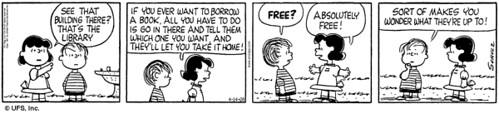
Oh my I love libraries.  Even when I am on vacation I go visit the library.  Some people hit the shops, others browse the galleries, most play, but I go check out the library.  I am so fortunate to have the library that I do.  Have I mentioned this before?

  • image from hofstra.edu

I am not the only one who has a real life love affair with libraries.  I know some great characters who love their libraries as well.  I came across this love letter to a library the other day:

The library was a little old shabby place.  Francie thought it was beautiful.  The feeling she had about it was as good as the feeling she had about church.  She pushed open the door and went in. She liked the combined smell of worn leather bindings, library paste and freshly inked stamping pads better than she liked the smell of burning incense at high mass.
                                             –beginning of chapter two from A Tree Grows in Brooklyn

Francie Nolan loved libraries.  The librarian wasn’t the greatest, but Francie persevered her weekly visits because  Francie had long ago dedicated every Saturday as her library day in order to work her way through all the collection, even though she usually ended up reading the same book.

What an amazing undertaking!  To walk into the local library and take down a book, read it, and move on to the next one until all is read.  A lifetime of literary adventure.

There are other literary library mentions.  For instance, Elizabeth Bennett comments about Mr. Bingely’s library, how fine she hears it is, and then he sheepishly admits he doesn’t read much, being he would rather be outside.  Lizzie’s father, Mr. Bennett, is well-known for hiding in his library.  They sadly are the only Bennetts who bothered with books. In fact, most of Austen’s books have a mention of libraries.  Emma’s father usually hid out in his library, avoiding the world. I’m pretty sure JA would be registered on my Book Boosters page had WordPress been around in her day.

What about you?  What aspects of the library do you love?

  • Is it the sheer volume of knowledge available at your fingertips?
  • What about the amazing amount of FREE reading waiting to jump into your book bag?
  • Are there special librarians or staff who make you feel welcome? (I think Francie’s librarian was an anomaly–all the librarians I have known have been absolutely wonderful)
  • Does the library have a special place where you sit and read or work?

I’m also interested if you have come across libraries mentioned in the books you have read or are reading.

Happy Pages!

Post Navigation