Pam Webb

a writer's journey as a reader

Archive for the category “Reading”

The Epicness of Poetry part two


Today we look at Homer.

This one:

Not this one:

Homer wrote The Iliad and The Odyssey, but you knew that.

These are both considered epic poems and boy, oh boy are they epic in the sense of BIG.  They are big in size (The Iliad is nearly 16,000 lines and The Odyssey is about 12,000), big on adventure, and have big heroes as well.  These two poems have also made a big impact on literature, culture, and on Hollywood.

Quick rundown:
The Iliad is mainly about Achilles and his fighting in the Trojan War (yes, think Brad Pitt in Troy), while The Odyssey is mainly about Odysseus and his adventures trying to get home from the Trojan War.

Cover of "Troy - The Director's Cut [Blu-...

Cover of Troy – The Director’s Cut [Blu-ray]

Why should you care about these really, really old poems (besides them being so incredibly epic)?  I’ll let the PhD expert analysis people at Shmoop explain all that:

The Iliad
You want large scale clashing armies? You’ve come to the right place. Even matched duels or obviously unmatched duels? Check out the long one-on-one combat descriptions, or that crazy nonsense between Paris and Menelaus. Spy thriller? Odysseus’s nighttime raid totally fits the bill. Nail-biting special ops missions? The Trojan Horse ruse has your name written all over it. Swords-and-sorcerers magic adventure? Try anything with the gods busting in on the action, like, say, that whole Laocoon fiasco. Snakes—yikes. In short, anything exciting you’ve ever seen or heard or read started right here.But that’s not all. Not only does the Iliad put the act into action, but it puts the philosophy in there, too. This isn’t just a reductive Good Guys versus Bad Guys bit of disposable nothing. Instead, what’s behind all that fighting is a whole lot of thinking about what the fighting means.
The Odyssey
Do you like stories full of adventure, danger, and suspense? How about stories set in fantastic worlds full of strange creatures like Cyclopses, witches, sirens, and gods? If so, then you’re in luck, because Homer’s Odyssey is Western literature’s original adventure story, and its first foray into the fantasy genre. If you need any proof of how much Homer’s poem defined this genre, just consider the fact that we now use the word “odyssey” simply to mean adventure.

Beowulf, The Iliad, and The Odyssey are old, or classic, epic poems.  We now move on to contemporary, or considerably younger epic poems.

Next Post: Lost in Paradise is not the same thing as Paradise Lost

A Garden of Verses


image

As children we begin our acquaintance with poetry through nursery rhymes and catchy little verse books and move up to reading by way of Dr. Seuss. If the love of poetry takes hold. Then we discover there is a world of rhyme through the pens of such poets as Jack Prelutsky (shown happily proffering his poetry pencil). And of course, Shel Silverstein.

Robert Louis Stevenson and Lewis Carroll come to mind for when we are older. And then what? We are told “good” poetry shouldn’t rhyme and rhyming verse is childish. We then go deep into the likes of Robert Frost, Longfellow, and perhaps Langston Hughes when we get into school. This is not a bad thing. Not at all. Life gets more complicated as we get older and poetry can be that reflection.

I wonder if this is where we lose the initial love of poetry, when we have to work at understanding it through its symbolism, imagery, and meter. Cats and fiddles, Jacks and Jills no longer suffice as poetry thrills. Tis a shame.
My freshmen groan and revolt when I trot out the poetry unit. I wish I could say I have swayed their opinions or created new converts at the end of the designated nine weeks, yet that doesn’t happen as often as I’d like. Most do appreciate poetry a bit more. Sure, that works for me–I’ll take it.

I wonder how many of us would continue loving poetry if we could only be allowed more Jack Prelutsky when we are all grown up.
image

When

Take Your Next Poem to Lunch


poetry

Silently mulling over the words, she reflected in her repose as she drank deeply of the healing verse before her….

Stop–cut–

Really, poetry doesn’t have to be all artsy, angsty to be enjoyed. The reflective part is okay, but honestly, poetry can be much more rewarding as an outward expression through sharing. During Poetry Month try some of these verse interactivities:

1.  Randomly leave a poem around the office or break room.

2.  Pack poems in your lunch for at least a week–you know, a read ’em and eat kind of thing

3. Sign off your signature with a line from a favorite poem

4. Use a poem for a bookmark

5. Memorize a poem–one you don’t know (Robert Frost won’t mind this time)

6. Read up about a poet–most have led amazing lives

7.Watch a movie with poems–I suggest Dead Poets Society

8. Chalk poems on the sidewalk

9. Attach a poem to a balloon and release it

10. Revisit a poem–has it changed in meaning for you?

Frost Covered Spring


Robert Frost. My first meaningful encounter with poetry occurred in fifth grade when Mr. C (still my favorite teacher) had us memorize “Stopping By Woods” and then we chalked our impressions of the poem onto dark blue construction paper. These were then pinned all around the classroom as the border above the chalkboard. As I teach this poem to my students I learn more and more from it. Frost does that with his poetry. It appears so deceptively simple at first and then there is a realization of its depth. It can be almost embarrassing at times once the analytical epiphany hits.

But I can’t imagine Frost laughing at my denseness–no, he would probably only chuckle. I imagine he might even be amused at the fuss we make analyzing his commentaries on birches, walls, and the snowy woods.

Frost is one of my faves and thought it very appropriate to feature him first among the many poets I hope to spotlight this month.

Here are a smattering of favorite poems:
“Mending Walls”
“Acquainted With The Night”
“The Road Not Taken”
“Fire and Ice”
“Nothing Gold Can Stay”

What are your favorite Frost verses? For some reason whenever spring arrives I tend to think of Robert Frost. Maybe this is fitting–a bit of Frost helps us appreciate the warmth of spring. I think he realized that as well.

Happy Poetry Month!

20130401-215741.jpg

Wives and Daughters


One of the final pages from the manuscript for...

One of the final pages from the manuscript for Wives and Daughters (The Works of Mrs. Gaskell, Knutsford Edition) (Photo credit: Wikipedia)

Have you ever eagerly brought a movie home only to discover you’ve watched it before?

When that happens I either slip it out and chastise myself for my negligent memory or shrug and go for it anyway.  Such was the case with BBC’s production of Gaskell’s Wives and Daughters.


Lovely.  I watched the whole thing in one sitting.  I would not do well with the weekly installment watch plan anymore.  I tend to eat all my Haagen-Daaz in one sitting too.

As for Wives and Daughters I think Gaskell should have actually named the series, The Doctor’s Daughter because it all centered on Molly, who was the doctor’s daughter.  I didn’t see much about wives and only a couple of daughters were the focus.  Maybe I will have to read the book.  And right now I am trying to do so.  It’s not working.

One problem I am finding out with watching really wonderful BBC adaptations is that they quench my desire to dig into the book.  I really should stick to my book first policy.


If you should hunger after a character driven historical plot that is reminiscent of Jane Austen’s complicated romance plots, then do look up Gaskell and her Wives and Daughters–watching or reading it is too personal of a decision for me to actually recommend. Umm-I did really like, really like the BBC more than I have Gaskell’s flowery writing.  But don’t let me influence you.

Bookmarks Past and Present


It’s not often I read a book in one sitting, and finding a bookmark is often a necessity that leaves me in a bit of a flummox.  I try to keep one consistent bookmark, yet that seem to evaporate.  My current favorite is a ticket from a vacation spent in Seattle.  I have attached good memories to the stub and combined with a good read it’s a double pleasure.  I’ve managed to keep hold of it since summer.  It might just be a record.

Bookmarks come and gone:

  • paper scraps:
  • napkins
  • yarn
  • pens, pencils
  • odd bits: flashlights, calculators, television remotes
  • Then there are the bookmarks that are actually bookmarks. The MEPA has provided the niftiest magnetic bookmarks.  The library seems to collect them more than I–they have reminded me more than once that I have left them once again in a book returned to them.
  • What about your bookmarks?  Any oddities or favorites to share?

Clasically Thin


My efforts to shed a few pounds have cascaded into my reading life.  I’m not sure if that is a confession or an observation.  I have come to appreciate the classic lite fare of literature as much as I have come to enjoy lighter meals when dining.  At times there is something so satisfying on digesting a novel of under three  hundred plus pages, not that I don’t enjoy a large tome now and then, but I do find I like a comparatively quick read fulfills my need for literature.  There is also the advantage of being able to start another literary morsel that much sooner.  Here are a few of my lighter, yet nourishing favorites:

Daisy Miller by Henry James

Frankenstein by Mary Shelley

Billy Budd by Herman Melville

The Old Man and the Sea by Ernest Hemingway


Room with a View by E. M. Foster


Their Eyes Were Watching God by Nora Zeale Hurston

Jane’s Offerings:

The Complete Novels of Jane Austen

Literary lite certainly does not mean insubstantial.  Actually, I have found after a couple of reads of  lighter weight (not to be confused with welter weights) I crave a jolly long read.  For instance, Daisy Miller introduced me to James’ Portrait of a Lady–which is quite fulfilling.

Any lite reads on your menu?


#9: Poems to Know and Grow On


It’s been too long since I paid attention to my Musings of a Voracious Reader list.  Tidying up my files I discovered entry #9: Poems to Know and Grow On and it seems quite appropriate as a post-Valentine’s Day post, since poetry is the food of love (right next to chocolate).

As I teach poetry, especially as I prepare my AP students for their exams in May, I am reading more and more poets and poetry.  This is a good thing.  In fact, I am now taking on what I have deemed as the “Emily Project” which is discovering Emily Dickinson.  Understanding her would be another project in itself.

As I teach, read, and study poems I have gathered a few along the way.  I dearly wish I had a better knack for memorization because I would like to pull out a poem for any occasion and dazzle, delight, and demonstrate the power of poetry to any willing listener. I love it when that moment arrives in a movie when one character starts a poem and another finishes it.  Remember Willoughby and Marianne from Sense and Sensibility? *sigh*

This is simply a sprinkling of poems I have deemed worth knowing and to grow on:

1. My First Memory (of Librarians) by Nikki Giovanni–a Book Booster’s banner poem of delight

2. Harlem (A Dream Deferred) by Langston Hughes–his imagery is enviable

3.Introduction to Poetry by Billy Collins–enjoy poetry, don’t tie it to a chair and beat a confession out of it (love this)

4. Hope Is A Thing With Feathers by Emily Dickinson–hope wings its way into our hearts

5. The Road Not Takenby Robert Frost–almost clichéd by its overuse, it’s still a powerful statement about making choices

6. The Jabberwocky by Lewis Carroll–delightfully fun for any age

7. This Is Just To Say by William Carlos Williams–after I discovered this was actually a note to his wife I embraced the poem even more

8. The Tyger by William Blake–imagine seeing a tiger for the first time; how can something so exquisitely beautiful be also so incredibly deadly?

9. One Art by Elizabeth Bishop–the more I read Bishop the more I realize what talent she has for capturing life’s moments

10.I Hear America Singing by Walt Whitman–“a sweaty-toothed madmen” claimed Todd from Dead Poets Society, when asked what he thought of Uncle Walt; Whitman is clearly underrated (check out the Poem Flow when you hit the link or better yet check out this YouTube)

11. Sonnet 130 by William Shakespeare–the Bard employs his wit whilst he poketh funneth at the syrupy nature of sonnets

12. We Real Cool by Gwendolyn Brooks–no matter the era, youth’s self-destruction prevails

13. Fog by Carl Sandburg–its simplicity speaks volumes

14. The Daffodils by William Wordsworth–my heart gladdens of spring’s promise as the daffodils lift their golden heads above winter’s chilly grasp

And there are  fourteen poems, a drop of verses in the deep well of that which stirs the soul, as a nod to Valentine’s Day and the tradition of sweet rhymes, chocolate, and roses.

One last poem to know and grow on, not necessarily my favorite, but definitely memorable.  True love is memorable, as Poe so deftly renders in this tribute to his lost love. This one usually makes my ninth grade students pause, which is one reason I refer to it.

Annabel Lee

by Edgar Allan Poe
It was many and many a year ago,
   In a kingdom by the sea,
That a maiden there lived whom you may know
   By the name of Annabel Lee;
And this maiden she lived with no other thought
   Than to love and be loved by me.

I was a child and she was a child,
   In this kingdom by the sea:
But we loved with a love that was more than love--
   I and my Annabel Lee;
With a love that the winged seraphs of heaven
   Coveted her and me.

And this was the reason that, long ago,
   In this kingdom by the sea,
A wind blew out of a cloud, chilling
   My beautiful Annabel Lee;
So that her highborn kinsman came
   And bore her away from me,
To shut her up in a sepulchre
   In this kingdom by the sea.

The angels, not half so happy in heaven,
   Went envying her and me--
Yes!--that was the reason (as all men know,
   In this kingdom by the sea)
That the wind came out of the cloud by night,
   Chilling and killing my Annabel Lee.

But our love it was stronger by far than the love
   Of those who were older than we--
   Of many far wiser than we--
And neither the angels in heaven above,
   Nor the demons down under the sea,
Can ever dissever my soul from the soul
   Of the beautiful Annabel Lee:

For the moon never beams, without bringing me dreams
   Of the beautiful Annabel Lee;
And the stars never rise, but I feel the bright eyes
   Of the beautiful Annabel Lee;
And so, all the night-tide, I lie down by the side
Of my darling--my darling--my life and my bride,
   In her sepulchre there by the sea,
   In her tomb by the sounding sea.

Virginia Poe watercolor painted after her deat...

Virginia Poe watercolor painted after her death in 1847. From eapoe.org Category:Edgar Allan Poe (Photo credit: Wikipedia)

The Little Write Lies We Tell


I think the best writing advice I have taken to heart lately comes from one of my latest reads, A Tree Grows in Brooklyn by Betty Smith.  Francie, the protagonist, is a girl of poverty and determination. She begins writing stories that please her teacher, ones that are about butterflies and happiness, receiving praise and the coveted “A” grade mark.  She then switches to tell life how it really is, the heartache of tenement living, and this alienates her teacher.  Fortunately, her teacher sees the struggle Francie is faced with: the write truth does not mean the right truth.

Here is the advice she gives Francie:

“You know, Francie, a lot of people would think that these stories that you’re making up all the time were terrible lies because they are not the truth as people see the truth.  In the future, when something comes up, you tell exactly how it happened but write down for yourself the way you think it should have happened. Tell the truth and write the story. Then you won’t get mixed up.”


Another author who swerves  from truthtelling into storytelling is Tim O’Brien, well known for his The Things They Carried.  I found a fascinating article from the United States Naval Academy, of all places, in which there is discussion concerning future military leaders and their discernment of what is truth.  The article relates this need of truth in leaders with a literary course with O’Brien’s novel as the text: (highlights are mine)

Fiction proves the golden means between absolute truth and absolute dream. It is impossible to ascertain the absolute truth of an experience, but it is nevertheless critical that one try to ascertain the multiple truths, to be “in uncertainties, Mysteries, doubts, without any irritable reaching after fact & reason,” and this challenge marks the human condition. Fiction is neither counter to nor identical with the truth, though given the exigencies of war, fiction often provides the best approximation of reality; as O’Brien writes in “How to Tell a True War Story,” “In war you lose your sense of the definite, hence your sense of truth itself, and therefore it’s safe to say that in a true war story nothing is ever absolutely true” (TTTC, 82). O’Brien claims that “My role is not to solve mysteries, but to expand them… To ultimately make readers think of their lives in terms of ambiguity. It’s the human condition and we’re uncertain about almost everything” (Hicks, 89-90). The storyteller takes the facts of experience and embellishes or even alters them in order to get at a closer experience of truth; O’Brien finds in fiction the possibility of expressing “that surreal seemingness, which makes the story seem untrue, but which in fact represents the hard and exact truth as it seemed” (TTTC, 71). Thus, the capacity to tell a story, to make a factual account that leaves out the subjective experience into a fictional but seemingly more truthful account, is essential to understanding the experience of war for all involved and to beginning the long process of recovering from its damages and of correcting its failures.

A US Serviceman reading an Armed Services Edit...

A US Serviceman reading an Armed Services Edition of A Tree Grows in Brooklyn (Photo credit: Wikipedia)


Tell the truth. Write the story.

Anyone know if a poster of this ideal exists out there?  It would go well on my office wall.

Have You Heard the Latest One About the Library?


I learned from a blogger that Saturday February 9th is National Library Appreciation Day.  Very much excited about this new and most needed celebration I quickly Googled the event only to discover it is a UK holiday–not a USA one.  At least not yet.

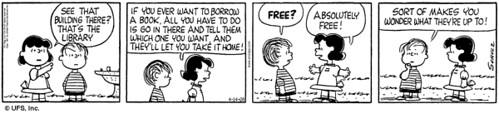
However, while researching I happened upon some incredibly funny cartoons about libraries.  Hope you chuckle, giggle, laugh, and enjoy as much as I did.


Post Navigation