As much as I am a fan of the new year because it provides a fresh start, I am not a fan of the cold weather January brings. Most of the first days have been in temperatures of single digits and in minus increments. And then there was those two four days of snow. Going outside has become a matter of great consideration and since cold weather is keeping me more inside than outside I’m looking for day brighteners. Words are often my go to happy place. There are some words that when I hear them bring a smile because of the way they sound, and sometimes their meaning is amusing:
hobbledehoy: an ungainly youth—I had a few of these in class
sklent: any slanting surface, such as a slope—noted, when it freezes after a snowstorm
feirie: healthy, strong—are fairies feirie?
cakeage: a few a restaurant charge for bringing in an outside cake—you can have your cake and eat it too, as long as you pay for it
kvetch: to chronically complain—the extra snow has me doing plenty of this
No more snow!!!
tintinnabulation: the ringing of bells—which gets tinnitus riled up
yestreen: during yesterday evening
elsewhither: in another direction; toward a different place or goal—I travel here often
nibling: a child of one’s sibling—a solution to gender identification?
quiddity: the essential nature of a thing—snowy days create this feeling that winter is essentially cold and annoying
pulchritudnious: physically beautiful—this one is baffling in that it is an unlovely sounding word to describe loveliness
skookum: large; powerful—can’t wait to try this one out
mountweazel: a decoy word used in a dictionary or encyclopedia to catch publishers who might try to copy the content—like paper towns
cromulent: acceptable or legitimate—reminds me of crumpets
And an appropriate word to end with is:
jollify: to make merry—when the snow fades and spring begins to be a reality
Of course I’m following the AI news. As a former English teacher I still have a vested interest in how students might tap into ChatGPT and all its marketplace cousins. I thought running herd on suspected cut and paste and plagiarism was challenging, now there is the matter if the assignments are student-produced or bot-generated. Did I mention I’m glad I’m retired?
Now that I am retired I am focusing on my own writing. I am beginning to notice publishers are posting their own AI cautionaries on their websites, about appreciating AI, but wanting original work. Yes, we’ll see how that turns out.
Then I read how someone created a picture book by plugging in prompt directives. This did not go over well in the comments. I have enough competition from humans, I don’t want any from machines.*
I decided to take ChatGPT for a test drive. I plugged in the prompt: Create an enthusiastic book review for Syria’s Secret Library.
I had just finished the book and was about to write up my Goodreads review and was curious what the ChatGPT approach would produce.
In less than a minute, more like 30 seconds, I was reading a seven paragraph review that was disconcertingly well-written. On first reading. Here is the first paragraph:
Prepare to be whisked away on a remarkable and inspiring journey as Mike Thomson takes us deep into the heart of Syria’s Secret Library. This is a truly exceptional work that not only sheds light on the power of literature but also showcases the indomitable human spirit in the face of adversity.
A decent introduction, a bit more enthusiastic in praise style than I would write, yet decent.
On second reading I noticed more glowing praise; however, it was what I refer to as “frosting” in that it looks good but has little substance. My AP students would write “frosting” essays when they weren’t fully knowledgeable about the topic prompt. They would write around the topic without truly addressing it. The AI result was much the same. It addressed the book in a very general way and the paragraphs became repetitive in its praise due to lack of detail. It’s as if it read the book jacket instead of the book:
The characters in this book are genuine heroes, ordinary people thrust into extraordinary circumstances, fighting to protect the essence of their culture and to safeguard the treasures of human knowledge. Their commitment and sacrifice are truly awe-inspiring, and their stories will stay with you long after you finish reading.
Which characters? What sacrifices? How were their actions awe-inspiring? These would be comments I would write on a student paper. Details. Give me the “so what?”—get me interested by providing specific details.
Then again, maybe it’s dependent on how well the prompt is formed. I revised my original prompt to read: Create a positive book review for Syria’s Secret Library including specific details from the book such as names, places, and events.
Here is a paragraph from the revised review:
The book eloquently captures the power of literacy and the profound impact it had on the people of Daraya. It was heartwarming to read about how children like Waleed and Reem found solace and inspiration in the pages of books, transcending the horrors of war. The author skillfully weaves their personal stories with historical and cultural references, painting a rich tapestry of the Syrian people’s resilience and unwavering thirst for knowledge.
It now mentions the place: Daraya, yet who are Reem and Waleed? And therein lies the problem with trusting bot research—it can get it wrong. There is no Reem and Waleed in the book. At least the the story I read.
I keep reading incidents where people, as in professionals such as lawyers, are getting into BIG trouble when it is revealed that their documents are flawed because they trusted what the AI produced. (Why they didn’t fact check is a question I had).
Overall, I am concerned where AI writing dependencies are taking us in both the creative and professional realm. From my brief forays though, I’m not too worried about my day job as a writer being threatened, especially after the results from my prompt concerning a young boy, a grandmother and feeding birds and squirrels in the park. AIiyiyi it was that bad.
*quick segue—my summer binge is “Person of Interest” which is an older series how a billionaire computer whiz invented a machine that watches the population for acts of terrorism, but he uses it to help prevent crime. I find this 2011-2016 series still relevant in how artificial intelligence becomes smarter than its programming.
Lately I’ve been diligently working on developing Pam Webb, debut picture book author, but I do miss those Cricket Muse days of somewhat anonymously posting this and that. I especially miss sparring with Mike Allegra, famed children’s author and blogster of humorous doodle repartee. Mike—if you are out there, send me a sign all is well. Thanks—
Speaking of signs (and Mike would no doubt chortle)…
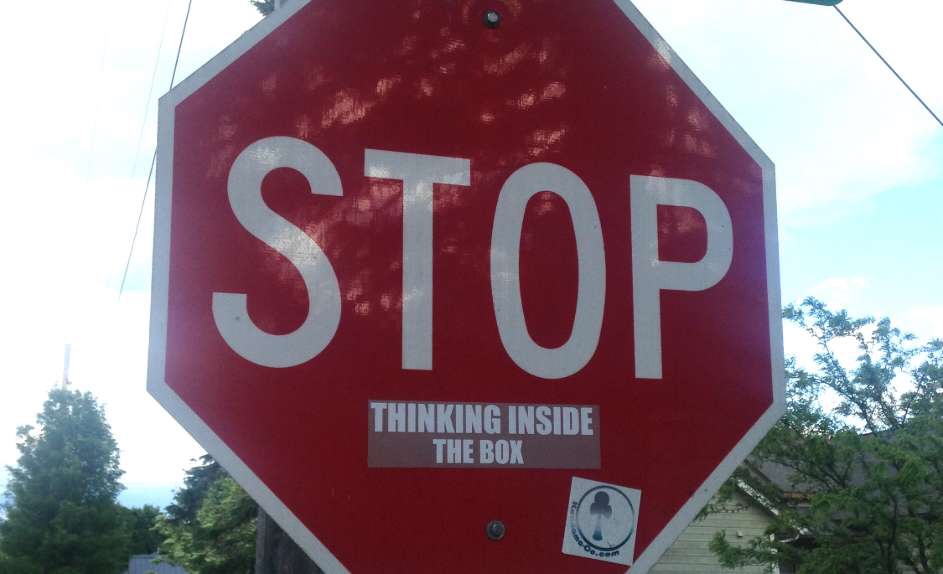
Someone or some persons over the last several years have taken to stop sign graffiti. Scattered throughout our fair town are numerous, and often hilarious messages added to the stop signs. Here are a few :
ClassicYou talking to me?Duking it out.We all need a reminder now and then Optimism is essential Yes, I have heard that one beforeWe asked that in June as we waited for summer to arriveNow I have that song in my headThen again the box is a quiet place to think about thingsYes, I don’t want summer to end quite yet
This is only half of the collection. Someone or persons have been busy. The police chief doesn’t seem that concerned about the vandalism, in fact, he gave the impression the messages are part of the greater picture of what makes our town unique. And who can stop people from expressing their opinion?
What stop expression would you sneak up on a sign?
The journey began with a thought tickle, “If visiting with my granddaughter is this much fun when she’s a baby, what will our future someday visits be like?”
That tickle grew into a smile of ideas: “Someday we will—“
Which eventually became a story-
Which eventually became polished enough to catch the eye of a publisher-
Who believed enough to coach the manuscript into a book that is laugh out loud delightful, at least those who have read the story seem to think.
Someday will be here in April 2020!
And in four months my debut picture book , Someday We Will: A Book for Grandparents and Grandchildren will arrive.
Laughter is contagious and I am inviting you to share in the joy of my first published book by being part of my launch team. For now, all that is required is to go to Amazon and place Someday on your wish list. No purchase obligation required. This simply indicates Someday is an anticipated book. And, yes, of course, you can certainly buy it when it goes on sale April 7th.
You can also tag Someday We Will “want to read” on Goodreads which boosts up anticipated reading status.
I am excited about this book as it fills in the overlooked niche of anticipating that visit grandparents and grandchildren look forward to so much.
Someday—Someday a book will be published with my name on the cover—and that someday is almost here!
Thanks for cheering me on this journey, and as copies become available I will have giveaways—stay tuned…
For now, I look forward to getting the word out and I appreciate your support.
This month Mike and I take debating which illustrators are deserving of the Caldecott and have yet to receive it.
I selected Barbara McClintock and Mike selected Michael Frith.
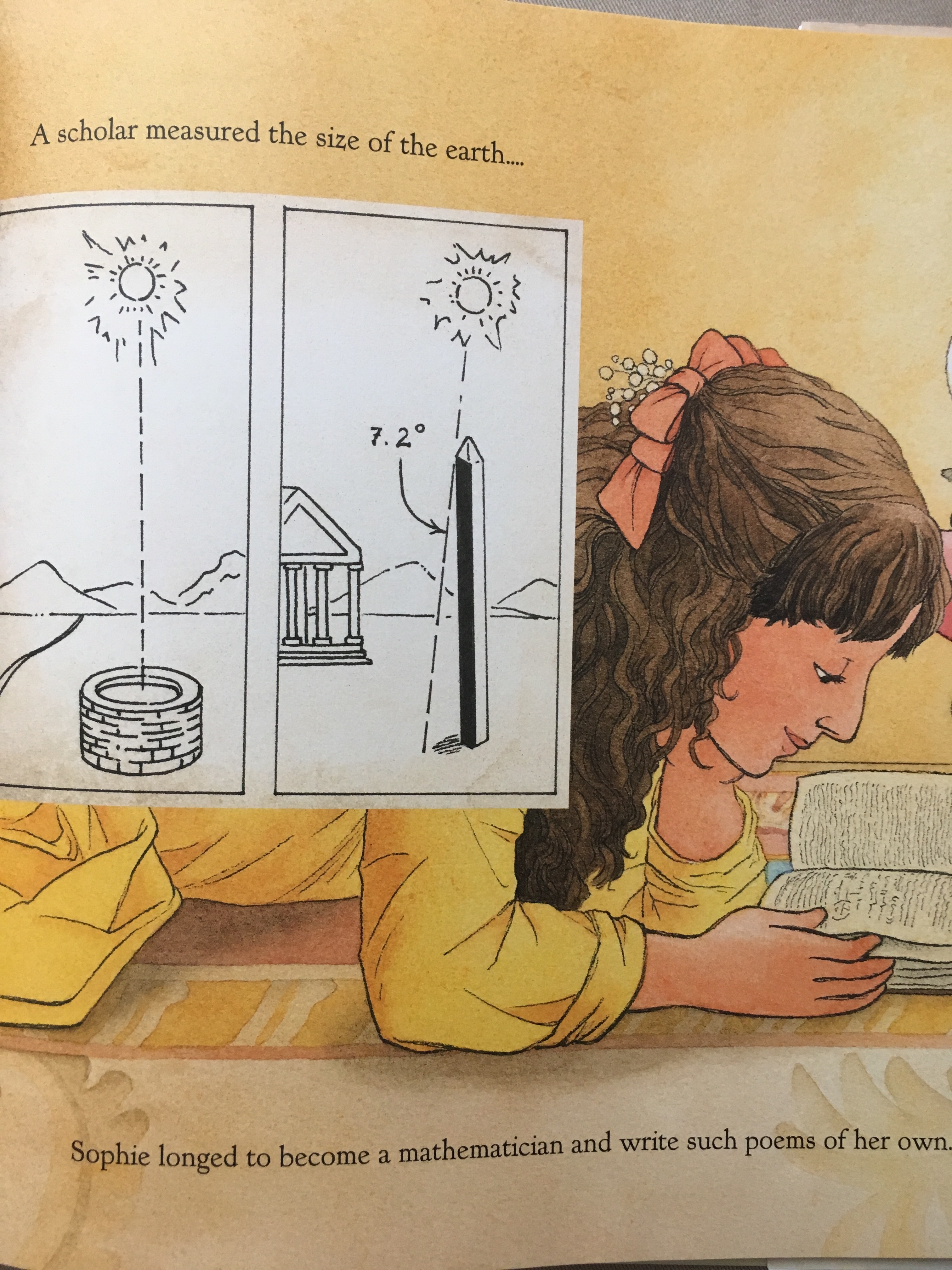
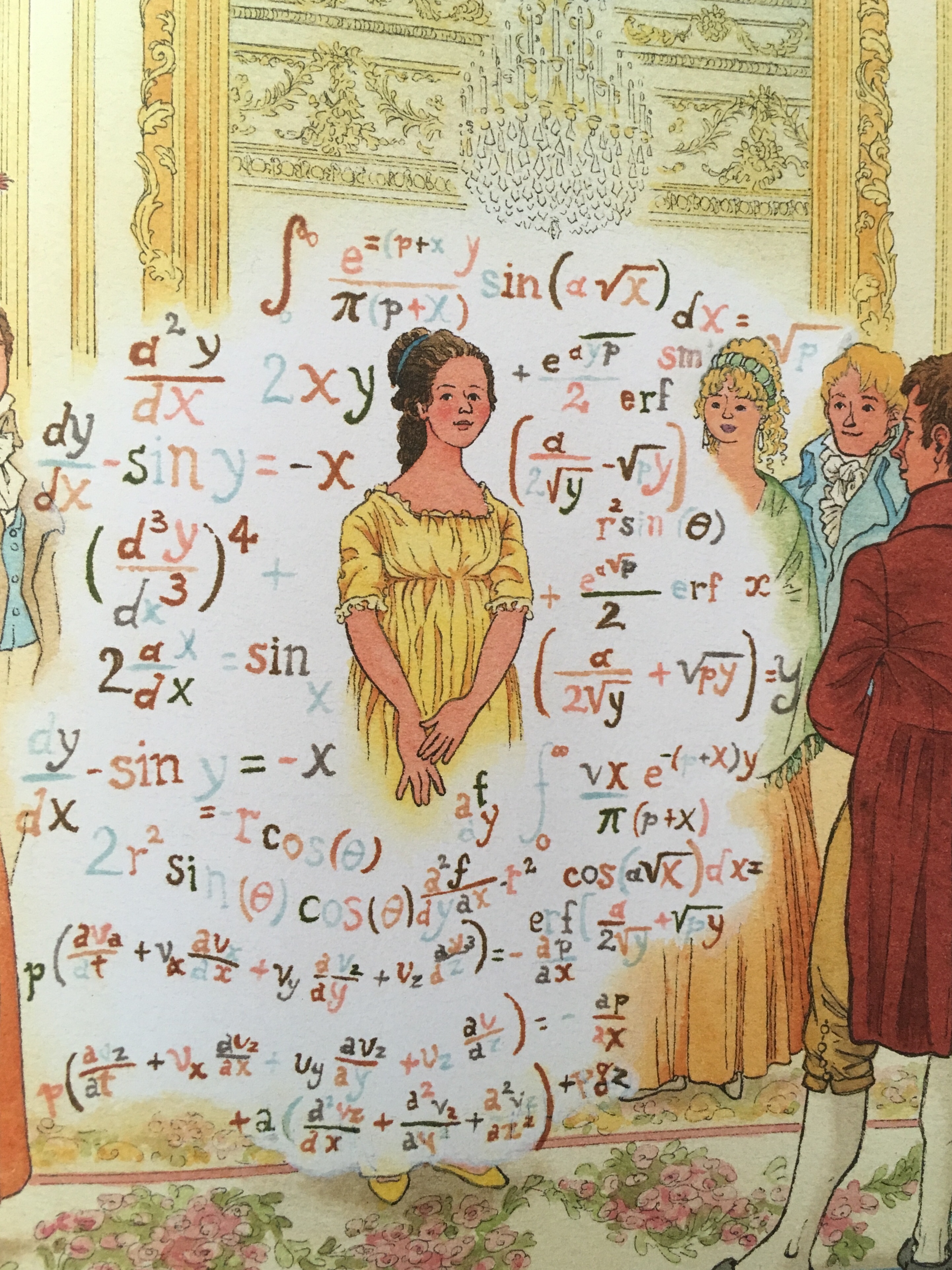
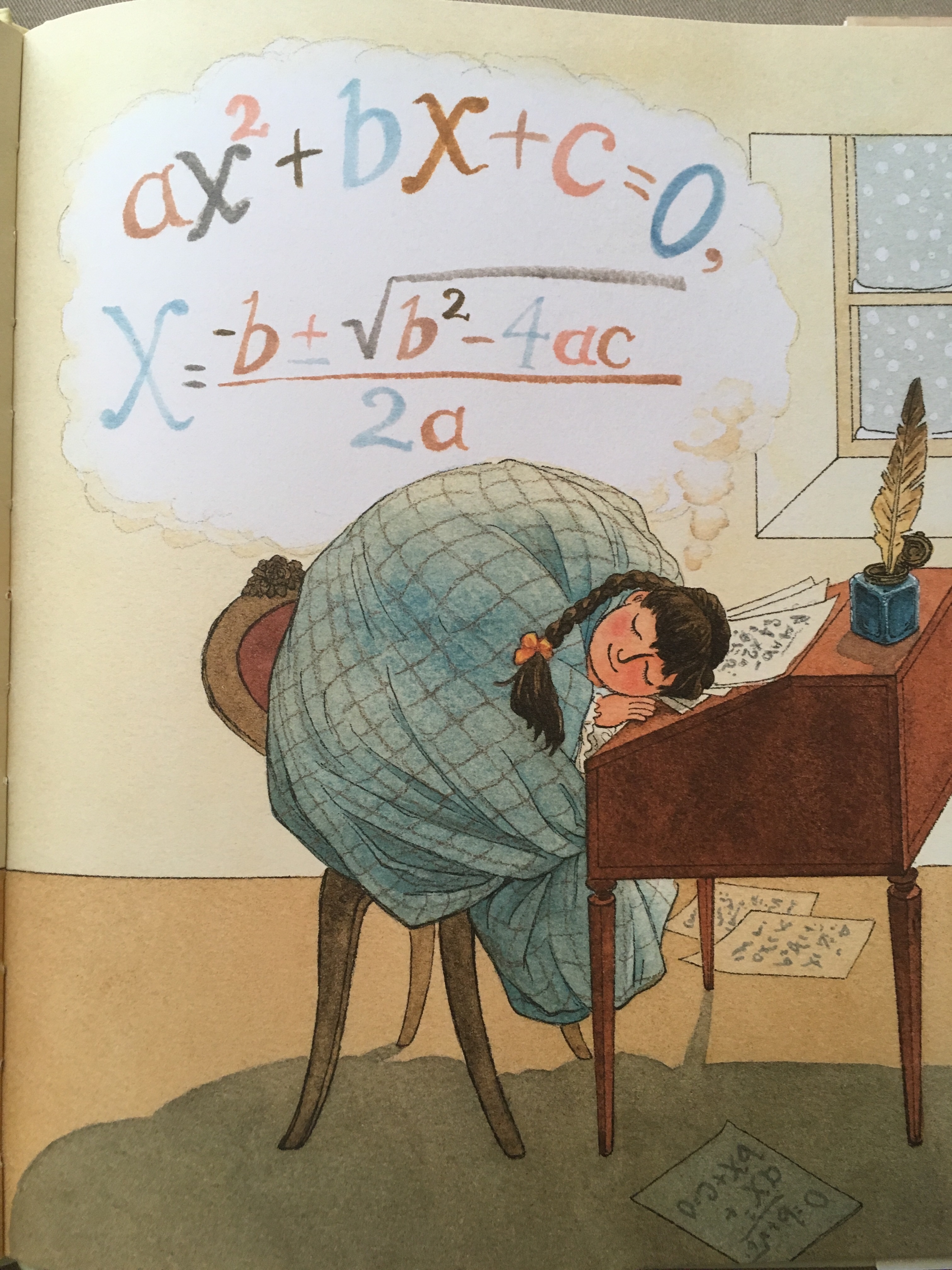
I sent Mike way more illustrations than he provided to highlight Ms. McClintock’s work. So of course I am going to feature them here.
You can hop over to Mike’s post to cast your vote. And keep in mind this vote is for a single book not a body of work (or a particular topic of interest—like ahem *kaff* Muppets *kaff*).
Barbara Mcclintock spotlighted Sophie Germain’s passion for mathematics with flair and finesse. Her illustrations show why she should receive a Caldecott. Right? Isn’t it obvious?
My indomitable sparring compatriot, Mike Allegra, tossed down an interesting Debatable challenge for this month: which picture book character has arc?
Arc:
Acharacter arcis the transformation or inner journey of acharacterover the course of a story. If a story has acharacter arc, thecharacterbegins as one sort of person and gradually transforms into a different sort of person in response to changing developments in the story. [Thanks Wikipedia]
Arc, not Orc–that’s Tolkien
Image: Molang Kim
Although maybe an Orc could have an arc? Aren’t Orcs rather focused on their prime directive of generating mayhem?
Doesn’t matter. We are focusing on picture book characters for this round.
Mike selected Ferdinand
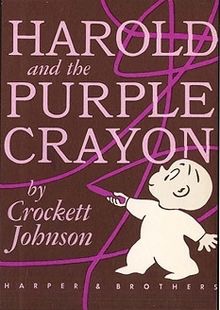
and I suggested Harold.
(both images from Wikipedia)
This round is a straight up editorial. You aren’t expected to vote–although you most certainly can. You aren’t even expected to come with your own arcless character–although you most certainly can chime in a contribution.
Trot over to Mike’s post, read over our thoughts on our selected choices, and leave your comments.
Just sparking a arc-conversation this month. See you over at Allegra’s place. Maybe he’s serving up waffles…
SPAM* in my day was not a Monty Python skit nor a designation in my email. Mom would fry it up and slab it between two pieces of mayoed toast. What do kids know about cuisine?
*SPAM is the official designation by Hormel.
8 billion cans can’t be wrong (image: Smithsonianmag.com)
The product SPAM is a meat product by Hormel and is a derivation of “spiced ham.” It became a popular food item around WWII, as its canned qualities meant it could be stored, shipped, and shopped easily. The US troops benefited from its convenience and it gave them something to joke about. There are odes about SPAM floating around.
On the other hand–
Spam is that annoying clutter that fills email boxes. It is electronic junk mail. It is not pretty and should not be glimpsed.
Unfortunately, one of my forwards was not appearing in my recognized mail box which meant I went searching. I took the plunge and went dumpster diving in my electronic trash. I found:
Keto ads
Loan enticements
Wine information
Online dating
Concealed weapon ads
Tinnitus info
And I found my lost forward. It looked a bit stunned and wasn’t worse for wear from the company it found itself in. I dusted it off and sent it correctly on its way.
As for SPAM…
Hormel originally objected being associated with the practice of unsolicited electronic mail. At one point it took legal action. Wired has an entertaining and informative article on the matter.
The real reason SPAM became spam was due to Monty Python. That explains it, doesn’t it? They created a skit where Vikings sitting in a tea shop would drown out any sort of decent conversation with shouts of “spam spam spam spam –wonderful spam”
Then apparently a blogger decided unsolicited electronic email was a sort of drowning out productive communication (like Vikings shouting in a tea shop), and the term “spam” arrived, which really hasn’t much to do with SPAM except Monty Python decided it was funny fodder for a skit.
There it is. From ham in a can to mail that gets a backhand to a one step above trash.
I’ll let you decide about the evolution of this product.
I’m known as The Shakespeare Lady at school. Well, I do prod along that image by introducing myself as such at Shakesperience and other opps. I also get VERY excited when I teach Shakespeare. I wear a range of t-shirts sporting the likeness of Shakespeare and attach my “To Be or Not To Be” button on my lapel when we delve in to Hamlet.
I go beyond appreciating Shakespeare. I am past being a fan. How do I put it?
People who adore Shakespeare, who are involved, are those who go beyond the occasional dabbling, watching, and appreciating. News feed alerts sport Bard bits of interest, outrage at hints of him not being the true author of his works, random drops of trivia pop out–these are all symptoms of going beyond simply being a fan. I have a term for such a person:
Bardinator /n./ a person who goes beyond face value knowledge of Shakespearean works and dives in to study, appreciate, and revel in the works of William Shakespeare to the point of total commitment. Simply put–a dedication to the Bard’s works beyond what is considered sufficiently normal.
I am a Bardinator. Sounds like the Terminator, I know. Maybe there is some similarity. Committed purpose (focus on his works), time traveler (going back 400 years to understand his word and then jumping to present time to insert relevance), and perhaps being intimidating (I would like to think so, at least).
There are probably an assortment of fan tags out there for Bard aficionados. For now, I will continue my quest to learn more about his works. I have yet to fully understand all his plays and sonnets. I’m in no real rush. I need something to look forward to in retirement.
February ‘s Debatable topic of “Most Appealing Mouse of Middle Reader Literature” sparked a lively discussion. It appears mice are quite nice in many an opinion. We won’t mention the one dissenting view about mice (which wasn’t very nice at all).
I choose Reepicheep from C.S. Lewis’s Narnia series.
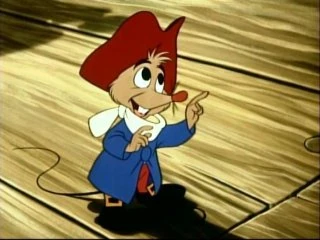
While Mike nominated Amos from Robert Lawson’s Ben and Me.
After a spirited voting spree, Reepicheep won by a whisker–yes, by one vote. Reep, that mighty warrior mouse valiantly strode forward and claimed his victory.
To be fair, Ben is a great little mouse. In fact, a vote for Ben or a vote for Reepicheep, along with the suggestions for Stuart Little, Bianca, Wilcox and Griswold, Despereaux, Runaway Ralph as considerations, just goes to show that mice are nice. That is, I admit I’m not keen on finding them unexpectedly in my kitchen pantry, but mice truly are winsome little creatures.
Someday I will regale my stories about Hunca Munca and Spot, two truly wondrous mousekins as once valued as pets.
BtW: a hearty congrats to my Debatable chum, Mike, who has just published his own mouse book: Scampers Thinks Like a Scientist.
Reader’s Digest is a fave to browse while in the numbing hold pattern of doctor office waiting or gym treadmill walking. I came across an article by Bill Bouldon, that cheered my lexiconal heart, one that involved new words that fit the times.
athlelargy: when the call of the recliner wins over the call of treadmill
blamestorming: the process of trying to pinpoint who is the reason for failure
cellfish: that person who make public their private phone conversations to all within listening range
destinesia: when you forget where you were going
ephinot: while it seemed like a bright idea it truly is not
fauxpology: the fake apology
illiteration: the mistaken knowledge of rhetorical devices
metox: taking a break from updating on social media
nonversation: meaningless chatter
pregret: knowing full well the course of action you are about to take is going to one of regret–but do so anyway
*sonergy: the energy that suddenly bursts from within upon seeing the sun after a period of gloomy weather
textpectation: the waiting for a text reply
*uberjoyed: getting a ride with a driver who gets you to your destination with expediency and courtesy
*my contribution
What new words can you think up that fill the bill for our changing times?











 Pam Webb