Pam Webb

a writer's journey as a reader

Archive for the tag “students”

Back to School Blues (not for me, maybe for you)


If you are reading this post you fall into one of the falling categories:

  • Parent of school age children
  • Student
  • Teacher
  • None of the above
Photo by RDNE Stock project on Pexels.com

If you identify with parent of school age children, then I commiserate with you for the back-to-school shopping marathon. Well, yes, it is exciting getting the kiddos ready for another (or their first) foray into the classroom routine. But it is tiring and expensive.

If you are a student, you are either bummed or excited, or perhaps a bit of both, since it means put a pause on summer fun in order to focus on the mojo needed to get into the school routine.

As a teacher, you are no doubt either already back in the classroom (depending on where you teach) or bum-weary from having to sit through endless admin-led meetings while you would rather be preparing your room.

None of the above? You are probably then retired or an empty-nester or perhaps neither a parent or teacher, although you vaguely remember your September back-to-school days.

This marks my fourth September I will not be returning as a teacher, yet I found myself back on campus anyway. My retirement days are centered around books: I’m either reading them, writing them, or doing something with them that is library related. Today I dropped off a box of donated of books to a couple of schools, one of which was where I formerly taught English.

Yes, it was strange.

No, I didn’t miss it.

Yes, I briefly said “howdy” to some former compadres. And yes, I delivered my usual line of “I highly recommend it!” when asked how I like being retired.

Okay, fine–I do miss some aspects of being a teacher, such as getting to know my students, watching them catch the spark of appreciating literature, lunch time sessions with teacher chums, and staff meetings (just kidding on that one).

So, here is hoping your back-to-school blues aren’t severe, and hoping the school year is fabulous, whether you are in a school desk, behind the teacher’s desk, or planning a cruise since everyone else is back in school.

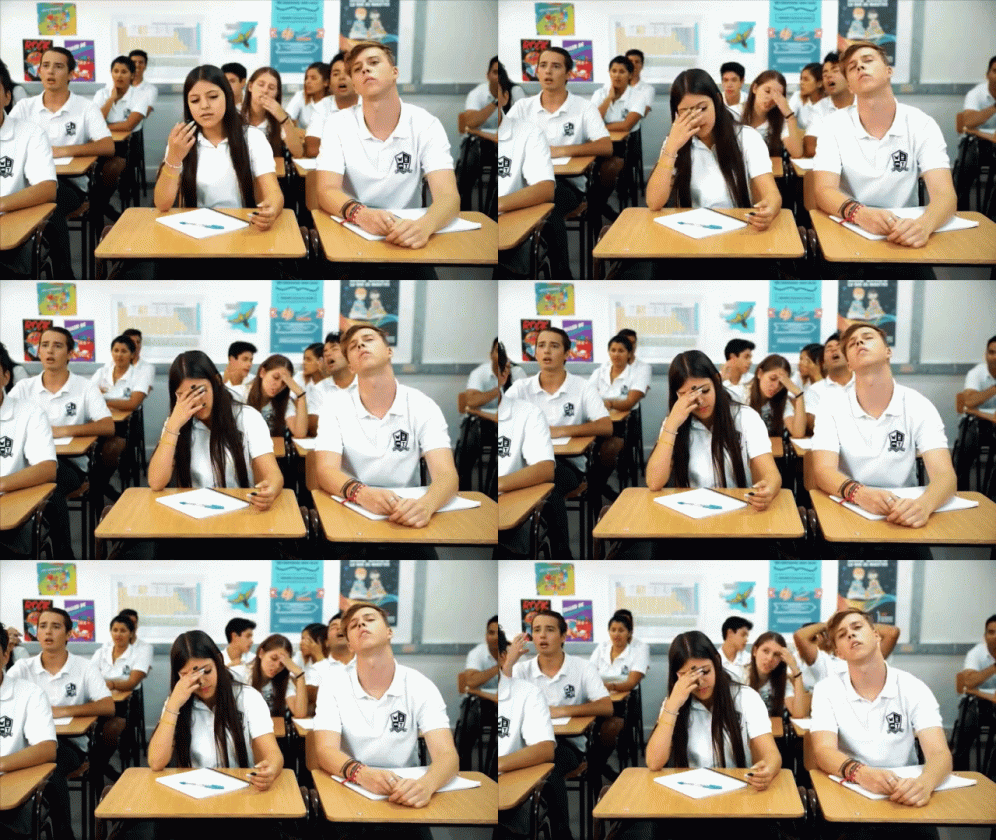
Photo by Diana u2728 on Pexels.com

That Tuesday Feeling


The day after Labor Day is traditionally when school starts. It signifies for most the end of summer and the beginning of nine long months of spending daylight hours in the classroom occasionally, and mostly wistfully, glancing out the window, anticipating being released from the four walls of education.

I imagine students feel the same way.

Is it June yet?

Before I retired from teaching I did look forward to the first day of school—kind of. Truth be told the first day of teaching, at least at the high school level, can be awkward for both students and teachers. Getting names right, going over expectations, trying to establish a rapport, returning to a scheduled routine of bells dictating the day week after week.

Wait—

Sounds a bit despondent, doesn’t it? Don’t get me wrong. I enjoyed being a teacher. I just enjoy being a retired teacher so much more. I’m in good company.

Recently I gathered with around 25 other retired teachers from our local high school for our annual get together. It’s always scheduled on the day teachers have to report to school for in-service meetings. I think that’s it meant to be a wink and a nod that we don’t have to be there anymore. We all agreed being retired is better than being tired again and again, something that occurred when teaching.

This will be the third year I will not be returning to school. People have been asking me if I miss teaching and are often surprised when I quickly say, “Nope.” Teaching is hard work. And teaching became harder because of Covid. In fact, talking to friends who still teach, Covid is still impacting teaching. It’s probably not going to get any easier.

So while I don’t miss teaching, I do miss being a teacher. Then again while I might not be currently teaching I will always be a teacher. You know the saying: You can take the teacher out of the classroom but she will kindly decline offers to return once retired.

Oh, there’s a different saying?

Happy Tuesday-after-Labor Day to students and staff. Hope your year is pleasant and enriching.

Excuse me while I plunk myself in my hammock and read another book in my retirement.

Reading, retirement, relaxing—my three new “Rs”

A Phoney Policy


Busted, ET–caught during class

ET would not be able to phone home if he were attending certain schools, school districts, and even some states. The cell phone debate once again hits the news as the controversy over phones in class continues.

According to Education Week, “By 2020, 77 percent of schools had prohibited non-academic use of cellphones during school hours, according to federal data.” In my twenty years of teaching I would say cell phone usage remained one of the biggest challenges when it came to student behavior. I remember when the first cell phone went off in my class (when only a few students had them). As I reminded the student to mute her phone she tersely replied, “It’s my grandma. She’s dying. I have to take this.” How am I supposed to enforce a policy contending with that kind of situation?

Phone policies have come and gone, and I am so glad I no longer have to deal with students and their phones. Although retired from teaching now, I remain interested in educational trends, and I can’t help but wonder at the shifting back to school districts adopting stronger cell phone policies.

Granted, cell phones have their use in the classroom; the problem is their potential for positive contributions is abused. Texting, gaming, scrolling, uploading, shaming are distractors and are distractions to the learning environment. While the intent of full, partial, or limited use is debated the real issue is enforcement.

Here are some problems with implementing a school phone policy:

  • Everyone has to be on board. Consistency is paramount to success. As a high school teacher I adhered to the school’s policy. Verbal reminders, posters, follow through—Yup. Other teachers not following the policy weren’t as much as a problem as the off-campus adults: parents, employers, medical appointments. One parent said, “I only leave a text to call me at lunch.” The problem is that when students feel or hear that “ping” they are programmed to check their phone like two-legged Pavlov puppies.
“But I need to answer it!”
  • Speaking of noticing students checking their phones, that leads into how odious it is to become the Phone Police. It is more likely a student is willing to give a pint of blood then surrender their phone. There is an addiction issue. It’s very real.
Plugged in
  • Once a phone is confiscated it demonstrates the consequences of disregarding the policy, right? Not really. Our school office manager showed me the desk drawer of confiscated electronics (ear buds are on the “no no” list as well). Instead of parents coming to school and picking up the phone they write it off as lost utilizing their phone insurance.
  • Phone policies are double-edged. School staff get to have their phones (unless the school policy is really hard-edged), which illustrates the irritating adage of “do as I say, not as I do“ that widens the gap of responsibility and respect between teachers and students.
  • Our school did modify its phone policy after it became apparent that a draconian approach was doomed. Leaving it up to individual teachers ended up as the soft approach.
Oh, for the good old days of being the only one to have a phone in class

My approach was a placing a poster in a prominent place which listed the classroom phone policy, mainly that phones needed to be out of sight during instructional time. There were times students could engage with their phones—for instance after ALL their was completed. The goal was to implement the need of discernment—there are good, better, and inappropriate times to use phones. At the high school level students are gaining book knowledge, but they are also gaining social skills. Allowing them to exercise self-control with their phones better prepares them to become responsible citizens. If seventeen year olds lack discernment when using their phones I can’t imagine what it must be like encountering seven year olds with phones, let alone a twelve year old.

Phones are here to stay. Phone policies will come and go. Perhaps those who are making decisions about policies should approach the issue as the phone not being the problem so much as how/when to utilize the phone. Phone etiquette is something that should taught right along with decimal points and comma usage. Maybe there is an app for that.

“What’s Appening with you?”

NPM: The Hand


April is National Poetry Month and my plan of sharing poems of significance to me fell to the wayside as life happened (or didn’t happen).

Emily Dickinson’s “Hope is a Thing of Feathers” was the first post, and now I am ending the month with Mary Ruefle’s “The Hand” as a tribute to students, teachers, the general education community. I miss being in the classroom.

The Hand

The teacher asks a question.
You know the answer, you suspect
you are the only one in the classroom
who knows the answer, because the person
in question is yourself, and on that
you are the greatest living authority,
but you don’t raise your hand.
You raise the top of your desk
and take out an apple.
You look out the window.
You don’t raise your hand and there is
some essential beauty in your fingers,
which aren’t even drumming, but lie
flat and peaceful.
The teacher repeats the question.
Outside the window, on an overhanging branch,
a robin is ruffling its feathers
and spring is in the air.

This poem is a poster that I place prominently in my classroom, to remind me, and to remind my students, that we all have something to share, yet if we don’t make that effort to speak out no one will know what we had to offer.

This poem has even greater meaning for me since I am now separated from my students and I am unable to hear their voices and we are unable to share our ideas with one another. Distance teaching provides learning, yet it’s in a vacuum since I am unable to interact with my students. They might be gaining knowledge through the lessons I send out to them; however, how are they receiving that knowledge, what it means to them is somewhat lost. Electronic response is not the same as seeing that hand raise and hearing their voice.

Yes, I miss being in the classroom. I miss my students.

A Cat Named Atticus


I will admit it: I am officially in countdown mode. 

Once Memorial Day weekend arrives it’s just a matter of reviewing for finals and finalizing grades. 

This is also the time of year that I begin to reflect upon the overall. The usual introspective “Was I effective as a teacher?” thing that often ends up with the “Maybe I should look into retirement” nudges.

Yes, there were plenty of successes: students embracing the new research paper format; scores for state testing going beyond stated requirements (at least in one class); finding lost papers.

Yet, I dwell upon those perceived failures: that one class, that one student, that one unit that didn’t quite, that didn’t quite–that, well, wasn’t quite a success.

Maybe retirement would be a good idea.

Thoughts like that prompt me towards a library run and lunch out. And that’s when I am handed a providential reprieve. 

In a small town like ours it is inevitable I run into students, both present and former. They bag my groceries, fill up my water glass, complete my Penney’s purchase, and serve my food. This one I couldn’t remember her name, or if I actually had her as a student. So I feign the friendly, “Hey, how’s it going?” 

Then the question pops up: “Do you still teach English?” 

I guess I do look like I’m retired. We talk as she wraps up my purchase. She was in my class when I taught freshmen (that was a ways back). I wonder silently if she gained anything from the class. Five years ago…That’s going back a ways. Then she says, “I remember we read To Kill a Mockingbird.” I wait for her reflection, her possible judgement. “I named my cat Atticus.”

A cat named Atticus. 

Yup, I can put off retirement for at least one more year.


image:sportsmagazine.net

In Between Aah Weekend


As I sit in my lounger recuperating from a week of giving finals, grading essays, posting grades, and planning next quarter’s lesson, I take a moment to breathe an “Aah.”

The weekend in between semesters is rather delectable. Finally–no papers to read and grade and no last minute adjustments to lesson plans. I embrace the leisurely weekend ahead. A good book to indulge in. A nice nap to appreciate. Maybe some shopping. No guilt. I am in between semesters and there is that hint of June frisking in the distance, even as snow falls.

Any other teachers out there feeling that in between “aah”?

Or maybe you’re a student feeling the same way.

Hoping you all have some “aah” time before Monday.

Shakespeare Knew Unrest


Peggy O’Brian, director of education, of the Folger, queries how former Folgerians are doing from time to time. Seeing the Folger is neighbors with many prominent Washington DC power sources, such as the Supreme Court, her question holds some resonance of consideration.

I paused and thought. How are we doing? The “we” for me being the school environment because school is a large part of my life and serves as a reflection of how the world out there is affecting the lives of present and future citizens: students. I will say this: there is unrest and concern.

Here is my partial response to Peggy’s question:

We are feeling the bite of unrest. Students are forming clubs that reflect their need to express their views. We have a club that celebrates the 50.5%, formed by young women (and young men). Another club is the League of Extraordinary Gentlemen, young men who want to explore what it means to be a male in today’s society. We also have Interact and Key Club, which reaches out with fundraisers to meet the needs of the community. The administration has a mentor class of student peers who lead discussion groups.

Class discussion topics for my AP Language class bring forth interests such as “fake news,” and how women are portrayed in the media. Students exchange ideas and debate views. We share. I remind them their voices can be heard. They march. They write letters and articles for the school paper. They are involved. I am fortunate to be part of their conscious desire to be the change they want to see in the world.

And in all this, I keep teaching Shakespeare. He saw injustice, corruption, love, hate, death, prejudice and he put pen to paper, and words became actions upon the stage. Students see that 400 years later we still have the same issues, even if they are expressed in a different manner at times. My students see that one man continues to have a large influence upon the world. Shakespeare truly is a man for all time.

Shakespeare is one way I illustrate how times of unrest are reflected through the arts. And it’s frightening to learn that funding for the arts is being threatened.

I’m hoping our voices will be heard up on the Capitol’s hill that the arts are important and the people want them to remain a vibrant voice.

We especially need our voices to be heard in times of unrest.

Oh, for a muse of fire


As a senior English teacher I have the distinction of being the last of a long acquaintance with school literature for my students. Many, if not most students, come in with a surly attitude about English. My goal is to get that frown turned upside down. While I don’t resort to extremes, I have been known for some surprising antics to liven up class. I inject movie clips, silly voices, and theatre activities into the lesson plan.

I enjoy teaching English because I’m actually a librarian at heart (budget cuts). To infuse the love of books is a mission, not a vocation.

At the end of the month my students will have studied a handful of sonnets, examined three Shakespeare plays, watched one live performance of Hamlet, analyzed two of the Bard’s speeches, and have performed one of the speeches from a play. They will be so full of Shakespeare at the end of this unit they will leak iambic pentameter onto their desks. This might cause consternation with the custodians, yet it is all part of my mission to turn these Bardihators into Bardinators. I would be Bardilating even if it wasn’t Shakesyear.

My extra effort Barding might be paying off; I think I might be making headway. We began with Taming of the Shrew, a farce that they could relate to because of Ten Things I Hate About You, and then we went onto a tragedy. I surprised them with Othello, a complicated study of villains and heroes and racial issues that resonates with my students even after 400 years it was first performed.

We moved onto my personal favorite: Hamlet. We explored the first eleven lines together and they realized Shakespeare’s language does not present the barrier they thought they would encounter. We prepared for the climatic duel of act five by going outside and learning  stagecraft fighting with duct-taped yardsticks.

I teach the same lesson six times, slightly modified, due to being the only senior English teacher this year, so my Shakespearience becomes even more enriched over the years because the math computes to a lot of repetition of knowledge. I’ve always said the best education I’ve received is from teaching.

As for students and their absorption of English? I wonder how much impact I will have. Will students fondly or disdainfully remember my efforts to interject the muse of Shakespeare’s fire into their lives? Will there be Renaissance Man moment, when they will recite a few lines or carry the meaning of a studied play with them into their future life? I hope so.

For now, my librarian-teacher  heart will continue to thrill when students make comments like: “I really like this. I really like digging into this Shakespeare stuff.”

My fire is amused.

image: pintrest

The Go-Slow-Need-My-MoJo Mode


Today the seniors begin taking their finals. I have earned the sympathy of staff members who do not teach seniors. Senioritis hit shortly after Spring Break and only graduation can cure its outbreak. There has been epidemic of no shows, skippers, and non-coms floating in my classes.

I have come to the conclusion that teaching seniors is not for sissies. There are only two of us in the English department who willingly sign up to take them on. Why the hesitancy, the reluctance, the fear? Well, this group of students is under the misguided assumption that just because they are eighteen they are adults and are entitled to set their own course. The half-baked logic of  “I’m signing out now because I’m eighteen and can do so” crops up halfway through class with some individuals. This reminds me of the Calvin and Hobbes cartoon where Calvin raises his hand and asks to be dismissed because his brain is full. Apparently, students are developing smaller brains because they seem to fill up quickly these days. It can’t be that they want to avoid British literature…no, that can’t be. Yet, these same proclaimed adults who have figured out they are able to write their own excuses, haven’t figured out that self-excused absences or any absence not sanctioned by school or a doctor’s note, add up and jeopardize graduation. It has now caught up, and many students are stunned that they haven’t gotten away with it after all.

The reckoning forces are visiting classrooms in force these past couple of weeks. When the office aides come in bearing admin passes I gleefully announce, “More Wonka tickets!” Yes, these yellow slips of beckoning, these invitations, these golden tickets are summons for the select few.  Alas, no chocolate awaits. These little lovelies announce the privilege of coming in after school either Wednesday or on Saturday to make up seat time. I wonder how these same studrnts who do not comprehend the  “play now, pay later” reality will deal with the cause and effect of credit card usage and credit card bills. 

Now with a handful of days remaining, I contemplate the need for time to slow down because I still have so much I want to teach them; however, I’m losing my Mojo because teaching seniors is tough. It’s as tough as herding cats, but I do it, because I’m no sissified English teacher. I’m tough, and I’m thankful for the opportunity of pouring some Dickinson, Keats, Yeats, and Thomas into their brains. It’s what I do. Yup, not everyone can do we do (EDS=English Department Staff). And when those students cross that platform and grab their diplomas, it’s all worth it. https://www.youtube.com/watch?v=m_MaJDK3VNE//

NPM: #28–a classroom poem


This poem is for all you teachers out there, and yes, to you students as well. We ask a question, and know our students know the answer, but there is such a reluctance to share the knowledge, unless you are the student who always has the willingness. What about the others? This poem helps to unravel the mystery of the reluctant hand.

The Hand

“Take a chance…” image: galleryhip.com


Post Navigation