Pam Webb

a writer's journey as a reader

Archive for the tag “Shakespeare”

How Cliché: Liking those “L” phrases


Lots of lovely “L” phrases coming your way…

Labor of love: to do something for the joy of doing so instead of doing so for personal gain. This phrase is found in the New Testament in Hebrews 6:10 and in Thessalonians 1:3. Both scriptures refer to those who labor in the name of God, doing so in love.

Lame duck: someone finishing out their term of office who will be replaced soon. Originally in 18th century Britain a broker who could not pay his debts were crossed off the membership and they would “waddle away” in shame. Moving to the USA in the 19th century the term was applied to congressmen who were not reelected yet had to serve out their term. perhaps causing them to “waddle away” in shame of losing their job.

Larger than life: appearing to be real. The original saying is from the Latin expression ad vivum, or “to the life.” In the 18th century the phrase appears, the 1799 Lame Jervas: “I see the puppets, the wheelbarrows, everything as large as life.” Other writers, such as Lewis Carroll and George Bernard Shaw began using the expression.

Last but not least: perhaps last but not not least in importance. It’s thought John Lyly originated the expression when he said, “Of these three but one can stand me in steede, the last, but not the least” in his 1580 Euphues and His England. It was also used by Shakespeare in his plays, including Julius Caesar and King Lear.

Last ditch effort: a desperate final attempt. In the 17th century the military term for last ditch applied to the last trench of defense. The 18th century saw the term used by Thomas Jefferson who said, “A government driven to the last ditch by the universal call for liberty.”

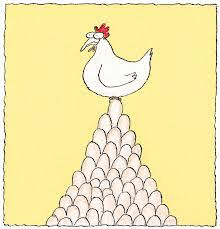
To lay an egg: to fail in an embarrassing manner. If a player or team does not score in the British game of cricket then a duck’s egg or zero is earned. Transfer this concept to America’s vaudeville and theater days when a performance failed to please the crowd or when a business fails the idea of laying an egg is applied, or in other words, an zero is achieved.

Left hand doesn’t know what the right hand is doing: taking an action that might indicate less than full knowledge. In Mathew 6:3 the passage indicates that a person should do good quietly instead of publicizing their action, basically keeping the action secret. Over time the secret aspect has taken to mean one department’s or organization’s action indicates a contrary action to another department’s or organization’s efforts, perhaps to the point of adding confusion or inefficiency to a situation.

Left-handed compliment: a statement that seems like praise, but is actually a disguised insult. Marriages between royalty and a commoner is known as morganatic and the ceremony involved the groom (the royal) giving the bride (the commoner) his left hand instead of his right as was done in conventional marriages. *This brings up the issue of the left hand being considered the “lesser” of the hands, which harkens back to superstitions about being left-handed.

Let one’s hair down: to behave informally, without constraint. Back in the day when women wore their hair up, the idea of wearing their hair loose and down around their shoulders was considered a breach of societal protocol. A woman let her hair down only in the privacy of her bedroom. P.G. Wodehouse had fun with this in his 1933 Heavy Weather: “We can take our hair down and tell each other our right names.” *I’m wondering why this only applied to men…

Let the cat out of the bag: to reveal a secret. In old-time open air markets people would purchase their goods and carry them home in bags and baskets. There existed the shady practice of placing a cat in the bag instead of the purchased pig. When the person got home the truth was revealed when the cat was let out of the bag.

There are lots of “L” phrases left. The one that surprised me most was the cat in the bag. I will probably think of pigs whenever I hear a secret revealed from now on.

How Cliché: That “F” list


Face the Music: to meet with consequences. An American saying that derived from the theater. An actor on stage would face the orchestra pit, and the audience. If the audience was a rough lot facing the music meant the actor had a tough performance ahead.

One way of facing the music (ufficoriroma.net)

Fair and Square: just with equity. Found in the 17th century the term is redundant since “fair” and “square” are similar in meaning. A “square deal” has similar meaning.

Fair to Middling: mediocre. In mid-nineteenth century America, Artemus Ward wrote in His Travels “The men are fair to middling” meaning things are so-so. Look over “Can’t complain.”

Mmm, average? (thefreedictionary)

Far and Wide: affecting those over great distances. One of the oldest clichés about, dating back to the year of 900. The Old English states it as, “feorr and wide.” Shakespeare added it to Romeo and Juliet with the line from Act Four, Scene Two: “I stretch it out for that word “broad”; which added to the goose, proves thee far and wide a broad goose.”

Feast or Famine: an overabundance or a severe deficit. The original expression stated: “either feast or fast.” During the twentieth century the original changed to the present form of “feast or famine.” Though cliché, it is a term that seems to remain applicable.

(Have a) Field Day: enjoy an outing or occasion. An expression from the 1700s that refers to the military proceeding with maneuver practices. The term then began to appear in the 1800s to civilian matters, such as schools taking students out on excursions. It can also mean to enjoy oneself away from the usual, expected routine or even to immerse in criticizing someone, as in the press having a field day with discovering an unsavory situation about a celebrity or politician.

My kind of field day (Reddit)

(To not care or not worth) A fig: worthless. In the Mediterranean area figs are plentiful, so if something is plentiful it’s not considered as valuable. However, in other parts of the world, such as England, figs have to be imported, so they would have value. This makes it interesting when Shakespeare used the expression in his Henry plays. Why did Shakespeare use the expression. I’m not sure–it’s Greek to me.

Filled to the brim: fulfilled to the absolute possibility. Both Shakespeare and Gilbert applied this cliché in their plays to create the meaning of utmost fulfillment as found Antony and Cleopatra (3:13): “He will fill thy wishes to the brimme” and in The Mikado‘s description of the three maids as “Filled to the brim with girlish glee.”

Or is this better for “My cup overflows”? (blogspot)

There are plenty more expressions for the “F” section. Stay tuned…

Any surprises in the discovered meaning?

Reader Round Up: July


July is my official summer vaycay month. June is tying up school and August starts it back up. July is my uninterrupted month of focusing on just relaxing in my hammock and reading. I do other activities besides immersing myself in books, but, yeah, I do read an enormous amount in July. This July I was fortunate enough to find a bevy of five star books.

Shakespeare After All by Marjorie Garber

While it might be easy to say, “Yet another Shakespeare reference?” This is THE reference book (and I have read more than a few) to keep handy. Garber’s book stands out among the crowd of reference books that examine Shakespeare’s plays. Her knowledge and insights are stunning. She is able to reveal plot details with subtlety and aplomb. She easily interjects historical allusions and intertextuality. Oh, to sit in on one of her lectures.

The Promise by Chaim Potok

Sequel to Potok’s stunning debut, The Chosen, the novel centers on Reuven Malter’s struggles with his religion and relationships as he strives towards completing his education. Can he bridge the two worlds he has chosen: philosophy and the study of the Talmud? His experiences and insights will help help him with a troubled young boy who is on the verge of isolating himself from the world.

The Leavenworth Case by Anna Katherine Green

Readers of Sherlock Holmes and Hercule Poirot be sure to check this possible inspiration for these famous sleuths. Written nearly a decade before Conan Doyle created his Baker Street detective, Anna Katherine Green penned into existence Detective Grace of the New York Police Department. He featured in many stories and his appeal boosted the author into being acclaimed one of the most popular authors of the 19th century. Many would say she led the way for detective stories as they are now known. I nudged Acorn to get this (and her other books) made into a series.

Eagle of the Ninth by Rosemary Sutcliff

Rosemary Sutcliff has stated in an interview that she writes not for children nor for adults—she writes to tell a story.
This story of Roman Centurion Marcus Flavius Aquila is one that combines adventure, history, and the theme of identity.
Well-researched and even better-paced, the story of redeeming family honor and discovering one’s identity inspired a movie. And this is an inspiring story. While most stories about Romans emphasize their brutality, Sutcliff provides a story that emphasizes the perspective that an individual does not have to conform to expectations of community credo, that a person can be trained and be an efficient member of a community, yet still hold individualistic ideals.
Recommended for ages 8 years and beyond, since a well-written story is always appreciated. Some of by favorite stories during this Reading Challenge have come off the juvie shelves. There is a movie with Channing Tatum and Jamie Bell; however, as always, the book is far better.

The Wind off the Small Isles by Mary Stewart

Under 100 pages this barely qualifies as a novella, and serves as a taste for what could have been as engaging as The Moonspinners. Stewart starts out the story with the beginnings of an old-fashioned historical romance which abruptly ends and leads readers into a modern setting of a children’s author and her assistant exploring an exotic setting for the author’s next book.
The short adventure is ripe with all of Stewart’s usual trademarks: expansive setting, lively dialogue, stock characters—including a damsel in distress saved by the likable hero, and a touch of the supernatural.
So fun, yet so short.

An Old Captivity by Nevil Shute


It’s hard to go wrong with a Nevil Shute. He is one of those rare writers that can interject technical details, like what it takes to fly three people on a photo expedition to Greenland, and not be boring. The details are such an integral part of the story they function like an added character.
In this story, Shute focuses on a professor, his daughter, and a pilot as they make their way to Iceland and Greenland. Doesn’t sound exciting, does it? Shute provides interest through his exacting detail, setting, and then adds a twist at the end that rings of a Du Maurier with realistic fantasy.
A satisfying and surprising read. And the title? Wait for it. The ending made me sit up and get that epiphany of “Oh, I get it now.”

Hope one of these, or maybe all of these titles, interest you. How about you? Any five star summer reads of note to pass on to the rest of us Book Boosters?

National Poetry Month: Shakespeare’s Birthday!


Bard Bits: Seasonal Sonnet


I tend to inundate my students with Shakespeare’s sonnets as part of our poetry unit. For one, sonnets often show up on the AP exam. For another, Shakespeare knows how to rock the sonnet. He saw what Petrarch has done with the Italian sonnet, smoothed and improved it to the point where he owns it. When someone says “sonnet” Shakespeare is what comes to mind. He tended towards taking what someone else had created and reshaped it so that it was his claim. It wasn’t plagiarism then, only genius.

This month’s Bard Bits recognizes how Shakespeare mastered the metaphor. Many of his sonnets dealt with aging out and Sonnet 73 captures the autumnal drift into winter with thoughtful reflection.

Sonnet 73: That time of year thou mayst in me behold

BY WILLIAM SHAKESPEARE

That time of year thou mayst in me behold
When yellow leaves, or none, or few, do hang
Upon those boughs which shake against the cold,
Bare ruin’d choirs, where late the sweet birds sang.
In me thou see’st the twilight of such day
As after sunset fadeth in the west,
Which by and by black night doth take away,
Death’s second self, that seals up all in rest.
In me thou see’st the glowing of such fire
That on the ashes of his youth doth lie,
As the death-bed whereon it must expire,
Consum’d with that which it was nourish’d by.
This thou perceiv’st, which makes thy love more strong,
To love that well which thou must leave ere long.

Captured this photo yesterday. Mehap’s I render this to be a new season:
Finter—when the trees have not shed their leaves before the first snow falls

Bard Bits: May


I managed to go to school without any experience with Shakespeare (yeah, how did that happen?) I can easily relate to my student’s bewilderment when we begin our drama unit. Freshmen study Romeo and Juliet, sophomores experience Julius Caesar, juniors skip Shakespeare to study American Literature (The Crucible), and depending on the teacher, students have a range of selection from an overview of the comedies to a dive into tragedy with Merchant of Venice, Hamlet, or Macbeth.

I am usually prepared for groans from my sophomores when I announce we are studying Shakespeare. “Not again!” “We did him last year.” “Shakespeare is so boring.” Instead of coming up with excuses and defending our Wily Bard of Stratford, I agree with them. This gets me some interesting looks–most def.

I do agree with my students. Shakespeare can be boring, or at least his plays were until I got the hang of them. Watching, let alone reading the plays, was painful to endure, and I felt I could never get anywhere, no matter how hard I tried. Then again, learning how to ski was painful, and I wondered if I would ever get down the mountain without a initiating a yard sale. Hmm, I should use this analogy with my students since they have grown up with a mountain in their backyard.

Here are two thoughts on Shakespeare:

“I am more easily bored with Shakespeare, and have suffered more ghastly evenings with him, than with any dramatist I know.” Peter Brook, English theatre director

“We find Shakespeare boring because we’re lazy. We’re not willing to get through the language. That’s the only barrier. If a play is performed right by those who are properly trained, after about twenty minutes you won’t be aware of the language because the human story is so strong.” –David Suchet, actor

What are your experiences with Shakespeare? Bored, frustrated, from having to endure year after year of his plays in school? Perhaps initially bored, but then the story unfolds and the words are no longer a barrier and serve as a contribution to the experience? Or maybe you grew to appreciate him with time and experience?

One of my standout memories of teaching my favorite play, Hamlet–sorry, I do mention that often, don’t I?–is after we wrapped up the unit, one student, from my regular, not AP class, stayed behind. “You know I’m going to miss discussing Hamlet, I really got to like this play.” He grew thoughtful. “I can’t discuss Shakespeare with my father.”

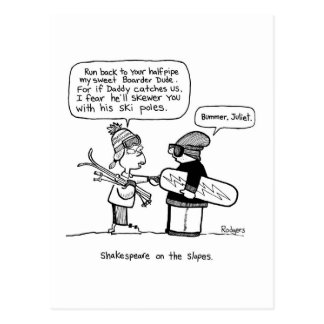
I never discussed Shakespeare with my father either. But I sure discuss him with my own children when I get the chance. Shakespeare boring? Not for long. Hang in there, dig in your poles, don’t cross your ski tips, and you will enjoy the thrill of going from snowplow to slalom. That applies to skiing as well.

Oatmeal Winter


Shakespeare must have experienced a few discouraging winters when he penned the lines for Richard III: “The winter of our discontent.”

Although the line is more metaphorical than literal, concerning rulership and kingly reign, it is a line that reverberates and has been applied to other aspects. Britain claimed in the late seventies with strikes occurring during a freezing winter, and Steinbeck borrowed it as well.

However, Shakespeare’s line aptly fits my present state of mind. Our corner of the world has experienced a ramshackle winter of excessive snowfall followed by excessive rain, which makes for interesting conditions—much like existing in a 7-11 Slurpee cup. Then there is the continuous grey or gray, if you prefer, days. The sky casts the muted shades of blahness, and the snow is no longer a cheery pristine. I call January and February the Oatmeal Days of winter: gray and lumpy all around.

Not that I really believe in the predictions of Old Puxy, but it’s some kind of wonderful when the thought of spring is that much closer. The first Sunday of February made me a believer of prognosticating groundhogs as blue skies and sunshine greeted the day. Even though it was a bracing 36 degrees, I bundled up and sat outside and soaked up as much heliotherapy as I could before the chill penetrated my enjoyment.

And then the respite ended. Back to the slog of rain and snow, which triggers my discontent.

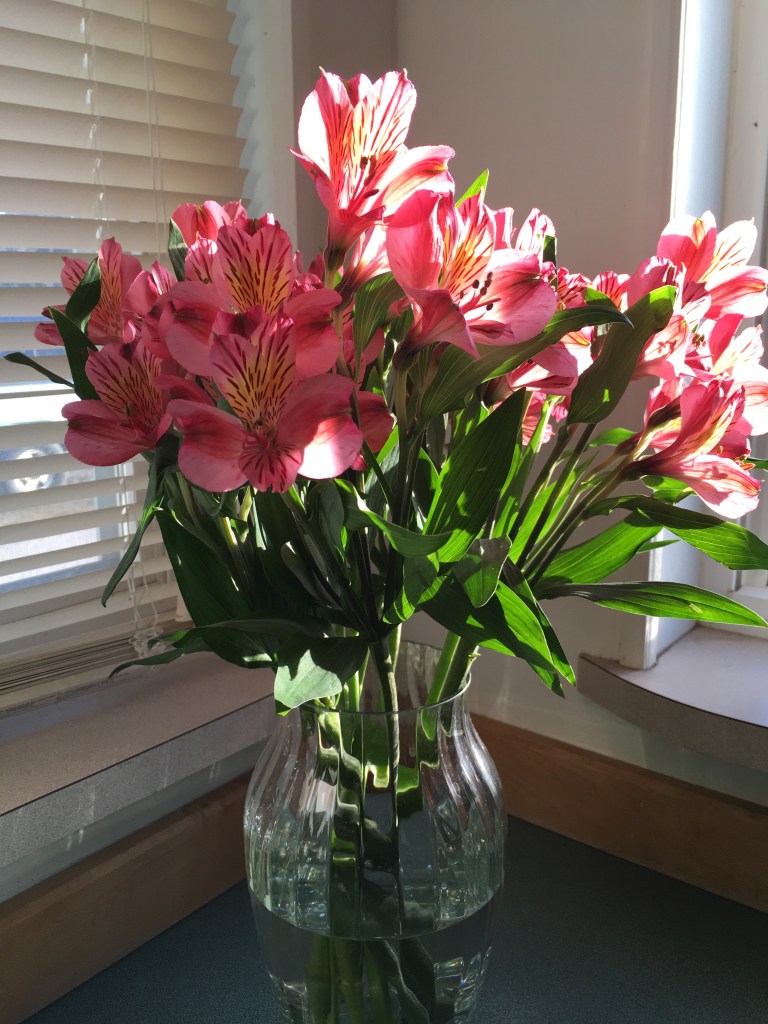
Having had that momentary blue sky day, I realized it’s not the snow that undermines my temporal happiness– it’s the lack of color. The sameness everyday is a mood quencher. Therefore, I have devised my own therapy.

If I can’t count on blue sky winters I will bring color to my own delight.

Safeway flowers
windowsill marbles
Chromecast screen savers
Puzzles
Plants

These attempts to brighten my outlook seem to help, especially when I see the forecast is once again gloomy. Winter can create discontent, yet I can always add a little color content to become content.

How do you cope with winter’s gray days?

Bard Bits: All Is True (not really, Ken)


As a bona fide Bardinator I look forward to new or new-to-me versions of Shakespeare’s plays. I also appreciate Shakespeare-ish films, those films, shows, and specials that speculate about the Bard of Avon, because in actuality we really don’t know much about him or his family. Kenneth Branagh, noted Bardolator, attempted to cast some (perceived) truth on Shakespeare’s life after retiring to Stratford.

If you missed All Is True it’s no doubt because it wasn’t playing in a theatre near you. It certainly wasn’t in my secluded part of the world. Fortunately I found a copy in the local grocery DVD corner. The hubs would have preferred a Tom Cruise flick and almost checked out yet another watching of a Mission Impossible. He acquiesced. This is one of the reasons he is such a keeper–plus he owed me for my relenting to watch The Italian Job yet again.

Kenneth Branagh has provided a marvel of a supposition: what happened after Shakespeare retired in 1613 to Stratford? We don’t know, historians don’t know, but Branagh sets forth what he perceives might have, could have happened based on the tiniest scraps of historical information.

Facts:
The Globe Theater burnt to the ground in 1613 and William Shakespeare retired from the theatre to live out his remaining days (three years) in his hometown of Stratford-Upon-Avon where he had a family: Anne, his wife, Susanna, his eldest daughter (married with a young daughter) and Judith (unmarried and the surviving twin). Shakespeare’s heir, Hamnet, died at age 11 (attributed to plague, but no one really is sure). There was some scandal connected with each of Shakespeare’s daughters. Shakespeare died on his birthday.

Fancy:
From those facts Branagh provides a family drama of a man who has been more absent than present for the past twenty years, and apparently has never recovered from the loss of his only son and heir. Branagh has Shakespeare creating a memorial garden for his son and battling out resentments with his wife and daughters.

Kudos:
The acting is superb. How could it not with Judi Dench as the long-suffering Anne, Ian Mckellen as the larger than life patron come to visit his favorite poet, and Kenneth Branagh, who has brought Shakespeare to the general public in bold and creative ways? The supporting actors hold their own as well, especially Susanna and Judith. The hubs did not even recognized Branagh as Shakespeare, being impressed when he saw his name as the director, but stunned to learn he was playing the Bard. Yes, the make up is that well done. He looks like the portrait we are all so familiar with. The costumes and time period setting is excellent–they even filmed in candlelight.

Image result for kenneth branagh as shakespeare

Concerns:
I am a stickler for historical accuracy and get a bit distracted when adaptations go too far afield in interpretation. I don’t mind Henry IV being set during WWI or gnomes becoming Romeo and Juliet, but hey, taking liberties with actual history and presenting it “all is true” goes beyond artistic license. The hubs finally shuushed me during the movie, indicating he didn’t care for my pointing out of inaccuracies and inserting corrections. He said, “I liked it.” But, but, not all was true.

Takeaway:
This is facfic in extreme. It is a love letter done with excellence. It is worthwhile to hunt up a copy and watch it, not just because for its production quality. Do it because it keeps Shakespeare alive, even though he has been gone for over 400 years.

Reader Round Up: August


August became my vacation month this year. Due to obligations, responsibilities, and unexpected events, my usual casual days of unwinding during summer before powering back up for the school year dwindled down to about two weeks of fetter free days. Amazingly enough during this hectic summer I found time to read. Actually, reading is what kept me sane. Chocolate might have, but that calorie thing always has me rethinking my grab towards the Dove bar whilst shopping.

Due to the unusual amount of stress this summer I read more than usual and this resulted in my hitting my Goodreads Reading Challenge of 101 books (and then some) earlier, much earlier than expected. Maybe stress can be a good thing after all? I do know reading is my go-to for relieving craziness that comes from being overwhelmed with the unexpected.

Here are the highlights for August reading:

King Solomon’s Mines by H. Rider Haggard ⭐️ ⭐️ ⭐️ ⭐️
If you appreciate Indiana Jones and Lost World you will want to explore this foundational novel. Written around 1885, as a challenge to write something better than Stevenson’s Treasure Island, Haggard succeeds in providing an adventure in Africa that brims with narrow escapes, lost treasure, mysterious strangers, cruel villains, and legends to perpetuate. Several movie adaptations, yet none come close to the actual novel.

Coming Home by Rosamunde Pilcher ⭐️ ⭐️ ⭐️ ⭐️
Fans of Downton Abbey this is a book for you. English gentry, family drama, war drama, convenient plot devices, surprising plot turns, likable heroes, inspiring heroines, emotional involvement. It’s all there—all 977 pages. Update: the miniseries wasn’t exactly the plot, but decent.

Shakespeare’s England edited by R.E. Pritchard ⭐️ ⭐️ ⭐️ ⭐️
The title is a bit deceptive in that it is actually an account of what life might have been like during the 1600 and 1700 time period in England. While this is the era when Shakespeare was prominent, the book is not focused on Shakespeare and his England. Fascinating information otherwise.

Sleeping Tiger by Rosamunde Pilcher ⭐️ ⭐️ ⭐️
A perfect airplane read: light, non-demanding, read in the two hours of flight.

Researching James Herriot I read several of his books, mainly biographies. A separate post is here.

A Woman of Independent Means by Elizabeth Hailey ⭐️ ⭐️ ⭐️
A fascinating arc of a woman’s life; however, it lost its appeal midway through due to the overly dramatic plot and epistolary device wearing thin. I am interested in watching the mini-series with Sally Field, as she strikes me as being capable of portraying the main character Bess having watched her in Places of the Heart.
Update: Even Sally Field couldn’t breathe solidity to this flimsy soap opera.

Report from Argyll by Alan McKinnon ⭐️ ⭐️ ⭐️
If James Bond ‘60s espionage tales are on your list, look for this little Crime Club edition. The story comes complete with sexist dialogue, political undercurrents, skulking villains, plot twists, and red herrings.

Stranger in a Strange Land by Robert Heinlein ⭐️ ⭐️ ⭐️
A classic I wanted to revisit, yet I couldn’t finish. And I wanted to. However, beyond the dated attitudes and interactions, let alone cliche characters, I could not easily digest Heinlein’s diatribe against societal conventions and practices such as religion, politics, and gender roles. It felt like the novel had been designed around his views, not so much around the unique idea of a Man from Mars adapting to the planet of his heritage. The novel did give us “grok” which is something worthwhile.

The House of Paper by Carlos Dominguez ⭐️ ⭐️ ⭐️
More of a short story then a novel and at barely 100 pages it might be a stretch to consider it a novella. One has to appreciate magical realism to fully grasp the focus of the story. The illustrations by Peter Sis are a bonus.

A Woman of No Importance: The Untold Story of the American Spy Who Helped Win WWII by Sonia Purnell ⭐️ ⭐️ ⭐️ ⭐️ ⭐️
Just when we think WWII might be exhausted for story angles, along comes the absolutely fascinating story of Virginia Hall, who might have gone unnoticed had it not been for scrupulously researched work of Sonia Purcell. Considering how Hall remained recalcitrant about her feats of super spy achievements in France, Purnell has honed a fascinating portrait of a person, no matter that she was an American woman with a prosthesis, who helped greatly during WWII, particularly with France’s efforts to free itself of the Nazi regime. Update: a movie is in the making

Yes, it is an eclectic list. Bouncing around to what catches my eye seems to be my indiscriminate pattern of reading selection. See anything of interest?

Reader Round Up: April


I don’t know if this is embarrassing or if it is something of an accomplishment to crow about–here it is:

I have read 57 books of my 101 goal. And it’s not even halfway through the year.

What does that mean?

Have I surreptitiously slipped from bibliophile, merely a person loves books, into a bibliomaniac, being crazy about books?

‘Tis a ponderment.

If I were to submit to a consultation, as if there is real concern about reading too much, (is that even feasible?) What would be revealed about my reading habits?

Today we will look in on the eminent Reader Analyzer, known for her insightful understanding of reading habits. The following is a session excerpt with Cricket Muse, known for her monthly Reader Round Ups and efforts as a chirpy Book Booster.

RA: Cricket, I appreciate your willingness to share your views about reading.

CM: Well, isn’t this really about whether I’ve drifted from casual reading into habitual reading?

RA: No one here is judging. We are here to celebrate your accomplishments. You do like to read, don’t you? <smile>

CM: Somewhat of an understatement. You’ve read my rap sheet: three years in a row of surpassing my Goodreads goal of 101 books? Reading 57 books before May 5 hit the calendar? I read 4 books in one week! <lowers voice> Is that even normal?

RA: Normal is subjective. Some say “normal” is a setting on the dryer.

CM: It is? Mine says “dry or more dry.” What type of dryer you own? A Kenmore? I think my mother had an old dryer that had that setting.

RA: Back to books and the normal reading standard. Who is to say what the new normal is? Reading isn’t what it used to be is it?

CM: That’s true. Some of my students wouldn’t ever pick up a book if I didn’t require SSR, silent sustained reading. I don’t know many adults who are avid readers either.

RA: Not being surrounded by readers, what influences you to read?

CM: Getting right down to it, aren’t we? Well, I read because at the end of the day I suffer from screen scream. When I’m not teaching up front and personal, my time is at the computer grading and creating lesson plans. My brain is buzzy from all that screen activity. My solution is to grab a book and knock back a couple of chapters, letting my brain settle down. Holding a book in my hands, feeling that paper between my fingers, hearing that crisp swish of pages turning is very therapeutic.

RA: Not judging <smile> but you said four books in one week? Teaching must be stressful.

CM: It can be. That four book week was not a teaching week. I was in a situation that resulted in a combination of weather conditions, downtime, and the need to de-stress.

RA: Sounds like reading is your go to for relaxing. Do you read for other reasons?

CM: Of course! I read out of curiosity–what’s the big hype about The Martian, for instance (I actually liked the movie better, but reading the book helped enjoy the movie more)? I read because as a writer I need to know what is current on the market–what are others reading and what are others writing? And yeah, I read for pleasure. A cup of cocoa, my cozy chair, a crackling fire, a good book or glass of lemonade, my hammock, a soft backyard breeze, a paperback of choice–yup, these are a few of my favorite things.

RA: Enjoying a book, for whatever reason, could be addictive. Do you just read?

CM: I see what you’re doing <wink/finger point> I have a full life that includes books; it doesn’t revolve around books: teaching, working out at the gym, volunteering at the library, writing, putzing about in the yard–books are frosting, not the cake.

RA: Sounds like a good balance. I can’t resist–what good books have you read lately?

CM: Here’s a few titles from last month and a couple of recommends. So–am I crazy about books or am I crazy?

RA: Not here to judge, remember–but it is crazy wonderful how much you enjoy reading. I’d say keep on reading on. Thanks for revealing your thoughts about reading.

CM: See you around, and I hope you find a good book to read this week.

April Read Highlights:

The City of Gold and Lead by John Christopher ⭐️ ⭐️ ⭐️ ⭐️ sequel to The White Mountains–classic science fiction and ignore that it’s in the juvie section because it’s a great plot and writing

King of Shadows by Susan Cooper ⭐️ ⭐️ ⭐️ ⭐️ ⭐️ Another juvie–yet appropriate for adults, especially for Bardalators and Bardinators as it is a time transfer back to the Renaissance Globe theatre when A Midsummer Night’s Dream played. Lots of marvelous historical detail and the plot is intriguing as well.

The Martian by Andy Weir ⭐️ ⭐️ ⭐️ ⭐️ finally got around to reading this and it was a bit better than okayall the science detail proved a bit daunting, but the Castaway on Mars with Mark proved a decent story.

For more reviews check out my Goodreads links on the right (on full site) or look me up on Goodreads as I have plenty to say about all those books I read.

Until the next Reader Round Up…

Post Navigation