Pam Webb

a writer's journey as a reader

Archive for the tag “reviews”

Hungry for Another Series?


After reading the Hunger Games series I cast about for something else as a continuous read.  Fortunately I found Divergent by Veronica Roth.  Although the next book is not due out until May I am set to move on to the further adventures of Tris.

What is it about getting involved in a series?  Is the lost-in-a-plot feeling?  Is it the invested interest in characters?  Perhaps it is the convenience of not having to find and audition yet another book (hmm, shades of dating and staying in a monogamous relationship).  Anyway, here are some suggested series, tried, true, and some still new to me:

1. Divergent by Veroncia Roth(next up will be Insurgent in May)

2. Chronicles of Narnia by C.S. Lewis

3.  Enders Game by Scott Orson Card

4.  Hitchhiker’s Guide to the Galaxy by Douglas Adams

5.  The Eyre Affair by Jasper Fforde

6.  Anne of Green Gables by L.M. Montgomery

7.  The Giver by Lois Lowry

8. The City of Ember by Jeanne Du Prau

9.  The Dune Chronicles by Frank Herbert

10. Little House on the Prairie by Laura Ingalls Wilder

11. Sisterchicks by Robin Jones Gunn

12. Arthurian Saga by Mary Stewart

13. Redwall by Brian Jacques

14. This Present Darkness by Frank Peretti

15. Dragon Riders of Pern series by Anne McCaffery

16. Janie Johnson series by Caroline Cooney

17. The Boxcar Children by Gertrude Chandler Warner

18. The Chronicles of Prydain by Lloyd Alexander

19. The Zion Chronicles by Bodie Thoene

20.  Stargirl by Jerry Spinelli

21. The Outsiders, That Was Then This is Now, Rumblefish by S.E. Hinton (shared characters)

22. Ramona by Beverly Cleary

23.  The Mrs. Pollifax series by Dorothy Gilman

23.  Constable  Evans series by Rhys Bowen

24. The Mars Diaries by Sigmound Brouwer

25. Chronicles of Fairacre byMiss Read

26. Amber Chronicles by Roger Zelazny

27.  Horatio Hornblower by E.M. Forester

28. Hatchet by Gary Paulsen

29. All Creatures Great and Small by James Herriot

30.  Encyclopedia Brown series by Donald Sobol

31. Little Britches by Ralph Moody

32. Diary of a Teenage Girl by Melody Carlson

33. Stonewycke Triolgy by Michael Phillips

34. Sarah, Plain and Tall by Patricia MacLachan

35. Paddington Bear by Michael Bond

If these don’t work for you, or if you’ve already devoured them, try the GoodReads link.  There are over 1200  entries and over 100 pages to browse through.  Book Boosters need their choices, ya know.

http://www.goodreads.com/shelf/show/series?page=1128

I’m interested in your thoughts.  Try out my first Polldaddy attempt:

Spring Came on Forever


Spring Came on Forever by Bess Streeter Aldrich

From the book:

This is the story of two midwestern families and the starnge way in which their paths crossed. It begins in Illinois in the year 1866, and end in Nebraska in the present one [1935], severed from all that went before and all that will continue beyond a thing of incompleteness.

Aldrich blends together a portrait of the harshness of prairie pioneer life and that of an unconventional love story.  Amalia Holmsdorfer, a sweet young girl of seventeen, finds herself attracted to twenty-one year Matthias Meier, the young clerk who sold her stern German father the soap-making kettle.  Matthias also finds himself attracted to Amalia and begins secretly courting her–even though she has been pledged in marriage to a man of her father’s choosing.  Amalia and Matthias plan to run away together, yet their plans meet up with the fury of flooded roads and even though Matthias attempts to meet her in Nebraska before she marries, he again meets up with one of nature’s blockades.  Matthias and Amalia miss each other by mere hours and she marries the wrong man.

So goes the begins a love story that will span three and four generations.  Aldrich, writing in the style prevalent of her time, reveals the story in an omniscient narrator fashion.  It’s as if we are sitting in a cozy living room and listening to a tale of long ago.  While the “tell” style of yesteryear may not got over well with the current “show” method of today, I have to admit I became so involved in the plot that by the last chapter I clutched the book and actually cried.  And I am not a crier when it comes to literature.  Movies, on occasion can induce some sniffling, but rarely can a book get me to sob.

The story is mainly about Amalia; her hopes and dreams of romance are forever changed when she is forced to leave with the rest of her family and the other members of her German community to build a new settlement in Nebraska. Though she appears complacent on the outside, she keeps her inner thoughts and desires to herself.  Aldrich captures this wonderfully:

pp. 9 & 10

But thoughts are acrobats, agile and quite often untrustworthy.  So now, with impish disregard of the command, they hopped about quite easily.  They asked Amalia innocently why the nice young man wanted to know where she lived.  They suggested with subtle art the possibility that he would try to find out.  And then when the gruff person at her side questioned their activities they urged her quickly to answer, “Nein.”

My interest in pioneer started long ago with the Laura Ingalls Wilder’s Little House on the Prairie books. There is a fascination in reading about how people created homes and towns out of the rough lands of prairie and wilderness, and through all this tremendous effort they had their own personal stories.   For the last five years I have labored on a novel about a family who follows the Oregon trail to turn off and make their claim in Idaho.  Historical novels require plenty of research to make the time period, setting, and characters come alive.  Aldrich’s Spring Came on Forever reminded me how moving pioneer stories can be.   I am also encouraged to someday write something that induces tears.

Sufficient Grace


Sufficient Grace by Darnell Arnoult

Listening to the voices in her head Gracie Hollman takes off her wedding ring, snips her credit cards, jumps in her car, and leaves everything behind.  Her husband Ed, a solid, everyday kind of guy who owns a tire shop, is at first concerned about her absence, thinking foul play at first, but the abandoned credit cards and wedding ring make him think she’s left him for another man.  He didn’t see that one coming, especially after thirty years of marriage

The story centers on Gracie and how her decision to leave everything behind causes a ripple through several families.  Each family, and each person will find that things have a way of working out because grace truly is sufficient.

Darnell Arnout has created a mesmerizing work which explores grief and healing with sensitivity, insight, and humor. Arnoult masterfully mixes together a variety of characters, who at first have separate stories, yet by the end of the book they are all connected.

One of Arnoult most distinguishable style attributes is taking the everyday and spotlighting it into something  of phenomenal clarity.    For instance, Mattie is becoming increasingly handicapped by her inability to get past her husband’s death. At her family’s insistence she begins to clean out his closet. During the process Mattie tries on her husband’s shoes, reminicsing about much she misses how their feet would lightly rest together at night when they slept.

p. 162:

Mattie will give up the clothes.  She can do that.  She’ll let Sammy put them in some bin and let some other needy soul have them.  but she needs to walk in Arty’s shoes for a while.  Feel her skin slide over the place where his feet have been.  Just for a while longer. She’s got to keep those feet.

This book gave me encouragement to take a batch of people and tumble them together to get a kaleidoscope of character mixing.  I also gained an insight on how levity lightens serious topics.  And food. Writing about food somehow makes painful stiuations like grief, discord, and mental duressl seem so much more palatable.

The Magic of Ordinary Days


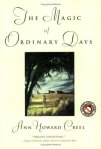
The Magic of Ordinary Days by Ann Howard Creel

Olivia Dunne’s dreams of becoming an archaeologist are irrevocably changed after a brief interlude with a solider shipping out overseas. Her father arranges a marriage with a reputable bachelor farmer and Livvy accepts this arrangement. Leaving her married sisters behind in Denver, Livvy arrives in rural Colorado to become the wife of a man she does not know.

The book explores many topics: grief, betrayal, loneliness, trust, forgiveness, acceptance, and love. Livvy shows the readers her situation and how she adjusts to it in a voice full of angst. She mourns the recent passing of her mother, as well as the changes her mother’s death has brought her father. She stoically accepts the arranged marriage, for her baby needs a name. Ray, her new husband, knows Livvy carries another man’s child, yet he does not judge or resent Livvy for it. He patiently waits for Livvy to love him as he has come to love her.

Within this main plot is Livvy’s friendship with two Japanese-American sisters, Rose and Lorelei, who are residents of a local interment camp. Readers see the affects of WWII on Americans through Livvy’s eyes and through Rose’s and Lorelei’s.

As a reader I relished Creel’s use of imagery. I could feel the isolation Livvy suffered: the expanse of the fields, the lack of neighbors and family to break up the monotony, the need of useful purpose. Found on page 41: A clay-colored tumbleweed wedged between rows of green leaves caught my eye. Thorny, trapped, and out of place, it let me know the insignificance of any one, distinctive thing caught in a place so mapped with sameness. Aunt Eloise and Aunt Pearl had once accused me of hiding out in school. Instead Father had sent me into hiding here, where the openness of land and sky made hiding out about as unlikely as finding clover among the sage.

As a writer I appreciated Creel’s ability to use the first person narrator in such a way that all the characters were given dimension. The narration flowed so effortlessly that I often forgot the story was told from Livvy’s point of view. Another aspect of Creel’s writing is her use of prologue. Not being much of a prologue fan, I find myself inadvertently cringing whenever a book begins with one. Why not just start the story? Why the compunction to have extra exposition? However, Creel’s prologue is perfect; it reads as a visual movie trailer. It sets up the plot, the initial conflicts, the intrigue. It hooked me as a reader.

The Magic of Ordinary Days is far from ordinary. A compliment to Creel is that her book became an inspiration for a Hallmark Hall of Fame movie, which I had actually watched many years ago. As always, the book is better.

The Magic of Ordinary Days

The Magic of Ordinary Days (Photo credit: Wikipedia)

Post Navigation