Pam Webb

a writer's journey as a reader

Archive for the tag “Plays”

Bard Bits: Bard in the Park


I’ve experienced Shakespeare plays (one experiences his works, versus watches them—a bit pompous sounding,sorry) in a variety of forms: live on stage (several as an audience member and once as Horatio—very brief); large screen theater; small screen TV; reading, and teaching.

One favorite form is watching a performance in the park, as it is open air, much like a Globe performance. Plus there is the anticipation of lively audience response, the atmosphere being one of shared spaces and camaraderie. And the plays are usually free, at least the one that comes to our fair city is.

Every year in August the Montana company arrives and performs one of Shakespeare’s popular plays in a local park. This year they presented a As You Like It, which is one of Shakespeares more popular comedies.

Bard in the Park

Arriving at the park 40 minutes early I discovered the space already teeming with people, but no matter since I prefer the back for that quick exit to avoid the parking lot tangle.

As the sun drifted behind the trees the temps cooled down and the stage action heated up with runaway sons and daughters, tangled romance, and character arcs. As You Like It is a fun romp and the audience showed its appreciation with plenty of applause and laughter.

Bard in the Park signifies the transition from summer fun to back to school readiness. And Jacques mentions going to school in his famous “All the world’s a stage” soliloquy.

Anyone catch a Shakespeare in the Park performance this summer?

Bard Bits: ‘Tis Summer


I always look forward to summer, and I especially look forward to the outdoor Shakespeare performance that comes round in August. It’s not easy waiting another month, so with the prompting of a recently vowed Folger Shakespeare Library post I will pass on some of Shakespeare’s best summer quotes because he must have really liked summer having mentioned summer over 80 times throughout his writing.

Alas, I doth forgot my SP30

How shall we beguile
The lazy time if not with some delight?
Theseus, A Midsummer Night’s Dream, Act V, scene 1

But with the word “The time will bring on summer,”
When briers shall have leaves as well as thorns
And be as sweet as sharp.
Helen, All’s Well That Ends Well, Act IV, scene 4

As a fair day in summer, wondrous fair.
Pericles, Pericles, Act II, scene 5

This bud of love, by summer’s ripening breath,
May prove a beauteous flower when next we meet.
Juliet, Romeo and Juliet, Act II, scene 2

O Westmoreland, thou art a summer bird,
Which ever in the haunch of winter sings
The lifting up of day.
King, Henry IV, Part 2, Act IV, scene 3

Thus sometimes hath the brightest day a cloud,
And after summer evermore succeeds
Barren winter, with his wrathful nipping cold;
So cares and joys abound, as seasons fleet.
Gloucester, Henry IV, Part 2, Act II, scene 4

Now is the winter of our discontent
Made glorious summer by this son of York,
And all the clouds that loured upon our house
In the deep bosom of the ocean buried.
Richard III, Act III, scene 1

And of course the most summery of his summer tributes is Sonnet 18.

Sonnet 18

Shall I compare thee to a summer’s day?
Thou art more lovely and more temperate.
Rough winds do shake the darling buds of May,
And summer’s lease hath all too short a date.
Sometime too hot the eye of heaven shines,
And often is his gold complexion dimmed;
And every fair from fair sometime declines,
By chance or nature’s changing course untrimmed.
But thy eternal summer shall not fade
Nor lose possession of that fair thou ow’st,
Nor shall Death brag thou wand’rest in his shade,
When in eternal lines to time thou grow’st.
So long as men can breathe or eyes can see,
So long lives this, and this gives life to thee.

Here’s to you with a hope you can catch an outdoor summer Shakespeare performance. A wondrous season indeed exalted by a wondrous writer.

Goats and Monkeys: the other aspect of Shakespeare


National Poetry Month is still among us for a few more days and I would be remiss not to mention Shakespeare and his sonnets. There–duly mentioned.

I am sorely tempted to give a brief lesson about the sonnet, something I miss teaching from my AP English Lit days. BUT (which is an indication of the turn in the sonnet mood or message known as the volta–see what I did there? Yes, I did squeeze in a brief lesson), I shall refrain and instead spotlight that other aspect of Shakespeare.

No–not him being a playwright. Did you know he started out writing sonnets and not plays? That he considered himself more poet that playwright and that he inserted many a sonnet into many of his plays? There are four sonnets in Romeo and Juliet alone. The prologue that introduces the play is a sonnet (watch for the volta–hint, hint “which” works as well as “but”):

Two households, both alike in dignity,
In fair Verona, where we lay our scene,
From ancient grudgeParenthesis break to new mutiny,
Where civil blood makes civil hands unclean.

From forth the fatal loins of these two foes
A pair of star-crossed lovers take their life

From forth the fatal loins of these two foes
A pair of star-crossed lovers take their life;
Whose misadventured piteous overthrows
Doth with their death bury their parents’ strife.
The fearful passage of their death-marked love,
And the continuance of their parents’ rage,
Which, but their children’s end, nought could remove,
Is now the two hours’ traffic of our stage;
The which if you with patient ears attend,
What here shall miss, our toil shall strive to mend.

There I am talking about sonnets again. Well, it is National Poetry Month. And being such a famous, well-known poet it is difficult not to have spent at least a bit of time about how the Bard rocked sonnets.

Sonnets. Plays. He did write them supremely well. We still read them, watch them, recite them, discuss them and you know what? Just watch a master recite the master discussing April–very appropriate, wouldn’t you say?

The cat is a nice touch.

Here I meant to talk about the other aspect of Shakespeare, and sonnets distracted me. A worthy distraction, true that. Yet, (another word that works as a volta, since I am changing the direction of this focus), beyond the perfect prose and poetry Shakespeare is so admired for there is a darker, mmm, not quite the right word–ribald, yes, Shakespeare has a definite ribald side to him: his insults!

Throughout his plays his characters lob the cheekiest insults at one another. Keeping in mind the majority of those attending Shakespeare’s plays were of the down-to-earth crowd, known as “groundlings” because they pay a penny to watch the performance and stood for the entire time, often shouting out their commentary to the stage actors. Stands to reason then why Shakespeare inserted earthy lines into his plays. He knew how to play to the crowd.

Here are some examples. They start at mild and run the course from G to PG13.

  • “Neighbors, you are tedious. ” —Much Ado About Nothing, Act 3, Scene 5
  • “[You] peevish baggage.” —Pericles, Act 4, Scene 6
  • “[H]e has not so much brain as earwax.” —Troilus and Cressida, Act 5, Scene 1
  • “You are not worth another word; else I’d call you knave.” —All’s Well That Ends Well, Act 2, Scene 3
  • “Out of my sight! Thou dost infect mine eyes.” —Richard III, Act 1, Scene 2
  • “Bloody, bawdy villain! Remorseless, treacherous, lecherous, kindless villain!” —Hamlet, Act 2, Scene 2
  • “A knot you are of damned bloodsuckers.” —Richard III, Act 3, Scene 3
  • “You rise to play, and go to bed to work.” —Othello, Act 2, Scene 1
  • “Heaven truly knows that thou art false as hell.” —Othello, Act 4, Scene 2

For more Shakespeare insults try this link:

Or you can create your own insults with this link. This is a classroom activity we used to do during our Shakespeare unit in English. It would culminate in an insult-off between a student and myself with the object of hurling such a created invective that the other person would cry–actually it usually ended up with everyone laughing.

So, a tribute to Shakespeare’s prowess with prose and poetry and a solid nod to his poison pen when it came to hurling insults.

Bard Bits: Shakespeare and the Ho Ho Ho


Nope, didn’t happen. Shakespeare and Santa were not pals. England during the Renaissance didn’t actually celebrate the holly jolly season like it is currently done. For one thing, the timing was different. These days Christmas sales start around July, with Halloween getting a minimum nod, and Thanksgiving receiving a cordial nod. It’s all about the merc, it seems. Instead of Santa, the Lord of Misrule presided as the seasonal host, whose main job was to organize games and entertainment. That “Twelve Days of Christmas” song that is piped through every store while we shop, shop, shop refers to the days celebrated beginning on Christmas and going on until January 6th. Gifts were exchanged on New Year’s Day. Christmas during Shakespeare’s was more about living than giving, with the emphasis on getting through the bleak season of cold.

Winter was tough in those days. No central heating, no Starbucks warm ups, no snow tires, and no Amazon for last minute orders. There was also the very real concern if the food gathered in the harvest would last until planting could begin again. To pass the long, cold season Elizabethan folk created a myriad of festivals and celebrations to get them through winter.

While he didn’t write a specific Christmas play, Shakespeare did mention Christmas a few times. In Taming of the Shrew Christopher Sly in the opening prologue mentions how the play the audience was about to watch was to be considered folly and fun, much like gambling and tumbling. In Love’s Labour Lost Shakespeare has a character acknowledge that Christmas is part of winter and snow is part of winter. Basically Shakespeare is acknowledging winter is cold and snowy, just accept it, and he would ease the hardship of this harsh season with his comedic plays.

How do you perceive winter? Is it a thumbs up or a thumbs down season for you?

Bard Bits: Here Be Monsters


When Shakespeare’s works are mentioned the association with him runs towards love stories, as in Romeo and Juliet or tragedies like Hamlet or even sweeping historicals found in the Henry plays.

Not necessarily Shakespearean

Monsters may not be the forerunner feature in his stories but Shakespeare did populate his plots with creatures, witches, and ghosts—oh my, he certainly did. In fact, most of his well known plays contain monsters or scary aspects.

Romeo and Juliet: Juliet about to take the friar’s prescription for a faked death believes she sees her dead cousin’s apparition. Then there is the part of waking up in the family crypt surrounded by her cousin’s recent corpse and long dead relatives. *cue creepy music*

Hamlet: Our titular hero receives a guilt trip from his dead father’s ghost—not once but twice.

Julius Caesar: Brutus must contend with great Caesar’s ghost.

Macbeth: Not only is there the ghost of Banquo there is a trio of weird sisters.

Cymbeline: another batch of ghosts.

The Tempest: A sassy sprite named Ariel and whatever Caliban is supposed to be.

A Midsummer Night’s Dream: speaking of sprites, Puck reeks of mischief galore.

Shakespeare inserted monsters into his plots because he pandered to the paying crowd and those folk of the Renaissance were a thrill seeking, superstitious bunch, queens and kings especially.

While Shakespeare created several memorable monsters his penchant for monstrous acts should be noted.

Offhand there is fratricide, homicide, verbal abuse, racism, sexual abuse, dysfunctional family relationships, and a mention about being wary when it comes to pie at dinner.

So—

Forget loading up on Frankenstein and Freddy for fright night watching. Instead save your anticipation for scare by streaming some Shakespeare.

Bard Bits: Shakespeare Said That?


William Shakespeare’s writing has provided some fairly memorable quotes, words, and expressions. While Billy Bard can take credit for most of what is tagged with his name, he doesn’t quite get all the credit.

Let’s play “How Well Do You Know Your Shakespeare?” You will be given two quotes. One or both quotes are presented. Decide which, or both, belong to Shakespeare.

1.A. “Bated Breath”
B. “Breathlessly Waiting”

2. A. “A Blinking Idiot”
B. “Foolish Ninny”

3. A. “Take Your Last Breath”
B. “Breathe One’s Last”

4.A. “Give Them An Inch”
B. “Budge An Inch”

5.A. “The Crack Of Dawn”
B. “The Crack of Doom”

6. A. “Kindness Is A Cruelty”
B. “Cruel To Be Kind”

7. A. “Fortune’s Fool”
B. “A Fool And Their Fortune Is Soon Parted”

  1. “Bated Breath” from The Merchant of Venice, 1.3.115-116, 123-129
  2. “A Blinking Idiot” also from The Merchant of Venice, 2.9.54-62
  3. “Breathe’s One Last” from Henry VI, 5.2.39-42
  4. “Budge an Inch” from Taming of the Shrew, induction.1.7-15
  5. “The Crack of Doom” Macbeth, 4.1.112-117
  6. “Cruel to be Kind,” Hamlet, 3.4.173-179
  7. “Fortune’s Fool,” Romeo and Juliet, 3.1.132-136

Bonus:

Who said “A fool and his money (fortune) will soon be parted?

Answer: Dr. John Bridges from Defence of the Government of the Church of England, 1587

And what was your score?

Next time–sayings Shakespeare really, really did not say…

Bard Bits: Oh, For Reading Out Loud


Today’s audiences talk about seeing a movie. And we are very much a visually oriented culture. Yet, in Shakespeare’s day audiences would say they were going to hear a play because language was such an integral aspect of their culture.

Shakespeare knew this, of course, which is why he wrote his plays with rhyme, rhythm, homonyms, laced with ambiguity. He wanted his audience to hear the auditory beauty of language.

Pen in hand the Bard does ponder

Modern audiences are more accustomed (or have grown more accustomed to) sound bites—quick bits of communication. No wonder eye rolls and twitches are commonalities when someone mentions Shakespeare—we are no longer used to the longer, more developed portents of language. We want quick and easy auditory digestion instead of the languid delight of a language banquet. ‘Tis a shame, yet supping upon a Shakespeare play is possible with a bit of effort.

Shakespearean plays are written to be heard and the Stratford-Upon-Avon wordsmith created the means to better enjoy his words by employing the following:

1. Read the lines with deliberation and emphasis. For example, Macbeth’s “Tomorrow and tomorrow and tomorrow” does better with a slow pronounced repetition to emulate the tedious monotony of life.

2. Use punctuation as a guide by reading to the end stop rather to the end of the line it gives more meaning to the lines. This is known as enjambment, where the line overflows into the next line, much like a waterfall cascades flow smoothly creating movement. For example, in Romeo and Juliet, Juliet pours out her emotions for Romeo in one rolling, passionate wave:

When he shall die,
Take him and cut him out in little stars,
And he will make the face of heaven so fine
That all the world will be in love with night
And pay no worship to the garish sun.

Reading this passage out loud, carrying one line over into the next enhances Juliet’s feelings for her Romeo.

3. Be aware of accented words, pronouncing them with an extra syllable. For example “perfume’d would be three syllables, not two. Shakespeare would have done this to enhance the meter or rhythm of the line. Plus, it has the bonus of sounding fancier.

4. Know that Shakespeare presented his words with intention to paint pictures (no access to CGI) with verbal cues to ignite his audience’s imagination. He needed his words to create imagery since scenery and props were minimal on the Elizabethan stage. For example, when Juliet says, “It was the nightingale, and not the lark,/ That pierced the fearful hollow of thine ear,” she is in her wedding bed with Romeo—she is no doubt as close to him as her heartbeat.

Reading Shakespeare can be an enriching, delightful experience when his words are read out loud with considerate digestion.

Bard Bits: Getting the Point


Shakespeare is known for his wordplay. He is less acknowledged for his swordplay. He could act, direct, write, and he could wave a sword quite well. Shakespeare’s audiences liked to be entertained and the Bard aimed to please. His plays had a combination of drama, comedy, and action. One audience pleaser was a swordfight.

These days theatre doesn’t depend on one brilliant person to create play wonderment. There are many essential components such as costume and set design, directors, producers, actors, sound, and choreography. Choreography usually involves dancing. It can also mean another kind of fancy footwork: sword fighting. A fight director’s goal is to make the audiences believe the characters are trying to smite one another. The smiting has to be convincing without injury. This is tricky stuff, as I learned.

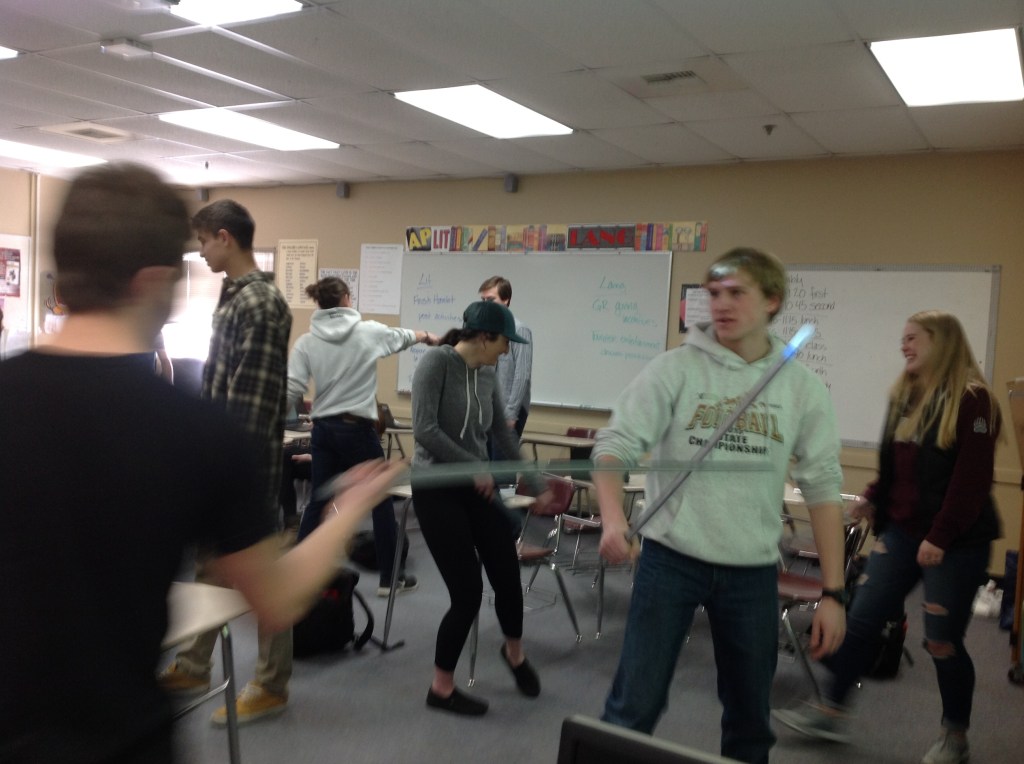
When I studied Hamlet at the Folger Shakespeare Summer Academy a few years back, we, of course, studied the play’s text, and we also studied the great duel in the last act by studying how to fight with swords. Actually we fought with wooden dowels. And yes, it was lots of fun and really cool.

We stopped traffic in Washington DC. That’s saying something.

When I brought my new understanding of Hamlet to the classroom I brought back how to stage fight. It became a high point to the curriculum. There was a rumor that my AP students signed up for my class because of the opportunity to bash one another with my duck taped yardsticks. I tend to think it was because of my other teacherly attributes. Nevertheless, those who signed up earned the caveat of learning how to stage fight.

At the end of the unit students would pair off and after demonstrating the basic five moves they would create their own routine. Swordplay helped students understand how Shakespeare created tension in the last act of Hamlet, at least that’s how I justified the inclusion into the curriculum.

No injuries during our sword fights. Can’t say the same for the swords. A few causalities. Thank goodness for duct tape.

After learning the basics of stage fight students readily joined in and were invited to show off their “homework” to the rest of the class. For myself, I better appreciate fight scenes, especially sword duels, having somewhat been there, done that. Shakespeare knew how to keep his audiences interested by throwing in some action to the plot. And I learned that getting students up moving about (bashing each other under supervision) goes a long way into keeping my classroom audience interested in the curriculum.

Shakespeare knew how to get to the point of his stories–keep them on the edge of their seat. Same goes for teaching.

Bard Bits: Shakespeare Is For Everyone? (That is the question…)


As an AP English teacher, Shakespeare is naturally part of the curriculum and it’s expected my students adore the Avon man as much as I do. Not usually the case. As for my regular sophomores? The groans when we approach Julius Caesar can discouraging. Yet, it is often in how Shakespeare is taught that makes a difference. This is a separate topic. The main topic is the assumption that Shakespeare is for everyone and they are going to like it. That’s like saying exercising is for everyone. It should be, but face it, not everyone embraces a push-up or a run around the block. Some like the idea of exercising and others have tried it, and many let others revel in it. So it goes with Shakespeare.

AUSTIN TICHENOR is the creator of The Shakespereance; co-artistic director of the Reduced Shakespeare Company. He contributed a thought-provoking article about Shakespeare. Here is the gist of his rhetorical stance:

Is Shakespeare for everyone? Of course he is! Absolutely!

I just wish people would stop saying it.

In Shakespeare’s day, his plays — and plays by others, and theater generally — really were for everyone. All levels of society congregated to see and hear plays in performance, to share gossip and news, and to rub literal and metaphorical elbows. Not just a source for entertainment, Shakespeare’s theater was the internet of its day.

But beginning in the 19th century, theater (and opera and symphonies) became co-opted by the upper class who wanted to keep socially — often meaning ethnically and economically — “unacceptable” people out of the theater, turning what was originally popular culture into “high” culture and using the arts as a tool of status and exclusion.

Worse, as a by-product of imperialism, Shakespeare was imposed on non-English speakers in different countries, held up as the best playwright in the world with the understanding that only by learning his plays and accepting his greatness — and, by extension, the greatness of the English language and Anglo-European culture — could one become truly civilized.

So I get it: “Shakespeare is for everyone” is an important correction, a reminder that Shakespeare’s plays were written to be popular entertainments, designed to appeal to everyone from the groundlings to the nobility.

But I worry that “Shakespeare is for everyone” nowadays feels less like a promise and more like a threat; the implication being that if you don’t like him, there’s something wrong with you..

Because the truth is, Shakespeare isn’t for everyone, and it’s disingenuous to suggest that it is. Nothing is for everyone: Personally, I don’t like opera, American football, or horror movies, yet these are popular entertainment choices. You know, to each their own. And in London, at the turn of the 17th century, there were tens of thousands of people who undoubtedly preferred to skip another one of Shakespeare’s epics and head to the bear-baiting pits instead.

So what’s the alternative? I prefer saying “Shakespeare is for anyone who wants him.” For many reasons (i.e., the comedies aren’t funny, the language is incomprehensible, the kings and their nobles are confusing, the references archaic), Shakespeare is demonstrably not for everyone. And that’s okay. But I’ll argue till my dying day that he can and should be made available to anyone who wants him, with many different entry points for people of all levels and interests, whether they be live productions, fascinating lectures, compelling museum exhibitions, excellent films and videos, or even, dare I suggest, pop-up books. One of the first steps in appreciating Shakespeare, it seems to me, is being honest about his output, for we can only truly appreciate his greatness by being discerning enough to recognize the parts that don’t measure up, and understanding that no matter what we do, he still won’t be everyone’s cup of tea.


Bard Bits: Being a Bad Be


Be the best you can be

Even if you are not familiar with Hamlet you are probably aware of Hamlet’s anguished soliloquy of questioning his existence. It’s such a well-known speech that it is almost a cliché. It’s ripe for parody.

A “B” by any other name…

However, there is a wee bit of scholarly doubt if the “To Be” speech that is proffered in plays is the “To Be” that Shakespeare intended. The problem being (yes, a bit of play on the play’s speech) is that Shakespeare’s plays were published without him having proofed the final copy, and most of his plays were published after his death. That’s another post.

When his plays were sent to the printer, they might have been copies taken from someone’s memory, such as an actor or an audience member—accuracy wasn’t exactly sound. These manuscripts came in three forms: good (from the theatre company and with permission), bad (someone’s recall), and dubious (another version of recall, but even worse in content).

The printer would create “quartos,” which were pages folded twice to create four leaves, or eight pages. Scholars have divided the available found quartos in “good” and “bad.”

Bad quartos have no authority and the manuscript content is suspect. Here is an example of a “bad” quarto line:

To be, or not to be, Ay, there’s the point,

To Die, to sleepe, is that all? Ay all:

No, to sleep to dreame, I marry there it goes.

Compared with the standard, recognized lines:

To be, or not to be–that is the question:

Whether ’tis nobler in the mind to suffer

The slings and arrows of outrageous fortune

Or to take arms against a sea of troubles

And by opposing end them. To die to sleep–

Some scholarly squabbles exist concerning if “bad” quartos are really all that bad.. The lines might have been rough drafts and since Shakespeare isn’t about for consultation, it’s suggested to leave the matter be.

Post Navigation