Pam Webb

a writer's journey as a reader

Archive for the category “Reflections”

TV, Eat, Sleep, Repeat…


Hmm—sounds like a recipe for the winter humdrums because the weather outside is frightful, and while I often do find some inside diversions that are delightful (such as reading and more reading), the above title reflects the tedium of my 14 hours of air travel to Okinawa.

Last year, around this time, I traveled solo to Okinawa to meet my DIL (daughter-in-law) and my new granddaughter. This year I was invited to return to Okinawa to be my DIL’s doula for their expected son. An honor I couldn’t resist.

Having flown last year to Okinawa, I felt better prepared for the flight, airport layovers, and overall stamina needed. Last year the hours in the air weren’t so bad, perhaps since I had splurged on Comfort Plus and snagged an aisle seat. Delta serves great meals, BTW. I also bought one of those advertised wraparound-the -neck pillows. Definitely a recommended purchase as I could nap without my head flopping about.

However, preparedness aside, this year I noticed my body didn’t travel as well. Backside, knees, shoulders all began to complain after six hours of sitting. Even my mantra of “Watch some TV, get some sleep, wake up to eat, and then repeat” did little to alleviate my discomfort.

I can’t imagine what it’s like being squished into economy for 10 hours. I’m glad my family convinced me into buying extra leg room.

All that discomfort and tedium faded away once established in my son’s guest room. Playing with my granddaughter, hanging out with my son and DIL, and touristing are all pleasant aspects of the visit.

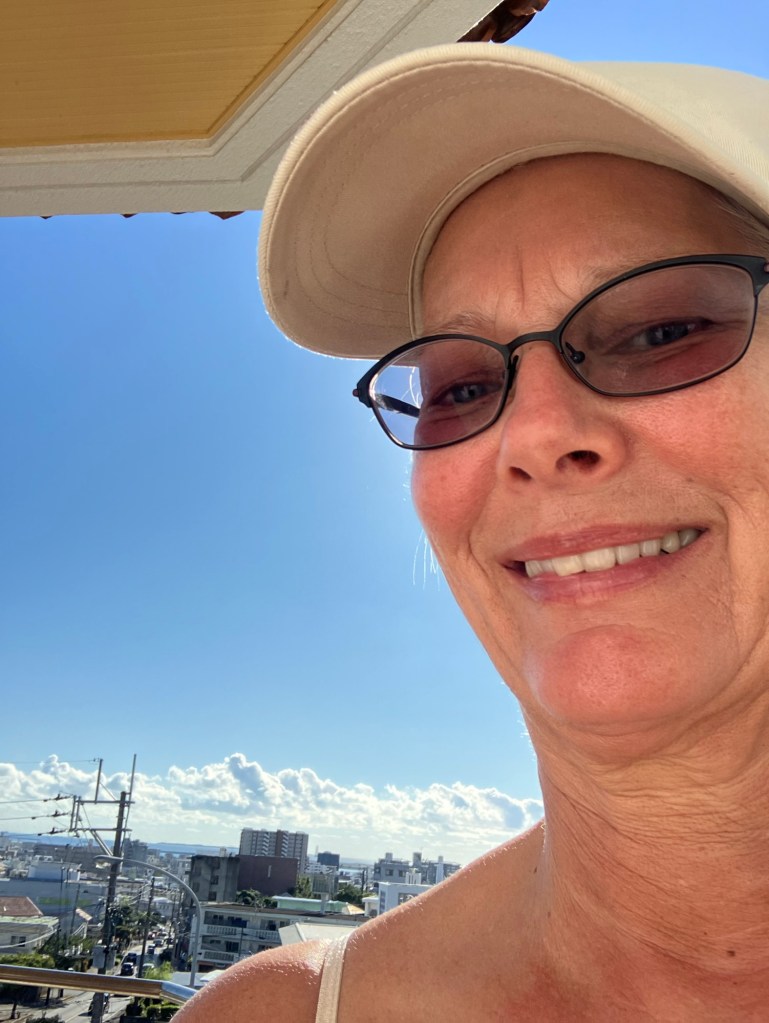
An extra bonus is that Okinawa weather is a tonic since with its blue skies, warm sun, and offshore breezes. I left behind in Idaho grey skies, snowy days, chilly temps, and a longing for sun. Today in Okinawa it was a balmy 66 degrees at 10 am and I slipped outside to soak up the rays.

Yes, I did pink up sitting in the sun for a few minutes. Who can resist an ocean view on a sunny balcony? I sure couldn’t!

Doula duty is coming up in a week or two. Until then it’s play, sleep, eat, and repeat with my amazing Okinawa fam.

Bard Bits: Shakespeare and the Ho Ho Ho


Nope, didn’t happen. Shakespeare and Santa were not pals. England during the Renaissance didn’t actually celebrate the holly jolly season like it is currently done. For one thing, the timing was different. These days Christmas sales start around July, with Halloween getting a minimum nod, and Thanksgiving receiving a cordial nod. It’s all about the merc, it seems. Instead of Santa, the Lord of Misrule presided as the seasonal host, whose main job was to organize games and entertainment. That “Twelve Days of Christmas” song that is piped through every store while we shop, shop, shop refers to the days celebrated beginning on Christmas and going on until January 6th. Gifts were exchanged on New Year’s Day. Christmas during Shakespeare’s was more about living than giving, with the emphasis on getting through the bleak season of cold.

Winter was tough in those days. No central heating, no Starbucks warm ups, no snow tires, and no Amazon for last minute orders. There was also the very real concern if the food gathered in the harvest would last until planting could begin again. To pass the long, cold season Elizabethan folk created a myriad of festivals and celebrations to get them through winter.

While he didn’t write a specific Christmas play, Shakespeare did mention Christmas a few times. In Taming of the Shrew Christopher Sly in the opening prologue mentions how the play the audience was about to watch was to be considered folly and fun, much like gambling and tumbling. In Love’s Labour Lost Shakespeare has a character acknowledge that Christmas is part of winter and snow is part of winter. Basically Shakespeare is acknowledging winter is cold and snowy, just accept it, and he would ease the hardship of this harsh season with his comedic plays.

How do you perceive winter? Is it a thumbs up or a thumbs down season for you?

How Cliche: N as next set of “n” cliches


Nose out of joint: to be irritated by something or someone. A somewhat confusing phrase traced to 1881. It implies the nose can be dislocated when it can’t see it has cartilage instead of a joint. So–this term projects a sense that a person is getting upset enough to feel like they are broken when they aren’t, just seems that way.

image: Flickr

No skin off my nose: it doesn’t bother me. An early twentieth century expression with a reference to boxing with the idea that unless someone who  fully committed to the fight they will get some skin off their nose meaning involvement is going to possibly hurt a little.

No sweat: no extra effort required. A phrase related to “no problem,” meaning that the exertion needed to perform the task won’t be enough to cause someone to perspire. Slightly older than “no problem.”

Nothing new under the sun: it’s happened before. A Biblical term from Ecclesiastes 1:9–“What has been what will be, and what has been done is what will be done; there is nothing new under the sun.” A phrase still appropriate today and used by the likes of Shakespeare in his Sonnet 95.

image: Crossroads Chapel

Nothing ventured, nothing gained: a person has to take a chance sometimes in order to succeed. An expression found as early (or even earlier) as Chaucer “naught venture, naught have,” and has shown up through the ages in similar forms with the most recent being “no pain, no gain,” uttered by business and sports pundits alike.

No way: not happening. American in origin, linked to the 1960s. It is a proclamation that means “under no circumstances,” which reflected an era of short, stated feelings such as “far out,” “dig it,” “bummer,” and “out-of-sight.”

Now on to “o” as in “oh my, what clichés shall we next ponder?”

Reader Roundup: November 2024


Colder weather, darker days, earlier nights are downsides of winter, although on the upside those are inducements for more reading opportunities. Here are the five star reads for November.

The Lost Ticket by Freya Sampson

image: Amazon

What starts out as an aging man’s hope to find that one woman who made a difference in his life sixty years ago turns into a story of a young woman on the verge of thirty who needs to find herself. Told in a simple, yet captivating style, the story interweaves the story of several people who find unexpected answers through second chances.

The Bletchley Riddle by Ruta Sepetys and Steve Sheinkin

image: Amazon

Another perspective of WWII by way of the Betchley Park codebreakers is presented by the talented partnership of Sepetys and Sheinkin. Told through the alternating voice lens of brother and sister, Jakob and Elizabeth, their relationship is reminiscent of Enola Holmes and her brother Sherlock. The story provides engaging historical insights on the valuable work on breaking the Enigma, the coding machine. There is also the riddle of whether Jakob and Lizzie’s mother is alive, if she is a spy, and what her contribution to the war effort might be. Witty, informative, and appealing characters help the story transcend the age designation of middle grade or young adult.

Crook o’Lune by E.C.R. Lorac

image: Amazon

Though it is the #38th entry of this particular detective series, it can be read as a standalone. Its languid pace and attention to detail creates a relaxed approach to a puzzling set of circumstances that involve sheep rustling, arson, and manslaughter. Think All Creatures Great and Small mashed with an Agatha Christie detective plot.

What types of reads brighten your long dark nights of winter?

Word Nerds: Sniglets


Image: Amazon

Sniglets is a clever book by Rich Hall (and friends) in which the reader will discover a collection of words that do not appear in the dictionary, but should. Below are several examples:

ambiportalous (am bit port’ atl us) adj. Possessing the uncanny knack for approaching a set of double doors and always pushing the locked one.

aqualibrium (an we lib’ re um) n. The point where the stream of drinking fountain water is at its perfect height, thus relieving the drinker from (a) having to suck the nozzle, or (b) squirting himself in the eye.

bovilexia (no him eks’ uh) n. The uncontrollable urge to lean out the car window and yell “moo!” when passing a cow.

carperpetuation (kar’ pur pet u a shun) n. The act, when vacuuming, of running over a string or a piece of lint at least a dozen times, reaching over and picking it up, examining it, then putting it back down to give the vacuum one more chance.

cinemuck (si’ he muk) n. The combination of popcorn, soda, and melted chocolate which covers the floors of movie theaters.

elecelleration (am a cam at ay’ shun) n. The mistaken notion that the more you press the elevator button the faster it will arrive.

flirr (flur) n. A photograph that shows the finger of the person who took the picture.

glackett (glak’ it) n. The noisy ball inside a spray paint can.

hangle (han’ gul) n. A cluster of clothes hangers.

niz (niz) n. An annoying hair at the top of a movie screen.

phonesia (to nee’ zhuh) n. The affliction of dialing a phone number and forgetting whom you were calling just as they answer.

trickle (thri’ kle) n. The itch at the back of the throat which can not be relieved without making disgusting sounds.

zibula (zi’ bew luh) n. The plastic spine which model car parts come attached to.

The only sniglet I recognized was “spork” that amazing blend of spoon and fork that so often is found accompanying take out these days. Tom Hall, unfortunately, cannot claim the fame of inventing the word. That honor goes to a nameless hero who formed ridges on the wooden ice cream spoon; however, in 1951, inventor Hyde W. Ballard trademarked the word “spork” with the Van Brode Milling Company, and then filed a patent to make plastic sporks at a later date.

Sporks–they can be found everywhere:

A Surfeit of Bees


I’m an appreciator of bees. They are truly amazing in design and admirable in purpose. I keep bees in mind when landscaping my backyard by maintaining a dedicated mound of lavender, not only because I find lavender to be a fairly perfect plant, I know bees enjoy lavender as well.

Once spring arrives and the lavender starts flowering I watch for the bees to arrive. It’s a Capistrano moment for me.

image: Stockcake

Some years it’s the tiny golden bees that are dominant. Occasionally there is a variety of bee with a bit of red to them. My favorites are the big, black bumblebees. They remind me of teddy bears, yet I wisely refrain my urge to hold them and hug them.

image: Bumblebee Conservation Trust

My penchant for bees came forth when I realized I’m reading my third book, or is it my fourth, where bees are a main focus. I scampered to my Goodreads list to confirm this epiphany. Actually, make that seven books.

The Secret Life of Bees by Sue Monk Kidd
Lily is introduced to the world of bees when she find refuge with three beekeepers and she learns about the power of not only bees but of women.

image: Amazon

The Bees by Laline Paul
The Bees is a creative tale of one bee, Flora 717, who is almost put to death for her lack of physical conformity but is spared and readers follow her rise from humble hive janitor to respected forager.

image: Amazon

The Music of Bees by Eileen Graven
Three people with deep hurts are brought together through the caring of bees.

image: Amazon

He Should of Told the Bees by Amanda Cox
A daughter working with her beekeeper is devastated when he passes away since impacts their business, and the hurt is even more deep upon the discovery she has a half-sister who wants to sell her interest in the business.

image: Amazon

Hour of the Bees by Lindsay Eagar
This middle grade novel features twelve year old Carol who unexpectedly finds herself helping her parents care for her grandfather who is slipping into dementia. A touch of magical realism as he believes the drought will end when the bees return.

image: Amazon

The Beekeeper’s Apprentice by Laurie King
Sherlock Holmes has retired, passing his days with keeping bees. His interest in mystery is awakened upon the arrival of a young woman who rivals his intuition and maybe even his intellect.

image: Amazon

The Keeper of Bees by Gene Porter-Stratton
A classic that is as beautiful in prose as it is rife with politically incorrect references; however, ignoring those or at least placing them in the context of the era it was written, a reader will delight in how a physically, emotionally, and spiritually wrecked WWI soldier is healed through the unexpected experience of caring for an ailing man’s bees.

image: Amazon

Are you a bee lover as well or have you read a book or two about bees? Please share the title, as I aim to keep on beeing a beeliver.

Blatant Ballot Box Stuffing or This is for Mike


Mike Allegra is a funtastic writer, blogger, humorist. He and I both share an appreciation for mice and capybaras. But those are other books and this post is about pirates and penguins. My mother was a pirate once–that’s a different story.

I figure we have been bloggy pals for over ten years 😳. We have even traded opinions in a series of posts called Debatables.

We both write for children. Mike is more prolific than I am. His books are funnier too. Like his latest books that combine a salty vision-impaired pirate and his new companion, a penguin. No offense, Mike. A pirate who identifies a penguin as a parrot needs an eye exam.

Pirates. Penguins. Definitely a winning combination.

Anyway-

Mike is running a contest where one special entrant wins copies of his Pirate and Penguin books. I would like to win copies of these books. I’m sure you would too.

I can get another ticket in the drawing by posting a blog post about his contest which, of course means you can trot over to Mike’s blog and enter the contest thus reducing my odds of winning…

I see what you’ve done, Mike.

So—check out Mike’s blog, enter his contest, and check out my book as well.

C’mon, Mike. I’m sure you don’t mind me edging in with just a little self-promotion.

See, Mike–just a little self promotion

Word Nerds: Mything Out on Grammar


Having taught high school English for twenty years one of the biggest complaints my students voiced (besides writing essays) dealt with grammar rules. Well, as Bob Dylan sings, the times they are a-changing.

According to a recent Reader’s Digest article here are some grammar rules that are soon to be or are already changing going from missed to being acceptable (or is that mythed?).

Image: Tatiana Amazon/rd.com

According to the grammar experts at the Chicago Manual of Style, there is no actual rule that states it’s an error to start a sentence with a conjunction. And I believe them.

Image: Tatiana Amazon/rd.com

That age old rule of not ending a sentence with a preposition creates strange sentences such as, “What city from where did he travel?” instead of “What city did he come from?” Sometimes a sentence just has end naturally, like it’s supposed to.

Image: Tatiana Amazon/rd.com

Ah, the old discussion about splitting infinitives. First off know what an infinitive is before considering the need to split it. Says Wikipedia: An infinitive is a verb form that is used as a non-finite verb.

An example would be the well known tag line: “to boldly go where no one has gone before.” “To go” is the infinitive, and “boldly” splits it. No harm, no foul.

Image: Tatiana Amazon/rd.com

What to do when faced with the dilemma of adding that apostrophe “s” to a word ending in “s”? Which way is the write way (see what I did there?)

  1. I’m going to go over to see Mr. James’s new car.
  2. I’m going to go over to see Mr. James’ new car.

Trick question. They are both correct. It comes down to preferred style and consistency, using the same form throughout the writing is essential. Or it can be confusing to all those readers’ understanding of what your style is all about.

What other writing rules have you stumped?

Reader Roundup: October 2024


Most of October was devoted to recovering from Covid and while reading books is my go to for relaxing, I found it difficult to sustain the energy to hold a book and keep my eyes open. Fortunately our local library provides plenty of audiobooks, especially e-versions. I simply download to a device of my choice, plug in my headphones, and delight in someone reading me a story. The best part is that no realizes I’m napping. Ssh…

Here is a batch of five star reads from October:

The Clock Strikes Twelve (Miss Silver #7) by Patricia Wentworth

Very Miss Marple in style down to the clicking knitting needles. Though at times the dozen or so cast of characters created some confusion in sorting out who and what, the dynamic plot structure created an intriguing locked room mystery. Would thoroughly enjoy seeing this as a BBC production in all its 1940s period glory.

Fatal First Edition (Library Lovers #14) by Jenn McKinlay

Listening to the story dented some of the enjoyment as the narrator presents the main character, Lindsey, as being on the edge of hysterical when she gets excited, otherwise, a great mix of characters with some fun plot twists. Some of the plot points are a bit too convenient, such as a horrendous snowstorm coinciding with the need to keep all the suspects in one place, which happens to be in Lindsey’s town.
It’s a bonus how the author inserts different books into the plot.

The London Eye Mystery (London Eye Mystery #1) by Siobhan Dowd

Given the intended audience is middle grade, the plot intricacies were on par with adult mystery stories. Despite the usual first person narrative being an unreliable narrator, Ted is the most interesting character. Though his condition is not stated, he knows he thinks differently than most people and it’s because of his perspective and thinking that his missing cousin is found. What especially made the story appealing is Ted’s focus on weather and how he related his observations to people and situations. Recommended for classroom reading.

1,000 Books to Read Before You Die by James Mustich

The scope of work presented is daunting. In fact, the author said it is the result of fourteen years of reading, rereading, and more reading. The entries are inspiring; however, little was added to my TBR list, not because I had read scads of titles listed. The reason comes down to not interested, but thank you anyway as many were historical or biographical and this reader leans towards fiction.

The Book of Lost and Found by Lucy Foley

An exceptional debut that foretells the quality of talent the author will produce in future writing. A rich, brilliant love story that spans eras filled with detailed research which illuminates each character’s struggle with identity, family, and love.

Death Comes to Marlow (Death Comes to Marlow #2) by Robert Thorogood

Listening to the book instead of reading it made a difference in accepting the contrived plot because it became a theatrical performance. Nicolette McKenzie proved an excellent narrator with an impressive range of voice characterization. The PBS series which is based on the books is quite a treat.

Well, I am becoming a fan of e-audiobooks after years of snubbing them. I am finding they are especially handy when I would like to combine escaping from the world with my eyes closed while grabbing a bit of sunshine. It’s a cozy experience being read to. No wonder kids request, “Read me a book.”

What’s your preference—to read or to be read to?

Bard Bits: Here Be Monsters


When Shakespeare’s works are mentioned the association with him runs towards love stories, as in Romeo and Juliet or tragedies like Hamlet or even sweeping historicals found in the Henry plays.

Not necessarily Shakespearean

Monsters may not be the forerunner feature in his stories but Shakespeare did populate his plots with creatures, witches, and ghosts—oh my, he certainly did. In fact, most of his well known plays contain monsters or scary aspects.

Romeo and Juliet: Juliet about to take the friar’s prescription for a faked death believes she sees her dead cousin’s apparition. Then there is the part of waking up in the family crypt surrounded by her cousin’s recent corpse and long dead relatives. *cue creepy music*

Hamlet: Our titular hero receives a guilt trip from his dead father’s ghost—not once but twice.

Julius Caesar: Brutus must contend with great Caesar’s ghost.

Macbeth: Not only is there the ghost of Banquo there is a trio of weird sisters.

Cymbeline: another batch of ghosts.

The Tempest: A sassy sprite named Ariel and whatever Caliban is supposed to be.

A Midsummer Night’s Dream: speaking of sprites, Puck reeks of mischief galore.

Shakespeare inserted monsters into his plots because he pandered to the paying crowd and those folk of the Renaissance were a thrill seeking, superstitious bunch, queens and kings especially.

While Shakespeare created several memorable monsters his penchant for monstrous acts should be noted.

Offhand there is fratricide, homicide, verbal abuse, racism, sexual abuse, dysfunctional family relationships, and a mention about being wary when it comes to pie at dinner.

So—

Forget loading up on Frankenstein and Freddy for fright night watching. Instead save your anticipation for scare by streaming some Shakespeare.

Post Navigation