Pam Webb

a writer's journey as a reader

Archive for the category “Reflections”

A Brace of Bookmarks


As a voracious reader bookmarks are essential to keeping order as I travel through books.

Dogearing pages is simply not acceptable and will not be tolerated. Civilized readers do not crisp back page corners. Unless it’s the latest Costco flyer.

I’m on the fence about notes and highlighting. That’s a different topic and post.

Concerning bookmarks…

Yes, most of them relate in some manner to Shakespeare–good eye

I have a brace of bookmarks ready for use spread through the house. Some are genuine bookmarks with various designs while others range from a ubiquitous fluorescent sticky note to a variety of postcards to my current favorite: Smokey the Bear.

Scored Smokey (and his twin at the Forest Dept booth at this year’s fair

There is something satisfying about firmly wedging a bookmark into my current read. It’s a decisive action signifying a promise to return. <Ooh, a feel the need to work this out as a PB story>

And sometimes the return is immediate; other times it takes it takes a bit longer. Like my Oxford Book of American Poetry. It has plenty of tiny bookmarks indicating favorite poems waiting to be reread. Other standby reads include Psalms, which I savor before going to bed. Like faithful sentinels these bookmards remain on duty, assuring they will easily guide me back to where I last left off.

The library recently displayed a collection of ephemera; those bits found in books that are donated. Photographs, receipts, tracts, love notes, clippings, leaves, as well as actual bookmarks. As I process donations, I collect these bits of personage, and save them, wondering about the stories behind them. Over the past year enough ephemera was collected to fill three poster boards. I wonder if people viewing the display recognize their lost bits, if they are saddened if they inadvertently gave away something cherished with that copy of Tom Clancy’s latest adventure novel.

Well, on to a new book. Smokey is already waiting for me.

P.S. As I opened my latest read these two bookmarks were waiting for me. Serendipity.

What is your favorite bookmark?

Word Nerd: Words Describing Words


Have you been there before, you know that time you were perhaps in a pub trivia round, or rooting for a Jeopardy contestant, or maybe just reaching for that word you maybe remember learning back in tenth grade English?

Those words that describe words is what this post is all about. You are no doubt familiar with that all time favorite onomatopoeia, which is fun to say (and less fun to spell), which means a word that sounds like what it is trying to emulate, such as buzz, ring, meow. Or what about oxymoron, when opposite words are used together, as in jumbo shrimp or Microsoft Works, or a loud whisper.

Ah, but there are so many other words that describe words. How about:

Tmesis: this is taking a compound word and inserting one or more words between the different parts.
“He abso-flippin-lutely said he refused to drive me to the airport.”

Portmanteau: blending two words to form a new word.
“Be a darling, and drive me to the airport. I’ll even treat you to brunch.”

Nonce: an invented word for a specific purpose, as often found in literature.
“Can you recite the Jabberwocky poem?”

Modegreen: replacing a word or phrase for misheard song lyrics.
“We got into a tiff about Cold Play’s song. He said “Dream of a pair of dice.” And I said, “Dream of paradise.” I was right of course, and he treated me to a gelato.

Crash blossom: when a news headline creates an ambiguous meaning, often creating inadvertent humor.
Dad almost fell over laughing when he read “Paramedics Rush to Help Bee Sting Victims” in his newsfeed.

Neologism: a new word or expression that becomes accepted into general use.
“Can you believe how many selfies Jana took on her vacation?”

Malapropism: mistakenly saying a similar sounding word, which can be both humorous and confusing to the listener.
“I tried not to smile when my niece said she liked the banana on my head, when I know she meant to say bandana.”

Counterword: a word that is used in a broader form than its original intent to the point that it has lost its true meaning.
“When I go shopping with Marjie she says everything I try on is nice, so it’s hard to believe if it is or not.”

Euphemism: using a word or phrase to more politely describe something that is awkward or unpleasant.
Wait for me while I go powder my nose.

Dysphemism: uses a word or phrase to more harshly describe something.
“My uncle has nothing good to say about that garage and called it a chop shop.”

Weasel words: those words signifying ambiguity that can lessen the impact of a statement.
“I might be able to take you to the airport. It’s likely that I will have time after my appointment.”

Synecdoche: using a figure of speech in which a part represents the whole.
“Grandpa will yell “All hands on deck!” when he calls us in to eat supper. I think he is remembering when he was in the Navy and was ordering his sailors to report to duty.”

So, which were new terms to you? I must admit I veer towards weasel words, and I have been known for my malapropisms, but try to pass them off as neologisms or portmanteau words. And for years I thought I was in modegreen thinking whenever I heard Creedence Clearwater wailing about that bathroom on the right. Thanks to YouTube I’m set straight.


There Be Dragons…


Sometimes that to-do list takes on epic proportions. This week was one of those weeks of epicness. And not in a good way epic.

This was the week of do-not-ignore-because-bad-stuff-will-happen-if -you-ignore deadlines.

It started with Microsoft’s ominous announcement that October 14th will be the day my trusty, and still viable, Lenovo will burst into flames.

Okay, slight exaggeration. But my Lenovo is so old it operates on Windows 8 and it looked quite confused when I tried to initiate the Windows 10 update option.

That was one dragon on my list.

Another dragon was that pesky Medicare letter. Oh, you got one as well?

Nothing like the unexpected panic that my supplemental medical program is going to disappear after December.

Anyone else dread having to enter the Blue Cross phone cue?

That was another dragon on the list.

Add in appointments, article due dates, paper trail checks, paying bills, amid the usual everyday quotidian. Lots of dragons—a nest of them.

Yet—

Slowly, one by one, those dragons disappeared through perseverance, resources, and prayer. The latter receives the most credit.

Hoping your week is filled with roses instead of dragons.

Bard Bits: See You Later Summer


When the Montana Shakespeare Troupe arrives in August to our fair town, it is a generally accepted acknowledgement that summer is on the wane. Pleasant weather still lingers, although it is a bit chill in the early morn and evening. There remains the essence of summer.

And then the calendar chimes out its equinoxal announcement that summer is past and autumn is now upon us. I’m not quite ready to bring in the patio furniture yet.

Shakespeare eloquently presents a metaphorical passing of one’s age in his often quoted Sonnet 73:

That time of year thou mayst in me behold

When yellow leaves, or none, or few, do hang

Upon those boughs which shake against the cold,

Bare ruin’d choirs, where late the sweet birds sang.

In me thou see’st the twilight of such day

As after sunset fadeth in the west,

Which by and by black night doth take away,

Death’s second self, that seals up all in rest.

In me thou see’st the glowing of such fire

That on the ashes of his youth doth lie,

As the death-bed whereon it must expire,

Consum’d with that which it was nourish’d by.

This thou perceiv’st, which makes thy love more strong,

To love that well which thou must leave ere long.

Back when in my AP teaching days, this was a poem we studied for its rich imagery and underlying message of mortality. However, bypassing an analysis (I hear that sigh of relief), I do want to focus on the last two the lines, the ending couplet.
In the previous lines the speaker has expressed his concern how he is aging to his lover (maybe even a child–oops, that’s analysis) and in the ending couplet we see the volta, or turn, that indicates a change of mood. Here the speaker interposes the thought that though he might be aging in his own eyes, and in perhaps his lover’s eyes, it is this very state of aging that should initiate an even deeper love for the narrator.
In other words, though summer (his youthfulness) is diminishing and hints of winter are coming (touches of grey in hair), this season of in between, autumn, should be even more cherished as it is the in between time before winter is fully realized.

Yeah, what Shakespeare said.

I welcome spring, enjoy summer, and embrace fall. Fall or autumn still has the warmth of summer, yet it ushers in harvest and nature’s graceful transition into a foliage showcase of beauty. Since retirement I am taking advantage of the gentle warmth of September afternoons. Previously (20 years worth) I wouldn’t get home until after the shadows filled my backyard and I would mourn having missed out on the sunshine having been inside a building all day (okay, mourn is a bit extreme, but I really disliked having to wait until the weekend to enjoy the fall sunshine).

Hoping you are appreciating the fall weather.

Hats Off to Socks


National Sock Day isn’t celebrated until December 4th but I have reason to celebrate today.

Before I share my sock jubilation here some interesting sock bits:

  • The word “sock” is derived from the Latin soccus, a loose-fitting slipper Roman actors wore. 
  • Once upon a time socks were considered a status symbol.
  • China’s Datang district is known as “Sock City,” since it contributes about 40% of the world’s socks. 
  • The first socks were probably animal skins wrapped a person’s foot.
  • Wearing socks can contribute to warming the body and can produce more restful sleep.
  • A pair of 1,600 old split-toe red wool socks were exacted from 19th century burial grounds near ancient Egypt. The socks are made from red wool and have split toes for wearing with sandals.
  • The average four person family can lose up to 60 socks a year.
  • Because you have always wondered: socks should match the shoe or pants color and it’s suggested the sock color should be at least one shade darker. But what’s the point of argyle socks if they aren’t for the world to see?

As for my sock news?

I beat back the percentage and found a lost sock—a brand new black sock, mind you. It only took 9 months. It wasn’t in the washer or the dryer or the hamper or mixed up in another clothes basket.

Nope.

Pulling on a pair of pants not worn since January I detected an anomaly in the pant leg. Yup. That sock had been playing hide and seek so long it must have gone into hibernation.

Perhaps I will write a picture book story about socks playing hide and seek.

Actually I wrote a PB about the importance of how a pair of special socks can brighten up a person’s day.

Here’s an illustration sample:

Dad socks

Hoping your lost socks make an appearance and get ready to celebrate socks in December.

How Cliché: Fit to a “T”


Getting closer to the end of the cliché alphabet. Here are a few popular “T” sayings:

  • Tables are turned: the situation has changed. This well-known idiom comes from 17th century game board playing such as backgammon, a game where players could switch or “turn” the board (or table) with the ability to gain the upper hand.
  • Take a back seat: to find oneself subordinate. In the 19th century stagecoach travel was common and travelers who were in less standing or importance would inevitably end up in the less desirable back seat which prompted the saying to come to mean being reduced to less prominent position.
  • Take a hike: to take long walk; to go away. Mid-19th century people were used to walking, sometimes involving long hikes which meant going away from people or a place, developing into a phrase that meant telling some to go take some air, to leave, sometimes in a rude manner.
  • Take a leaf out of someone’s book: setting an example. The saying refers to 1800s practice of actually taking a page or “leaf” from someone’s book to copy their example or style. It originally alluded to the copying or plagiarism, later developing into today’s usage of following someone’s example because of admiration or success.
  • Take a nosedive: to fall unexpectedly. The 20th century ushered in airplanes, and early airplanes could lose altitude unexpectedly. The meaning now refers to a sudden drop in a situation, condition, or state of being.
Photo by dumitru B on Pexels.com
  • Take a raincheck: to politely decline. If it rained during 19th-century baseball spectators could receive a voucher or “rain check” for free admission to another game. 
  • Take a shine to: to form an attraction. “Shine” in 19th century vernacular meant taking a sudden liking to someone, seeing the attraction or “shine” in their eyes. Today people use the expression to indicate immediate fondness for someone or something.
  • Take a straw poll: an informal survey. In the early 19th century newspapers who wanted to get a feeling for how the public felt about a matter, such as a presidential election, they would take an impromptu survey among people. The informal method was likened to tossing straw into the wind due to its lack of scientific method. Today when people are looking for a quick opinion among a group they will take a straw poll.
Photo by Pixabay on Pexels.com
  • Take by storm: a forceful overcoming. Going back to the 1600s military campaigns could be waged with such force it was compared to a storm overcoming an area, which has developed into the phrase meaning to win over a situation with impressive results.
  • Take for granted: believing something will always be true. The 1600s say “granted” to indicate something to be true without requiring proof. In contemporary days the saying has come to mean taking advantage of someone, expecting someone or something to always be available, believing its true.
  • Take forty winks: a quick nap. Combing British phraseology and Biblical reference “wink” refers to a 19th century English book extolling the virtues of taking short rest and “40” is found in the Bible a term referring to indefinite amount of time. If someone takes forty winks they aren’t blinking forty times they are resting for an undefined amount of time.
Photo by Dina Nasyrova on Pexels.com
  • Take guts: to have courage or bravery. Long ago in the 14th century people believed a person’s personality or soul lay in the region of their stomach or “guts,” and to rally up needed emotions for a tough situation requiring fortitude, they would be advised to “have the guts” to face the matter. Today the phrase still alludes to digging deep within for the needed bravery.

And that’s just a sample of “T” clichés. What are a few sayings to add?

Reading Roundup: August 2025


August has traditionally signified the end of summer for me since returning to school was just around a calendar flip away.

However, retirement means I will be still in bed (probably) when the school bus rumbles past our house. And I will most likely be reading since that has become part of my routine due to still waking up at 5 am (dratted body clock) after so many years of doing so and not wanting to start my day quite that early.

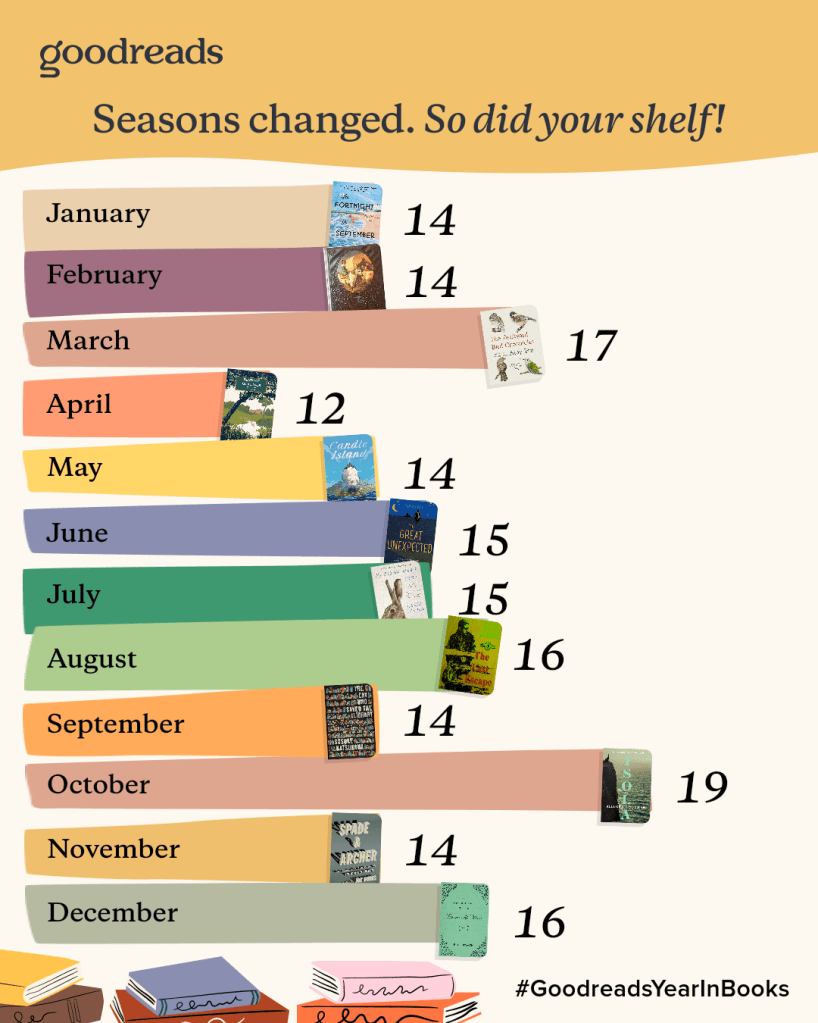
All that reading as certainly impacted my accumulative reading states. To date my Goodreads Reading Challenge total is now at 116, nicely surpassing my 101 goal. I’m wondering if I can hit 200 this year. Hmm…

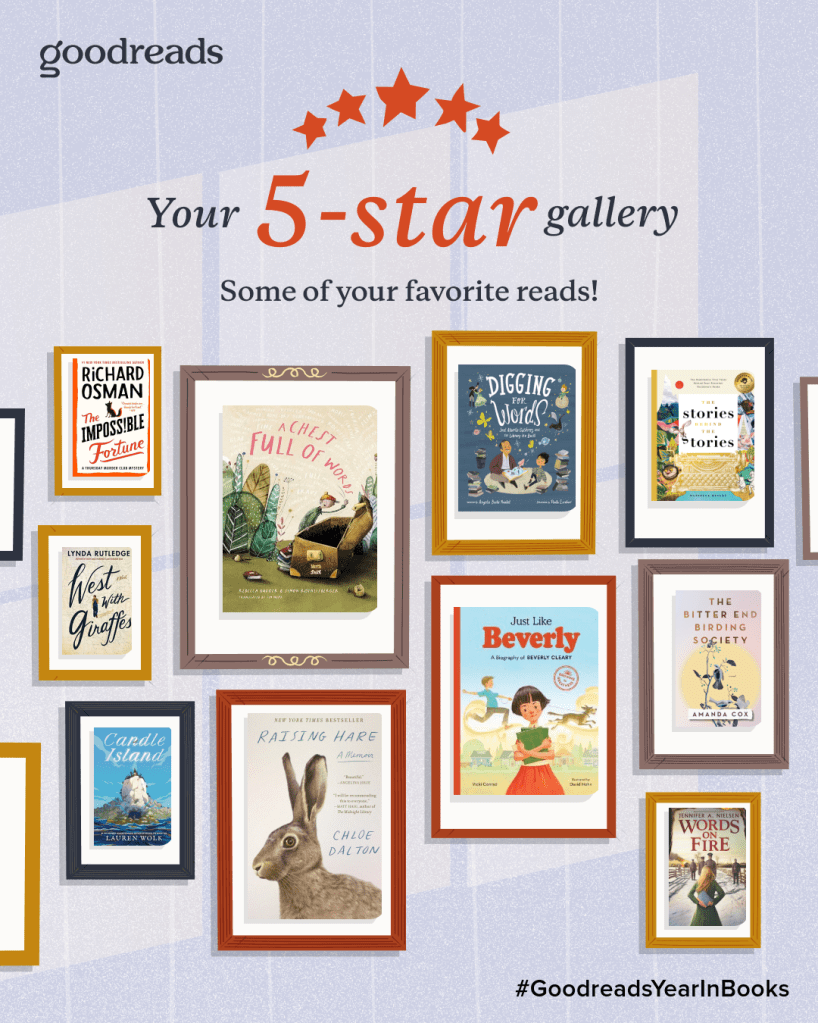
Five star reads of August:

The Last Escape by ECR Lorac

Goodreads image

Aptly named, The Last Escape is the last mystery readers will sleuth along with Inspector Macdonald. After 40 (!) mysteries to solve it appears the unflappable CID man will retire to Lunesdale on the farm he purchased a few stories back (Crook o’ the Lune). Once again Lorac begins the novel with a smidgen of backstory which leads into the principal players and when a crime is committed Macdonald is on the scene.
These books have been all interlibrary loan derived and I have found each one does well as a standalone. I have many more cases to solve with the Scottish inspector and look forward to the next book that comes my way.

Harry’s Trees by Jon Cohen

Goodreads image

A grown up fairytale complete with one simple fairytale embedded in the plot makes this an unusual book and entertaining tale.

I was embarrassed to realize as I got into the story I had read it before—that “Gee, this is a lot like another book I’ve read” feeling. This either means I’m reading too many books or I read the book too fast or the story didn’t resonate at the time.

This time the story did resonate as it was a fun lounging-in-the-summer-hammock read.

Just Like Beverly by Vicki Conrad

Goodreads image

An excellent picture book biography of beloved children’s book author Beverly Cleary. Focusing on her as a child who lived books and wanted stories about children just like her provides a better understanding of how her stories have a timeless appeal. Illustrations and text are complementary and the additional material adds to the overall appeal.

I’m looking forward to the cooler days of fall and I am anticipating some really good reads coming up as my TBR list is quite plump.

How Cliché: Say “yeS”


Today’s batch of cliches focus on the “s” range. It’s “yes” to cliches with “s”.

Scarce as hen’s teeth: When something is very rare.
Don’t use this one much. It makes me wonder how it came into use. Some farmer having fun counting his chickens before they hatch?

Scared of his own shadow: Someone who is often afraid.

Scraping the bottom of the barrel: Taking whatever is left behind.

Reddit image

Second banana: Second in command.
I prefer being second banana. Less pay, true, but less responsibility than the top banana.

Shape up or ship out: Do what is right or correct.

Shoot the breeze: Casually talk about things.

Signed, sealed, delivered: The task is complete.

Skeleton in the closet: scandalous events in someone’s past.

Slow and steady wins the race: Going too fast could cause you to fail.

Squeaky wheel gets the grease: speaking up can get something accomplished.
This one is a personal favorite as I tend to get things done that haven’t been done. Some call that being proactive. Others consider it being squeaky.

Articulate Persuasion image

Bard Bits: Bard in the Park


I’ve experienced Shakespeare plays (one experiences his works, versus watches them—a bit pompous sounding,sorry) in a variety of forms: live on stage (several as an audience member and once as Horatio—very brief); large screen theater; small screen TV; reading, and teaching.

One favorite form is watching a performance in the park, as it is open air, much like a Globe performance. Plus there is the anticipation of lively audience response, the atmosphere being one of shared spaces and camaraderie. And the plays are usually free, at least the one that comes to our fair city is.

Every year in August the Montana company arrives and performs one of Shakespeare’s popular plays in a local park. This year they presented a As You Like It, which is one of Shakespeares more popular comedies.

Bard in the Park

Arriving at the park 40 minutes early I discovered the space already teeming with people, but no matter since I prefer the back for that quick exit to avoid the parking lot tangle.

As the sun drifted behind the trees the temps cooled down and the stage action heated up with runaway sons and daughters, tangled romance, and character arcs. As You Like It is a fun romp and the audience showed its appreciation with plenty of applause and laughter.

Bard in the Park signifies the transition from summer fun to back to school readiness. And Jacques mentions going to school in his famous “All the world’s a stage” soliloquy.

Anyone catch a Shakespeare in the Park performance this summer?

Word Nerds: Yes, that is a word…


A Redbubble poster after my own heart

Your search for that precise descriptor has ended with this batch of discovered words. I must admit I am familiar with “twaddle” and have come across “quidnunc” no doubt due to those old English mystery novels from the forties that I favor.

kyoodle: to bark or yelp noisily or foolishly

gloze: to explain away

twaddle: silly, tedious talk or writing

otiose: serving no practical purpose or result

recondite: relating to, or dealing with something little known or obscure

parlous: full of danger or uncertainty

drouk: to drench

elucubrate: to produce (something) by long and intensive effort

opprobrium: harsh criticism or censure

quidnunc: person who seeks to know all the latest news or gossip

I need to find a way to work “kyoodle” into a conversation.

Post Navigation