Pam Webb

a writer's journey as a reader

Archive for the category “Literature”

A Murdered Austin


As a confessed Jane Austin fan, I find myself searching for more of her books. Yes, I know that isn’t happening. I doubt Cassandra had a “lost” manuscript squirreled away in the family bank vault like sister Alice did for Nelle.

But one does hope for finding at least a satisfying pastiche.

I have tried a few, and quite frankly, I find them annoying. There are liberties taken with the characters that simply aren’t at all Janish, in either style or intent. If one doesn’t live in the time period, trying to write it and pull it off successfully is about as satisfying as a diet Dove bar. Exactly. They don’t exist because what would be the point?

Sigh. I do keep trying though.

I’d heard PD James had tried her hand at Austin with the Death Comes to Pemberley. Not having read any of her mysteries, I still decided to add the title to my TBR list, because James is a respected author and who can resist a mystery attached to the P&P gang?

I should have resisted.

But it looked so promising… image: BBC


Spying the DVD adaptation on the new release shelf I snagged it quickly. I don’t know why I sequestered it away under my arm. Perhaps I envisioned some maddened JA fan descending upon me screeching “I saw it first!” Decorum before drama. This became the byword as I settled down for an evening of what I hoped to be a lost in Austen evening, for drama versus decorum permeated Pemberley. Yes, death indeed came to Pemberley, but it wasn’t the murder in the woods that was so terrible. So much more damage had been rendered.

I had a prepared list of all that I found oh so wrong with this BBC rendering. Taking the a Thumper path of reviewing practice instead, I will say this one nice thing: At least they used the Pemberley estate from the Kiera Knightley version.

I now need to read James’ novel and see how badly they adapted it, because surely a respected author couldn’t have committed so many travesties to Elizabeth and crew, especially if she is the devotee she is supposed to be. The Amazon reviews aren’t promising. Any thoughts on James and her pastiche of Pemberley? Are there any decent Austin homages out there at all?

Author Snapshot: Daphne du Mariuer


Last night I dreamt I went to Manderley again…


One of the more famous opening lines for a novel is Daphne Du Mariuer’s first sentence of the eponymous character recalling her days at Manderley. Rebecca, a gothic romance, if there ever was one. No wonder Hitchcock snapped it up. I’m not sure which is the bigger hit: the novel or the film. They are both memorable, eerie, and suspenseful. Whenever I reread the book, I immediately want to view the film again. The novel leaves a legacy found in a variety of mediums:

Literature

  • Stephen King alludes to Mrs. Danvers, the troubled housekeeper, several times in Bag of Bones, and again refers to her in “Father’s Day.”
  • Jasper Fforde creates an army of Mrs. Danvers clones in his  Thursday Next series.
  • Danielle Steel nods to the novel in her Vanished, since the plot is similar to Rebecca.

Film

  • The Man with Two Brains, a Steve Martin comedy, acknowledges the novel as his character consults the portrait of his deceased wife, Rebecca.

Television

  • Dark Shadows, the original 70s Gothic soap opera (not the Johnny Depp film) relied on Rebecca’s sinister setting to create its creepy plotline.
  • Carol Burnett lampooned the novel with her “Rebecky” skit.

And if Rebecca‘s Gothic romance plot line isn’t your cup of tea, perhaps you remember The Birds? It was a short story before Hitchcock got ahold of it and produced a movie that still freaks me out. I found her short story in an anthology of animal uprising stories including Animal Farm. Watch out for pigs and birds–they pack a punch when they take over the world.

While Daphne Du Mariuer might not be in vogue as much as she once was, she definitely left on impact on the literary world with her contributions of novels, plays, and non-fiction. She often wrote ahead of her time, as evidenced in her House on the Strand, which alluded to the mind-altering drugs used in the sixties. There is some controversy about plagiarism, which I choose not to dwell upon. And some aspersions about her personal life, which I won’t delve into either. What fascinates me is her diversity as a writer. Though labeled as a romantic novelist (a label she disliked), she proved she could write beyond what critics’ and the publics’ labels. She wrote historical biographies, chilling mysteries, science fantasy, and wrote them well.

Some trivia which isn’t trivial:

  • awarded the Dame Commander of the Order of the British Empire.
  • daughter of actor parents: Sir Gerald du Maurier and Muriel Beaumont; granddaughter of George du Maurier, Punch cartoonist.
  • cousin to the Llewelyn Davies boys, who were the inspiration for J.M.Barrie’s Peter Pan.

    Daphne du Maurier in her later years image: BBC news

2/50: Bloom’s BioCritiques–William Shakespeare


William Shakespeare  Frustrated Harold Bloom. image:meme.com

Harold Bloom knows a lot about literature. I think “intimidated” along with “impressed” are among my reactions to his introduction on William Shakespeare


2015 is going to be my Shakesyear, since I have set out a goal to gather research to write about Shakespeare. I’m not sure from what angle I’ll proceed, but I’m looking forward to the process. I do enjoy researching. It’s the doing something with it all that I struggle. I do know I have a daunting task ahead of me. Consider how little we know about him, I realize I’m probably going to be chasing about looking at the same old information presented by different people. Maybe I’ll be fortunate and find two needles in the info haystack…

The first book I’ve come across is a dandy. Harold Bloom, esteemed literary critic, takes on the task on presenting literary biographies of all sorts of famous authors. Although intended for juvenile readers, I found his vocabulary and syntax fairly challenging at times. For instance, what middle schooler would grasp this sentence easily: “I surmise that the egregious interventions by Vencentio and Iago displace the actor’s energies into a new kind of mischief-making, a fresh opening to a subtler playwriting-within-the-play.”

Bloom creates a portrait of Shakespeare through the observations of others including Samuel Johnson and Ralph Waldo Emerson. Considering this volume is under 200 pages, it’s packed with vital insights, including a chronology, works list, and a bibliography, to set me off along the trail in my search for Shakespeare.

Some new-to-me facts about the Bard:

  • he was “fostered” out to another family whose connections might have helped him rise above the failings of his father (which is quite the story in itself)
  • in 1587, when Shakespeare was 23, five theatrical companies visited Stratford and it wasn’t long after that Billy Boy went off to London
  • Hamlet, produced in 1601, was among the first plays the Lord Chamberlain’s Men performed at the Globe theater
  • Shakespeare’s company performed at least twelve plays every year for King James and his court
  • The purchase of the Blackfriars, another theatre, allowed Shakespeare’s acting troupe to perform year round since this was an enclosed theatre, unlike the Globe

I look forward to my discovering of William Shakespeare, and I hope you won’t become bored with my Bardinating over the course of the year.

Button, Button


My usual adage of “The original source is always better” went out the window after watching The Curious Case of Benjamin Button.
When the movie came out in 2008, I promptly avoided it. I thought the premise strange, that a baby would experience life backwards–going from old and decrepit to incapacitated infant. It especially seemed odd, even a bit creepy, since a romance was part of the plot.

Aging backwards. Not a new concept, apparently backwards aging is not a truly new trope. After all, Shakespeare hinted at our returning to our infancy state in his “Seven Ages” poem.

I also was a bit leery of Brad Pitt at the time. Fight Club isn’t exactly my type of genre. The male progeny tried to interest me (who can resist bonding with their sons via a movie?) but after a few minutes of gruesome artsy cinema, I deferred. However, since Fight Club Pitt has appeared in movies I do like, such as the Oceans triple, and Mr and Mrs Smith. Into the library basket went Benjamin Button as I gathered movies for the week. I didn’t realize I was committing to two and a half hours.

A sick day, and no energy for reading and in popped the movie. I sat spellbound. I even cried at the end. And was a bit indignant that Brad Pitt got passed over for an Academy Award. This trailer captures the heart of the movie well:

The most interesting part for me is that the movie is based on a F. Scott Fitzgerald short story. The fantasy genre intrigued me because I didn’t peg FSF for writing anything but brooding rebellious characters from the Roaring Twenties. The story’s biting satirical tone is very much Twain, and I learned that Fitz was indeed influenced by MT, who had made a comment about what a shame we don’t experience the best years, our older years, first. Interestingly enough, the only thing the movie and short story have in common is the title and premise. Here is the story link:


Any of you been surprised by the film being actually better than the written work?

Last Minute Housekeeping: 2014 Vocabulary


Before January totally rolls into February, I wanted to take up Vanessa-Jane Chapman’s nudging to “trot out” my 2014 vocabulary list. And I only thought about doing so because she did such a cool thing by coming up with a word of personal significance for each of the 365 days in 2014. Some of the words a person can only wonder about: Pirate?

My list seems rather mundane in comparison. I set out to record all the new-to-me or review, please words as I read last year. I usually read with my iPhone nearby and type them in my notes (which I can then email to my Google Docs account–handy). I started doing this with my AP reread novel Jane Eyre, which I began in February last year. Periodically I reread books I teach, just to refresh my memory of whatever it is I’m trying to impart to my students. I soon realized my vocabulary wasn’t up to snuff. Here’s a sampling of my Jane Eyre word collection:

appanage: benefit or rank belonging to someone
meretricious:attractive with no real value
diablerie: reckless in a charismatic way
seraglio: women’s apts in Muslim palace
puerile: childishly silly
avidity:keen interest or enthusiasm
inanition:exhaustion caused by lack of nourishment
elysium: Greek mythology-the place where Greek heroes went to be honored after their death
aspirant: ambitions to follow something, as in a political career
coadjutor: bishop which assists a bishop
ineradicable:unable to be destroyed or removed
pertinaciously:holding firmly to an opinion

Some of these I doubt I will be using anytime soon: “appange”? And others I hope to pop out with aplomb at some advantageous point in a conversation: “My inanition requires we go to lunch sooner than later.”  I seriously don’t think I will ever have an ocassion for “coadjutor”; however, I am prepared now should the need arise.

Other words I added from here and there encounters, including one from watching David Suchet in a Hercule Poirot episode and I ever so want to slide it into a conversation (look for *):

poltroon: utter coward
propound: put forward
adamantine: unable to be unbroken
apocryphal: doubtful statement
quash: reject as invalid especially in a legal procedure
blazon:form of poem which describes person through body part description. (Shakespeare’s Sonnet 130 is a parody of the form).
*avuncular: acting as an uncle figure
venal: susceptible to corruption or bribery
louche: disreputable or sordid
gallimaufry: jumble
kloofs: African valley
intercalary: calendar alignment-Feb 29
imbroglio: confused situation
vitiated: impair vitality
vertiginously: high or steep
antinomy: a paradox
soteriology : the doctrine of salvation
verdure: lush, green vegetation
encomiums: speech of praise
abstruse: difficult to understand
perfidious: deceitful and untrustworthy

Has collecting these words improved my overall diction? No, not really. Truthfully, I forgot most of these until I attempted to entrap them in the block quote (I give up, Mike, I can’t figure out the boxy thing–sigh). So why do I bother with finding them, typing them in, defining them–yada, yada. Why? I am a confessed word nerd. I just gotta know what that word is. I have a compunction about taking the time to look up the meaning so I continue reading (or watching) my story without being bothered by not knowing. I don’t think that’s because I’m a librarian gigging as an English teacher–I just like words.

Any other word nerds out there? Any words off the list that totally pop out at you for being extra cool? How about “kloofs”? Tish Farrell–you run into any “kloofs” in your African adventures?

Author Snapshot: Edward Rostand


You might not be familiar with Rostand as an author, yet if I said “Cyrano de Bergerac” I imagine a glimmer of recognition would spark. Cyrano or “I nose a hero with a flare for the ridiculous when I see one.” The guy on the left is thought to be the real Cyrano (really, there was a real Cyrano de Bergerac) and the actor on the right is Jose Ferrer, who presented an entertaining version in the 1950’s adaptation:

Do you nose these men? image: listal.com


When I inherited the AP English Literature program I had a gamut of material to select from to build my own signature curriculum. Although most literature programs focus on Shakespeare’s plays, I veer towards presenting breadth, along with my depth, and toss in Cyrano de Bergerac as a study in the comedic hero. And what a hero! We romp and frolic through this play reading scenes, discussing deeper moments, celebrating epiphanies, and watching clips. We end the unit with a French feast of bread, cheese, fruit, Martinelli’s, and chocolate while we watch Megamind. You did know Megamind is thinly veiled Cyrano, didn’t you? There’s even a Roxanne!

  The classic (image: Amazon.com)

And the retelling of the classic (image: Dreamwork.wikia.com)


Wait–you aren’t quite familiar with Cyrano, beyond knowing he was the guy with the big nose? Okay, quick recap:

In old time France, think Musketeers, Cyrano is a dashing soldier known for his flair (flare is nostril, of course) with his wit and sword. A fighting poet, making him a bit of a paradox. He has a major crush on his high society cousin Roxane (that’s when marrying your cousin didn’t weird people out). She doesn’t know this and thinks fondly of Cyrano as the brother she never had, putting him in that awkward friend zone, or brother/cousin zone. She confides she is in love with the new guy, who has great hair, face, etc, but she doesn’t know his name. You know what’s coming, don’t you? It turns out the mysterious new guy in town, Christian, also has a crush on her.

Jumping right into the action: Roxane extracts a promise from Cyrano to watch out for Christian since he will now be in Cyrano’s regiment. Cyrano takes the watchful friend idea a little too far by helping Christian woo Roxane through some amazing letters he writes under the guise of Christian. Roxane ends up falling in love with the letters (which is really Cyrano) and begins to become bored with Christian’s feeble attempts to woo her on his own. “I love you. I want to kiss your neck” doesn’t work for her.

As the plot unfolds, there is a villain by the name of Le Guiche, a war, a quick marriage, a revelation, secrets, and an unhappy/happy ending–depends on your point of view.

This play is a favorite and is responsible for introducing the word panache, which originally meant the feather(decoration) on the person’s hat , but has come to mean a person’s style or manner of expression.

Steve Martin introduced his own version of Cyrano as Roxanne, which is an 80’s comedy worth checking out.

Steve Martin plays CJ Bales, who crushes on the new astronomer in town. image: Amazon.com


Rostand also wrote a play about Chanticleer, the rooster who believed the sun needed his crowing in order to rise everyday. This was made into a clever little animated film called Rock-a-Doodle.

No matter the version you encounter, you will not forget Cyrano, a comedic hero worth getting to nose, umm, know.


Author Snapshot: Thomas Hardy


image: Wikipedia


Thomas Hardy is not being featured because he’s a fave found on my author list. Actually, I’m doing so because I recently finished reading Far From the Madding Crowd and I surprisingly liked it. I had tried his other novels: Jude the Obscure, Tess of the d’Urbervilles and they simply didn’t grab me. FFMC did. The funny thing is while reading the book I kept imagining Julie Christie as Bathsheba Everdene and Alan Bates as the faithful Gabrial Oakes. These are not current box office top notes of today. Click. Click. I watched the movie version years ago, and guess who were the stars of that gem? Yup, Julie and Alan.

image: lecinemadreams.blogspot.com


Book Cover:  Far from the Madding Crowd

image: Penguin Books


Hardy’s tale of a headstrong, independent young woman who is courted by three men is set in Hardy’s fictional Wessex county, which in reality was a composite of different counties found in southwest and central England. The story is of rural England in 1874 and of love found in its many forms: unrequited, endearing, faithless, adoring, and feckless. A complicated love story of multiple levels, Hardy exposes readers to his real love, which is the pastoral side of England. His details of running a farm, the harsh cruelties of nature, and the enduring spirit of the hard-working people is what makes this novel so memorable. It’s considered the novel that moved his career into the front spot of literary fame. Although he did write novels, Hardy also wrote poetry and considered himself more of a poet than a novelist. In fact, FFMC’s title is inspired from a bit of poetry from another Thomas (Gray). From PublisherWeekly.com:

Far from the Madding Crowd by Thomas Hardy comes from “Elegy Written in a Country Churchyard” by Thomas Gray

Far from the madding crowd’s ignoble strife
Their sober wishes never learn’d to stray;
Along the cool sequester’d vale of life
They kept the noiseless tenor of their way.

Hardy Bits:

  • His heart is buried at Stinsford with Emma (first wife) and his ashes are in the Poets’ Corner
  • He disdained much of Victorian principles, just like Dickens
  • Hardy’s second wife, his secretary, was *ahem* forty years older
  • A remake of Far From the Madding Crowd is due out March 2015http://www.youtube.com/watch?v=VEXGL-Y5D2A

I’m looking forward to comparing the two versions. And we all know the book is always better.

Here is a bonus for you Hunger Games fans: an interview from Entertainment Weekly with Suzanne Collins. See, there is too a reason for reading classics.

Which classic have you never read — but pretended you did?
I sort of half read Thomas Hardy’s The Mayor of Casterbridge. It was assigned in 10th grade, and I just couldn’t get into it. About seven years later I rediscovered Hardy, and consumed four of his novels in a row. Katniss Everdeen owes her last name to Bathsheba Everdene, the lead character in Far From the Madding Crowd. The two are very different, but both struggle with knowing their hearts.

Romeo, Romeo. Wherefore art my balcony?


As a professed Bardinator, I must admit my dismay upon learning some shocking information concerning Shakespeare’s most famous scene from Romeo and Juliet–perchance there was no actual balcony in the balcony scene. I will give you a moment to recover. Basically, this:

Balcony_Scene

image: education portal presents the traditional view


is what we have grown accustomed to over our years of study and admiration of this endearing romantic tale of woe, that of Juliet and her Romeo. However, according to The Atlantic, this is more in align to actuality:

image: rapgenius.com presents as Shakespeare liked it

that Juliet, like most Italian girls of her time period, lived protected behind the walls of her father’s villa. Traipsing about on balconies wouldn’t have happened. For one thing, Shakespeare didn’t know what a balcony happened to be, because no balconies existed in England when he wrote R&J.  From the article:

According to the Oxford English Dictionary, the earliest known use in English of the word “balcone” (as it was then spelled) didn’t occur until 1618, two years after Shakespeare died. Even the concept of a balcony was (literally) foreign to Shakespeare’s British contemporaries.

Why then, do we associate a balcony with our two tragic lovers? Blame it on Thomas Otway, who heavily borrowed  from Shakespeare’s play for his own 1679 play, The History and Fall of Caius Marius. Otway places his lovers on a balcony, a known bit or architecture adornment by then, and somehow over the years when Shakespeare’s Romeo and Juliet returned to public favor–yes *gasp* it wasn’t always popular, the audience simply filled in the gap and placed Juliet on her own balcony.

You don’t believe me? Here, check out why Sparknotes did with the scene. They have  perpetuated the mistaken notation of balcony traipsing versus window leaning. As for me, I go with the balcony. Window leaning just doesn’t cut it for romance. What do you think?


Author Snapshot Update: Jasper Fforde


I’m pretty sure I’ve expressed my appreciation for Jasper Fforde from time to time. He’s right up there with Douglas Adams in literary wit and as for style? I’m not sure who comes close to his genre-tweaking way of getting his point across. Playful, knowledgeable, and quite entertaining.

I was introduced to Jasper Fforde by a librarian who knew I taught Brit Lit. “You will definitely enjoy him.” Of course, with those words I felt a)obligated to try him out b)a bit hesitant–whenever someone tells me I will like something I inevitably don’t. Happens to you as well? Must be that human nature thing.

The first in the series. I do adore Jane Eyre. I’m drawn to capable women protagonists. I relish clever wordplay. And I’m hoping Thursday Next will become a series.

I didn’t care as much for the Nursery Grimes series. I also felt Mother Goose a bit grisly for my tastes, same for Grimm fairy tales. I waited for another Fforde to interest me.

Then I picked up his , which I started reading about the same as that other Grey novel came out. I shocked one of the progeny when he happened to see the title upon first glance. “Mother!”
After reassurances, accompanied by a quick summary, my son’s relief became evident when he learned the plot involved dystopian ideology based on quirkiness. He understood it to be my kind of book after all.

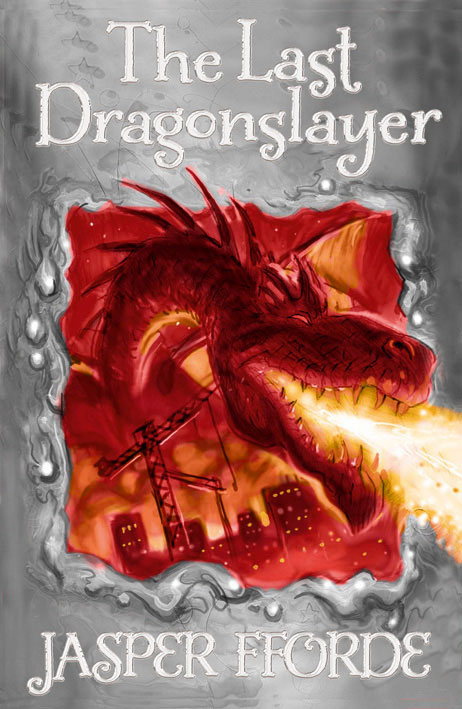
While fretfully awaiting the next in the series, Fforde pulls a fast one and comes out with another series The Last of the Dragonslayers. Although aimed at YA readers, I’m thinking it is really Thursday Next vacationing as a sixteen year old foundling who is coping with dysfunctional magicians.

First oneDragonslayer Book cover        Last Dragonslayer cover just read this one and now awaiting this one…

Eye of Zoltar coverIf you haven’t come across Jasper Fforde and you do appreciate a writer who wittily pokes fun at politics, literature, and popular culture, you might want to try one of his series.

Plus, it’s difficult to resist a writer who appreciates Volkswagen Beetles like I do. They are the car of choice. I came soooo close to spending my inheritance check on a bright red convertible Bug. Caving into family concerns who convinced me into buying something more sensible (I don’t regret my choice of buying a Honda Civic) I now live vicariously through heroines who drive VW Bugs as they dash about taxiing futzy magicians to and fro.

I’m still waiting for my next installment of Shades of Grey…ahem…

Light and Eyrey


image:: pintrest.com Jane Eyre Silhouette Black and White Book Cover by Pendantmonium,

I am preparing myself early this year for when I announce we will be studying Jane Eyre.

“Do we have to?”

“Is that our only choice?”

“Isn’t that a chic lit selection?”

And that’s the question I shall endeavor to answer. Because the first two questions both can be answered with “no.” But we won’t go there for now.

So, is Charlotte Bronte’s famous classic novel of being true to oneself, of overcoming adversity, of embracing family over riches really a chic lit because it centers on a romance, intrigue, and a woman who is victimized more than once.

First off let’s look at a couple of definitions:

from http://www.chicklitbooks.com:

What is Chick Lit?

Chick lit is smart, fun fiction for and/or about women of all ages. Many of these books are written from a first-person viewpoint, making them a bit more personal and realistic. The plots can range from being very light and fast-paced to being extraordinarily deep, thought-provoking and/or moving.

Another perspective–from http://www.dictionaryreference.com:

chick lit

/lɪt/ Show Spelled [lit] Show IPA

noun

literature that appeals especially to women, usually having a romantic or sentimental theme.

At this point Jane Eyre could be considered smart, fun? probably not so much. First-person viewpoint–yes. Personal and realistic–maybe. The plot is not very light and could be considered deep, thought-provoking and moving. It does appeal to women and does contain a romantic theme. Perhaps it is chic lit. Then again, let’s explore “classic.”

Mark Twain’s definition is universally accepted: “A book which people praise and don’t read.” However, Jane Eyre is read evidenced by it still being in print, let alone being studied in AP courses. Plus, look at all the film versions of JE.

I put the question to the guy students in class and most said the novel held their interest. The language, the setting, the intrigue, the cousin plot, the bitter aunt, and of course that underplot of a possible vampire living upstairs–wait, that’s a different novel (or is it?)

The verdict? How about JE is a classy literary novel focusing on a woman who overcomes her unjust circumstances. Oh, yes, let’s not forget Mr. Rochester.

Any thoughts?

Did you dread reading Jane Eyre in high school and roll your eyes or embrace the story of a strong young woman who finds happiness after much travail? (yes, I am slanting the vote).


Post Navigation