Pam Webb

a writer's journey as a reader

Archive for the category “Reading”

Lost in Translation: Part Three or “The Glad Idings of March”


The Ides of March have come and gone and so as the unit on Julius Caesar.  Between Odysseus, Hamlet, and the Roman senate I feel I have been wading in testosterone for a month. Lots of wanderlust, stabbings, and confused emotions of doing the right thing.  Next month it’s satire, heroes,  and star-crossed lovers, which should provide a decent change up of scenery.

Image Detail

I learned my lesson about front loading Caesar a few years ago when I first started teaching the play to sophomores.  I thought my students knew all about Julius Caesar. Wrong, so wrong.  Roman history is not a featured item in most history books up to ninth grade, and it’s not much of a feature in high school at all–that is, unless students opt for World History as one of their electives, and even then not a lot of time is part on the Roman Empire.  This is why there wasn’t much impact when the protagonist is bumped off by the second act.  Why should my students care about the hero dying when they hardly know him?

Speed it up a few years, interject some marketing savvy, and Julius Caesar becomes a dynamic unit.  My recipe for getting kids to care about Gaius Julius Caesar.

1.  Show a Hollywood version of Caesar that is colorful, even though historical correct: baiting the hook

Jeremy Sisto plays a likable Caesar. I play the movie up to the point of where Caesar returns to Rome after Gaul, receiving the cheers of the Romans and the news that Pompey has fled, fearing for his life.  This builds up intrigue and my students better understand what is going on when we began reading the play.

2.  Fishing for interest: Assign parts, upping the reluctance with bonus reading points.

After writing the parts on the whiteboard I stand back and let my students sign up for who they want to read.  Equal voice prevails in that it’s okay for guys to read female parts and vice versa.  I’ve had some lovely deep-voiced Portias, and some commanding lighter-toned Cassius readers.  Shakespeare would understand the need to pinch-hit.

3.  We read up to the assassination.  I used to include it as part of the agenda, yet my wanna be thespians somehow couldn’t do the death scene with proper dignity.  I decided to give that over to the more experienced.  There are a number of productions to choose from, although I keep with the tried and true John Gielgud version.

4. After each act we have class discussions about themes, issues, and notables.  This is my favorite part, getting students to realize how history has shaped the world they live in.  Events of a thousand years ago still echo down the corridors of their everyday life.  We discuss ideas such as: Is murder ever valid? Do political leaders always act in the best interests of their country?  Are beliefs worth dying for?  These fifteen year old minds begin grasping the need to be informed and how being informed influences the vote they will cast in three years.

5.  Once the play is packed up, the packet turned in, I reel in my students as we move on to the really fun stuff: Who was Caesar?  I want my students to understand his far-reaching influence (beyond calendars, salads, and quippy quotes) and get to know the man and form their own opinion about him.  I know Shakespeare had his reasons for not including Cleopatra in the play; however, Cleo cannot be ignored.  So she gets showcased because she was a larger-than-life influence on Caesar:

I annoy my students with all kinds of move trivia: costs (1 million to Liz–a shocking amount; 44 million to make–equaling about 300 million today); tracheotomy scars (Liz almost died, you know); thousands of extras (pinch police to protect the ladies); real sets (CGI in ’63?).  Grand stuff, indeed.

I also slip in a documentary with the idea that Hollywood and history don’t always see eye to eye on the truth.

The Sparknotes folk have done a really new cool thing by creating learning videos.  This one was also helpful:

Then the assignment: Write an opinion essay on who you believe Caesar to be?  Was he a megalomaniac who murdered for his own means?  A philandering player  who used women as stepping-stones to increased power?  A frustrated tyrant? A genius strategist? A leader cut short in his prime?  I guess the term is officially called synthesizing–gathering all the evidence and sifting it to form a valid opinion.  Kind of like suffering through election year.

The play itself is not one of my favorites: “Hey, I’ll stab you, you stab me, will all die so nobly.” A little too gritty for my tastes.  I do find a fascination in Caesar and I look forward to reading those essays.

In our district it’s mandated we have our objectives up on the board so that all may see what it is we are trying to get our students to learn.  Mine for the Julius Caesar unit?
May my students learn from the experiences of the past in order to better apply the knowledge that is gained

Books, Nooks, and Looks–Unpacking Your Library


I’m nosy.  Total confession.  When I am visiting I tend to check out the my host’s books.  Of course, I’m subtle and discreet, although I figure if it’s in open view, it’s open season on snooping.  This, what could be considered a habit of questionable good manners, began in college. Ah, college days.  Where all the believe-we-have-the-answers crowd congregated at one another’s flats, apartments, dorm rooms, and houses to sip upon cheap brews and crushed grapes and nibble on snacks and talk, talk, talk.  Being a gregarious hermit by nature, I would chat enough to leave an impression and then slip away to surreptitiously  inventory the host’s or hostesses’ bookcase.  Sound like a book stalker, don’t I?

www.myminihouseofstyle.blogspot.com

Actually, the habit developed out of the need to remain anonymously conspicuous within the crowd.  Though I like conversation, I do get overwhelmed with a room full  of it swirling about me.  Slipping off to study books is acceptable crowd avoidance behavior, at least this is what I came to believe.  Contemplating book titles allowed me remain a part of the assemblage, yet gave me space.  It also gave opportunity for other hermits to find sanctuary while we scanned books.  Books make great conversation starters.

You can tell a lot about a person about the books they keep on their shelves.  On the other hand, that wouldn’t be so true of my bookshelf.  After years of lugging books from place to place I began to understand that books, while a treasure in my life, took up a lot of space.  And I began to stop buying them, collecting them, and hoarding them.  Instead I am a frequent flyer at the library.  I go so often that I am on first name basis with the librarians and counter folk.  True story: I grabbed the wrong key chain and did not have my self-check out scan card (my Fred Meyer card doesn’t do the trick), so I stepped up to the counter and hoped one of the friendlies would have compassion on my card-less state.  I didn’t know her but she knew me and checked me through.  She whispered, “We don’t do this for everyone,” and confirmed my regular patron status.

This is why my local library rocks. This is also why they are my bookshelf. I do, of course, I have books on my home bookshelf.  I review books and have my keepers.  I also have my set of reference books.  I have books from parents inherited, forgotten children treasures waiting for new eager hands, and books that I know are there for yet another read.  To Kill a Mockingbird is one of those books.  There are also gift books, I probably won’t read, but respecting the giver too much, they nestle among the other keepers.

All that to introduce this little book I picked up on the way out the library the other day.

Unpacking My Library: Writers and Their Books (Unpacking My Library Series)

Unpacking My Library: Writers and Their Books edited by Leah Price features the personal libraries of Alison Bechdel, Stephen Carter, Junot Díaz, Rebecca Goldstein and Steven Pinker, Lev Grossman and Sophie Gee, Jonathan Lethem, Claire Messud and James Wood, Philip Pullman, Gary Shteyngart, and Edmund White.

Some people delight in PeopleNational Enquirer, and other celebrity peep sheets.  I am curious about the to-dos of the literary crew.  Unpacking My Library was a grab and go and admittedly it proved a bit disappointing since I did not recognize any of the featured writers.  Maybe you will.  What I did get out of the book was the delicious lookey-looks at about dozen different private libraries.  Ooh, I did indeed enjoy doing so.

In this age of Kindle, Nooks, and phone app capabilities, books and bookshelves might become more of an anomaly than a requisite in homes.  Although it wouldn’t take much to pack up my own home library these days, I still root for the book on the shelf.  Here is a fun video about bookshelves.

Happy Pages,
CricketMuse

Oh–there is still plenty of room on the Book Boosters page if you haven’t yet exclaimed your love of books.

The Ultimate Valentine Found in My Favorite Book


Happy Pages,

CricketMuse

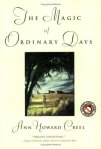
The Magic of Ordinary Days


The Magic of Ordinary Days by Ann Howard Creel

Olivia Dunne’s dreams of becoming an archaeologist are irrevocably changed after a brief interlude with a solider shipping out overseas. Her father arranges a marriage with a reputable bachelor farmer and Livvy accepts this arrangement. Leaving her married sisters behind in Denver, Livvy arrives in rural Colorado to become the wife of a man she does not know.

The book explores many topics: grief, betrayal, loneliness, trust, forgiveness, acceptance, and love. Livvy shows the readers her situation and how she adjusts to it in a voice full of angst. She mourns the recent passing of her mother, as well as the changes her mother’s death has brought her father. She stoically accepts the arranged marriage, for her baby needs a name. Ray, her new husband, knows Livvy carries another man’s child, yet he does not judge or resent Livvy for it. He patiently waits for Livvy to love him as he has come to love her.

Within this main plot is Livvy’s friendship with two Japanese-American sisters, Rose and Lorelei, who are residents of a local interment camp. Readers see the affects of WWII on Americans through Livvy’s eyes and through Rose’s and Lorelei’s.

As a reader I relished Creel’s use of imagery. I could feel the isolation Livvy suffered: the expanse of the fields, the lack of neighbors and family to break up the monotony, the need of useful purpose. Found on page 41: A clay-colored tumbleweed wedged between rows of green leaves caught my eye. Thorny, trapped, and out of place, it let me know the insignificance of any one, distinctive thing caught in a place so mapped with sameness. Aunt Eloise and Aunt Pearl had once accused me of hiding out in school. Instead Father had sent me into hiding here, where the openness of land and sky made hiding out about as unlikely as finding clover among the sage.

As a writer I appreciated Creel’s ability to use the first person narrator in such a way that all the characters were given dimension. The narration flowed so effortlessly that I often forgot the story was told from Livvy’s point of view. Another aspect of Creel’s writing is her use of prologue. Not being much of a prologue fan, I find myself inadvertently cringing whenever a book begins with one. Why not just start the story? Why the compunction to have extra exposition? However, Creel’s prologue is perfect; it reads as a visual movie trailer. It sets up the plot, the initial conflicts, the intrigue. It hooked me as a reader.

The Magic of Ordinary Days is far from ordinary. A compliment to Creel is that her book became an inspiration for a Hallmark Hall of Fame movie, which I had actually watched many years ago. As always, the book is better.

The Magic of Ordinary Days

The Magic of Ordinary Days (Photo credit: Wikipedia)

Post Navigation