Pam Webb

a writer's journey as a reader

Archive for the category “Reading”

Oxymoron Murder


Book Jacket

IMDB

Recently I sat down to a marathon watching of Agatha Christie’s Hercule Poirot.  I adore David Suchet’s portrayal of the funny little Belgian detective.  I’m not so keen on Christie as a read, but I relish Suchet’s portrayal of Poirot engaging his little gray cells to solve the crime. I am a fan of BBC’s Mystery series as well.  I bring home all kinds of detective reads, especially if they are series-based.  I have to wonder why I am drawn to books that dwell on someone dying in order to form the plot conflict.

Encyclopedia Brown Tracks Them Down

Goodreads

If I were to analyze my interest I think I would have to go back to my discovery of the Encyclopedia Brown series by Donald Sobol when I was in school.  I thrilled to the challenge of solving the mystery before going to the answer page.  Kid lit didn’t dwell much on dead bodies, but I had become hooked on suspense and intrigue.  Somehow I went from solving the case of the stolen bike to homicides in my reading habits.  I would much prefer the mystery without the corpse, yet those don’t seem to be as popular or readily available.  My compromise is cozy mysteries where body count is not so grisly.  I have discovered there is a entire culture of cozy out there.  My faves so far include Mrs Pollifax by Dorothy Gilman, and the Evans Constable series by Rhys Bowen. Minimal murder is a prerequisite as is sheet hopping of characters and profanity profundity. Prudish, aren’t I?  I like to practice safe read, I know.  So you can see it’s difficult for me to whet my appetite for mystery if I’m squeamish about death, violence, sex, and swearing.

Pattern of Wounds

Goodreads

This brings me to my latest read.  I fulfill my new authors, new reads list by freelance book reviewing.  While I have reviewed for several journals over the years, I mainly review for the Christian Library Journal and I have discovered Christian fiction is becoming quite amazing.  It used to be dominated by prairie romances and predictable soft plots of which I am not a fan.  Then Frank Peretti,  Davis Bunn, Ted Dekker, and Robert Whitlow came along.  I discovered Terri Blackstock and Dee Henderson as well.  My latest find is J. Mark Bertrand. His Roland March series is riveting. The protagonist, Detective Roland March, is a hard-boiled Houston homicide cop who has fallen from grace and is slowly working his way back up.  His character looks at Christianity from the outside and makes one ponder at the platitudes offered to the “unsaved.”  The plots involve grisly murders, the type where if the book became a movie I would be too squeamish to watch.  Then here comes the question: Why am I reading these books?  Answer? Darn good writing.  Bertrand provides a plot filled with dips, twists, and characters with dimension. His prose is sharp as is the voice. It also fulfills my safe plot requirements, even though the murders are often gruesome. I also appreciate how Bertrand gives us a protagonist who interacts with various Christians and comes up with some insightful perspectives when pressurized about his beliefs.  In this passage March is trying to explain to Carter, his renter who is also a youth pastor, why he is not keen on going to church. From pages 120 to 122:

Carter is saying to March:

“With the kind of work you do, the kind of things you see, there has to be a corrosive effect.  You’re always in the presence of evil.  When we met, I got a firsthand taste, so I think I have an idea what it must be like.”

March tries to explain how he sees the underlying corruption of the human condition while Carter dwells on the good, surrounding himself with the good.

March:

“Carter, listen to me.  You mean well, I realize that.  But there’s no magic formula or platitude they taught you in seminary that’s going to turn me into one of you.  It’s not gonna happen.  You have no idea what I’ve seen and what I’ve done.  Trust me, if you did, you’d be like me, and we wouldn’t be having this  conversation.”

March and Carter then get into a heavy discussion about  Carter’s viewpoint of how knowing God is loving and all-powerful and can bring good out of evil.  March counters with,

“…if there really was some loving, all-powerful force out there, I wouldn’t be hunting a man down for plunging a bowie knife in a woman’s chest and then stripping her and using her dead body as a pincushion….Now, what you’re saying is that, seeing something like that, I should be comforted.  I should feel good knowing that as bad as it looks, it was all for the best.  God was up in heaven watching it go down, and even though he didn’t lift a finger, he sure wishes us well.  I’m sorry, Carter, but that doesn’t do it for me.  If I believed that, I think I’d be miserable.”

Carter points out March is miserable.

And this is why I am a fan of Bertrand’s writing.  He provides an excellent whodunit and manages to stir up tough questions and nudge some comfort zones.

I sometimes wonder if the genre “Christian murder mystery” is an oxymoron.  After all, dwelling on death, murder, deceit, and lies isn’t Sunday School curriculum.  Then again, it is.  Bertrand points out through March that there is evil in the world and ignoring it doesn’t mean it goes away.  Carter’s character makes us see that there is a means of coping with that evil and not letting it get the best of us.

I think I answered my concern about being drawn to murder mysteries: I like seeing the bad guy get caught because in real life the bad guy often gets away.

Hercule Poirot explains how it all happened

Hercule Poirot explains how it all happened (Photo credit: elena-lu)

#7: Saw the Movie, and then I Read the Book (or intend to someday)


Though a professed Book Booster, I  freely admit I haven’t gotten around to reading all that I desire, or for that matter, should.  With time and interest constraints I tend to be selective in my reading, which can be received as either justification or a lame excuse.  I view my dosing of classics like one who would rather take a vitamin rather than endure the indignities of measured broccoli consumption.  Often I will watch a movie and decide, “Well now, I get the gist of the plot, let’s test drive the book.”  Or words to that effect.  Here are some movies which have prompted me to finally read the book:

1. Huckleberry Finn: As much as enjoy Mark Twain as a personality I’m not much for reading his books.  A  couple of summers ago I attended a week-long conference on Mark Twain, complete with experts and workshops, and still did not become a fan.  I will go on professing his genius and his contributions to literature, although I am a reluctant reader.  When I watched the movie I became drawn into the complexities of how a young man, namely Huckleberry, came to shed the baggage of his culture, slavery, being the biggest bag. Twain is an unmerited expert in taking on such a huge issue and presenting it so that it palatable.  Then again, Twain’s presentation creates a lump hard to swallow for many people, which is why Huckleberry Finn continues to be a challenged list somewhere at any given point.

Cover of "Les Miserables"

Cover of Les Miserables

2.  Les Miserables: Someone told me how they suffered the reading of this classic in their French class, and it made me leery.  He said it was not the  struggling through the actual reading of it–it was the sad, sad nature of the book.  I think absolutely depressing, was the term used.  Not exactly the best encourager to check it out for myself.  I watched the Liam Neeson version and went on emotional alert.  The acting, the story, the cinematography–all riveting. I wept, I commiserated, I rankled at the injustice, I shivered with anticipation, I was exhausted when the final credit rolled by. Shamefully,  I still haven’t read the book.  I am concerned I would compare it too much to the movie.  Yes, the movie was that amazing.

3. Little Dorrit, Bleak House, Great Expectations, Oliver–okay, okay, pretty much all of Dickens.  I’ve professed in a previous post my grievance of Dickens’ penchant for overwriting; nevertheless, it is no excuse for me not to read his books.  Again, I respect his tremendous literary influence, especially in terms of how his writings brought about social reform (child labor laws, especially). There is so much profundity in his writing I cannot properly chew and digest. Literary indigestion, I’m afraid.  Hence, I pop that cinematic vitamin pill and feel vindicated that at least I’m experiencing Dickens.  This is why I adore the British Broadcasting Company. All of the Dickens adaptations watched have been BBC productions viewed via the Masterpiece Theater on-line option.  My latest viewing involved the newest version of Great Expectations with Gillian Anderson as the imposing Miss Haversham.  Wow and my goodness, she was incredible.  Having invested heavily into the Thursday Next adventures by Jasper Fforde, I thought it essential to understand who and what Miss Haversham was all about.  Gillian Anderson provided the answers.

4. The African Queen: Humphrey Bogart and Katherine Hepburn.  How could I resist such a combination? After watching their captivating performance I sought out the book.  For once I will state  the movie proved better than the book.  Especially the ending.  No spoiler. Nuff said on this one.

Cover of "The African Queen (Commemorativ...

Cover via Amazon

5.  True Grit: My dad and I watched plenty of John Waynemovies together and I couldn’t believe someone would be bold enough to remake the one movie, his signature movie.  Staying true to the Duke I snubbed the Coen’s remake and simmered.  After hearing all the good reviews, and prompted by family members I relented finally and checked out the DVD.  This was no remake, but a recreation.  The Coen’s found an actress, Hailee Steinfield, who delivered a stunning performance.  She reminded me of Mary Badham’s performance in To Kill a Mockingbird.  I promptly checked Charlie Portis’s novel and found the Coen had paid fine tribute to a beautifully written story of forgiveness and redemption.  I plan on making this a required reading for my sophomores. Unfortunately, the publisher has no plans of reissuing it in a more affordable format as can be found for TKAM.  I plan on adding this movie and the book to my favorites list and will be revisiting them from time to time.

I might revisit my #7 at a later time.  Five seemed a good number for now.  Now, I pose a question for you:

Beary Wonderful Books


Recently I attended a SCBWI (Society of Children’s Book Writers and Illustrators) writing conference. There is something so energizing about them.  Everyone who is attendance is somehow connected with writing or illustrating books for children, which means this is a gathering of grownups, a room full of adults whose main concern and occupation is celebrating the wonder of presenting the world so that it appeals to children.

I have attended other types of writer conferences, and learn much from them–yet, they are so much more serious in tone.  Writing is a serious business, of course, of course, and I do take my writing quite seriously.  But, there is something about attending a SCBWI conference that is delightfully different.  There is this celebratory exuberance, this uncontainable joy that cascades over, around, and through the conference.  We are all gathered together because we know how to celebrate like a child.  We all take delight in the unexpected rainbow.  We sing the praises of butterflies and dragonflies and kites that flit upon the summer’s breeze.  We are all grown-up, but haven’t forgotten the wonder of childhood. We’re talking a fun-filled work and learn weekend.  I like it.

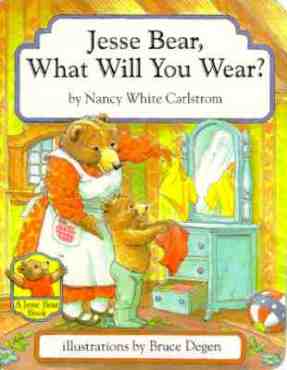
The main reason for attending the conference is to learn all about the business end of writing for children: submitting manuscripts, understanding the trends, listening to expert advice and soaking up valuable insights.  There is also the anticipation of connecting with other writers, and maybe even an author.  This is how I rediscovered Jesse Bear. 

On the first day, as we selected seats, made polite small talk, and exchanged introductions, I glanced around at name tags and stopping at one I thought “Hmm, that name sounds familiar.”  I then realized I was conversing with the Jesse Bear author!  These books are sweet, gentle reads that embrace the warm fuzzy moments of childhood.   Nancy White Carlstrom, is the author of these delightful books, and  each read is like receiving a hug of reassurance that the world through a child’s eyes is ever so pleasant.

During the break I took the opportunity to ask Nancy a few questions, which she graciously answered.

CM: What are the biggest changes you’ve seen in the publishing world?

NWC: Picture books are more quirky and loud. Those are getting the attention in the market place.

We then talked about how quiet stories, like Jesse Bear, (and the ones I like to write) are not in the forefront like they once were.  Newer books focus on characters who tend to be naughty, loud, or even angry.  Most certainly, these books are entertaining, yet Nancy and I both agreed there are times when a child needs a gentle read, a quiet time book to settle down.

CM: Why is a successful author like you attending the conference?

NWC: I have several novels I never finished.  I’m going to be submitting books I want to write now and need to know what the market is doing.

In the few minutes we had between sessions we traded concerns, tidbits, and comments about the current status of the children’s book market.  Sitting together the next morning and continuing our conversation we even discovered we had mutual friends.  That six degrees thing kind of sneaks up on a person now and then.

Overall, I came away with quite a bit from this last conference.  One big takeaway is the encouragement I received from Nancy’s example of a pro sitting with the novices. She showed me that even when the trends don’t go our way, we as writers shouldn’t get discouraged.  Getting our writing published and appreciated is an important part of the creative process; however, more importantly Nancy demonstrated to me we write because writing is what we do.


Chilling about my Frenzy


Script Frenzy 

In the beginning of April I blithely announced I would be participating in ScriptFrenzy, that annual craziness involving writing 100 pages in 30 days.  So here it is April 23 and I have finished ScriptFrenzy.  No, I did not type 100 pages. I did type 37 and ended up with a one-act play which I am quite satisfied with. I know I won’t receive my nifty little completion certificate, and I will end up as one of those sideline statistics who did not complete the goal.  However, I must protest.  The intent was to write a play and I did.  I cannot see the point of overwriting a play just to meet the page requirements.  The logic sounds like something from Alice in Wonderland.

Speaking of Alice in Wonderland–that’s what my play is–an adaptation of Lewis Carroll’s most marvelous classic of comedy logic.  My play is actually part of the NaNoWriMo novel I wrote two years ago.  Initially it was supposed to be a short story, yet it slipped into a play bit by bit .  You can see why I like Alice; I seem to dwell in the land of illogicals.

The play is a mix of Hamlet, Alice in Wonderlandwith a smidgen of Wizard of Oz. If you read the entire play the mix makes sense.  I shall not bog you down with all the details.  The short and quick: there two Alices–one is the narrator who is in a chair moderating her “dream” which what we watch on the stage.  “Stage Alice”  is the dream Alice and she has this terrible problem of speaking only in couplets (a bit of the Hamlet influence).  This portion is from the courtroom scene:

The Knave of Hearts, from a 1901 edition of Mo...

Stage lights open to a courtroom scene.  The King and Queen of Hearts sit on thrones. Stage right is a table with the KNAVE who is handcuffed next to a LAWYER.  Across at stage left is two rows of chairs, three in front and two in back, filled with an array of ANIMALS. The end chair is empty. Center stage is a small table with a plate of tarts. Stage Alice enters stage left and sits in the empty chair. Each animal is holding a DRY ERASE BOARD AND MARKER.  Stage Alice finds hers under her chair.

BAILIFF:  All rise.

The entire courtroom rises, except King and Queen.  Stage Alice reluctantly rises only at prodding from animal next to her.

We are gathered here today to hear the confession of the Knave, whom we know to have stolen the hearts, and we all know he will be sentenced accordingly.

STAGE ALICE: Well, that’s hardly fair and certainly not just,
I’d say this court room scene is most certainly a bust.

ANIMAL in front row turns around and hushes Stage Alice.  Stage Alice sticks tongue out when it turns around.  The ANIMAL besides her snickers.  The Bailiff(White Rabbit) walks over and bops snickering Animal on head with a BOPPER, a long-stick with a soft endpiece which could emit a funny noise for more comic relief.  The Animal winces and rubs head, even though bopper does not hurt.

QUEEN: And what has the defendant have to say for himself?

BAILIFF: (walks over to Knave) That’s you.  (whispers loudly) Stand up.

KNAVE: Well, your Majesty…

QUEEN: Thank you, that’s quite enough.  I find him guilty.

KING: Yes, I find him guilty too.

QUEEN: Then off with his head.

While the Bailiff begins to haul away the sobbing Knave, the courtroom is suddenly interrupted by the entrance of the WICKED WITCH

WICKED WITCH: Dorothy. You can’t escape me. I’ll get you yet, my pretty.  And your little dog, too.

She walks over to each of the jurors and inspects them one by one. They shiver and cower.

QUEEN: Off with her head!

WICKED WITCH: (turns around to Queen) Excuse me?  Whose head are you referring to?

QUEEN: (nervously) Her head (points to Stage Alice)

WICKED WITCH: Aha! Think you can hide out with all your little friends? Well I’ll show you. (cackles)

STAGE ALICE: No, I’ll show you (pulls out SQUIRT GUN and squirts Wicked Witch) You’re all wet, and your bullying is too.

Wicked Witch begins to shriek and runs out of courtroom, dropping off pieces of her costume on the floor.

WICKED WITCH: I’m melting! I’m melting!

BAILIFF : (Calls in on shirt cuff)Clean up on aisle three

WORKERS ONE AND TWO scurry in from stage left with MOPS AND BROOMS and clean up witch debri and quickly exit stage right

QUEEN: Now where were we?

KING: Before we go much further. I want to know why she (points to Stage Alice)knows a witch and a witch knows her.

The entire courtroom stares at Stage Alice who crosses her arms in defiance.

STAGE ALICE: Which witch I may ask of whom you inquire?
Press me further and a lawyer I shall hire.

KING: No need for that, my dear.  Just curious is all. (to Queen).  It looked like the witch knew her. (the Queen pats him in reassurance).  Bring on the next case.

BAILIFF: (calls out from a scroll) The Case of the Stolen Tarts by the Knave of Hearts

STAGE ALICE:But we just heard this case.
I cannot abide the ill-logic of this place.

ANIMAL NEXT  TO stage ALICE (whispers)Oh, there is perfect logic. What you saw first was the mock trial. We have to practice to get it write (points to whiteboard)so we can’t get it wrong.

STAGE ALICE: Getting it right is important indeed,
To practice justice, I understand; I see.

ANIMAL NEXT TO STAGE ALICE: (holds up whiteboard)No, no. Not “right”.  “Write” (makes writing motion)It takes us all such a long time to spell, that we have one or two trials before we get all our notes down.

Animal in fronts turns around and hushes Stage Alice.  She hushes Animal back.  Animal is shocked and turns around quickly.  Bailiff comes over and bops the hushing Animal.

KING: Read the case, Bailiff

BALIFF: (clears throat, reads from scroll)

The Queen of Hearts
She bought some tarts
On sale it was last Thursday

The Queen jumps up

QUEEN: I made those tarts from scratch, I’ll have you know

Bailiff clears throat and continues

BAILIFF:The Queen of Hearts
Says she baked some tarts
Perhaps it was last Thursday
The Queen nods her satisfaction, waves for him to continue

The Knave of Hearts he stole those tarts
And he ate them all on Friday

DEFENSE LAWYER: Objection!

KING: Proceed

DEFENSE LAWYER: My client could not have possibly taken those tarts and eaten them

KING: He must have–why else would he be here?

DEFENSE LAWYER: My client has a gluten allergy. He could not have eaten the tarts.

The King and Queen confer

KING: In that case he is dismissed.

BAILIFF: Mistrial.

The jury animals busily erase their whiteboard. Stage Alice stands up and clears her throat.

STAGE ALICE: Your honors, may I address the court?

QUEEN: No, you may not.

Stage Alice sits down with arms folded in a huff

KING: Bring on the witnesses.

STAGE ALICE: If the case is dismissed, then why are they calling for witnesses?They start one case, but it never finishes.

ANIMAL NEXT TO STAGE ALICE: (whispers loudly) If they like the witnesses they will create a case.

Animal in front row turns around to hush Stage Alice and she hushes him first

BAILIFF: (loudly calls out) First Witness!

The Hatter comes out sipping from a Starbucks container and eating a croissant

BAILIFF:No eating in the court!

The Hatter looks around and realizes the Bailiff is addressing him.  He lifts up top hat and puts cup and croissant on head and puts hat back on.

KING: Take your hat off in court!

HATTER: So many rules, my goodness! Besides, it’s not my hat.

KING: Aha! You stole it, didn’t you!

HATTER: Of course not.  I make hats.  If I make them how can I steal them?

KING: Where were you when the tarts were stolen?

HATTER: The tarts were stolen?

KING: Yes, that’s why you brought in as a witness. Who stole the tarts?

HATTER: How should I know?  I never touch them.  Croissants yes, tarts no.

KING: Avoiding the question, are you?

HATTER: Yes, I would like to avoid the question.  I never associate myself with questions I don’t have the answer to.  Do you have a question I might have the answer to?

Silly stuff, I know.  Carroll’s Alice is wonderful and punderfull, just like I like it.  I like Alice for its silliness, odd logic, and madcap tomfoolery.  If I caught but a twisp of it my day has been made.

So for those of you who are freaking about it being April 23 and knowing you won’t finish your ScriptFrenzy commitment–chillax.  The ScriptoFrenzo Police squad won’t take you out and publicly humiliate you.  That’s only a rumor.  They are only a figment of your writer’s block.  If you haven’t completed your writing goal don’t worry, be happy.

Quite Lost in Austen


For the past couple of months most of my reading time has been invested in Jane Austen, particularly Pride and Prejudice. I found a Barnes and Noble edition for my current reread, and all the nifty little notations throughout  illuminated the reading experience.  You know, that epiphany light bulb sensation. I relate my recent reading of P&P with complementary notes to when I clicked on subtitles during yet another viewing of Pirates of the Caribbean“Oh, that’s what Jack Sparrow said.”  That pseudo rum drawl tends to blur a bit at times for me.  Just as some of the Regency references zipped by me the first time around with P&P.  Finding a well-done annotated classic read makes for a riveting read.


Pride and Prejudice (Barnes & Noble Classics Series)

One aspect of the Barnes and Noble edition is the solid introduction by Carol Howard, essayist and English Department Chair at Warren Wilson College. Howard provides both context and historical background on Austen and her times.  Details make the difference, and knowing the flavor of times and disposition of the author’s family does indeed create a more enriching read. There were also delicious endnotes at the back of the book. It was much like having a personal guide  strolling  with me through an art gallery who diligently and enthusiastically explained all the finer nuances of the featured selections.

The problem  after supping my way through P&P (one does not dine and dash through Austen) I wanted more.  Yes, I could have turned to Emma or even Sense and Sensibility.  I wanted Lizzie and Darcy and the other Austen do-ups simply wouldn’t do.  I went in search of more P&P.

Austenite Fan Fiction land is formidable.  My local library contains at least three pages of on-line card catalog Austen-related material .  GoodReads garnered about nine pages. Diving into the choices, I quickly bypassed the Zombie offerings (shiver), thumbed through a couple of suppositions, and briefly contemplated the notion of Lizzie and Darcy as detectives (nah).   I ended up with a fine trilogy by Pamela Aidan, the Fitzwilliam Darcy, Gentleman series.  This is Pride and Prejudice from Darcy’s point of view.  I’m usually a bit irritated when an author tries to overlay his or her own ideas upon an established character, but truly, as much as we want to think we know Darcy, Austen didn’t flesh him out as thoroughly as she did Elizabeth.  To her credit, Aidan develops Darcy admirably.  Some  of the Austen FF I browsed couldn’t maintain its platform without leaning heavily upon Austen; however, Aidan provides a satisfying historical fiction offering that stands well on its own.  The Darcy aspect adds to it most certainly, but replace Darcy with another English surname and the books still stand strong.

                  Of course what really made it work was seeing Elizabeth from another point of view, namely Darcy’s.  Aidan’s series has proven successful enough to venture out with Wytherngate Press, which focuses on Austen continuances and likened historical fiction.

Other Austenite offerings of note on my literary Jane jaunt varied.  One I picked up was not fan fiction, but a sort of self-help book a la Austen.  A Jane Austen Education: How Six Novels Taught Me about Love, Friendship, and the Things That Really Matter by William Deresiwicz is entertaining and educational.  Deresiwicz, a noted book critic and former associate professor of English at Yale University provides “an eloquent memoir of a young man’s life transformed by literature.” In other words, he became William by understanding how  Jane became Jane.  His life became entwined with each of Jane’s six books at different points in his life and he transformed into a better man for it.  At least that’s the impression I got by the time I finished reading his book.   Here are some takeaways:

page 12 on Emma)
Austen, I realized, had not been writing  about everyday things because she couldn’t  think of anything else to talk about.  She had been writing about them because she wanted to show how important they really are.

page 50 (Pride and Prejudice)
…by putting me through Elizabeth’s experience–by having her make mistakes and learn from them, and having me stumble and learn right there along with her–what the novel was really showing me was how to grow up.

page 92 (Mansfield Park)
Being a valuable person–a “something” rather than a “nothing”–means having consideration for the people around you.

I did delve into other Austen-related writing; however, I shall not mention them lest you seek them out of curiosity–it’s not that they were bad reading, they just weren’t that good and I only have so much reading time and I don’t quit a book easily. I will say this: after two months of Pride and Prejudice I’m still as smitten with it as ever.

Image at the beginning of Chapter 34. Darcy pr...

Image at the beginning of Chapter 34. Darcy proposing to Elizabeth. Austen, Jane. Pride and Prejudice. London: George Allen, 1894. (Photo credit: Wikipedia)

#4: Required Reading for High School English


Having recently plunked out my series list caused me to wonder about creating other lists.  Yes, I am a confessed list maker.  I have Post-It squares tacked all over the place of To-Dos, Epiphanies, Story Starts, Poem Parts, and Lesson Plan Pundits.  The Cricket List will be an on-going project.  Today’s offering is #4: Required reading in high school English.  I encourage your suggestions:

The Cricket List:

1. Children’s authors and selected titles

2.  YA authors and selected titles

3.  Picture books

4.  Required reading in high school English:

  • The Outsiders(teens haven’t changed too much in the thirty years this has been out)
  • The Miracle Worker (Helen Keller is a hero favorite and goes a long way in learning about overcoming adversity)
  • Pride and Prejudice (all man/woman hate-at-first sight movies stem from this gem)
  • Sherlock Holmes (the original, to understand why Robert Downey and Jude Law’s version is pure entertainment)
  • Frankenstein (a riveting read and shows the fallacy of Hollywood’s meddling)
  • Jules Verne (original science fiction master storyteller)
  • Julius Caesar (politics gone wrong)
  • Hamlet (love-revenge-hate-murder-intrigue-dueling-witty wordplay–who could ask for more in a plot)
  • Taming of the Shrew (Men are from Mars and Women are from Venus four hundred years ago)
  • Othello (Shakespeare was ahead of his time with this tale)
  • A Midsummer Night’s Dream (a light-hearted romp which shows not all is tragedy on Shakespeare’s plate)
  • To Kill a Mockingbird (timeless classic which showcases the South both in a positive and negative way)
  • The Once and Future King (or some version of King Arthur–I like John Steinbeck‘s version)
  • Stargirl (beautiful story of not conforming to peer pressure or the consequences when one does)
  • John Donne‘s Holy Sonnet X (Death Be Not Proud)
  • She Walks in Beauty (timeless appreciation of beauty)
  • Rime of the Ancient Mariner (To understand Pirates of the Caribbean better)
  • Beowulf (so you can boo/hiss at the animated version and hope it will be done correctly someday)
  • Canterbury Tales (when you rewatch A Knight’s Tale you will laugh at the inside jokes)
  • Steinbeck (Grapes of Wrath, of course)
  • Mark Twain (American Lit wouldn’t be the same without him)
  • The Odyssey (understanding the epicness of heroes and their journey)
  • Romeo and Juliet (umm, how could one not read R&J?)

5.  Beach Reads

6.  Must reads

7. Saw the movie, then read the book

8.  Read the book, wish it were a movie

9. Poems to know and grow on

10. GoodRead gotta-get-to-someday reads

Hungry for Another Series?


After reading the Hunger Games series I cast about for something else as a continuous read.  Fortunately I found Divergent by Veronica Roth.  Although the next book is not due out until May I am set to move on to the further adventures of Tris.

What is it about getting involved in a series?  Is the lost-in-a-plot feeling?  Is it the invested interest in characters?  Perhaps it is the convenience of not having to find and audition yet another book (hmm, shades of dating and staying in a monogamous relationship).  Anyway, here are some suggested series, tried, true, and some still new to me:

1. Divergent by Veroncia Roth(next up will be Insurgent in May)

2. Chronicles of Narnia by C.S. Lewis

3.  Enders Game by Scott Orson Card

4.  Hitchhiker’s Guide to the Galaxy by Douglas Adams

5.  The Eyre Affair by Jasper Fforde

6.  Anne of Green Gables by L.M. Montgomery

7.  The Giver by Lois Lowry

8. The City of Ember by Jeanne Du Prau

9.  The Dune Chronicles by Frank Herbert

10. Little House on the Prairie by Laura Ingalls Wilder

11. Sisterchicks by Robin Jones Gunn

12. Arthurian Saga by Mary Stewart

13. Redwall by Brian Jacques

14. This Present Darkness by Frank Peretti

15. Dragon Riders of Pern series by Anne McCaffery

16. Janie Johnson series by Caroline Cooney

17. The Boxcar Children by Gertrude Chandler Warner

18. The Chronicles of Prydain by Lloyd Alexander

19. The Zion Chronicles by Bodie Thoene

20.  Stargirl by Jerry Spinelli

21. The Outsiders, That Was Then This is Now, Rumblefish by S.E. Hinton (shared characters)

22. Ramona by Beverly Cleary

23.  The Mrs. Pollifax series by Dorothy Gilman

23.  Constable  Evans series by Rhys Bowen

24. The Mars Diaries by Sigmound Brouwer

25. Chronicles of Fairacre byMiss Read

26. Amber Chronicles by Roger Zelazny

27.  Horatio Hornblower by E.M. Forester

28. Hatchet by Gary Paulsen

29. All Creatures Great and Small by James Herriot

30.  Encyclopedia Brown series by Donald Sobol

31. Little Britches by Ralph Moody

32. Diary of a Teenage Girl by Melody Carlson

33. Stonewycke Triolgy by Michael Phillips

34. Sarah, Plain and Tall by Patricia MacLachan

35. Paddington Bear by Michael Bond

If these don’t work for you, or if you’ve already devoured them, try the GoodReads link.  There are over 1200  entries and over 100 pages to browse through.  Book Boosters need their choices, ya know.

http://www.goodreads.com/shelf/show/series?page=1128

I’m interested in your thoughts.  Try out my first Polldaddy attempt:

Have you hugged a librarian lately?


Well, National Library Week is about done

To end it out, let’s have some fun.

Click on the link for a Famous First Lines quiz.

Have no worries–Book Boosters are a literary whiz.

Famous First Lines

(Rats, I missed three)

Drop a line why you love your library…

Happy Pages,

CricketMuse

National Library Week


National Library Week.  You gotta love the library.  I know I do.  I celebrate the library all year long, not just one week out of the year.  My hometown library is fabulous.  First off, our library is always busting out busy, yet there is always a place to park and I so appreciate how I can pull up and pop in my checkouts because the return box is conveniently placed near the building.  Secondly, we have a larger-than-life statue of Abraham Lincoln in the foyer. How cool is that?  Honest Abe, who we all know was a definite Book Booster is right there greeting each and every patron who enters the door.  Thirdly, the foyer always has a group of kids hanging out.  Being a teacher I certainly enjoy seeing my students, past and present (and maybe some future ones) relaxing  in a safe place that welcomes them. Our library has a wonderful kids program ranging from preschool to high school.  Kids are a valued aspect of our local library.  But the reason above all reasons I love my local library is they know me on a first name basis.  This cartoon is me going to the library.  No kidding.

I have librarians who email me new book read suggestions, and will actually buy my requests instead of just inter-library loan order them.  Love my library! Oh, yes indeed I do.  Check out this link if you love your library.

You belong on atyourlibrary.org this National Library Week | American Libraries Magazine.

For fun here is a tribute to libraries:


Oh, by the way…if you haven’t become a Book Booster yet, there is still room on the list.

Well, gotta run.  My library closes in fifteen minutes and I have a book on hold.

Blue Skies,

CricketMuse

An Uncommon Unexpected Read Among the Shelves


The other day as I was filling up my book bag I came across a book I must share: The Uncommon Reader

First off, the title grabbed my attention: The Uncommon Reader.  Being a Book Booster I naturally felt inclined, even obligated to inspect it.

Image Detail The Uncommon Reader is one of those “supposes” about Queen Elizabeth II, much as the movie The Queen supposed her reaction to Princess Diana’s death, TUR supposes the reaction of the Queen once she discovers reading.  From the flyleaf:

When her corgis stray into a mobile library parked near Buckingham Palace, the Queen feels duty-bound to borrow a book.  Discovering the joy of reading widely (from J.R. Ackerley, Jean Genet, and Ivy Compton-Burnett to the classics) and intelligently, she finds that her view of the world changes dramatically.  Abetted in her new found obsession by Norman, a young man from the royal kitchens, the Queen comes to question the prescribed order of the world and loses patience with the routines of her role as monarch.  Her new passion for reading initially alarms the palace staff, and soon leads to surprising and very funny consequences for the country at large.


Though I am not familiar with Alan Bennett, the book jacket reviews sang his praises loudly and enough to reel me in, and anyone willing to poke a bit of fun at the monarchy gets a try out.

Another reason I stuck TUR into my bag is it’s size.  Thick paperbacks and scrawny print do wear on one after a while.  I slated my dishy little find for Saturday afternoon’s nap/read.

Like many Brits, Bennett has a dry sense of humor.  I totally spoon up and relish the Brit Wit, partly because its my ancestry, and partly because I tend to love the understated which drifts into the ridiculous.  Not Monty Python overboard, more like Terry Jones when he does one of his historical videos.

At first I thought, “Of course the Queen is a reader.”  I found out from a review she prefers her dogs and horses to books. Yet, she has met and knighted many an author during her reign.  However, this does not necessarily mean she’s read them.

After the Queen mentions what a waste she had not actually read the books of the authors she knighted and therefore could not actually converse with the authors at the ceremony, her secretary replies:

‘But ma’am must have been briefed, surely?’

Of course,’ said the Queen, ‘but briefing is not reading.  In fact it is the antithesis of reading.  Briefing is terse, factual and to the point.  Reading is untidy, discursive and perpetually inviting. Briefing closes down a subject, reading opens it up.’

I thought about this and had to agree with her.  Often I will skip the book and check out the video.  I’ve done much of Dickens this way.  Some of you will nod your head in agreement, and others will more than likely berate my laziness (or temerity).  I also think those wretched abridged stories I’m faced with teaching in my curriculum are a form of briefing.  Two pages of King Arthur is not the same thing as diving into The Once and Future King  or relishing Mary Stewart’s Crystal Cave series.  I doubt the slim, anemic textbook offerings entice students to check out further readings.  No, I think these briefings close down their interest instead of opening it up.

I also applaud any book that has me scrabbling for my chairside dictionary. Reading this little gem provided me at least two new words: amanuensis and opsimath.  Both I do and have done.

Another aspect of the book is the clever play on words.  According to Wikipedia:

The title is a play on the phrase “common reader”. This can mean a person who reads for pleasure, as opposed to a critic or scholar. It can also mean a set text, a book that everyone in a group (for example, all students entering a university) are expected to read, so that they can have something in common. A Common Reader is used by Virginia Woolf as the title work of her 1925 essay collection. Plus a triple play – Virginia Woolf’s title came from Dr. Johnson: “I rejoice to concur with the common reader; for by the common sense of readers, uncorrupted by literary prejudices, after all the refinements of subtilty and the dogmatism of learning, must be generally decided all claims to poetical honours.”

In British English, “common” holds levels of connotation. A commoner is anyone other than royalty or nobility. Common can also mean vulgar, as common taste; mean, as common thief; or ordinary, as common folk.

I have to admire any author who can get so much mileage out of a three word title.

The best for last is when the Queen discovers something about reading–it leads to writing.

She found, though, that when she had written something down, even if it was just an entry in her notebook, she was happy as once she would have been happy after dong some reading.  And it came to her again that she did not want simply to be a reader.  A reader was next door to being a spectator, whereas when she was writing she was doing, and doing was her duty.

Just when the book seems like an overplayed joke, Bennett snips it off with an absolutely brilliant and perfect ending.

It’s hoped you are enticed to look up this delightful little offering.

Wait a minute, I’ve got the sequel to the book.  If she next discovers writing she could open up her own WordPress account.  Yes, bang on, that’s the ticket–The Uncommon Blogger.

Post Navigation