Pam Webb

a writer's journey as a reader

Archive for the category “America”

Life Long Loving of the Library of Congress


Main Library of Congress building at the start...

Main Library of Congress building at the start of the 20th century (Photo credit: Wikipedia)

And yet another reason I continue my praises of the Library of Congress. In recent Internet research sleuthing I stumbled across their Festival Author Booklist. Yippee! I love bookish gatherings, especially when I don’t have to do much traveling to enjoy it.  If you do want to travel, then get your arrangements made for Washington D.C. because that’s the happening spot. Last year the festival ran the weekend of September 21 and 22.  For more information: National Book Festival

Author and Reading Celebration

Since 2001,  authors, illustrators and poets make presentations on the National Mall in various pavilions. In 2013 over a 100 authors represented  Teens & Children, Fiction & Mystery, History & Biography, Contemporary Life, Poetry & Prose, Graphic Novels & Science Fiction and Special Programs.

Library of Congress Pavilion

If a person has longing to know all about the Library of Congress, then a visit to their LOC Pavilion is in order. There is so much moAt the Library of Congress Pavilion than books.

Wait!

There is more bookish good stuff from the LOC. Want handy access to classic reads? Then you need to click on the Read.gov link and start enjoying a range of reading from the John Carter series to Aesop Fables and what lies in between.

Contest!

Are you a teacher, a parent? If books are an important part of your education input, you will want to perk up and take time to read the guidelines about the LOC contest Letters About Literature.  Prizes too! I look forward to introducing this to my students.

Stay tuned for more love notes about the nation’s library.

Happy Sites for Smiles


Eagle Eyed Editor recently posted some thoughts on social media and it poked my brain into reflect mode. While there are many things I don’t like about the influx of social media–decline of manners (I’m here to watch the movie, aren’t you?); bullying (mean girls rule the airwaves); meaningless blurbs about mundane aspects of everybody’s life (celebrity haircuts make the banner-really?); and the instant shock news (the ceaseless exploitation of tragedy is morbid, not informing). HOwEvER—— Some people have figured out that social media platforms are amazing ways to promote happy thoughts, to interject some meaning to our day, to enlighten and amuse. Some are simply fun. Here are a couple of favorite finds: Puppet Guy at Vine Puppet Guy is a little yellow fellow with a big heart, a smallish brain, an a beguiling personality. His clips ranges from his rendition of Kermit singing to the “Rainbow Song” to being scared of virtual fish tanks to claiming Bill Cosby is his dad.  These short looping clips are mesmerizing.  Whenever I need a quick laugh I click hoping for a new adventure.  I guess I never outgrew the Muppet Show. You’ve probably discovered Kid President on your own.  My students begged me to play one of his episodes as our icebreaker.  I’m hooked. This kid reminds me of Gary Coleman (remember him?). Maybe even a much younger Erkle. Not only are his messages inspirational, but his life is inspirational. Robby Novak, aka Kid President, is a TED speaker, and has interviewed President  Obama, Beyoncé, and others. His winsome personality and impromptu dance moves and off-the-cuff remarks spell G-E-N-U-I-N-E.

What are your favorite upbeat sites that add a smile to your day?  I’m always looking for icebreakers for my students, so keep those suggestions family friendly, if you please.

Continuing the Love for LOC


Cover of "The Legend of Sleepy Hollow (Pi...

Cover via Amazon

Visiting the Library of Congress is high on my BIG list, yet that one wish won’t be actualized until time and funding match up. For now I continue visiting it on-line for research and serendipity surprises. For instance, as I browsed for Idaho pioneer entries my screen popped up their Books that Shaped America entry. I’m thinking somewhere there is a book about pioneers in Idaho? It didn’t matter because I became lost through the eras as I browsed, read, and absorbed.  Fascinating, illuminating, and enlightening how the books reflected the times and influenced future reading. For the entire link go to Books That Shaped America.

Here are some titles to ponder:

Benjamin Franklin, Poor Richard Improved (1732) and The Way to Wealth (1785)

Washington Irving, The Legend of Sleepy Hollow (1820)

L. Frank Baum, The Wonderful Wizard of Oz (1900)

Upton Sinclair, The Jungle (1906)

Dale Carnegie, How to Win Friends and Influence People (1936)

Ralph Ellison, Invisible Man (1952)

Dr. Seuss, The Cat in the Hat (1957)

Harper Lee, To Kill a Mockingbird (1960)

Ralph Nader, Unsafe at Any Speed (1965)

César Chávez, The Words of César Chávez (2002)

I know, I know–I’m hearing the “what about _______!” I was surprised at what made the list and what didn’t. I hope you check it out and let me know what you think should have made it.

Interior Library of Congress, by G. D. Wakely

Interior Library of Congress, by G. D. Wakely (Photo credit: Wikipedia)

The Autumn of My Discontent


The Idaho Territory in 1863. © 2004 Matthew Tr...

The Idaho Territory in 1863. © 2004 Matthew Trump Idaho territory in 1864 (Photo credit: Wikipedia)

The toughest part about writing a historical novel is research. I am discovering researching is becoming as addictive as dark chocolate Dove bites. I can’t seem to stop once I start.

For instance, having characters taking a walk in winter is not a simple undertaking. The month, year, and locale all become significant. There is also clothing considerations, appropriate interactions, and possible terrain aspects.
I ran into this when I decided the sisters would walk outside with two brothers after a neighborly get together. I scampered to my files to find if young people did indeed walk unchaperoned, if  the area had some snow–or too much. Which leads to clothing, which leads to age appropriate mannerisms, which leads to..

It’s If You Give a Mouse a Cookie syndrome–one aspect leads to another. I’m feeling a bit overwhelmed at this point.

Yet, here’s the problem–I’m too far into the novel to abandon it (again). I have this quirk about finishing projects. Especially when I get encouragement from agents, editors, friends, and critique circlers to finish it.

When I do feel bogged down in detail I turn to my inspirational muse, Hattie Big Sky by Kirby Larson. She won the Newberry Honor for her novel about a sixteen year old girl who inherits her uncle’s Montana homestead claim. It’s a dazzler for historical detail, characterization, and overall verisimilitude. It flows with imagery, sparkles with plot points, and it’s based on her great grandmother’s homesteading adventures. It’s becoming a favorite yearly read.

As inspiring as Larson’s Hattie is, I’ve unfortunately hit that dratted writing wall. Right now I’m stuck between seasons. What would my homesteaders be doing in autumn? Winter and Spring are covered. October and November? Hmmm…

I can see why fantasy novels are popular–creating worlds has got to be easier than traipsing backward to figure out what’s already taken place in ours.

Any Idaho historians out there?

When Movies Meant…


A box of Junior Mints

Movies and Junior Mints. The perfect combo.(Photo credit: Wikipedia)

Movies. I do enjoy a great flick. Admittedly, I rarely actually go to the theater anymore to watch a first run.  You will find me trawling the New Releases at my supermarket instead. Why? Oh, lots of reasons.  The main reason is because I remember when movies meant…

1. A Really Special Night Out.
We dressed up and anticipated An Evening. We selected the movie, the theatre, and piled into the family Buick and drove downtown. After parking, we promanaded along the sidewalk, anticpating the moment Dad stepped up to the little glass booth and announced out ticket needs: “1 child, 2 adults, 1 teen.” Stepping inside we handed the uniformed usher our tickets and entered into the lobby.  MyOMy–as a kid I felt like Dorothy entering Oz. Plush carpets, shiny brass rails, subdued lighting, posters of upcoming movies.  And an upstairs.  The bathrooms were marble and gloriously huge. Stalls galore.  Just going to the theatre proved thrill enough.

2. More For Your Money.
Not only did your ticket gain you admission into the glamour of the Rialto or Roxy, it secured two to three hours of absolute transfixing entertainment. The red velvet curtains parted, and the newsreel played, and then the cartoon: Bugs Bunny or Woody Woodpecker or maybe Tom and Jerry. The B feature (hence the term “B” grade film) played and finally the MAIN feature. I can’t remember all the films my parents brought me to and I don’t remember too many babysitters, but I do remember hanging out on the stairs while my folks watched Barbara Streisand in Funny Girl or Hello Dolly and the like. No problem if I wasn’t in sight. It was the good old days.  Safe and sane times. It was G, M, or X back then.  No, my folks didn’t take me to any X-rateds, but I do remember my share of shoot em-ups with Steve McQueen, James Coburn, Sean Connery. Dad picks. Barbara Streisand if Mom picked. If the adult fare bored me or if the folks thought I should “step out” for a bit I would traipse upstairs and perch on the steps to peer down on the those below. Maybe even sneak into the balcony section, at least until the usher checked through with his flashlight. 

3. Appreciation For Seeing the Film Right Then or Miss It.
A person anticipated a movie. The previews tickled our curiosity. The television adverts build up suspense. And finally the standing in line to see the newest. Because if you didn’t see it in the movie theatre you waited until it came out on Movie of the Week on the TV and then it would be sliced up by commercials or sanitized to neatly fit into alloted time slot.  No VHS, let alone DVD or Blu-Ray or streamed versions. WhoTube?

4. Snack Bar
Milk Duds or Junior Mints tasted far better being purchased from the theatre snack bar. Yes, they were more expensive, but the box was bigger.  You never found that size box at the local grocery store.  And there is something better about movie popcorn as well, especially the Dr. Pepper that went with it.

5. Disney In All Its Glory
My much older brother received Matinee Duty. Then again I am sure he derived some pleasure out of driving the family car downtown and getting movie and snack bar money, out of watching Lil Sis for a couple of hours.  There is nothing like watching a Buena Vista nature film prior to the REAL show.  Disney Movies do best on the Silver Screen. Moon Spinners, Jungle Book–ohgolly, those were the days.  The Walt days of Disney.  Yup, the best days of Disney.

I could do a whole separate blog on the Drive-In experience. Hmm, I probably will.

Though I will always and forever be a Book Booster, I do enjoy my flicks. These days though, it’s the big screen via the comfort of the living room.  Got my recliner and my remote control.  I also crave those Special Features.

My inspiration for the Old Days of Movie Going came from this here  Check it out.  If you remember Bugs Bunny days you’ll love the reminiscing.  If you don’t remember Bugs and the Merrie Melodies theme song–ah well, let’s just say, the good old days were really good in many ways.

The Essential Bugs Bunny

Oh Willa–Your Pioneers!


''The Song of the Lark ''Oil on canvas, 1884

”The Song of the Lark ”Oil on canvas, 1884 (Photo credit: Wikipedia)

As I continually research my own pioneer novel-in-progress, I return to favorites for inspiration.  Having reread most of Laura Ingalls Wilder’s Little House of the Prairie series, I am moving on to more grown-up fare such as Willa Cather’s Midwest trilogy of My Antonia, Song of the Lark, and O Pioneers!

Cather’s writing continually surprises me with its subtle acuity. She follows the nineteenth century omniscient style of narration that is no longer in vogue, yet as I read her seamless insights into each character, I realize I am easily visiting each character’s thoughts while still in the scene. That’s art.  It adds so much more dimension to the reading  that I find myself slipping from third person limited into omni in my own writing. *Sigh* Maybe I shouldn’t be reading Willa Cather–at least until I get my manuscript’s revisions tidied back up.

In that regard, unless you have your own concerns about being overly influenced while writing your own pioneer epic, I suggest rereading or experiencing Willa Cather’s O Pioneer!

Cover of "O Pioneers!"

Cover of O Pioneers!

Why?

It’s good stuff.  Really good stuff. Setting, for instance.  Turn to page 97 of your Random House Vintage Classic version and feast:

(Part III: Winter Memories: I)

Winter has settled down over the Divide again; the season in which Nature recuperates, in which she sinks to sleep between the fruitfulness of autumn and the passion of spring. The birds have gone. The teeming life that goes on down in the long grass is exterminated. The prairie-dog keeps his hole. The rabbits run shivering from one frozen garden patch to another and are hard put to it to find frost-bitten cabbage-stalks. At night the coyotes roam the wintery waste, howling for food. The variegated fields are all one color now; the pastures, the stubble, the roads, the sky are the same leaden gray. The hedgerows and trees are scarcely perceptible against the bare earth, whose slaty hue they have taken on. The ground is frozen so hard that it bruises the foot to walk in the roads or in the ploughed fields. It is like an iron country, and the spirit is oppressed by its rigor and melancholy. One could easily believe that in that dead landscape the germs of life and fruitfulness were extinct forever.

Personification, alliteration, imagery galore, tone, diction–it’s a banquet of literary delight.  Cather dedicates this full exposition to set up how this coldest of seasons affects the characters.  Steinbeck did much the same in Grapes of Wrath. Remember the turtle scene?

Sometimes I think we forget the importance of slowly revealing the story in our pressing need to “let’s get on with it” plot modernity mentality. Yet, there is an absolute pleasure in immersing oneself in the cadence of well-placed and balanced words.

Oh Willa–your pioneers keep singing to me of your prairie love through your song of fields, seasonal cadence, and your indelible tribute to those who left their mark upon the land.

Ain’t Is Too in the Dictionary.


image: nytimes.com

The Story of Ain’t by David Skinner isn’t so much about the word itself, rather it’s more about the dictionary that elevated its use from barely tolerated to denounced celebrity status.  It’s difficult to believe that a dictionary could rock the nation, but Merriam-Webster’s Third Edition achieved that claim back in 1961.

Why care about a dictionary? Simple. As writers, words are what define us.  Pun very much intended.  Before technology made referencing a simple thumb click or flip check, a person had to physically grab a dictionary off the shelf and flip through the pages and ease down the page for the answer.  A somewhat time-consuming process, yet it proved oh so satisfying when the answer yielded the “See, I knew it!” answer.  There was also the resounding “thwack” of the cover-to-cover closure vent of being caught wrong.

On-line access has made dictionary referencing such a ready convenience that reading about the controversy about a dictionary that has been out for over fifty years seems inconsequential.  Yet, writers are wordsmiths and learning about lexicographical history is as revealing as reading up on the Wright brother to perfect piloting skills.

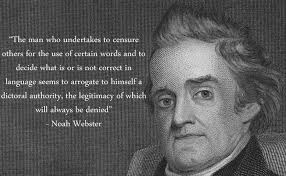
Noah Webster, long associated with the dictionary, left his legacy in the hearts, hands, and minds of capable descendants who continued the craft of prescribing proper word usage for all, that is until the 1961 Third Edition came out. A couple of wars, some cultural changes, and a few major historical events like the Depression not only changed the world, the language had noticeably been impacted.

Enter Philip Gove, the new editor who rattled the paradigm with the new (disturbing) descriptive instead of prescriptive format.  Merriam-Webster had to make room for all the new entries which meant remodeling the model so long held up in esteem.  No longer would it be the go-to reference for correctness of letter writing, titles, names, and places and other encyclopedic information; it would settle down and become a tome of how a word is used versus how it should be used.  More or less a Joe Friday approach, “just the facts, m’am.”

While at times digressive, Streeter nevertheless leads readers along his winding path of explanation as to why the Third Edition alienated newspapers, associations, and academics, irked the public and changed the manner of dictionary presentation forever.  The Story of Ain’t may not be a first pick read in terms of how-to’s and polishing writing skills; however, knowing how this particular dictionary came to be and the absolute furor it caused somehow causes pause, especially since plans for the fourth edition were announced in 2009.  Who knows how long, what, or if, any impact will be made once it hits the bookstores, since there are less and less bookstores to sell it in, now that users frequent screens instead of paper for their lexicon needs.  Now–ain’t that a shame?

Notable quotes:

Page 7:

And Merriam was very much in the business of authority.  In its own pages, Webster’s Second was “the Dictionary,” with a capital D and the definite article as if no other existed.

 Page 11:

The press release quoted Dr. Gove saying that the English language had become less formal since 1934. For an example the PR hands chose the new dictionary’s surprisingly tolerant, though oddly worded, entry for ain’t, which said ain’t was “used orally in most parts of the U.S. by cultivated speakers.”

image: sparklepony.blogspot.com

Page 30:

In those days the National Council of Teachers of English still observed Good Grammar Week, when children were called on to go seven full days without splitting an infinitive. As a reward they were treated to entertaining skits in which Mr. Dictionary vanquished the villain Ain’t. At home, however, as radios in the 1920s went from being a rare possession to a basic appliance, children might hear “Ain’t We Got Fun,” a popular foxtrot, “Ain’t Misbehavin’,” a Fats Waller song, or perhaps even “Ain’t She Sweet,” another hit song of the time.

image: yesterhair.wordpress.com

Page 49:

In the 1920s, Shall I? was still a common usage, but it would not be for long.  A few years after Fries’s study [Charles Carpenter Fries] was released, Bell Telephone allowed a researcher to listen in and count words spoken in the phone conversations of its customers. In the course of 1,900 conversations, will as an auxiliary term was used 1,305 times. Shall  appeared only six times. The long-term trend was obvious.  Twenty-five years hence, Alfred Hitchcock fans would leave the theater with the voice of a very proper Doris Day singing in their heads, using will in the first person to ask, “Will I be rich? Will I be pretty?”

Page 175:

In one instance, he said [Gove], the Webster’s Second board had spent at least an hour discussing whether hot dog should be in the dictionary. (In the end hot dog had won admission: “a heated wienerwurst or Frankfurter, esp. one placed in a split roll;–used interjectionally to express surprise or approval. Slang.”) 
Page 191:

Racy was often used to describe American English: H. L. Menchken more than once called it that. Webster’s Second defined racy as “manifestating the quality of a thing in its native, original, genuine, most characteristic state,” citing a weirdly fitting phrase from the Victorian thinker Walter Pater: “racy morsels of the vernacular.”

Page 213:

The comedian Fred Allen said, “Television is called a new medium, and I have discovered why they call it medium—because it is neither rare nor well done.” Yet its presence in the living room continued to redirect household activity, setting the table for TV dinner, dated 1954 in the Merriam-Webster files.  But one year later, another phrase was making the rounds: idiot box.

image: xk9.com

Page 230:

Said Gove: “Five basic concepts set forth in the English Language Arts supply a starting point.” Then he listed them:

1. Language changes constantly

2. Change is normal

3. Spoken language is the language

4. Correctness rests upon usage

5. All usage is relative

The concepts had been endorsed by the National Council of Teachers of English, Gove noted, “but they still come up against the attitude of several generations of American educators who have labored devotedly to teach that there is only one standard which is correct.”

image: lili.org

Page 241:

The dictionary [Merriam’s Third] weighed thirteen and a half pounds and featured 100,000 new words and senses, a massive amount of new language that Merriam called “the greatest vocabulary explosion in history,” While new words were being added, a quarter million entries were subtracted, and all remaining entries were revised.  “Every line of it is new,” Gove wrote in the preface.  With 450,000 total entries, the new dictionary contained 100,000 quotations from more than 14,000 authors. The foundation for Merriam-Webster’s lexicography comprised some 10 million citations, and the new edition had cost $3.5 million to make.

Page 266:

[James] Parton quoted the dictionary’s critics, the Washington Star calling it “literary anarchy”; the Library Journal calling it “deplorable”;  the New York Times saying, “a new start is needed”; the American Bar Association complaining that Webster’s Third was “of no use to us”; Wilson Follett, in the Atlantic, calling it “sabotage,” a “scandal,” a “calamity,” a “disaster”; a recent Times article calling it a “gigantic flop.”

Page 272:

[Bergen] Evans’s broadest point was his most persuasive: that the language itself had changed profoundly since 1934. “It has had to adapt to extraordinary cultural and technological changes, two world wars, unparalleled changes in transportation and communication, and unprecedented movements of populations.” And, he continued, “more subtly, but pervasively, it has changed under the influence of mass education and the growth of democracy.” Whatever its faults might be, Evans argued, Webster’s Third was an enormous effort to capture and describe, in sufficient detail and without undue prejudice, this great shifting thing called contemporary standard American English.

image: nytimes.com

Personae:

□       Asa Baker: president of G & C Merriam Company

□       Bergen Evans: television host and co-author of a significant dictionary of usage

□       Wilson Follett: professor of English and author of a guide to modern usage—most furious critic of third edition.

□       Charles Carpenter Fries: scourge of old-fashioned grammar and evangelistic scholar who sought to bring American English teachers around to the scientific view of language.

□       Philip Gove: editor of Webster’s Third

□       H.L. Mencken: famed newspaper columnist and magazine editor

□       Robert Munroe: successor to Asa Baker and uncomfortable with Gove’s plans for Webster’s Third.

□       James Parton: journalist and president of American Heritage publishing company who sought to use the controversy over Webster’s Third to take control of G. &C. Merriam Company.

The Merriam-Webster logo.

The Merriam-Webster logo. (Photo credit: Wikipedia)

Willa You Let Me Read Your Letters?


intr.v. snoopedsnoop·ingsnoops

To pry into the private affairs of others, especially by prowling about.

Looking where we shouldn’t seems to becoming more and more acceptable or at least it’s becoming more prevalent. I don’t know about you, but I got in BiG trouble if I got caught snooping. Parents, siblings, friends, even strangers don’t appreciate having their hidden stuff exposed. And face it, we all have stuff we want to remain hidden.

This is why I am having such difficulty with my latest selected tome of erudition.

image: Oprah.com

Right there. It says it right there. Willa Cather’s letters were hidden.  She didn’t want them hanging out in the public eye.  In fact, it’s taken about seventy years after her death to get these letters out.  Why?  Cather expressly stated in her will that she did not want her correspondence bandied about. Aren’t last wishes significant? Apparently not. If the agenda and credentials are proper enough it is deemed in everyone’s best interest to snoop and reveal.* No shame attached. In fact, no contrite apologies. Furthermore, the editors, Andrew Jewell and Janis Stout, justify their snooping in the book’s introduction:

Before Willa Cather died, she did what she could to prevent this book from ever existing. She made a will that clearly forbade all publication of her letters, in full or in part. And now we flagrantly defy Cather’s will in the belief that her decision, made in the last, dark years of her life and honored for more than half a century, is outweighed by the value of making these letters available to readers all over the world. [highlights are mine]

Hmm, “forbade” means to me “don’t do that.”  What about “flagrantly defy”? Do I hear a little self-righteousness bragging, as in “I know it’s wrong, but I’m going to be proud out loud anyway”? Tsk.

As interested as I am in Willa Cather, I feel it’s wrong to snoop her letters.  Just because they are published by a reputable and respected publisher doesn’t mean it’s ethical. Literary vultures waited until the will expired in 2011 and swooped down for the feast.  Here is a paradox: if these two editors so respect Willa Cather, why aren’t they respecting her last wishes? Don’t get me started about trotting out King Tut’s burial goods for the paying public.  I guess celebrities are open season dead or alive.

Granted, the letters represent only 20% of the entire collection, and none are present that might tarnish or stain Cather, (says  the editors). I still feel mighty uncomfortable reading her private correspondence. There are family matters, personal matters, circumstances and situations that  reveal too much of a peek behind the privacy curtain.

As much I appreciate learning about Cather’s background, which helps provide more depth to enjoying and understanding her prairie trilogy (Song of the Lark, O Pioneers, My Antonia), I have  shut the book after about 200 pages, right about the third section, about when she left her editor position at McClure’s to pursue writing full time. The best is yet to come, yet sorry, I’m gonna pass. I respect Willa as an author too much to rummage around in her personal life.

Maybe, it’s me. Snooping for the cause of erudition is still snooping.

What do you think, readers?  Should Willa Cather’s wishes been respected? Should her letters have been left alone, should they not have been dusted off and printed up, even if it’s in the quest  harkening the light of “literary illumination”?

Willa is not amused.

*This could easily segway into a Snowden blog,, couldn’t it?

Prairie Love


image: oceanliteracy.org

Growing up with the ocean ever present in my life, I couldn’t  fathom living  without it. The salty tang of the air, the lullaby rhythm of the waves, the restoring sandy walks–I couldn’t imagine or even desire living apart from its presence.

And yet, for the past twenty years I have done so. I traded the ocean for trees and mountains. The ocean is still a part of me, though we are now parted. There are aspects of my adopted environment that have also become woven into my person. I call this the sense of setting.

image: wallstickeroutlet.com

Because of my familiarity and connection with the ocean, forests, and mountains, I find myself drawn to reading about unfamiliar landscapes, and for some reason my list of setting interests includes an abundance of stories about the prairie.

Initially, I don’t think I could bear the flatness, the unyielding run to the horizon from end to end, nor bear the extremes of seasons and the monotony of view. This is where the marksmanship and craft of writing happens. Writers, poets, authors portray the prairie in such a way I find myself surrounded by the grass, the wind, and witness vicariously the openness and beauty through another’s eyes. The sense of place.

Recently two writers have presented their sense of place, their love of the prairie so profoundly, my paradigm has shifted. I now understand the fullness of this unique setting, and respect it and perhaps even admire it, which replaces my former disdain. True writing,  the skill of a wordsmith can do this.

While I have read many prairie pioneer books in my life, Laura Ingalls Wilder being the first, my most recent read is Willa Cather. She provided readers with a portrait of the midwest through her trilogy Oh Pioneers, My Antonia, and Song of the Lark. A memorable passage from My Antonia:

Presently we saw a curious thing: There were no clouds, the sun was going down in a limpid, gold-washed sky. Just as the lower edge of the red disc rested on the high fields against the horizon, a great black figure suddenly appeared on the face of the sun. We sprang to our feet, straining our eyes toward it. In a moment we realized what it was. On some upland farm, a plough had been left standing in the field. The sun was sinking just behind it. Magnified across the distance by the horizontal light, it stood out against the sun, was exactly contained within the circle of the disk; the handles, the tongue, the share—black against the molten red. There it was, heroic in size, a picture writing on the sun.
Even while we whispered about it, our vision disappeared; the ball dropped and dropped until the red tip went beneath the earth. The fields below us were dark, the sky was growing pale, and that forgotten plough had sunk back to its own littleness somewhere on the prairie.
Cover of "My Ántonia (Dover Thrift Editio...

Cover of My Ántonia (Dover Thrift Editions)

Cather presents both the starkness of the prairie and the greatness. The plough represents the solitary efforts of those who tried to tame the vastness of that flat, grassy expanse, and while the abandoned plough could have been viewed as sad or even tragic in its loneliness, Cather displays it as heroic.  And this is the view I now have of the prairie. It is like the ocean in its vastness, its grasses the tide upon the land. Those who worked it by tilling the land, navigating its immensity with their ploughs, horses, and tractors are much like those who navigated the ocean with their own crafts of boat, steamers, and ships. Both land and sea represent the need to explore the unknown and forge a living  from it.

Another view comes from today’s Poem-a-Day offering:

Poppies on the Wheat
by Helen Hunt Jackson
Along Ancona’s hills the shimmering heat,
A tropic tide of air with ebb and flow
Bathes all the fields of wheat until they glow
Like flashing seas of green, which toss and beat
Around the vines. The poppies lithe and fleet
Seem running, fiery torchmen, to and fro
To mark the shore.
The farmer does not know
That they are there. He walks with heavy feet,
Counting the bread and wine by autumn’s gain,
But I,–I smile to think that days remain
Perhaps to me in which, though bread be sweet
No more, and red wine warm my blood in vain,
I shall be glad remembering how the fleet,
Lithe poppies ran like torchmen with the wheat.
English: , located on west side of just north ...

English: , located on west side of just north of the Nebraska-Kansas border in southern . (Photo credit: Wikipedia)

I smile, too, grasping the juxtaposition of frivolity of the simple flower merged the purpose of the land.

I may never go to Kansas or Nebraska, but I can say I have traveled to their prairies.


Dandelion Summer


It’s always a pleasure to discover a new author, especially one who is prolific. Such is the case with my discovery of Lisa Wingate and her novel, Dandelion Summer.

Set in contemporary Texas, this is a character-rich story  with two polar opposites.  Imagine Henry Fonda from his role in On Golden Pond and a teenage Queen Latifah, you then would have Norman Alvord and Epiphany Jones, better known as J. Norm and Epie. Thrown together against their will, they reluctantly form a truce of temperaments as they launch out on a journey of discovery together.

One of the more delightful aspects of the novel is how Wingate swings the viewpoint from J.Norm’s to Epie’s, allowing the reader to fully realize the entire picture. Norman is a recent widower, ailing not only in health, but in regrets.  He is at odds with his only child, Deborah, a resentful professional woman who believes her efforts to run her father’s life is merely a way to honor her promise to her deceased, beloved mother. Epiphany is a troubled biracial sixteen year old who has it tough at home and at school. Both Epie and J. Norm want to break free of their circumstances and solve the mystery of who they really are.  The varying viewpoints provides the balance of age and youth, and it isn’t long before it’s clear that no matter a person’s age, status, or experience the basic need of family is foremost.  Epie and J. Norm form a family bond of sorts and what could have become oversweet in outcome turns into a realistic story of two hurting individuals who learn to rely on someone they least suspect of being a means of help to their situation.

My biggest takeaway from the novel is Norman’s letter to his daughter, Deborah.  He knows he wasn’t there for her when she was growing up and his letter is an apology, yet it is also an instructive that all fathers can learn from.  I plan on slipping this to my sons someday (never mind there aren’t married, or even have serious girlfriends yet), and maybe I can convince my pastor to read it for next Father’s Day. Here is an excerpt:

Dear Deborah,
Words do not come easily for so many men. We are taught to be strong, to provide, to put away our emotions. A father can work his way through his days and never see that his years are going by. If I could go back in time, I would say some things to that young father as he holds, somewhat uncertainly, his daughter for the very first time. These are the things I would say:
When you hear the first whimper in the nights, go to the nursery and leave your wife sleeping. Rock in a chair, walk the floor, sing a lullaby so that she will know a man can be gentle.
When Mother is away for the evening, come home from work, do the babysitting. Learn to cook a hotdog or a pot of spaghetti, so that your daughter will know a man can serve another’s needs.

The letter continues with sound advice and lyrical admonition to be all a man can be by being the best father a daughter can have and remember.  I read this to my writing compadres and the “oohs” and “aahs” circled around the table.

Dandelion Summer is definitely a book for perfect for the summer read list, yet  its warmth resonates long after the last word is read.

Post Navigation