
Goats and Monkeys: the other aspect of Shakespeare
National Poetry Month is still among us for a few more days and I would be remiss not to mention Shakespeare and his sonnets. There–duly mentioned.

I am sorely tempted to give a brief lesson about the sonnet, something I miss teaching from my AP English Lit days. BUT (which is an indication of the turn in the sonnet mood or message known as the volta–see what I did there? Yes, I did squeeze in a brief lesson), I shall refrain and instead spotlight that other aspect of Shakespeare.
No–not him being a playwright. Did you know he started out writing sonnets and not plays? That he considered himself more poet that playwright and that he inserted many a sonnet into many of his plays? There are four sonnets in Romeo and Juliet alone. The prologue that introduces the play is a sonnet (watch for the volta–hint, hint “which” works as well as “but”):
Two households, both alike in dignity,
In fair Verona, where we lay our scene,
From ancient grudgeParenthesis break to new mutiny,
Where civil blood makes civil hands unclean.
From forth the fatal loins of these two foes
A pair of star-crossed lovers take their life
From forth the fatal loins of these two foes
A pair of star-crossed lovers take their life;
Whose misadventured piteous overthrows
Doth with their death bury their parents’ strife.
The fearful passage of their death-marked love,
And the continuance of their parents’ rage,
Which, but their children’s end, nought could remove,
Is now the two hours’ traffic of our stage;
The which if you with patient ears attend,
What here shall miss, our toil shall strive to mend.
There I am talking about sonnets again. Well, it is National Poetry Month. And being such a famous, well-known poet it is difficult not to have spent at least a bit of time about how the Bard rocked sonnets.
Sonnets. Plays. He did write them supremely well. We still read them, watch them, recite them, discuss them and you know what? Just watch a master recite the master discussing April–very appropriate, wouldn’t you say?
The cat is a nice touch.
Here I meant to talk about the other aspect of Shakespeare, and sonnets distracted me. A worthy distraction, true that. Yet, (another word that works as a volta, since I am changing the direction of this focus), beyond the perfect prose and poetry Shakespeare is so admired for there is a darker, mmm, not quite the right word–ribald, yes, Shakespeare has a definite ribald side to him: his insults!
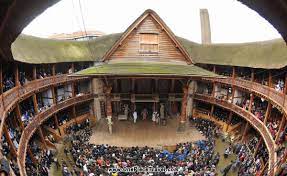
Throughout his plays his characters lob the cheekiest insults at one another. Keeping in mind the majority of those attending Shakespeare’s plays were of the down-to-earth crowd, known as “groundlings” because they pay a penny to watch the performance and stood for the entire time, often shouting out their commentary to the stage actors. Stands to reason then why Shakespeare inserted earthy lines into his plays. He knew how to play to the crowd.
Here are some examples. They start at mild and run the course from G to PG13.
- “Neighbors, you are tedious. ” —Much Ado About Nothing, Act 3, Scene 5
- “[You] peevish baggage.” —Pericles, Act 4, Scene 6
- “[H]e has not so much brain as earwax.” —Troilus and Cressida, Act 5, Scene 1
- “You are not worth another word; else I’d call you knave.” —All’s Well That Ends Well, Act 2, Scene 3
- “Out of my sight! Thou dost infect mine eyes.” —Richard III, Act 1, Scene 2
- “Bloody, bawdy villain! Remorseless, treacherous, lecherous, kindless villain!” —Hamlet, Act 2, Scene 2
- “A knot you are of damned bloodsuckers.” —Richard III, Act 3, Scene 3
- “You rise to play, and go to bed to work.” —Othello, Act 2, Scene 1
- “Heaven truly knows that thou art false as hell.” —Othello, Act 4, Scene 2
For more Shakespeare insults try this link:
Or you can create your own insults with this link. This is a classroom activity we used to do during our Shakespeare unit in English. It would culminate in an insult-off between a student and myself with the object of hurling such a created invective that the other person would cry–actually it usually ended up with everyone laughing.
So, a tribute to Shakespeare’s prowess with prose and poetry and a solid nod to his poison pen when it came to hurling insults.





 Pam Webb