Pam Webb

a writer's journey as a reader

Archive for the tag “Sayings”

Why We Say: #16


This round involves some flash and splash in terms of remberance…

Flash in the Pan
We know the story: a new talent comes on the scene, everyone is appropriately dazzled, and whist and fizzle, the name fades from view. The expression “flash in the pan” comes from 17th century muskets and how the flint sparks ignited the powder in the loading pan. The powder, like flashy talent, gave off a spark, yet had no significance or long-lasting effect.

these guns were fairly flashy in their day image: revwarheart/Morguefile

Flirtation
Flirting is a behavior most associated with women, although I’ve known a few men who can rustle up the attraction factor as well. However, I don’t think too many men would consider waving a fan about to get attention, which is from where our term of “flirting” originates. Women desiring the attention of available men at dances, balls, or other gatherings would practice the fine art of waving or flirting their fans about. Fans are out, but flirting is still in play today. Perhaps words and actions have replaced the fan’s muted motions.

Pennywise (Morguefile) might be suggesting that someone fanning this about would definitely attract attention

Forget-Me-Not

These sweet little flowers have a sad story image: Jusben/Morguefile

These are garden favorites of mine. Every year I faithfully sprinkle out seeds and hope for the best. Not as many pop up as I hope, yet once planted they perk up the summer landscape with their multitude of blooms. Now that I’ve discovered their story I appreciate them even more. I’ve added a wee bit more to the snippet I found:

Once upon a time, (like all great German tales start), a dedicated knight decided to surprise his lady-love. Making his way down to the banks of the Danube river he began to pick a bouquet of the blue-star flowers that grew there. So intent was he upon gathering the flowers that he did not notice how close he was to the edge of the riverbank. Alas, the ground gave way and he fell in. Being a fighter and not a swimmer, he found himself being swept away by the river’s current. His lady-love rushed along the riverbank, yet she was not a swimmer either. Before the river claimed the gallant knight he tossed the remaining flowers he held in his hand towards his lady and called out “Vergiss mein nicht” asking her to “forget him not.” It’s said the lady never married and instead of black she wore the gentian blue of the little flower, as her way of always remembering her lost knight.

Next time we’ll look at different ways a person gets burned…

Why We Say: #8 (a backstock of Bs)


Well, Well…

I haven’t run a “Why We Say” since December. Tsk. Not wanting to disappoint I will make up the lost months in a bevy of Bs. Five months equal five reasonings for “Why We Say”–


1. Springtime is April showers and May flowers and baseball!  It is appropriate we begin our first B with Baseball Fan. Back when newspaper ruled the news, there would be great competition for space. Naturally, if a longer word could be exchanged for a shorter one, or if a long one could be condensed, the switch was made.  Charles Haas, apparently is the reason we now refer to sports enthusiasts as “fans.”  He was credited as being the greatest baseball “fanatic,” which became shortened to “fan” once it hit the press pages.  And here I thought “fan” referred to the paper waving needed for those hot days in the stands.


2. “Oh quit beating around the bush, and just tell me what you think!” Have you ever been accused of holding back information? If so, this statement might be flung at you. You might not realize how foxy you’re being by holding back from your audience.  Back in the day, hunters wanting to rout foxes from their hiding spots in the bushes, would send someone to beat the bushes to scare out the tawny evaders.  Not wanting to become some ladies fur stole, the foxes would learn to keep hidden, which meant it took a long time to get a fox to pop out.  The “aha” moment with this phrase: sometimes it takes someone a long time to get to the point of the story.


3. Do you suffer from getting in tight spots? Do you sigh at the getting behind, just when you thought you had it all in order? Do you wish you could be a winner, instead of being a loser?  If you checked “yes” to any of these questions, you will then most certainly relate to the expression “Behind the Eight Ball.” This expression is derived from the pool game of rotation, where each ball is played except the eight ball. If the eight ball blocks your shot, you have basically lost the game.

4. “I would love to be in your shoes.” This one makes sense all on its own.  It’s simple, right?  It simply means we want to trade places.  That’s true and then some.  Let’s go back as far as 1834 in England. At that time children who were to be adopted would step into their new father’s shoes to stress the importance of the new connection and family ties.  “Shoes me, are you my new dad?”

image: 74211.com


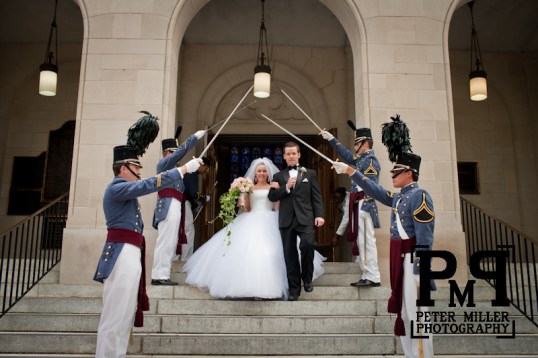
5.  With spring comes summer and with summer comes weddings.  Ooh, I love a summer wedding and I am so disappointed when I don’t get to go to at least one summer nuptial exchange.  I love the chance to actually dress up, mix and mingle with old and new acquaintances, eat, drink, and be merry and best of all I enjoy watching the bride and groom exchange their commitment to one another.  I look forward to the wedding theme and the fashions.  How many bridesmaid? Will the best man be serious? Or will he pull the old “ring, what ring?” routine.  The best man is naturally the groom’s best friend or close relation, and it’s a place of honor.  This custom stems from centuries ago (primarily in Europe) most weddings took place at night (don’t know the reason on that one–research time) and it wasn’t unheard of to have the rival come swooping in an attempt to kidnap the bride. One precaution against this shocking, and irritating practice, was to have the groom’s men stand guard during the service.  The main guard would be the groom’s most trusted or best man. Tuxedos optional with swords?


Next month B on the lookout for some more Bewildering “Why We Says.”  Until next time…

Why We Say: #5


“I tell you, George, my daughter is the cutest little thing.  I come home and she runs up and jumps into my arms. She wraps herself around me, gives me a big smooch and says, ‘Daddy!’ Makes me swell up with sheer happiness. She’s a precious blessing–she is the apple of my eye.”

Image: Morguefile

History

According to my reference book, sometime around in the 9th century people began to realize apples were fairly tasty  and  valued them.  Eyes, being valued, somehow drew the same worth as apples, and so, when something was valued it became the “apple of the eye.”

Application

We have all kinds of expressions relaying our appreciation for things, such as”You’re the best!” “You’re one in a million!” Being the apple of someone’s eye? I guess that’s right up there with the “bees knees.”


My Thoughts

The book offers a really weak explanation. Apples have been a loooong time, and seeing as how they are fairly inexpensive and easy to obtain I’m having a tough time grasping that eyes and apples are on the same scale of value. I definitely think eyes are more precious than a Golden Delicous or even a Honey Crisp. However, I do see the connection between apples and eyes in that the pupil looks like an apple in shape.  I associate apples with knowledge (ahem, Eve) and seeing someone as being special means you have learned their value.

There must be a better explanation out there?  Anyone?

image: losemyaccent.com

Why We Say: #2


Title page of Three Hundred Aesop's Fables

Title page of Three Hundred Aesop’s Fables (Photo credit: Wikipedia)

Continuing on with what could be an enlivening series of posts is #2: “Adding Insult to Injury”

History:
This expression is traced back to Aesop, the storyteller who attached morals onto his flash fiction parables.

Story:
Apparently a man who possessed hair deficit disorder swatted at a fly and in doing so missed the fly and smacked himself in the head.  Not only did the fly get away (the insult), but the man got a lump on his noggin for his efforts (the injury).

Application:
Today, when someone says or does something that hurts another person, either verbally or physically, and then does something that furthers this problem, such as not apologizing for the initial incident, or creates another problem, that person is said to add insult to the injury.

My Thoughts:
Did it really matter that the guy in Aesop’s story was bald to begin with? Was that the insult–that not only did the guy have no hair, now he had a lump for everyone to see.


Post Navigation