Though the end of the cliche alphabet draws near, there are still plenty of tired but true phrases to explore. Today’s focus is on “V”
Vanish into thin air: to disappear suddenly
Variety is the spice of life: experiencing the new and different can add meaning to one’s experience
Vent your spleen: keeping anger held inside can have physical consequences NOTE: way long ago, the spleen was once considered the center of emotions. Valentine’s Day would be quite different if that thought had remained.
Nothing ventured, nothing gained: giving something a try is a consideration
Vertically challenged: a polite term for short
Vested interest: personal stakes are involved
Vicious circle: going right back to where it all started, and not always in a good way
A hollow victory: sometimes there is an unexpected cost to winning that can seem to be a loss
There’s a guy I know, laid back, long hair, beard, comfy clothes, a man of few words—yeah, kind of that hippie vibe—and when you greet him he says, “You know it” with a smile. Yup, Charlie is pretty chill.
So with the vibe of relaxed, here are some chill “u” clichés”:
Under her/his thumb: subservient (beware of a boss who is considered all thumbs)
image:BBC Learning English
Under a microscope: close scrutiny (nothing like being pinned between glass slides with an eyeball staring at you)
Under the table:receiving payment without notifying the IRS as income (I don’t know what you are talking about)
Up for grabs: available (it is polite to ask first, I would think)
Ugly as a mud fence: very unattractive (can’t imagine such a fence making the pages of Better Homes and Gardens)
image: Citizen Times
Up in the air: no decision made (it’s up in the air whether it’s more popular to say up in the clouds instead)
Until the cows come home: waiting expectantly (cows are time conscious and will return to the barn when they are ready)
Up in arms: to become upset (referring to when soldiers when prepare for a fight by grabbing their weapons)
Up the ante: increase the odds or compensation
Up the creek without a paddle: to be in trouble or in possible peril
Getting closer to the end of the cliché alphabet. Here are a few popular “T” sayings:
Tables are turned: the situation has changed. This well-known idiom comes from 17th century game board playing such as backgammon, a game where players could switch or “turn” the board (or table) with the ability to gain the upper hand.
Take a back seat: to find oneself subordinate. In the 19th century stagecoach travel was common and travelers who were in less standing or importance would inevitably end up in the less desirable back seat which prompted the saying to come to mean being reduced to less prominent position.
Take a hike: to take long walk; to go away. Mid-19th century people were used to walking, sometimes involving long hikes which meant going away from people or a place, developing into a phrase that meant telling some to go take some air, to leave, sometimes in a rude manner.
Take a leaf out of someone’s book: setting an example. The saying refers to 1800s practice of actually taking a page or “leaf” from someone’s book to copy their example or style. It originally alluded to the copying or plagiarism, later developing into today’s usage of following someone’s example because of admiration or success.
Take a nosedive: to fall unexpectedly. The 20th century ushered in airplanes, and early airplanes could lose altitude unexpectedly. The meaning now refers to a sudden drop in a situation, condition, or state of being.
Take a raincheck: to politely decline. If it rained during 19th-century baseball spectators could receive a voucher or “rain check” for free admission to another game.
Take a shine to: to form an attraction. “Shine” in 19th century vernacular meant taking a sudden liking to someone, seeing the attraction or “shine” in their eyes. Today people use the expression to indicate immediate fondness for someone or something.
Take a straw poll: an informal survey. In the early 19th century newspapers who wanted to get a feeling for how the public felt about a matter, such as a presidential election, they would take an impromptu survey among people. The informal method was likened to tossing straw into the wind due to its lack of scientific method. Today when people are looking for a quick opinion among a group they will take a straw poll.
Take by storm: a forceful overcoming. Going back to the 1600s military campaigns could be waged with such force it was compared to a storm overcoming an area, which has developed into the phrase meaning to win over a situation with impressive results.
Take for granted: believing something will always be true. The 1600s say “granted” to indicate something to be true without requiring proof. In contemporary days the saying has come to mean taking advantage of someone, expecting someone or something to always be available, believing its true.
Take forty winks: a quick nap. Combing British phraseology and Biblical reference “wink” refers to a 19th century English book extolling the virtues of taking short rest and “40” is found in the Bible a term referring to indefinite amount of time. If someone takes forty winks they aren’t blinking forty times they are resting for an undefined amount of time.
Take guts: to have courage or bravery. Long ago in the 14th century people believed a person’s personality or soul lay in the region of their stomach or “guts,” and to rally up needed emotions for a tough situation requiring fortitude, they would be advised to “have the guts” to face the matter. Today the phrase still alludes to digging deep within for the needed bravery.
And that’s just a sample of “T” clichés. What are a few sayings to add?
Moving through the alphabet of clichés, we now enter upon the O’s, and oh my, there are some good ones:
Off again, on again: intermittent; fickle. A nineteenth century American expression derived from a railroad term when a train car went off the track and returned to it. The expression found its way into a popular song, and today it can refer to a romantic relationship that starts and stops and then begins once again. I believe this can also apply to weather, as evidenced by one day of sun followed by three days of gloom this winter.
Off the top of one’s head: impromptu. A mid-twentieth century expression originally found in at least two separate books in which a character is noted to think impetuously. It is currently in use and describes a person who tends to act before thinking something through. *Ahem* I resemble take umbrage at the possibility of that truth.
Old as the hills: quite aged. A reference to when mountains first appeared could be one argument for this cliché, another could be the Biblical reference found in Job 15:7–“Art thou the first man that was born? or wast thou made before the hills?” Writers such as Sir Walter Scott and Charles Dickens have also used the expression, and it applies today, although personally I will not comment upon the desire to look like a geologic formation as I age.
Old enough to know better: showing discerning wisdom. The phrase was often completed with but young enough to learn. Found in the nineteenth century, authors such as Oscar Wilde incorporated the saying into their works, as noted in Lady Windermere’s Fan (1892): “my experience is that as soon as people are old enough to know better, they don’t know anything at all.” Oscar’s observation still makes sense today.
On an even keel: well-balanced. A quick ship’s structure lesson–the keel is found at the bottom of the ship’s hull, extending from front to back, essentially being the spine. It must be straight and true in order for the ship or boat to ride steadily in the water. So, an even keel means the vessel is balanced, not tilting to one side or the other, which is a fitting metaphor for the how people deal with situations and fits in with the expression, “Steady as she goes.” Chugging through life’s waters without tipping over is an admirable strategy.
One good turn deserves another: providing a favor for one bestowed. A very old expression that can be dated clear back to a 1400 Latin manuscript, and is also considered a proverb. I think I have received this as a fortune cookie saying.
One picture is worth a thousand words: graphic illustrations can express more than verbal ones. In our visual society this cliché is an absolute truism, just think of Instagram and there is the proof. Apparently this expression began as “One look is worth a thousand words,” coined by Fred R. Barnard in the December 8, 1921 issue of Printers’ Ink. Not as catchy as the well known saying, which is why he probably changed it six years later to the one now in use, and acknowledged it to be taken from the Chinese proverb of one picture to be worth ten thousand words. It would have to be some picture to be worth that many words, although some Pintrest posts manage to say a lot without saying much at all.
On one’s toes: to be in full readiness. This refers to the image of those who are poised and in position for quick movement, such as a runner or a dancer and applies to anyone needing to be attentive to be ready to move at quick notice. Found in use since the early twentieth century, the metaphor of being ready is still applicable. Just be aware that one must watch out for one’s toes being stepped on.
On the carpet (called upon or to put upon): to be chastised. This one has an interesting history. Carpets in the eighteenth century were also considered table coverings and to put something on the carpet could indicate it was to be placed upon the table for discussion. However, the phrase, to walk upon the carpet, indicated to be reprimanded as only employers or the gentry enjoyed the luxury of carpeted floors. If an employee or servant was being called to walk upon the carpet they would be in for a reprimand. Carpets became more common in the nineteenth century, although found more in use by the well-off, and underlings were still summoned for chastisement. Getting called in to see the boss still has that effect of being on the carpet, be it bare wood floors or not.
On the tip of one’s tongue: unable to remember something precisely. An older similar expression is at one’s tongue’s end, which means that a person blurted out what they wanted to say instead of being unable to remember it to speak what they were thinking. Today people are still trying to get that stuck thought out that is on the tip of their tongue.
On top of the world: elated. P.G. Wodehouse is credited with the expression found in his 1930 Very Good, Jeeves! in the sentence: “If ever a bird was sitting on top of the world, that bird was Bingo.” Bingo being a close friend of Bertie Wooster, known for his romantic outlook. I always think of Karen Carpenter when I hear this cliche.
Out of the frying pan into the fire: from bad to worse. Pretty much self-explanatory, although it can’t be resisted to list George Bernard Shaw’s contribution stated in his 1903 Revolutionist’s Handbook: “We shall fall out of the frying-pan of the football club into the fire of the Sunday School.” That commentary could use some additional research for context, I do believe.
image: amazon
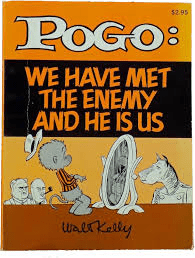
Own worst enemy: to be the source of one’s difficulties. Ancient philosophers already had this one out in circulation with the idea that “What is man’s chief enemy? Each is his own” (Anacharsis 550 B.C.). Although the cartoonist summed it up better with Pogo stating, “We have met the enemy, and they is us.”
Oh my and oh my goodness, I left quite a few “O” clichés on the editing floor. If I left out a favorite I encourage you to browse through Christine Ammer’s Have a Nice Day–No Problem: A Dictionary of Clichés.
Humans are prone to utter the most interesting interjections. Understatement, I know. Leaving aside those words that will get you making a deposit in the swear jar, let’s explore those odd guttural responses to surprise, getting hurt, and showing displeasure.
oof Surprisingly, “oof” is an invented word. It’s most connected with pain, dismay, or even sympathy. Apparently, there is connection to the game Roboblox and “oof” which is uttered when the Robos are hit or regenerated. Tommy Tallarico, the original creator, is surprised how “oof” has become such a popular utterance, that is has become a verb, as in “I oofed my driving test by running up on the curb when I tried parallel parking my Mom’s suburban.”
ew This one is traced back to the movie Clueless when a character expresses her disdain for immature teen boys, although it had been in use since the 1960s as “Ew, what’s that smell in your locker?”
aye yi yi Probably derived from the Spanish/Latin languages, “aye yi yi” is often found in song lyrics, although it is also used to express pain, dismay, or even shock. For example, “Aye yi yi, the cat got into the meatloaf I set out for dinner.”
oy Another interjection borrowed from a foreign language, “oy” is often teamed with “oy veh” and can express dismay, sadness, or grief. Once upon a time I lived way out in the country and the main road was a county maintained thoroughfare (please read in a dismissive tone) that was dented with potholes and washboarded to every vehicle’s detriment. Someone spraypainted an addition to the road sign “Vay” the word “Oy.” Yes, driving that road daily initiated that response of dismay.
ugh Similar to “ew,” the interjection “ugh” was also made popular by Clueless; however, its use can be traced clear back to the 1670s. Trot this one when expressing disgust. “Ugh, we have a pop quiz today.”
yuck or yuk or yucky If it’s gross it’s usually deemed as “yuck” or “yucky.” Going back to the sixties, the Poison Control center’s warning label used to be skull and crossbones, but there was the thought children would be attracted to the pirate aspect of that emblem and so the green unhappy face with the tongue sticking out became “Mr. Yuk,” providing a clear message to steer away from the substance.
oops Then there is the ubiquitous “oops,” that interjection associated with making a mistake, a blunder, or being clumsy. Britney Spear’s gave “oops” some spotlight with album Oops!… I Did It Again.
Naming a group of something is a job I wouldn’t mind applying for. Someone gets to do it and the results are pretty fun, especially when it involves animals.
William Shakespeare’s writing has provided some fairly memorable quotes, words, and expressions. While Billy Bard can take credit for most of what is tagged with his name, he doesn’t quite get all the credit.
Let’s play “How Well Do You Know Your Shakespeare?” You will be given two quotes. One or both quotes are presented. Decide which, or both, belong to Shakespeare.
1.A. “Bated Breath” B. “Breathlessly Waiting”
2. A. “A Blinking Idiot” B. “Foolish Ninny”
3. A. “Take Your Last Breath” B. “Breathe One’s Last”
4.A. “Give Them An Inch” B. “Budge An Inch”
5.A. “The Crack Of Dawn” B. “The Crack of Doom”
6. A. “Kindness Is A Cruelty” B. “Cruel To Be Kind”
7. A. “Fortune’s Fool” B. “A Fool And Their Fortune Is Soon Parted”
“Bated Breath” from The Merchant of Venice, 1.3.115-116, 123-129
“A Blinking Idiot” also from The Merchant of Venice, 2.9.54-62
“Breathe’s One Last” from Henry VI, 5.2.39-42
“Budge an Inch” from Taming of the Shrew, induction.1.7-15
“The Crack of Doom” Macbeth, 4.1.112-117
“Cruel to be Kind,” Hamlet, 3.4.173-179
“Fortune’s Fool,” Romeo and Juliet, 3.1.132-136
Bonus:
Who said “A fool and his money (fortune) will soon be parted?
Answer: Dr. John Bridges from Defence of the Government of the Church of England, 1587
And what was your score?
Next time–sayings Shakespeare really, really did not say…
Moving into the “k” section it is surprising how many clichés begin with “keep.” Here are ten of the top keepsakes of that section:
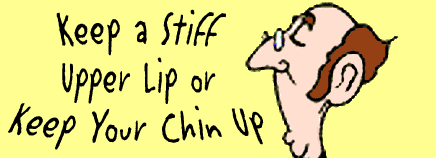
Keep a stiff upper lip: don’t show your true feelings. Oddly I tend to think of this being of British origin as it is uttered often enough in literature and films, especially in WWII period dramas. However, the book indicates it from early 1800s America, referring to not allowing the upper lip to tremble, an indication tears are about to fall. In actuality it is the bottom lip that usually does the trembling prior to crying.
Keep your chin up: don’t lose heart or courage. A well-established cliché since at least 1840, the original body part and due to its slang connotations was exchanged for chin to emphasize keeping one’s head up in adversity instead of other misconstrued meanings.
Keep a straight face: look appropriately serious for the occasion. Derived possibly from Henry Miller’s 1953 Plexus where a character states: “All felt called upon to do was keep a straight face and pretend everything was [all right].
Keep at arm’s length: to keep someone or something at a distance. A long time expression harking back to the sixteenth century when it began as keeping “at arm’s end” which then became “at arm’s length.”
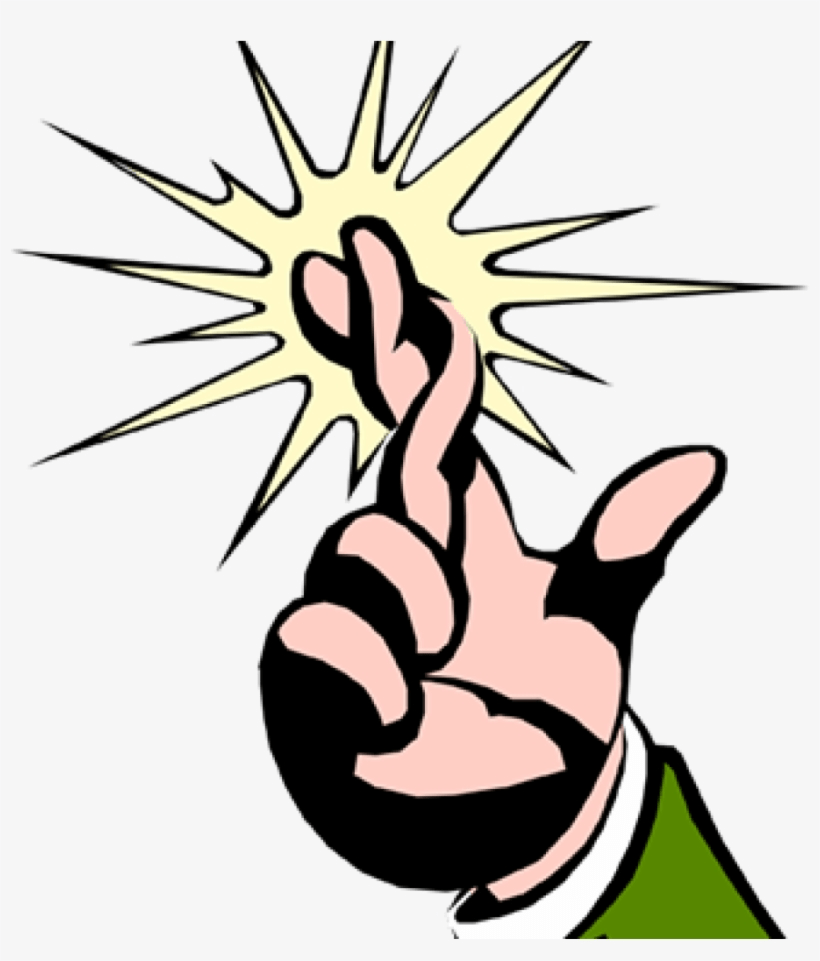
Keep your fingers crossed: hoping for the best outcome. An ancient belief of making the cross with avert harsh outcomes. It can also mean to keep from telling a lie, as in “xing” out the deed or what was said, a transfer from children’s games.
Keep under your hat: hiding a secret. In the old days, when hats were more predominantly worn, keeping items under one’s hat could be handy since it was hidden. A song from the 1920s sings out: “Keep it under your hat!” You must agree to do that. Promise not to breathe a word.”
Keeping up with the Joneses: living beyond one’s means. A cartoonist, Arthur R. Momand used the term in one of his cartoon titles as a reflection of living on a tight budget in an upscale New York suburb. While his cartoons may not be remembered the expression lives on.
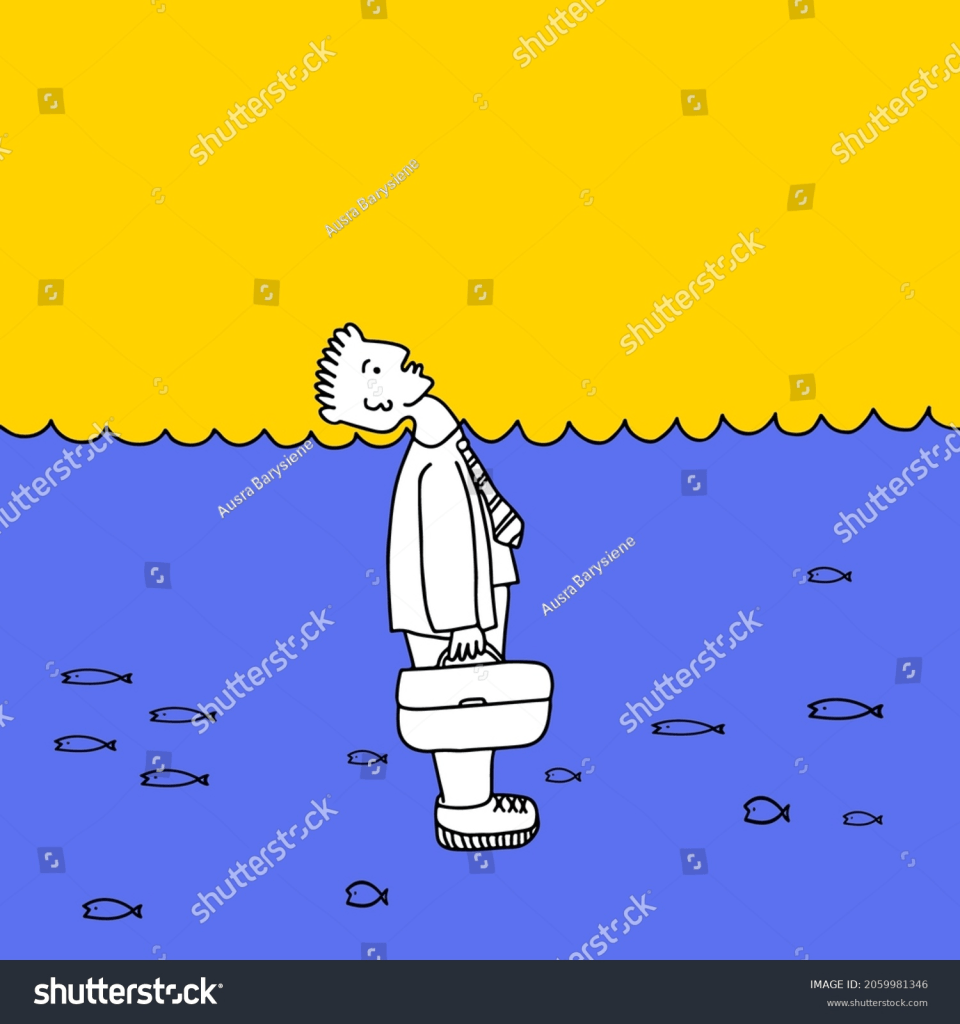
Keep one’s head above water: to avoid being overwhelmed. Going back to the eighteenth century writer John Arbuthnot wrote in the 1712 John Bull: “I have almost drowned myself to keep his head above water.”
Keep your eyes peeled: have your eyes wide open. A reference from as early as the 1840s when people were on the lookout for possible hazards, as in pioneers being watchful for trouble while scouting out in the woods.
Keep your shirt on: don’t get upset. A nineteenth century American expression relating to the men removing their shirts before getting into a fistfight. It has since come to mean to not lose one’s patience.
There are not too many notable cliché “J” phrases, so let’s look them over.
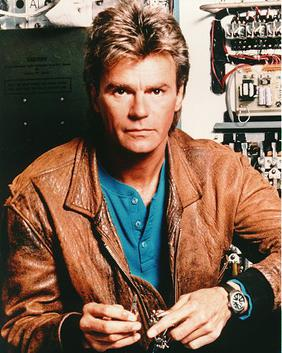
Jack of all trades: someone who is able to do everything. This phrase dates to around the 1600s, Shakespeare’s time, yet there was a prevailing thought that if someone is good at everything they will not be outstanding in anything. Ouch. That’s harsh. I have moved away from saying Jack of all trades and just go with my personal reference of calling someone a MacGyver if they can fix anything and everything. MacGyver, I’m talking about the 80’s version, not the reboot. Great show. Angus MacGyver could take chewing gum and a paper clip and save the world from bad guys. He rocked an awesome mullet, which alone made him memorable.
image: Wikipedia
Jet set: the socially fashionable group. This term was introduced in the 1950s when airplanes became jets and moved people around quickly from one hot spot to the next. Flying was still out of easy reach for most people and mainly the affluent could afford jet travels. Not sure if jet set still applies today since platforms like Hopper make it more affordable to bounce from one place to the next more easily.
Jockey for position: to get into an advantageous place or position. A horse race term that literally meant that the jockeys were vying for the best position on the track. It later transferred to other situations such as the 1955 London Times that included the sentence, “Lawyers jockeying for position to appear before the right judge.” These suit and tie folk are smiling now, but it may not be so pretty once the gate bell rings, “And they’re off!”
image: Idioms4you
John Hancock: a person’s signature. A personal favorite. John Hancock signed the Declaration of Independence in a large and bold manner so that King George could read it. Today, anyone’s signature on anything is considered a John Hancock. Kings not included.
image: Online Library of Liberty
Johnny-come-lately: a newcomer or someone arriving late. A nineteenth-century British seaman would be referred as Johnny Newcomer. This term became Johnny-come-lately in the United States.
image: Amazon
Johnny-on-the-spot: someone who is available at the right time. An early nineteenth American term that is not as popular as it once was when it appeared in the 1896 Artie by George Ade: “I could see that a Johnny-on-the-spot…was trying to keep cases on her.” Although it’s pretty clear that the phrase still has found its way to being useful.
image: johnny rentalsimage: johnnysvegas
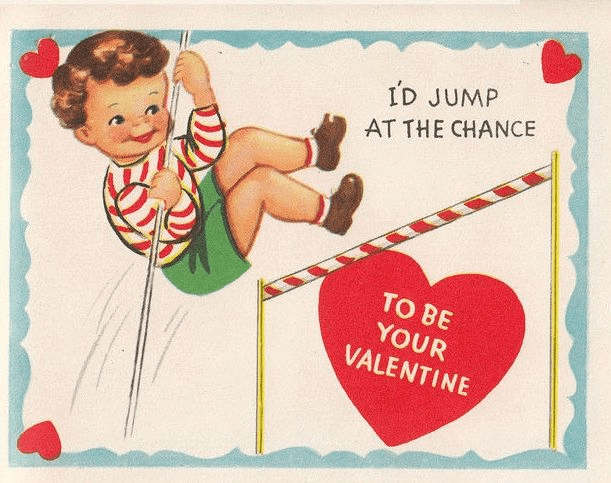
Jump at the chance: to grab an opportunity. Strangely enough this expression was likened to a rooster jumping at a berry. Apparently Sir Walter Scott liked the expression and would refer to someone jumping at the “ready penny.” It certainly shows a degree of eagerness.
image: Free Dictionary
Jump down someone’s throat: to rebuke someone sharply. A metaphor still in use from its start in the late nineteenth century.
Jump the gun: to start too soon. An easy one to figure out when thinking about how sport participants are not supposed to set off before the starter’s gun goes off. To do so, to jump out into the race before the starter indicates to go, could scratch the participant from the race, let alone get the other participants a tad upset at the false start. Originally the expression was “beat the pistol,” which changed to its present form by 1942. The expression is a metaphor that goes far beyond athletic competitions.
Just deserts: a deserved reward or a deserved punishment. I would consider getting dessert a reward, except notice the spelling—“desert” refers to “deserve” not in cheesecake or pudding after the main meal. A mid-eighteenth century proverb: “Desert and rewarde be oft tuned things far of,” which means what one deserves and the reward they receive is not always the expected. Just deser is indeed different than just dessert.
Any surprises! I always thought it was “dessert” and wondered why someone would fling out, “they got their just dessert.” They weren’t talking about a slice of pie. Now I know.
Moving on the “I” section of the cliché book. Going for a mix of familiar and not so familiar.
[No] ifs, ands, or buts: presenting excuses or reservations. This expression is derived from two expressions: ifs and ands; but me not buts. The first expression from the sixteenth century is found in the 1850 rhyme by Charles Kingsley: “If ifs and ans were pots and pans, there’d be no trade for tinkers.” Sir Walter Scott made us of “but me no buts” in his The Antiquary (1816). Today the expression is used as a negative imperative as in “Get this done, no ifs, ands, or buts.”
If the shoe fits, wear it: accept the situation if it applies. Another version is the early eighteenth century saying: “if the cap fits, put it on,” which referred to a if someone who wears a fool’s cap is usually a fool. “Cap” was replaced with “slipper” with a nod to the popularity of the Cinderella story. “Slipper” has slipped into “shoe” yet still carries the meaning of accepting the situation as it applies.
If worst comes to worst: should the most unfavorable happen. The expression should actually read: “if worse comes to worst”–comparative to superlative. It is what it is since the sixteenth century.
Ignorance is bliss: sometimes it is best to not be fully aware of the outcome. Sophocles expressed the idea and it has traveled through the the centuries, sometimes being noted as “blissful ignorance.”
In a nutshell: stated concisely. Pliny the Roman writer noted that Homer’s epic poem the Iliad had been copied in such tiny writing it could fit in a nutshell. Definitely a hyperbole, it caught the attention of writers such as Jonathan Swift. Down the line “the Iliad” was dropped to the present use of “in a nutshell.”
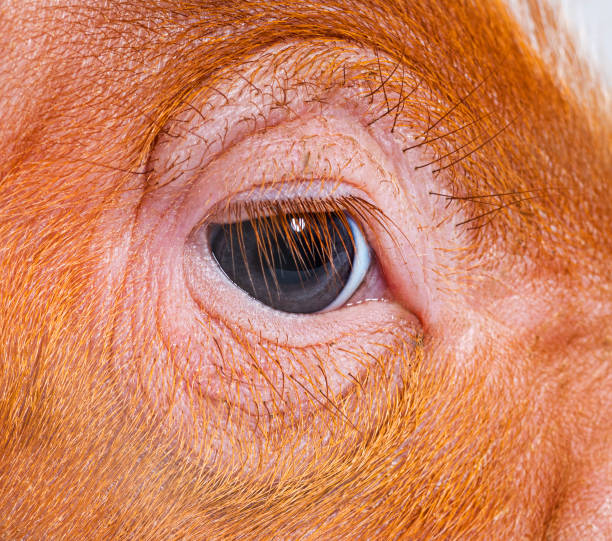
In a pig’s eye: not happening. Attributed as an American saying, it’s thought it developed from the expression “when pig’s fly.” Either expression means “never.”
In for a penny, in for a pound: to become fully involved. The saying means that if someone owes a little, they probably owe more. In the seventeenth century Thomas Ravenscroft wrote, “Well, that, O’er shooes, o’er boots, And In for a penny, in for a Pound.” Charles Dickens ran with the sayings and included it in three of his novels, which no doubt popularized the phrase.
In full swing: quite active. In the sixteenth century “swing” referred to a course of a career or a period of time. Someone being in “full swing,” meant they were actively involved in their career or the period of time.
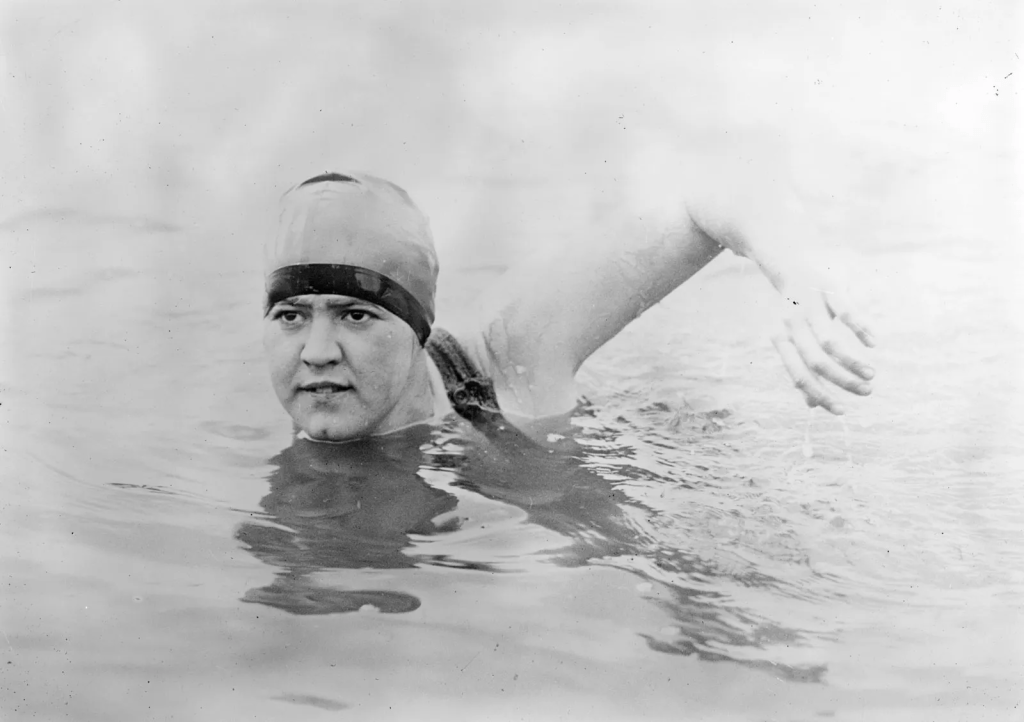
In over one’s head: to be unable to meet the demand of the situation. The saying is a reference to being in water too deep for one’s ability to swim. Other situations, beyond swimming in too deep of water, can be referenced such as paying bills or dealing with work responsibilities.
In the bag: guaranteed success. In the 1600s and beyond, hunters placed their game in bags after bringing them down. In other words, they had already had success in the hunt and the results were placed in the bags to prove it. From hunting success the saying came to mean an acknowledgement success has been achieved.
In the pink: in good health. Shakespeare gets some credit for this one. In his time “the pink” meant perfection and he used the expression in Romeo and Juliet when Romeo and Mercutio traded quips. “The very pink of courtesy” meant the perfection of politeness. Today the expression refers to being in perfect health.
In the swim: actively involved. This is a fishing phrase. When a large amount of fish were found in one place this would be called “a swim.” It later transferred to mean being in the current of what is happening. Arthur Conan Doyle wrote in his 1893 THe Stock-broker’s Clerk, “He knew I was in the swim down here.”
There are sooo many more “I” phrases and these just a dozen. What was missed? “I” would like to know.























 Pam Webb