Pam Webb

a writer's journey as a reader

Archive for the tag “ROMEO AND JULIET”

Bard Bits: Here Be Monsters


When Shakespeare’s works are mentioned the association with him runs towards love stories, as in Romeo and Juliet or tragedies like Hamlet or even sweeping historicals found in the Henry plays.

Not necessarily Shakespearean

Monsters may not be the forerunner feature in his stories but Shakespeare did populate his plots with creatures, witches, and ghosts—oh my, he certainly did. In fact, most of his well known plays contain monsters or scary aspects.

Romeo and Juliet: Juliet about to take the friar’s prescription for a faked death believes she sees her dead cousin’s apparition. Then there is the part of waking up in the family crypt surrounded by her cousin’s recent corpse and long dead relatives. *cue creepy music*

Hamlet: Our titular hero receives a guilt trip from his dead father’s ghost—not once but twice.

Julius Caesar: Brutus must contend with great Caesar’s ghost.

Macbeth: Not only is there the ghost of Banquo there is a trio of weird sisters.

Cymbeline: another batch of ghosts.

The Tempest: A sassy sprite named Ariel and whatever Caliban is supposed to be.

A Midsummer Night’s Dream: speaking of sprites, Puck reeks of mischief galore.

Shakespeare inserted monsters into his plots because he pandered to the paying crowd and those folk of the Renaissance were a thrill seeking, superstitious bunch, queens and kings especially.

While Shakespeare created several memorable monsters his penchant for monstrous acts should be noted.

Offhand there is fratricide, homicide, verbal abuse, racism, sexual abuse, dysfunctional family relationships, and a mention about being wary when it comes to pie at dinner.

So—

Forget loading up on Frankenstein and Freddy for fright night watching. Instead save your anticipation for scare by streaming some Shakespeare.


Bard Bits: Quotable Quotes, Words, and Phrases (and some not)


Shakespeare was a dramatist of note:
He lived by writing things to quote.
H. C. Brunner

“The course of true love never did run smooth.”
A Midsummer Night’s Dream

Friends, Romans, countrymen, lend me your ears.
Julius Caesar

Life’s but a walking shadow…
Macbeth

All the world’s a stage,
And all the men and women merely players.

As You Like It

What’s in a name? That which we call a rose
By any other word would smell as sweet.

Romeo and Juliet

We are such stuff
As dreams are made on, and our little life
Is rounded with a sleep.

The Tempest

“To be, or not to be, that is the question.”
Hamlet

The above are just a smatch of quotes that are Shakespeare derived. Below is a mere sampling of the 1,700 words Shakespeare is credited for either inventing, introducing, or making common. Some words attributed to Shakespeare are contested by word source experts like Merriam Webster and Mental Floss, but we’ll let them work it out, so note the *.

accommodation
aerial
amazement
apostrophe
*assassination
auspicious
baseless
bloody
bump
castigate
changeful
clangor
control (noun)
countless
courtship
critic
critical
dexterously
*dishearten
dislocate
dwindle
eventful
exposure
fitful
frugal
generous
gloomy
gnarled
hurry
impartial
inauspicious
indistinguishable
invulnerable
lapse
laughable
lonely
majestic
*manager
misplaced
monumental
multitudinous
obscene
palmy
perusal
pious
premeditated
radiance
reliance
road
sanctimonious
seamy
sportive
submerge
suspicious

Moving on now to some familiar phrases:

Green-Eyed Monster

In a Pickle

Love Is Blind

Salad Days

Wear My Heart on My Sleeve

There’s the Rub

Cruel to Be Kind

Wild Goose Chase

Dogs of War

Strange Bedfellows

According to the Folger Shakespeare website (and these folk know their Bard Bits and Facts), the following are not Shakespeare quotes:

1. “Expectation is the root of all heartache.”

2. “When I saw you, I fell in love, and you smiled because you knew.”

3. “All glory comes from daring to begin.” from Eugene Ware

4. “But for those who love, time is eternal.”

5. “Love me or hate me, both are in my favor…If you love me, I’ll always be in your heart…If you hate me, I’ll always be in your mind.” I really thought this was from Shakespeare—apparently Some EE Cards thought so too.

Any “aha” (not a Shakespeare word as far as I know) moments from the list?

Bard Bits: Oh, For Reading Out Loud


Today’s audiences talk about seeing a movie. And we are very much a visually oriented culture. Yet, in Shakespeare’s day audiences would say they were going to hear a play because language was such an integral aspect of their culture.

Shakespeare knew this, of course, which is why he wrote his plays with rhyme, rhythm, homonyms, laced with ambiguity. He wanted his audience to hear the auditory beauty of language.

Pen in hand the Bard does ponder

Modern audiences are more accustomed (or have grown more accustomed to) sound bites—quick bits of communication. No wonder eye rolls and twitches are commonalities when someone mentions Shakespeare—we are no longer used to the longer, more developed portents of language. We want quick and easy auditory digestion instead of the languid delight of a language banquet. ‘Tis a shame, yet supping upon a Shakespeare play is possible with a bit of effort.

Shakespearean plays are written to be heard and the Stratford-Upon-Avon wordsmith created the means to better enjoy his words by employing the following:

1. Read the lines with deliberation and emphasis. For example, Macbeth’s “Tomorrow and tomorrow and tomorrow” does better with a slow pronounced repetition to emulate the tedious monotony of life.

2. Use punctuation as a guide by reading to the end stop rather to the end of the line it gives more meaning to the lines. This is known as enjambment, where the line overflows into the next line, much like a waterfall cascades flow smoothly creating movement. For example, in Romeo and Juliet, Juliet pours out her emotions for Romeo in one rolling, passionate wave:

When he shall die,
Take him and cut him out in little stars,
And he will make the face of heaven so fine
That all the world will be in love with night
And pay no worship to the garish sun.

Reading this passage out loud, carrying one line over into the next enhances Juliet’s feelings for her Romeo.

3. Be aware of accented words, pronouncing them with an extra syllable. For example “perfume’d would be three syllables, not two. Shakespeare would have done this to enhance the meter or rhythm of the line. Plus, it has the bonus of sounding fancier.

4. Know that Shakespeare presented his words with intention to paint pictures (no access to CGI) with verbal cues to ignite his audience’s imagination. He needed his words to create imagery since scenery and props were minimal on the Elizabethan stage. For example, when Juliet says, “It was the nightingale, and not the lark,/ That pierced the fearful hollow of thine ear,” she is in her wedding bed with Romeo—she is no doubt as close to him as her heartbeat.

Reading Shakespeare can be an enriching, delightful experience when his words are read out loud with considerate digestion.

Bard Bits: Oh, the Places He Didn’t Go


Suitcase Shakespeare

Although Shakespeare’s home stage was the Globe Theater, and his plays are set in places as far flung as Denmark, Cyprus, Verona, Egypt, and Rome, there is not much in evidence that he actually traveled to any of those places. Rick Steves’ guidebooks and travel episodes were not available, so Wm. S. did the next best when it came to creating his settings: research sprinkled with imagination.

Travel Guru Rick Steves Reveals His 10 Best Vacation Tips
Steve probably finds some of Shakespeare’s setting descriptions amusing

Then again, why not set plays in jolly old London? No doubt the fear of offending present citizens played into the scriptwriting. Or not having as much wiggle room with creative license. Plus, it’s much easier to imply unknown cultural aspects such as young marriages and sparring families as found in Romeo and Juliet or having a widower mandating the oldest daughter is married off first as stated in Taming of the Shrew. Wild flora and fauna can be invented, which is seen in The Tempest. Conquering queens and funny forest business is better placed in Athens than in England in terms of sparking the imagination (also known as “getting away with suspension of disbelief).

While there is not much Danish about Shakespeare’s Denmark in Hamlet, there is the hint of the romance of Venice in Othello, and there is definitely Roman reign in Julius Caesar. Shakespeare did stick around Britain for his histories, all those Henry plays and what have you. Perhaps it was more than inventing or embellishing cultural aspects in his plays, that encouraged Wm. S. to spin elaborate settings. Methinks the draw of experiencing a two hour traffic set in a land far from London’s teeming streets appealed to the audience.

Shakespeare was no doubt an amazing wordsmith, but he also knew how to plump up box office interest. The show must go on, and it has, hasn’t it?

Tour the Places William Shakespeare Stayed Over 400 Years Ago |  Architectural Digest
All the world’s a stage, especially the Globe Theatre

Bard Bits: May


I managed to go to school without any experience with Shakespeare (yeah, how did that happen?) I can easily relate to my student’s bewilderment when we begin our drama unit. Freshmen study Romeo and Juliet, sophomores experience Julius Caesar, juniors skip Shakespeare to study American Literature (The Crucible), and depending on the teacher, students have a range of selection from an overview of the comedies to a dive into tragedy with Merchant of Venice, Hamlet, or Macbeth.

I am usually prepared for groans from my sophomores when I announce we are studying Shakespeare. “Not again!” “We did him last year.” “Shakespeare is so boring.” Instead of coming up with excuses and defending our Wily Bard of Stratford, I agree with them. This gets me some interesting looks–most def.

I do agree with my students. Shakespeare can be boring, or at least his plays were until I got the hang of them. Watching, let alone reading the plays, was painful to endure, and I felt I could never get anywhere, no matter how hard I tried. Then again, learning how to ski was painful, and I wondered if I would ever get down the mountain without a initiating a yard sale. Hmm, I should use this analogy with my students since they have grown up with a mountain in their backyard.

Here are two thoughts on Shakespeare:

“I am more easily bored with Shakespeare, and have suffered more ghastly evenings with him, than with any dramatist I know.” Peter Brook, English theatre director

“We find Shakespeare boring because we’re lazy. We’re not willing to get through the language. That’s the only barrier. If a play is performed right by those who are properly trained, after about twenty minutes you won’t be aware of the language because the human story is so strong.” –David Suchet, actor

What are your experiences with Shakespeare? Bored, frustrated, from having to endure year after year of his plays in school? Perhaps initially bored, but then the story unfolds and the words are no longer a barrier and serve as a contribution to the experience? Or maybe you grew to appreciate him with time and experience?

One of my standout memories of teaching my favorite play, Hamlet–sorry, I do mention that often, don’t I?–is after we wrapped up the unit, one student, from my regular, not AP class, stayed behind. “You know I’m going to miss discussing Hamlet, I really got to like this play.” He grew thoughtful. “I can’t discuss Shakespeare with my father.”

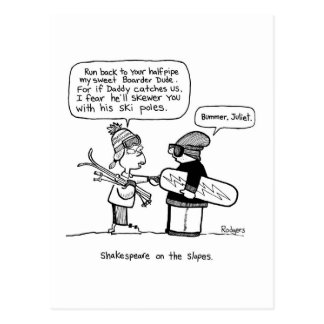
I never discussed Shakespeare with my father either. But I sure discuss him with my own children when I get the chance. Shakespeare boring? Not for long. Hang in there, dig in your poles, don’t cross your ski tips, and you will enjoy the thrill of going from snowplow to slalom. That applies to skiing as well.

Romeo, Romeo. Wherefore art my balcony?


As a professed Bardinator, I must admit my dismay upon learning some shocking information concerning Shakespeare’s most famous scene from Romeo and Juliet–perchance there was no actual balcony in the balcony scene. I will give you a moment to recover. Basically, this:

Balcony_Scene

image: education portal presents the traditional view


is what we have grown accustomed to over our years of study and admiration of this endearing romantic tale of woe, that of Juliet and her Romeo. However, according to The Atlantic, this is more in align to actuality:

image: rapgenius.com presents as Shakespeare liked it

that Juliet, like most Italian girls of her time period, lived protected behind the walls of her father’s villa. Traipsing about on balconies wouldn’t have happened. For one thing, Shakespeare didn’t know what a balcony happened to be, because no balconies existed in England when he wrote R&J.  From the article:

According to the Oxford English Dictionary, the earliest known use in English of the word “balcone” (as it was then spelled) didn’t occur until 1618, two years after Shakespeare died. Even the concept of a balcony was (literally) foreign to Shakespeare’s British contemporaries.

Why then, do we associate a balcony with our two tragic lovers? Blame it on Thomas Otway, who heavily borrowed  from Shakespeare’s play for his own 1679 play, The History and Fall of Caius Marius. Otway places his lovers on a balcony, a known bit or architecture adornment by then, and somehow over the years when Shakespeare’s Romeo and Juliet returned to public favor–yes *gasp* it wasn’t always popular, the audience simply filled in the gap and placed Juliet on her own balcony.

You don’t believe me? Here, check out why Sparknotes did with the scene. They have  perpetuated the mistaken notation of balcony traipsing versus window leaning. As for me, I go with the balcony. Window leaning just doesn’t cut it for romance. What do you think?


Romeo and Juliet Stories


Mass-produced colour photolithography on paper...

Mass-produced colour photolithography on paper for Toy Theatre; Romeo and Juliet (background and surroundings removed) (Photo credit: Wikipedia)

Soon I will be introducing my students to Shakespeare through Romeo and Juliet.  It’s a timeless story repeated throughout literature and film.  Two lovers not meant to be together yet drawn to love one another regardless of their circumstances.  I didn’t realize how strong that story line ran until I watched Lorna Doone the other night.  And there it was right before me–John Ridd and his pure love for Lorna Doone.  Such a gorgeous love story.  I then began to think about all about the other Romeo and Juliet stories I’ve come across without realizing it.  Some end happily and others do not.  It’s the telling of the two hearts intertwined that makes the story so memorable. I do believe the world has been made a bit lovelier for the joy that comes from the sorrow that happens when two hearts are kept apart because it is so wonderful when those hearts do find their way to be together after all.

A handful of Romeo and Juliet themes:

Lorna Doone


The Summer of My German Soldier


Tristan and Isolde


Pyramus and Thisbe


West Side Story

I am looking forward to the upcoming release of Romeo and Juliet starring the lovely Hailee Steinfeld, nominated for her role in True Grit. There are many  Romeo and Juliet versions, yet I am hopeful this new version will be a standout. The depth Ms. Steinfeld brought to the role as Mattie Ross, she will, I hope, bring as Juliet, for a Romeo does need his inspiration.

Romeo, Oh Romeo…


Today will the last day of the Romeo and Juliet unit for my freshmen.  We will end it appropriately with an Insult-o-Rama, which is basically a member from each designated family, Montague vs Capulet, stepping up to the line in our market square and squaring off with insults ala Bard.  You know the ones:

“Thou art an apish, lily-livered bed presser.” If that one doesn’t sting enough:

“Thou be an insolent foot-licking parasite.”  These go beyond thumb-biting, and it is all in good fun.  I keep my door shut just in case, as it does get a bit loud.

My focus when studying Romeo and Juliet is not so much as an introduction and exploration of Shakespeare’s famous play, it is more of an exploration and introduction to Shakespeare himself.  Surprisingly, my freshmen come to class with about a teaspoonful of knowledge about him.  Then again, I didn’t have any exposure to Shakespeare until I began teaching him.  I had heard of him, of course, but I didn’t really believe he had much physical substance.  I placed him a little bit above the Loch Ness monster in that there might be evidence of his existence, but not totally proven. After about ten years into teaching Shakespeare I believe a bit more and in fact have become a proponent of making sure my students appreciate his genius.  Please, no theories on Bacon and company and “Will the real Will please stand up, please” comments.  I think his plays, sonnets, and poems rock.

And so our curriculum starts with Romeo and his Juliet.  I guess two teenagers who are heck-bent on breaking rules by disobeying parents, state law and such still resonates with the teens today.  It makes sense, since if we started off with Macbeth they might go into spasms of cerebral overload.  We start them off gently.  Good call, curriculum powers that be.

Overall, we read a little, act it out a little, and watch different versions.  By the end of the unit most of them can understand Shakespearean language without consulting their No Fear Shakespeare interpretations.  Some students go into unattractive fits of eye-rolling and twitching at the  thought that they will study Shakespeare in their sophomore and senior year.  I don’t know why we skip him their junior year. American Lit studies have no room for him I guess.

There are many faces of Romeo, and both the girls and guys relate to his brash impetuosity.  Who wouldn’t want to be that in love?  Oh, Romeo, thou art timeless.

I leave off with some of the many faces of Romeo with his Juliet:

image: wikepedia.org

image: wikipedia

image: wikipedia.org

Romeo Juliet

Romeo Juliet (Photo credit: Wikipedia)

Still of Natalie Wood and Richard Beymer in West Side Story

image: imdb.org

Post Navigation