Today’s batch of cliches focus on the “s” range. It’s “yes” to cliches with “s”.
Scarce as hen’s teeth: When something is very rare. Don’t use this one much. It makes me wonder how it came into use. Some farmer having fun counting his chickens before they hatch?
Scared of his own shadow: Someone who is often afraid.
Scraping the bottom of the barrel: Taking whatever is left behind.
Reddit image
Second banana: Second in command. I prefer being second banana. Less pay, true, but less responsibility than the top banana.
Shape up or ship out: Do what is right or correct.
Shoot the breeze: Casually talk about things.
Signed, sealed, delivered: The task is complete.
Skeleton in the closet: scandalous events in someone’s past.
Slow and steady wins the race: Going too fast could cause you to fail.
Squeaky wheel gets the grease: speaking up can get something accomplished. This one is a personal favorite as I tend to get things done that haven’t been done. Some call that being proactive. Others consider it being squeaky.
As we close up the “S” section of Why We Say certain phrases there will be found some interesting sayings to explore.
Spitting Image: When someone says, “He’s the spittin’ image of…” there is an understanding the reference is the two people are very similar in appearance. In fact, there is such a remblance that their “spit” is alike. This might stem from how sons wanting to resemble their fathers would act like them, right down to “spittin'” like Dad.
Spruce Up: To “spruce up” indicates someone is changing their clothes, their appearance for the better. “Spruce” means “like the Prussians,” which comes from the French word for Prussia, Prusse.” To “spruce up” then, is to dress like a Prussian.
Hmm, shall we spruce up a little before heading out on the town?
Stamping Ground: Sometimes known as “stomping ground,” the term refers to a known, familiar area, where people congregate. In actuality, animals, such as deer, that gather in familiar areas, do so often enough to leave the imprints of their stamping hooves, creating a stamping or stomping ground.
Just hanging out, deer…
Steal One’s Thunder: Nope, this is not about Thor or his hammer. This is about Dennis the playwright, who in 1700 invented a machine that duplicated the sound of thunder. This was no doubt handy for plays needing some celestial angst. Unfortunately, the machine proved so successful that others coveted it, essentially “stealing his thunder.” Today, taking one’s due away is like taking away their ability to make some noise about themselves. Just ask Thor about when Loki took his thunder away.
Dude, don’t mess with my hammer.
Stickler: Familiar with Rabbit from Winnie-the-Pooh and how he is a bit of a fussbudget about getting it all exactly right? He would be considered a stickler. In Middle English stightlen means “to set in order.” Sticklers had the role of making sure all was set to rights at duels, that the rules were followed. Today, someone who is determined to make sure all is as it should be is a “stickler” for rules.
Stogie: Cigars, like them or despise them have come a long way from their first form. Stogies are from the Conestoga wagon, built in the Conestoga valley in Lancaster County, Pennsylvania. The wagon drivers would roll up tobacco leaves and roll them up to smoke when on long trips. Conestoga is a bit of a mouthful, so it became shortened to “stogie.”
Stumped: Can’t figure it out? Don’t have an answer? You might be stumped. If you are stumped, you are outwitted. If you are playing cricket you would be the pitcher having succeeded in hitting the wicket or “stump,” thus outwitting the batter.
That “hippopotamus” is derived from the Greek potamos (river) and hippo (horse)? Which means the hippo is actually considered a river horse. I do not advise saddling one.
pinterest.com
Those who “hit it off” are “striking the scent”, as in the hunting terminology of old. This means people who get along must have common scents.
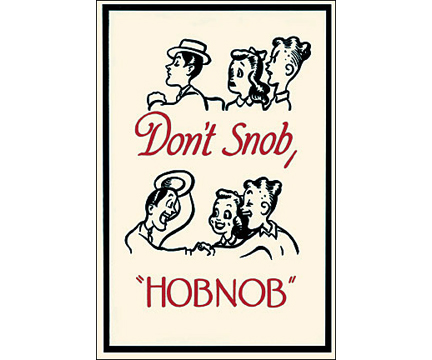
When people “hobnob” together they are participating in “have and not have” which is another way of saying “give and take”–aptly applied to conversing.
That you are mispronouncing “hodge podge” since it is derived from “hotchpotch” which is a stew comprised of this and that.
When referring to a crook as a “hoodlum” you are referring to a San Francisco gang-leader by the name of Muldoon? Because the reporter reversed the spelling to “Noodlum” and the typesetter could not read his writing, he set it up as “Hoodlum.” Good handwriting is important when spelling out bad crooks.
That “hopscotch” is actually “hop scratch” since “scotch” is another word for “scratch”? The child’s game is based on hopping over the scratches made in the dirt. I am hoping you aren’t scratching your head over this one
retroland.com
Next time we continue with the exploration of “h” phrases ranging from “horse sense” to “hussy.” Stay tuned…
“George, do you think we can afford to go out to dinner and maybe take in a show? Will that be too expensive?”
“Why, Martha. The expense of going out on the town with my best girl is chicken feed. Grab your hat, darling, and let’s skeddadle downtown.”
George and Martha probably enjoyed their night out because more than likely George, being a generous fellow, had made his fortune and a spending money mattered no longer to him. In fact, a few dollars was a mere pittance, like tossing crumbs to the birds.
And that’s exactly where the expression “chicken feed” comes from–tossing small bits out at a time. Chickens don’t have the capacity to chew up their food (ever see a chicken smile?) and must peck at small amounts. Apply that idea to money and chicken feed means a small amount of spending, not enough to worry or get choked up over.
image: thedo.gs not your average chicken
“Martha, are you going to be able to get that spot of gravy out of my tie? I have to look sharp for tomorrow’s presentation.”
“No worries, George. I’ll get it clean as a whistle.”
I doubt Martha was whistling was she worked on George’s tie. Honestly, George, don’t you know gravy is just looking for the opp to drip on ties?
As for the expression “clean as whistle”, this one is pretty much as it sounds (sorry, the pun overcame the keyboard). About the time of Huck Finn and company, boys would find reeds and poke holes in them to make their whistles. The cleaner the reed, the cleaner or clearer the sound.








 Pam Webb