Pam Webb

a writer's journey as a reader

Archive for the category “Teachers”

Summer Wonders


Returning school goes beyond getting back into a routine because it means I also have to make adjustments to my practicing for retirement. No more rolling over and going back to sleep, no more schlepping around in jammies, no more naps, no more odd eating hours, or meals for that matter. And worst of all, no more diving into books for an entire day and barely coming up for air. Responsible English teachers don’t partake in any of the above behaviors. At least not during the school year. Yet, summer vacation does allow me to practice the art of retirement and one of those skills is thoroughly enjoying a really good read. I was fortunate this year and enjoyed more than my usual share of good reads:

All the Light We Cannot See by Anthony Doerr

Breathtaking in its flow and style, I absolutely devoured Doerr’s novel about two lost children. Set in WWII, Doerr portrays the war in a way I’ve not encountered before. One perspective is through the blind eyes of Marie, a young French girl whose indomitable spirit carries her beyond the war’s cruelties. The other perspective is that of Werner, a German youth whose talents land him in the Hitler Youth. The parallel stories eventually telescope down to a satisfying denouement. Doerr, already an award-winning author, will do doubt increase his presence with this amazing tale of how the spirit can overcome its surroundings.

Mr. Penumbra’s 24 Hour Book Store by Robin Sloan

Sometimes I simply have to take a break from the pedantic pace of classics, or step away from serious literary excursions. Mr. Penumbra helped me to once again find the wit in wordsmithing. This foray into classic literature name dropping reminds me of Jasper Fford’s Thursday Next series, which is a delight in how it metafictionally pokes fun at how serious we tend to take our literature. Robin Sloan not only lovingly jabs at academia, he embraces our wanderings over to the dark side of technology via Google (those villains). Yet, bad guys (technology) aren’t so bad, once you understand them, and often they prove helpful overall because they are just misunderstood.

Remains of the Day by Kazuo Ishiguro

My first introduction to Ishiguro and of the three novels I read of his over the summer, this one is certainly the best in my opinion. The voice of nationalistic pride and misguided directive is so artfully penned in this memoir of a proper English butler. The bonus being how well the film adaptation captured the slow realization of how corrupted Steven’s outlook was after all.

The Mockingbird Next Door by Marja Mills

As a TKAM devotee I jumped on ordering Mills’s account of her time with Harper Lee faster than freckles popping out during a July heat wave. Lee has become such a recluse over the years it has been feared this national treasure will leave little behind in way of knowing who she really was. Fortunately Marja Mills went beyond her journalistic assignment and got to know Harper Lee as friend and neighbor allowing fans and readers a delightful glimpse into what Scout might have been like in the real.

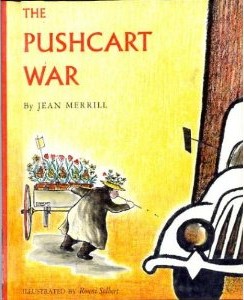
The Push Cart War by Jean Merrill

This cannot possibly be a kids’ book! The wit is droll in delivery and its lampooning so adroit I don’t see how children could appreciate it fully. Maybe I’m only bereft in my opinion since I missed this one growing up. I think I got sidelined by Encyclopedia Brown. Just like The Phantom Tollbooth or Alice in Wonderland is not strictly for children, neither is Merrill’s classic. I’m ever so glad I found it and I made up for lost time.
The_Pushcart_War_-_cover_image_1964

image: Wikipedia

One Whole and Perfect Day by Judith Clarke. A Printz Honor Award
YA reads are hit and miss for me. There tend to be riveting and noteworthy like Hunger Games and Divergent or fall into high school drama–been there done that and see it everyday. Now and then I do get to pick up a YA which should be in what I call the YA+ category, meaning it’s more towards literary then temporal contemporary (I think it has lasting merit, not trendy, and an adult shouldn’t be embarrassed reading it). Clarke’s novel concerning a girl’s desire to have one day where her family is not dysfunctional fills that YA+ bill. Set in Australia, Lily does indeed have an odd family and what is even more odd is Clarke’s approach to the Point of View–it’s omnipotent, which has fallen out of favor. With almost Dickensian flair for characters and situations, Clarke provides a plot that slowly builds to the becoming a whole and perfect story–pretty nearly.

What’s really the wonder of these summer reads is that they were all recommends found on blogs I perused. Following other Book Boosters definitely has its benefits and I no longer have to forlornly drift the stacks hoping to uncover the newest hot read or find a lost treasure.

How about you?  Any really good reads found and savored over the summer?  Any great recommends discovered while catching up on your blogs?

Labor Intensive Days


Well, those laid-back, lazy days of summer break get stowed away with my white shoes after September 2. (Yes, I know I’m showing my age by my stodgy self-imposed fashionista rule).

White shoes for summer

September whites still a no-no? image: theclothingmenu.com


What I don’t like about the first day of school:

  • Trying to get through the name rosters without totally slicing and dicing the pronunciation.
  • Going over classroom expectations because even though I need to, I doubt anyone is seriously listening to yet another teacher reeling off the rule spiel.
  • Fretting over what I’m wearing. Hair and wardrobe malfunctions do not create good first impressions.
  • Trying to reason with my stomach that grazing days are done for now, and to please hush it’s malcontent state. Especially since our hallway is slated for second lunch this year.
  • How tired I am at the end of the day. Remember the Barbie clip in Toy Story? Yep, that “it’s exhausting being that up and happy feeling” really does slam a person.
  •  My feet hurt. Stylish shoes still rule over sense. I doubt I will rock Reeboks to school.
  • Timing bathroom breaks. And no, my classroom is not even close to the staff rest rooms. I have line up with everyone else. On the other hand, I do get to hear some unexpected choice bits while stalled for time.
  • Dreading that stage fright feeling of “am I gonna bomb or be the bomb?” Really, it’s like running a three show routine with three different audiences. Are they going to get my jokes? Do they respond in the right places? I commiserate with ever Saturday Night Live host about this time of year.

But the cool thing about September is that I do get to go back to school.

  •  There’s that excited buzz of the new as everyone returns to the hive of learning.
  •  What about the opportunity of “clean slate”–never mind last year, this year is gonna be even better.
  •  New clothes! I took advantage of Coldwater Creek closeouts this year.
  • Renewing and forming friendships among staff. “Old and new faces sharing spaces.”
  • Trying out new ideas on old curriculum. “I can’t wait to release this new perspective of Beowulf.”
  •  Schedule–I like a well-ordered life and getting back into a routine makes me humm like a happy llama.

What are your back-to-school thoughts? What side of the desk are you on?

Read Me a Story


One of my favorite classes in college involved learning how to read picture books out loud to children. Yes, and we did get credit for doing so. This class gave me real life skills. For true.

I learned there is a proper way to hold the book when facing the audience.

  • First of all, sitting down facing your audience, you hold the book’s bottom spine stretched out on your forearm.

*By the way if you are looking for a dazzling, scintillating meme-worthy Prezi, it ain’t happening*

  • You then read sidewise, yet facing your audience because eye contact is quite important. This is easier than it sounds because picture books usually have more illustration than words.
  • It is then important to properly turn the page. This is done by reaching over and across the top of the book, sliding the first two fingers done the present page and the next, and pulling the page over for the next spread. NOTE: though commonly practiced, it is not in the best interest in the book’s wear to turn from the middle bottom, especially towards the inside spine. Rippage and tearage can occur in doing so.
  • Proceed throughout the entire book in the proscribed method.
  • It is also important to use appropriate voices for characters, and it can be highly desirable to create separate voices for each given character. NOTE: characterization voices are best done by those who can do so without creating havoc among the audience. For example: if your Cockney mouse is such a smash hit your audience might laugh to the point of interfering with the story’s progress.
  • Body language is  also important. Leaning in to emphasize special junctures, or pausing for same can add a delightful amount of drama and dimension to the story.

I believe the course to be quite edifying and suggest signing up should the adult education flyer come through the mail. Today I utilize those skills reading to the grandkiddo, although I use my snuggle reading skills instead. I have read stories to my high school students. Yes, that is one reason I am known as the weird English teacher.

Then again, there are those who possess natural skill at reading and technique does not actually matter. Case in point is our boy Sherlock.

Have you a favorite technique for reading stories?  Or better yet–any famous readers you’ve come across? One of my most favorites is Meryl Streep’s audio book reading of Jeremy Fisher by Beatrix Potter.


Remaining the Orphaned Narrator


It is always exciting to discover a new-to-me author. In this case it’s Kazuo Ishiguro. I know, I know. I’m a bit late in my discovering; however, better late than never in finding an author of mesmerizing style.


I knew the movie Remains of the Day, before finding the novel and didn’t realize the movie was the adaptation.
How could I possibly pass up a film starring Anthony Hopkins and Emma Thompson?
Flash forward five years later and I’m perusing the AP Literature list (“read that one, will never read this one, not reading this one again”), when I recognized the title Remains of the Day and connected it to the movie. Then I read the author’s name and I must admit I expected something like Adrian Smythe or Winston Greene, not Kazuo Ishiguro. After all, the novel is about a very proper English butler and his reflections of what it takes to become the best of English butlers. Wouldn’t one need to be English to understand that sort of nationalistic pride? I’m not getting points here for narrow-minded thinking, am I?

It turns out Ishiguro is quite well-suited to the task of writing about the English since he moved to England when he was around six years old. This gives him the ability to have an insider’s view with a somewhat detached perspective. The result is  basically a stream-of-consciousness narrative concerning the tunnel vision of a man’s quest for the unattainable. Trying to live a life that is beyond reproach, to achieve a status of perfection, requires sacrifice. Can sacrifice be made without regret? This is the hidden truth Stevens, the butler is searching for, except he does not realize it.
A quest novel of notice did not go unnoticed, for Ishiguro’s debut garnered him the Man Booker Prize and set a bar. Would he be a one shot wonder or would this be the first work of a noteworthy word smith?

image: goodreads.com This cover indicates the layers found within the story.

My literary taste buds curious for more, I trotted down to the library. Grabbing any title of his that caught my eye on the  shelf, I opened up his fifth novel When We Were Orphans. I immersed myself in reading it to the point the MEPA queried, “Still a good book?” Yes, thank you. Prognosis? After reading two novels, indications are Ishiguro is wordsmithing wonder.

Here are some bio facts and  stats:

  • Two novels have been adapted to the screen, Remains of the Day, and the more recent Never Let Me Go. Both have been received well, considering Ishiguro’s stories are mainly first person narratives, making them difficult to translate into a cinematic plot.
  • His novels are historical in nature, with attention to detail.
  • The stylistic viewpoint is that of the unreliable first-person narrator, one who is flawed in outlook.
  • Although born in Japan, he did not return until thirty years later.
  • He has received four Man Booker Prize nominations
  • The Times ranked him 32 on the list of the 50 most influential British writers since 1945.

As for an actual review of When We Were Orphans, I leave it to the more qualified:
New York Times
 review:

I plan on continuing my course of exploring Ishiguro’s work and look forward to introducing a contemporary author to my APters, who, I’m sure, would like a break from dead white folk now and then.

Any thoughts on Ishiguro’s writing? Any suggestions for the next title I should read of his?

Blog Spotlight : Eagle-Eyed Editor


Here begins a series of spotlights about blogs I follow. Maybe you’ll become a follower too!

When I first began blogging about two years ago I noticed a trio of bloggers who often stopped by my posts and left chatty comment bits. Quite encouraging and fun, actually. Think about it–we tip tap out our words, launch them out, and hope to spark some kind of response. Often off-the-cuff comments lead into revelations and further discussions.

Eagle- Eyed Editor has always encouraged me to dig a bit deeper by providing both thought provoking, as well as, humorous posts. Recipient of Freshly Pressed. Twice.  Many of 3E’s posts concern the impact of social media. Try out this post.

I mentioned I would show the “Look Up” video to my students and pass on the response:

I decided not to show my freshmen the video since I didn’t think they would get or receive the message as well as my seniors; plus,  I was rather annoyed with my freshmen by the end of the year with their constant need to peek at their phones during class. Confiscating phones became a sideline to teaching at a point.  I should have asked for commission. Maybe that was their response: they have such an addiction to texting, snap chatting, and twittering that they can’t stop themselves even when the consequences are dear. In fact, some freshmen students are so addicted to their iDevices they can’t bear to be parted. This came to light when we were practicing our monthly required fire drill in May. We file out, I lock the door, we stand on the edge of the parking lot, wait for the all clear. Ten or fifteen minutes later, it’s a checklist item for admin. Purses, backpacks, coats, etc are all left behind. Not phones. “The room’s locked. We’ll be back in a couple of minutes.” A look of indecision and then a shake of the head, accompanied by clutching. “No, I must have my phone with me. I have to.” Is there a twelve step program for technology addiction?

Seniors were more blatant about their phone usage, but they were more compliant if I said “This is a no-device portion of class.” They understood time and place I blithely thought. Most of them used their phones and pads to actually look up meaningful additions to the learning process. Others didn’t. Really? Clash of Clans? From our saluatorian? Actually, I guess I was rather annoyed with my seniors by the end of the year as well. Perhaps this is why the “Look Up” video sparked the discussion that it did–they recognized the message because it was directed at many of them.

“Yet another example of how bad technology is for society,” one student stated, with thinly veiled sarcasm.

From across the room came the reply, “But if the technology weren’t there as a temptation people wouldn’t be tempted.

Across the room discussions rarely go well. Fortunately the bell rang, with the discussion still lingering as students trailed out, I would safely say there rang a truth some of my students were uncomfortable with: technology is an increasing demand on their lives, more than they care to admit.

So perhaps this generation, the one born with a device in one hand and a pacifier in the other, will swing the other way with their own children, like mine did concerning the tolerance of cigarettes and television, and decide “technology is detrimental to our well being.” I wonder will there be tech free zones established in the future? “No tech usage within 25 feet of building entrance.” “We’d like the tech-free section, please.” “I’ll have the tech-lite, please.”

Thanks again to Eagle Eyed Editor for providing blog posts which stimulate classroom discussions. I hope you will check out 3E’s blog–you won’t be disappointed.

Blue Skies,
C. Muse

Just Another Smalltown Graduation


One thing about living in a small town (under 8,000) is how everyone comes out to cheer on our graduates.  Rain or shine we hold the ceremony out on the football field so that as many people as possible can stand, sit, recline as they root on children, siblings, friends, neighbors transitioning out from high school to the “real” world–I ponder this expression, but shall save for another post, another time.

This year the weather remained in the perfect mid 70s with a touch of balmy breeze.

I volunteer as one of the staff crowd control, which involves trying to look imposing enough so that anyone trying to edge up beyond the perimeter rope won’t even think about it. The look and stance usually last about the first fifteen minutes before someone sneaks past and then the inevitable breach occurs. Crowd control is annoying as well as fun.  Telling people “please stay behind the line” when they only want a quick hug and photo op makes me feel a bit heartless. Yet, chaos would ensue if there wasn’t some attempt at decorum.  Did I ever tell you about the time someone handed a grad a lit cigar as he approached the admin gauntlet and he blew cigar smoke in the principal’s face?  Well, that’s one reason we now have a perimeter rope. It’s a rowdy crowd.  I’m always amazed at how loud  people can whistle, yell, or airhorn their sentiments to the exiting grads. I think having the ceremony on the football field must influence the enthusiasm.

We don’t invite in a fancy shmancy speaker–it’s all student-generated, except for a brief commentary from our principal. There is the Senior Class President, student nominated speakers, plus the valedictorian and salutotorian.  Each speech varies in its focus. The range is humorous with last-minute digs at admin and staff and students to sentimental and sincere (“Thanks, Mom.”).

Then the pomp and circumstance and parade begins. In a twinkling all too soon, students cross the stage and emerge as adults stepping into the next phase of their life. As they turn up the ramp to take their bleachers there are last-minute congratulations and hugs.  And the inevitable, “Please stay behind the rope–okay, make it quick.”

Yup, gotta love the small town celebration of life’s accomplishments.

image: blog.sparefoot.com

Having a Senior Moment


Today marked the last day and first day for a group of seniors.  As we wrapped up their visual essays that little old epiphany popped up:

“Hey guys, do you realize this is the last class on the last day of your high school career?” I obviously was more impressed with that fact than they were. I offered up the Kleenex box, but no takers. There’s no room for tears when there is cheering going on!

Wanting to capture the moment before they all split in separate directions I said their exit ticket required five memories of AP Senior Literature.  Silly me, I was thinking they might mention any of the following:

  • “I sure appreciate knowing how to properly apply anaphora and polysyndeton when emphasizing my need for repetition and parallelism.”
  • “Having learned the significance of water when reading literature makes me want to run right out and grab a copy of Moby Dick this weekend.”
  • “I wake up in the middle of the night craving yet one more reading of Prufrock’s lovesong.

No. None of that. Instead they popped off these memories:

“Your cow jokes.”

“The story of how you met your husband and made polenta for him.”

“French day. All that bread and cheese and fruit we enjoyed when watching Cyrano de Bergerac.”

Nope. All the labor spent on creating scintillating lesson plans went unnoticed and instead the personal aspects is what became memorable for them.  Lesson learned: The best teaching comes from learning to set aside the plans now and then.

I’ll miss this batch of seniors, we’ve had our share of moments, that’s for sure.  Saturday is graduation and once they leave behind high school I wonder if they’ll take along some new friends with them–Jane, Janie, Lizzie, Darcy…

Of Memos and Mementos


When I return to school on Monday I will return to countdown week.  Every day is finals, which means every day is closer to school ending. Pause… How do I feel about that? Umm, isn’t this what I’ve been waiting for all year?  Okay, maybe not all year, but pretty close to it.

The year started out with surprises:

1. New technology. Learn now.  You didn’t get the memo?

2. We moved the Senior Project up one month. Sorry, we forgot to send the memo.

3. Two classes have 30 students, while one has 14.  Maybe I should send a memo.

4. Common Core Standards implementation–no one counted on month long testing.  Forget memos–stock up on Tums.

Those were not the nicer surprises, although I did have a few of those as well:

1. “You’re my favorite teacher!” one of my special ed students reminds me every class.

2. All AP students stuck it out and didn’t transfer when the going got tough.

3. I received a glossing 8×10 photo of the “Three Hubri” decked out in their prom finery.

4. More freshmen passed than failed first semester this year.

The end of the year always surprises me when it arrives.  I can’t wait for summer to start, yet there is still so much I want to teach my students.  Unfortunately, they too want summer to start and their brains are beginning to resist anymore knowledge bits that try to drift in past their deflector shields.

Tick, tick, ticking the time away.

Really. Where did the year go?

Adieu, Adieu Sweet Month of Muse


national-poetry-month

I agree with Juliet, “Parting is such sweet sorrow.” April is a busy, busy month with its heralding of spring, removal of snow tires, paying of taxes, celebrating Billy Bard’s birthday, prepping for AP exams, and musing upon poems. I started loading my April blog calendar back in December as I discovered poems and poets I would pre-schedule them and now the days are spent and I am a bit bereft as I head into May. Whatever shall I fill my May days with?  It is ever so nice to have a theme for a month, like poetry for April. May will probably become my mish-mash month. I have several posties that I’ve been saving that don’t relate to anything except that I like them–sorta serendipity finds.

As I bid adieu to April I shall reflect:

  • Gathering poets for most of the year is akin to Saturday yard sale mornings as I scout for treasures to stuff in my bag
  • I appreciate poetry more and more as I become more and more involved with the reading of it
  • Having Billy Bard’s 450th birthday in the middle of National Poetry Month was absolute icing on the loveliest of cakes
  • Passing out poems to my students on April 24 for National Poem in Your Pocket Day is a blast–reactions range from excited anticipation of reading their poem to leaving them on the floor–which is about par for poetry (love it or leave it)
  • My school superintendent emailed me that I encouraged him to read a sonnet in my postscript to enjoy Shakespeare’s birthday
  • I decorated my hallway in recognition of Shakespeare’s birthday and convinced the journalism department to put it in the school’s daily video. Well, it’s not everyday a person is 450 years old…


Displaying photo.JPG


I look forward to May. School is winding down, weather is heating up, and the countdown to summer break begins.  Here is to May and all its blooming good days

24112-teacher_at_desk

Waiting out the days of May to slip into June

Get Your Poems and Pockets Ready…


Get your poems and pocket ready. April 24th is National Poem in Your Pocket Day!

From Poets.org:

On Poem in Your Pocket Day, people throughout the United States select a poem, carry it with them, and share it with others throughout the day.

You can also share your poem selection on Twitter by using the hashtag #pocketpoem.

Poems from pockets are unfolded throughout the day with events in parks, libraries, schools, workplaces, and bookstores.

Create your own Poem in Your Pocket Day event using ideas below or share your creative ideas with us by emailing npm@poets.org.


Last year I downloaded the poems selected especially for PYPD and printed them out on colored paper and rolled them up and handed them out to students from a special canister.  They unrolled them and smiled and shared them. Yes, some ended up on the floor, but mostly my freshmen and AP seniors thought it pretty cool to have their own poem to carry around for the day.  I enjoyed watching them excitedly ask one another, “Which one did you get?”

So–you’ve got the website link, now get on it!  Get those poems ready for those pockets!


Post Navigation