Ennui infiltrated my November solace. Usually I decompress after work by grabbing a book and sitting and reading in my comfy chair. This year, though, that plan has been scuttled due to being so tired after teaching all day that I find myself nodding off mid-chapter. It doesn’t help that it’s dark when I get home. I better understand why bears are prone to hibernate when winter arrives. I did manage to find a few books that kept my attention during November–no five stars this month, unfortunately.
The film is far different than this memoir of man remembering his childhood pet
The Patrick Malahide BBC series is definitely a recommended viewing for those who like personality-based mysteries such as Poirot.
Both books were read after watching the film version. So, the adage of “book first” can be adjusted to “book afterwards.”
While not a fan of Halloween, I am a fan of pumpkin. While not a fan how pumpkin spice seems to rule the season, I am a fan of guinea pigs. So here is a share that should please those who love pumpkin spice and adore guinea pigs. Let’s see how long it takes for Mike Allegra to say he inspired this post.
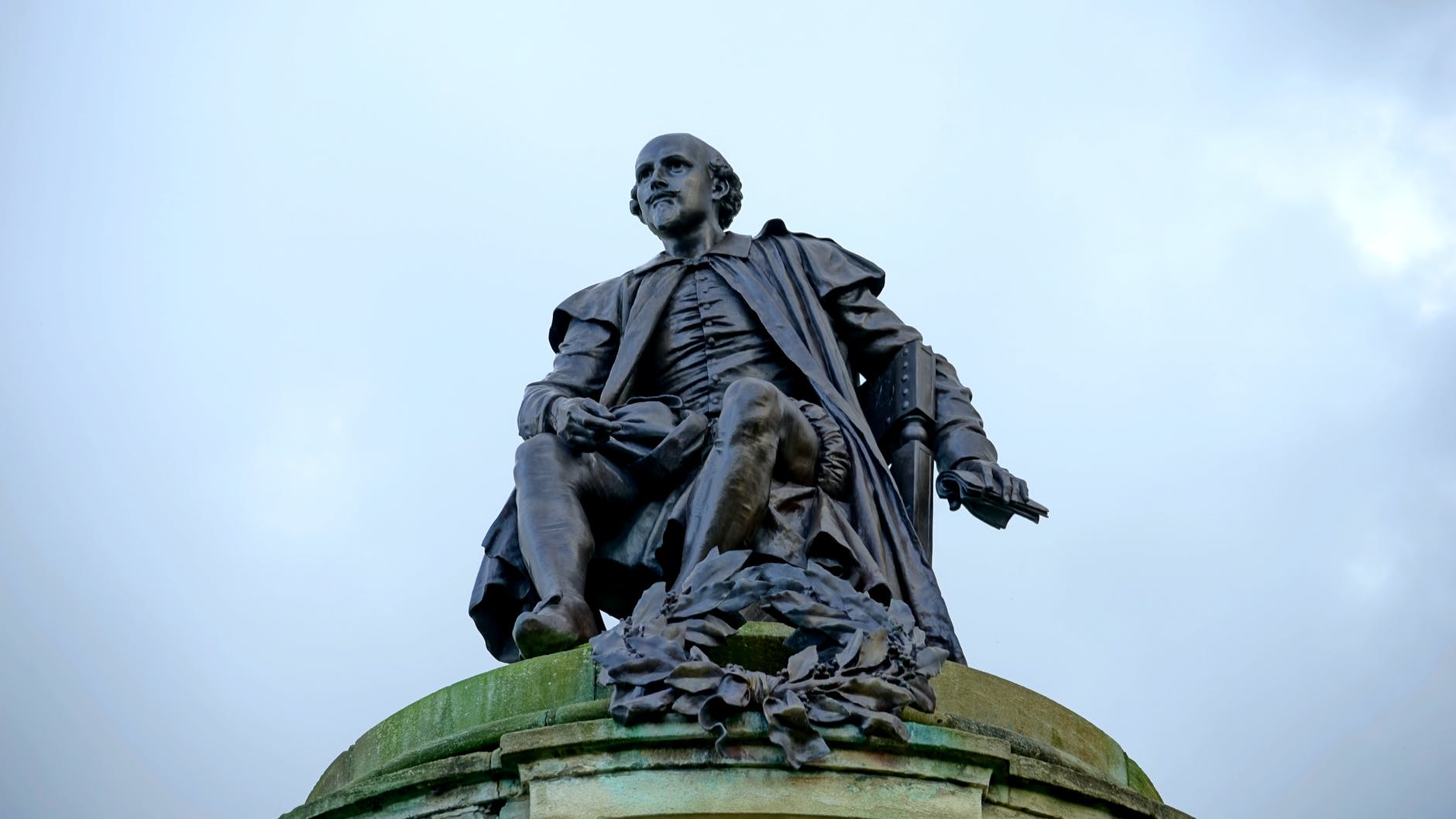
T.S. Eliot is attributed as saying “Bad poets borrow, good poets steal.” If that is the case, then Shakespeare is no doubt the Prince of Plot Thieves. He heavily borrowed his stories from others. All those wonderful plays that have lasted the ages? Not one is original.
It was not considered “stealing” during Shakespeare’s time as there were not copyrights. In fact, the plays did not belong to Shakespeare–they belonged to the theatre company. Shakespeare did not earn residuals or did not receive an advance. His earnings came from the box office of the paying customers, and that was split with the other theatre owners.
Shakespeare wouldn’t be considered a thief in his time. Nope he was just another writer inspired by someone else’s story (who no doubt had “borrowed” it from someone else.
Here are some of his inspirations:
Othello comes from Cinthio’s Hecatommithi.
As You Like It? Look to Thomas Lodge’s Rosalynde.
Julius Caesar and the other Roman plays were developed from Plutarch’s Lives.
Romeo and Juliet is a much better version of English poet Arthur Brooke’s The Tragicall Historye of Romeus and Juliet, a “borrowing” from a story by the Italian writer Matteo Bandello.
King Lear is complicated. Not only in plot, but in the way of which version inspired Shakespeare, since there are at least 40 versions available.
So-
Is Shakespeare a thief or simply a writer who knew how to improve upon available resources?
Back again this month as we continue looking at the clichés found in the “A” section of Christine Ammer’s Have a Nice Day–No Problem.
All that glitters is not gold: what you see is not always the truth. Though is not exactly the same wording the intent is found in Proverbs 13:7, NIV: “One person pretends to be rich, yet has nothing; another pretends to be poor, yet has great wealth.” This expression is traced to a Middle Ages proverb and in Shakespeare’s Merchant of Venice during the suitor scene it is stated, “All that glisters is not gold.” It is an apt saying that has its time and place.
All to the good: everything will turn out well. “Good” used to be an accounting term applied to overall profit. If something was “all to the good” that meant the outcome was profitable. Today it’s more of a term that indicates the situation might have had some bad moments, yet in the end it all worked out. Another one of those clichés that depends on perspective or use.
All wool and yard wide: the real item–not a fake. Once upon a day in the yards-good industry, a person would be assured the measurement and quality of the goods was true by stating it was measured by the standard yard. This was an assurance that the item was genuine and substandard measurements were not used. Personally, never heard of this one.
Being passive doesn’t mean being unhappy
Along for the ride: passive participation “I’m just along for the ride.” Might be considered as more of a clarifying statement than an actual cliche. It’s relatively new being traced to the mid-twentieth century.
Another day, another dollar: another work day accomplished. Back in the day a day’s work would equal a dollar. Today the term is not so literal as it is figurative and is probably stated with a facetious or ironic tone.
Any port in a storm: accepted relief in a desperate situation, even if it isn’t the first choice. Found in the 18th century in different plays, but thought to have been in use previously. One of those sayings that can truly fit certain occasions.
Pacha agrees that it’s all A-OK
A-OK: just about perfect. The term “OK” is abbreviated from “okay.” The term “A-OK” is attributed to NASA’s Colonel Power who misunderstood Alan Shepard’s “okay” confirmation that the flight was going well as “A-OK.” It entered into the everyday lexicon and indicates that everything is excellent, the best it can be. That is, unless, one is being sarcastic and applies the term as irony.
A poor thing but mine own: as in “it’s not much, but it’s mine.” This expression might have been derived from Shakespeare’s play As You Like It when Audrey says, “An ill-favour’d thing, sir, but mine own.” There are many variations of this and I heard it recently in an Australian whodunnit when the sheriff defended one of her officers by saying, “He might be (uncomplimentary term), but he’s our (term). So the expression can take on the sense of ownership pride, loyalty, identity, but then if it came from Shakespeare there are a multiple interpretations already implied.
As the crow flies: the most direct route Probably originated before the 18th century, the expression is given when a person is getting directions. It should be duly noted that crows can fly over traffic jams, don’t have to stop at toll booths, and avoid gas stations. Then again they don’t have cruise control or tunes while traveling.
At one fell swoop: happening all at once, usually a description of a singular violent incident. Shakespeare, once again, is the author of this expression which appears in Macbeth. “Fell” at that time meant “fierce” and when it applies to the metaphorical line of how Macduff’s family was brutally murdered as a hawk might swoop down and kill chickens, it is quite appropriate.
So leaf me alone for awhile, ‘kay?
At one’s beck and call: being at someone’s demands. Oh, we’ve been there, right? When it is required to meet a person’s every need, call, wish, command. “Beck” is no longer in use, but it means “a silent gesture” as in finger beckon or nod of the head. “Call” is to vocalize a need. To be at someone’s beck and call means to be in someone’s line of sight to watch for both a silent gesture or a vocalized instruction. Isn’t that why texting was invented?
At one’s fingertips: instantly ready. There is an ancient Roman proverb that says, “To know as well as one’s fingers and toes,” meaning it’s readily available. Fingers transformed into fingertips in the USA around the 19th century. I don’t know about you, but my fingertips aren’t always instantly ready. Mixing up the meatloaf puts fingertips on standby status, among other occupations that come to mind.
At this moment/point in time: at a particular time. My editing fingers get itchy at this phrase. “Wordy” is the penciled side note. Just say “now.” There is also the expression, “At this stage of the game” for sports fans. Where did this phrase originate? It’s thought Watergate leaned heavily on this construct. It was cliché before it left the building.
Are you feeling self-conscious of these expressions now that you realize they could be cliché candidates? Or have you found one that you will casually drop in a conversation some time? They are there at your fingertips and it is A-OK to use them at your beck and call.
Not sure if we have adopted a squirrel or if she has adopted us.
It began with me spotting a medium grey squirrel bounding across the lawn. A somewhat unusual sight. Deer are more frequent visitors. Squirrel activity diminished with dogs moving into the neighborhood.
Or so we thought.
Upon spotting the bounding squirrel I mustered up my squirrel call. You know the one, that high-pitched ch-ch-ch the do. Yeah. She was impressed and came leaping right over to me. She look fairly surprised to find me instead of a swaggering grey suited critter of interest.
Since then she has shown little fear of hanging out in the yard with us. Costco is making a tidy profit from the bags of peanuts the hubs buys for her.
She will cautiously approach us and grab a peanut from our fingers. Rolling and measuring its worth in her mouth she will then deposit it in some part of the yard. Digging like a little terrier she pats it in place with dainty satisfaction and traipses over for more. I split them open because once open she tastes that peanuttyness and snacks right on the spot, inches from where I sit on the bench. Syringa, does truly work for peanuts.
Now we have a couple of new additions. A tiny sable squirrel who discovered the neighbor’s squirrel proof bird feeder could not deter him. He used our fence as a diner freeway until trashing the bird feeder in less than two weeks. He has moved on the freebie peanuts laid out for Syringa. She’s having none of it.
Their tussles and chitterings range across the lawn and through the lily leaves. Entertaining turf wars at its best. We call this little guy Skitter, since he moves as fast as a drop of water on the pancake skillet. He’s too fast to snap a photo.
And a third squirrel has appeared. Yet, this one is a puzzlement. I notice it is small with characteristic squirrel gray coloring yet its eye rings are white like a chipmunk and so is its tummy. The legs are brownish. A hybrid squirrel? We’ve dubbed this one Buddy, as in “Hey, Buddy—what are you?”
The birds are beginning to vacate the area for warmer climates so there is less action at the feeder. On the other hand, the colder weather is ramping up squirrel activity as they gather nuts and bury them all over the yard. I find peanuts in my plant containers, in flower beds, and all over the lawn. How will they find them all?
Syringa will come over and spread out on the concrete like a dog when we are hanging out back. Classic splooting stance.Buddy infiltrating Syringa’s snack tray. Strange markings for a squirrel, wouldn’t you say?
Let’s return to school for just a moment. Did you study any of these plays as a student?
Romeo and Juliet
Julius Caesar
Macbeth
King Lear
Hamlet
Taming of the Shrew
Midsummer Night’s Dream
Othello
The Tempest
Now, let’s take a quick quiz. In what order do you think the plays were presented?
Here’s some appropriate music to play in the background while you are thinking. Thinking–not consulting Siri or Googling your request.
Ready?
Here is the dated order (per scholarly agreement):
Romeo and Juliet: 1593-96
Julius Caesar: 1599
Macbeth: 1606
King Lear: 1606
Hamlet: 1600
Taming of the Shrew: 1590
A Midsummer Night’s Dream: 1595-96
Othello: 1604
The Tempest: 1611
While these are not always studied in schools, most people are familiar with them. According to the list Romeo and Juliet would be among his earliest plays, along with The Taming of the Shrew The Tempest among his last. Going from the consequences of hasty decisions and dysfunctional families to prolonged revenge definitely showcases how Shakespeare was able to present a range of human emotion during the span of his stage career.
Ah, September. The slow farewell to summer as school begins and the beaches close. This batch of words focuses on learning as the transition from beach bags to school bags takes place.
willyard: obstinate; willful (not all children, or adults, are joyful about attending classes)
obsteperous: noisy, clamorous, or boisterous (have you ever entered a kindergarten class on the first day?)
crankle: to bend; turn; crinkle (lots of paper, paperclips, pens and such to crankle in fall)
pother: a heated discussion, debate, or argument; fuss; to do (let’s hope these are avoided)
hebetude: the state of being dull; lethargy (this might be the case after a couple of months of vacation)
antediluvian: very old, old-fashioned or out of date; antiquated (some students might feel this way about their teachers)
tirrivee: a tantrum (students and teachers might throw one or two of these depending on how classes go)
swivet: a state of nervous excitement, hast, or anxiety; flutter (applies to both students and teachers on the first day of school)
faineant: idle; indolent (these moments do happen-to teachers as well)
amity: friendship; peaceful harmony (getting along is a key goal)
If not attending school, do any of the above work for you in your situation?
August ushers in the reality that it’s the last month of summer vacation. My attention becomes split between the urge to start thinking about (mind you, only thinking about) getting into school mode, and enjoying every day left of summer break. Being outside this August proved somewhat challenging given the amount of haze from wildfires. The air quality index became one of the first items on my daily reading list. Fortunately, a bag full of good books from the library kept me from going stir crazy. Here are the top picks for August:
Amazon image
I kept this one on the shelf because I knew I needed to read it again someday. Needing a weekend read, the Hubs grabbed it and snickered and snorted so much I grabbed it as soon as he was done, then I snickered and snorted through my second reading. Like Virgil, I’m at a loss for adjectives. Extraordinary? Mystical? I think cerebral hilarity works. So much to enjoy: near death experiences, mysterious disappearances, quirky characters, kite gurus, small town drama, animal manifestations, lurking malevolence. So much. This one is a definite keeper. Goodreads review
Amazon image
While this is the second novel to feature the charming, one-step-from-a rogue Morrie Morgan, it can be considered detailed enough to be a standalone. Morrie Morgan is a man hoping to hide from his past (and those who would like to see him in the past tense) and finds himself in Butte, Montana in a post WWI mining town. Trying to find fortune, not necessarily fame, in the mining town causes Morgan to have an enlivening stay. Going from a professional crier at Irish wakes to a library roustabout, he inadvertently finds himself involved with the mining union and becomes unexpectedly involved with his widowed landlady. For Patrick MacManus fans and for those who are looking for a historical read with a tickle up its book sleeve.Good Reads review
Amazon image
Sir Francis Drake? Was he a pirate or a defender of England? Albert Marrin provides an enlightening historical reference on Drake, who Elizabeth I referred to as “My deare pyrat.” The Spanish called him “The Dragon.” Though aimed at younger readers, the information is thoroughly interesting and though it is slanted towards the English, it does illuminate the background of a brilliant seaman.
As an aside, although Drake is indeed an interesting historical figure, my interest in him was mainly for research purposes since my mother, once long ago, was a pirate on the Golden Hinde. True. Well, she served as a tour guide on the the replica of the Golden Hinde when it was making its West Coast tour in the late ’80s. One of the fifth graders had asked her if Drake was really pirate. His father had answered before my mother could: “Depends if you were from England or from Spain.”Good Reads review
From kite flying movie theater amnesiacs to runaway gamblers to seafaring kings (and a few books in between), August proved an adventuresome month.
Hope you found some Good Reads during summer. I welcome your suggestions and comments about what you have read.