Pam Webb

a writer's journey as a reader

Archive for the category “Literature”

Summer Wonders


Returning school goes beyond getting back into a routine because it means I also have to make adjustments to my practicing for retirement. No more rolling over and going back to sleep, no more schlepping around in jammies, no more naps, no more odd eating hours, or meals for that matter. And worst of all, no more diving into books for an entire day and barely coming up for air. Responsible English teachers don’t partake in any of the above behaviors. At least not during the school year. Yet, summer vacation does allow me to practice the art of retirement and one of those skills is thoroughly enjoying a really good read. I was fortunate this year and enjoyed more than my usual share of good reads:

All the Light We Cannot See by Anthony Doerr

Breathtaking in its flow and style, I absolutely devoured Doerr’s novel about two lost children. Set in WWII, Doerr portrays the war in a way I’ve not encountered before. One perspective is through the blind eyes of Marie, a young French girl whose indomitable spirit carries her beyond the war’s cruelties. The other perspective is that of Werner, a German youth whose talents land him in the Hitler Youth. The parallel stories eventually telescope down to a satisfying denouement. Doerr, already an award-winning author, will do doubt increase his presence with this amazing tale of how the spirit can overcome its surroundings.

Mr. Penumbra’s 24 Hour Book Store by Robin Sloan

Sometimes I simply have to take a break from the pedantic pace of classics, or step away from serious literary excursions. Mr. Penumbra helped me to once again find the wit in wordsmithing. This foray into classic literature name dropping reminds me of Jasper Fford’s Thursday Next series, which is a delight in how it metafictionally pokes fun at how serious we tend to take our literature. Robin Sloan not only lovingly jabs at academia, he embraces our wanderings over to the dark side of technology via Google (those villains). Yet, bad guys (technology) aren’t so bad, once you understand them, and often they prove helpful overall because they are just misunderstood.

Remains of the Day by Kazuo Ishiguro

My first introduction to Ishiguro and of the three novels I read of his over the summer, this one is certainly the best in my opinion. The voice of nationalistic pride and misguided directive is so artfully penned in this memoir of a proper English butler. The bonus being how well the film adaptation captured the slow realization of how corrupted Steven’s outlook was after all.

The Mockingbird Next Door by Marja Mills

As a TKAM devotee I jumped on ordering Mills’s account of her time with Harper Lee faster than freckles popping out during a July heat wave. Lee has become such a recluse over the years it has been feared this national treasure will leave little behind in way of knowing who she really was. Fortunately Marja Mills went beyond her journalistic assignment and got to know Harper Lee as friend and neighbor allowing fans and readers a delightful glimpse into what Scout might have been like in the real.

The Push Cart War by Jean Merrill

This cannot possibly be a kids’ book! The wit is droll in delivery and its lampooning so adroit I don’t see how children could appreciate it fully. Maybe I’m only bereft in my opinion since I missed this one growing up. I think I got sidelined by Encyclopedia Brown. Just like The Phantom Tollbooth or Alice in Wonderland is not strictly for children, neither is Merrill’s classic. I’m ever so glad I found it and I made up for lost time.
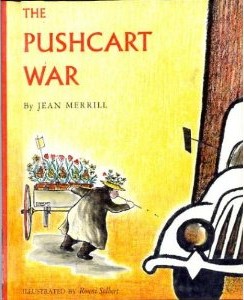
The_Pushcart_War_-_cover_image_1964

image: Wikipedia

One Whole and Perfect Day by Judith Clarke. A Printz Honor Award
YA reads are hit and miss for me. There tend to be riveting and noteworthy like Hunger Games and Divergent or fall into high school drama–been there done that and see it everyday. Now and then I do get to pick up a YA which should be in what I call the YA+ category, meaning it’s more towards literary then temporal contemporary (I think it has lasting merit, not trendy, and an adult shouldn’t be embarrassed reading it). Clarke’s novel concerning a girl’s desire to have one day where her family is not dysfunctional fills that YA+ bill. Set in Australia, Lily does indeed have an odd family and what is even more odd is Clarke’s approach to the Point of View–it’s omnipotent, which has fallen out of favor. With almost Dickensian flair for characters and situations, Clarke provides a plot that slowly builds to the becoming a whole and perfect story–pretty nearly.

What’s really the wonder of these summer reads is that they were all recommends found on blogs I perused. Following other Book Boosters definitely has its benefits and I no longer have to forlornly drift the stacks hoping to uncover the newest hot read or find a lost treasure.

How about you?  Any really good reads found and savored over the summer?  Any great recommends discovered while catching up on your blogs?
Stacking the Odds


Barbie

image: Amazon.com

Now and then I try to squeeze in volunteer time at the library by shelving a cart or two of books.  Having worked at a couple of libraries I can do the Dewey sufficiently well.  In the future I should remember that the reason the non-fiction juvenile cart is up for grabs is because it takes a loooong time to do. I will have to say that it does involve quite a bit of aerobics stretching from whales to the Star Wars cookbook.

Besides the getting some calisthenics in and helping out the library, I volunteer shelve because I find all sorts of treasures for myself. And because I am on my own clock now I don’t suffer the guilt (and rebuke from my supervisor and coworkers) when browsing. Okay, I do feel a little bit of guilt.

Here  are some of the treasures I’ve discovered:


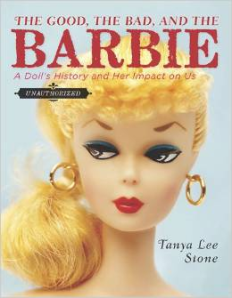
The Good, the Bad, the Barbie by Tanya Lee Stone
Being a Boomer girl I had quite the Barbie collection. I even had the one in the zebra one piece. Had Midge, Skipper, Ken complete with a kitchen set and canopy bedroom ensemble. Oh, yes, I do wish I still had them. No, not because I’m a Barbie fan, but I’m sure my retirement account would have been a bit healthier because there are LOTS of Barbie fans out there.

Lincoln Lawyer (this was a series before the movie!)

Limitless–having watched the movie I was intrigued enough to read the book. Go with the movie.

Monk? based on the series? How could a book do him justice?

Deadly Pursuit–a Christian thriller mystery? I’m game. Toss it on the TBR list.

I also made some observations:

If I look like I know what I’m doing people will think I do know something. I felt really, really good about helping a patron find a book she wanted. We didn’t find it but I gave her information how to place a hold or a search for the title.

I had no idea how prolific Christie, Cussler, Jance, Patterson are as authors until faced with trying to alphabetize their numerous titles. SIDENOTE: I found out it’s okay to get the titles in place by author (you know how that’s dratted patrons just mix them up anyway–wait, I’m a dratted patron).

People really do read Melville’s Moby Dick.

And To Kill a Mockingbird still rocks the shelves! Big yeah on this one.

So don’t be shy, trot right on down to your friendly local neighborhood library and see about volunteering for shelving. You’ll feel good, the library folk will be happy, and you’ll have an even fatter TBR list.

Let’s Stop With The Cloning Around


STOP: SPOILER ALERTS for the following
Never Let Me Go
The Island
Moon
I, Robot
Oblivion
Frankenstein
Robocop

“Four legs real, fake legs baaaad.” image: nature.com

What is this fascination with the humanity aspect of clones or artificial intelligence? Why do we want to inject a soul into something man has created? Or a more defined question is: why do we explore whether man-made creations have a soul?

Is it guilt? Afterall, creation is best handled by the Creator, the One who has the Master Plan. That statement could incite a whole firestorm of commentary in itself, which is fine, but I’m really after the literary and even film aspect of cloning/artificial intelligence.
For instance, having just finished Never Let Me Go by Ishiguro, I began thinking about other cloning works: The Island,Moon, Oblivion, and while there are other aspects attached to these films, the main takeaway: “cheated.” The clones are cheated because even though they look human, act human, they are not, which becomes a matter of concern because there is an investment of empathy for these characters, yet part of me says “Wait! They aren’t real.” I feel cheated because I am tricked (seemingly) into believing and caring about something I inherently don’t subscribe to: cloning.
Have you ever tasted imitation crab? Once–thank you very much. Looks like (mostly), tastes like it (kind of), smells like (a bit), same texture (not really). After being duped into eating it I came away with the same feeling: cheated.
Duplicating sheep, crab, humans–it’s not the same, and can never be. I believe in science; I do not subscribe to Luddite philosophies, but there are moral boundaries and these boundaries keep reappearing in novels and films as guilt and even revulsion. Why?
I think we try to justify the curiosity to recreate human life through the compassion for the Creature, as in the case of Frankenstein. The Wretch had initial goodness until it met up with repeated rejection. However, Shelley pointed out the disastrous results of man attempting to recreate man.
We root for Tom Cruise (Oblivion) and Sam Rockwell (Moon) as clones, only because we thought they were human. Upon realization they were clones I immediately reneged my emotional investment–I had been cheated, someone had switched in that imitation crab.
I have no problem with robots though. The A.I. component works for me. I liked R2D2, who didn’t? And Sonny, from I, Robot? A charmer. They were machines with heart; they did not have a soul. Machines are machines. On the other hand, that fuzzy line is not so warm and fuzzy when it comes to cloning: Humans with no soul? Are these simply sophisticated machines with feelings?
Which brings me to my latest Ishiguro read, Never Let Me Go. Having heard raves about it, and having read two other of his novels, I looked forward to this particular one. Ishiguro’s style of unreliable first person narrative and undercurrent, deceptively complex plot is very much evident. It wasn’t until about halfway through I realized I’d been cheated. Here I thought Ruth, Kathy, and Tommy were victims of a cruel government experiment, only to discover (oh so subtly) they are clones. Dissapointment. I finished the novel, although I felt a detached flatness. No joy in that one. I did feel a resonance with Robocop, but then has man trapped in a machine. And even though he was mostly machine I rooted for him because people I can relate to–fake crab, not.
Anyone else have thoughts on cloning in literature in regards to character empathy?

Read Me a Story


One of my favorite classes in college involved learning how to read picture books out loud to children. Yes, and we did get credit for doing so. This class gave me real life skills. For true.

I learned there is a proper way to hold the book when facing the audience.

  • First of all, sitting down facing your audience, you hold the book’s bottom spine stretched out on your forearm.

*By the way if you are looking for a dazzling, scintillating meme-worthy Prezi, it ain’t happening*

  • You then read sidewise, yet facing your audience because eye contact is quite important. This is easier than it sounds because picture books usually have more illustration than words.
  • It is then important to properly turn the page. This is done by reaching over and across the top of the book, sliding the first two fingers done the present page and the next, and pulling the page over for the next spread. NOTE: though commonly practiced, it is not in the best interest in the book’s wear to turn from the middle bottom, especially towards the inside spine. Rippage and tearage can occur in doing so.
  • Proceed throughout the entire book in the proscribed method.
  • It is also important to use appropriate voices for characters, and it can be highly desirable to create separate voices for each given character. NOTE: characterization voices are best done by those who can do so without creating havoc among the audience. For example: if your Cockney mouse is such a smash hit your audience might laugh to the point of interfering with the story’s progress.
  • Body language is  also important. Leaning in to emphasize special junctures, or pausing for same can add a delightful amount of drama and dimension to the story.

I believe the course to be quite edifying and suggest signing up should the adult education flyer come through the mail. Today I utilize those skills reading to the grandkiddo, although I use my snuggle reading skills instead. I have read stories to my high school students. Yes, that is one reason I am known as the weird English teacher.

Then again, there are those who possess natural skill at reading and technique does not actually matter. Case in point is our boy Sherlock.

Have you a favorite technique for reading stories?  Or better yet–any famous readers you’ve come across? One of my most favorites is Meryl Streep’s audio book reading of Jeremy Fisher by Beatrix Potter.


Remaining the Orphaned Narrator


It is always exciting to discover a new-to-me author. In this case it’s Kazuo Ishiguro. I know, I know. I’m a bit late in my discovering; however, better late than never in finding an author of mesmerizing style.


I knew the movie Remains of the Day, before finding the novel and didn’t realize the movie was the adaptation.
How could I possibly pass up a film starring Anthony Hopkins and Emma Thompson?
Flash forward five years later and I’m perusing the AP Literature list (“read that one, will never read this one, not reading this one again”), when I recognized the title Remains of the Day and connected it to the movie. Then I read the author’s name and I must admit I expected something like Adrian Smythe or Winston Greene, not Kazuo Ishiguro. After all, the novel is about a very proper English butler and his reflections of what it takes to become the best of English butlers. Wouldn’t one need to be English to understand that sort of nationalistic pride? I’m not getting points here for narrow-minded thinking, am I?

It turns out Ishiguro is quite well-suited to the task of writing about the English since he moved to England when he was around six years old. This gives him the ability to have an insider’s view with a somewhat detached perspective. The result is  basically a stream-of-consciousness narrative concerning the tunnel vision of a man’s quest for the unattainable. Trying to live a life that is beyond reproach, to achieve a status of perfection, requires sacrifice. Can sacrifice be made without regret? This is the hidden truth Stevens, the butler is searching for, except he does not realize it.
A quest novel of notice did not go unnoticed, for Ishiguro’s debut garnered him the Man Booker Prize and set a bar. Would he be a one shot wonder or would this be the first work of a noteworthy word smith?

image: goodreads.com This cover indicates the layers found within the story.

My literary taste buds curious for more, I trotted down to the library. Grabbing any title of his that caught my eye on the  shelf, I opened up his fifth novel When We Were Orphans. I immersed myself in reading it to the point the MEPA queried, “Still a good book?” Yes, thank you. Prognosis? After reading two novels, indications are Ishiguro is wordsmithing wonder.

Here are some bio facts and  stats:

  • Two novels have been adapted to the screen, Remains of the Day, and the more recent Never Let Me Go. Both have been received well, considering Ishiguro’s stories are mainly first person narratives, making them difficult to translate into a cinematic plot.
  • His novels are historical in nature, with attention to detail.
  • The stylistic viewpoint is that of the unreliable first-person narrator, one who is flawed in outlook.
  • Although born in Japan, he did not return until thirty years later.
  • He has received four Man Booker Prize nominations
  • The Times ranked him 32 on the list of the 50 most influential British writers since 1945.

As for an actual review of When We Were Orphans, I leave it to the more qualified:
New York Times
 review:

I plan on continuing my course of exploring Ishiguro’s work and look forward to introducing a contemporary author to my APters, who, I’m sure, would like a break from dead white folk now and then.

Any thoughts on Ishiguro’s writing? Any suggestions for the next title I should read of his?

Having a Senior Moment


Today marked the last day and first day for a group of seniors.  As we wrapped up their visual essays that little old epiphany popped up:

“Hey guys, do you realize this is the last class on the last day of your high school career?” I obviously was more impressed with that fact than they were. I offered up the Kleenex box, but no takers. There’s no room for tears when there is cheering going on!

Wanting to capture the moment before they all split in separate directions I said their exit ticket required five memories of AP Senior Literature.  Silly me, I was thinking they might mention any of the following:

  • “I sure appreciate knowing how to properly apply anaphora and polysyndeton when emphasizing my need for repetition and parallelism.”
  • “Having learned the significance of water when reading literature makes me want to run right out and grab a copy of Moby Dick this weekend.”
  • “I wake up in the middle of the night craving yet one more reading of Prufrock’s lovesong.

No. None of that. Instead they popped off these memories:

“Your cow jokes.”

“The story of how you met your husband and made polenta for him.”

“French day. All that bread and cheese and fruit we enjoyed when watching Cyrano de Bergerac.”

Nope. All the labor spent on creating scintillating lesson plans went unnoticed and instead the personal aspects is what became memorable for them.  Lesson learned: The best teaching comes from learning to set aside the plans now and then.

I’ll miss this batch of seniors, we’ve had our share of moments, that’s for sure.  Saturday is graduation and once they leave behind high school I wonder if they’ll take along some new friends with them–Jane, Janie, Lizzie, Darcy…

Poet Appreciation #9: Wallace Stevens


World War I affected the world in a way that changed forever our outlook on life. Losing 50,000 young men in one day alone, is a travesty of waste. Lost lives, lost dreams, lost generations have a profound impact. One section of the world culture which was touched was that of the artist in all forms. In poetry, the Modernist movement began with its focus on looking at how this brave new world affects us. T.S. Eliot is most frequented with modernist poetry with his offerings such as The Wasteland and The Lovesong ofJ. AlfredPrufrock.

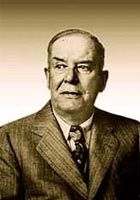
Wallace Stevens

Another poet of that time, Wallace Stevens, is as important as Eliot in his contributions to Modernist poetry, although Eliot seems to pop up first in Modernist contribution conversations. Bio facts of note for Wallace:

  • didn’t get published until he 44
  • attended Harvard, but had to leave due to lack of funds
  • Editor for both of Harvard’s publications
  • His wife the model for the Liberty dime and half-dollar
  • Career primarily as an insurance lawyer
  • Won the Pulitzer Prize and National Book Award
  • His poetry collection, Harmonium, ignored by critics when first published, is now highly regarded
  • His home town of Hartford, Connecticut has a walk devoted to his blackbird poem with signs of each section along the way
  • Connoisseur of Asian art

Disillusionment of Ten O’Clock

The houses are haunted
By white night-gowns.
None are green,
Or purple with green rings,
Or green with yellow rings,
Or yellow with blue rings.
None of them are strange,
With socks of lace
And beaded ceintures.
People are not going
To dream of baboons and periwinkles.
Only, here and there, an old sailor,
Drunk and asleep in his boots,
Catches Tigers
In red weather.

Poet Appreciation #8: William Shakespeare


*Gasp* Billy Bard is celebrating his 450th birthday on the 23rd. I advise those attending the birthday party to stick to the crumpets and steer clear of the kippers, as they didn’t do ol’ William any good at his own birthday din celeb.

Would William be surprised to know how many Bardinators there are coasting about due to his most marvelous ability with words, wit, and retrofitting old tales into something more appealing?  Probably.  Ben Jonson knew his contemporary, and somewhat rival was “a man for all time.”

What better way to say “Happy Birthday, Bill!” than with a couple of his sonnets.

First, the Mona Lisa of his career:

SONNET 18

Shall I compare thee to a summer’s day? 
Thou art more lovely and more temperate:
Rough winds do shake the darling buds of May,
And summer’s lease hath all too short a date: 
Sometime too hot the eye of heaven shines,
And often is his gold complexion dimm’d; 
And every fair from fair sometime declines,
By chance, or nature’s changing course, untrimm’d;
But thy eternal summer shall not fade
Nor lose possession of that fair thou ow’st;
Nor shall Death brag thou wander’st in his shade,
When in eternal lines to time thou grow’st; 
So long as men can breathe or eyes can see,
So long lives this, and this gives life to thee


Who hasn’t heard this lovely tribute of admiration? No matter how many years I’ve taught it to high school students they still “get it” and appreciate the trick ending of the couplet.  That’s what I like about Wm’s wit: it’s subtle and winking.  I think he’s winking right now as it’s being read. I’ll let Michael York recite it for you.  He gets it for sure, this is a loving tribute (don’t get shook up about it being for a man, like my freshmen do–this was supposedly to William S.’s patron, the guy who paid the bills so Wm could keep writing. Is that any different from dedicating a song or book to an agent, sibling, parent, or editor?)

Another tribute sonnet is perhaps not as complimentary, yet I think it showcases Shakespeare’s ability to take the accepted medium and poke fun at how poets tended to extol too vigorously the glories of a person, thus rendering him or her to be removed from humanity–it’s difficult to climb down off a pedestal that’s built too high. This particular sonnet at first sounds like a bash session; however, after a step back moment, it’s clear to see Shakespeare extols the real beauty of his love.  He loves this woman, warts–that is, frizzy hair, and all.

SONNET 130

My mistress’ eyes are nothing like the sun;
Coral is far more red than her lips’ red;
If snow be white, why then her breasts are dun;
If hairs be wires, black wires grow on her head.
I have seen roses damask’d, red and white,
But no such roses see I in her cheeks; 
And in some perfumes is there more delight
Than in the breath that from my mistress reeks.
I love to hear her speak, yet well I know
That music hath a far more pleasing sound;
I grant I never saw a goddess go;
My mistress, when she walks, treads on the ground:
   And yet, by heaven, I think my love as rare
   As any she belied with false compare.

This video captures the satire of those mushy sonnets while intones the general attitude of love.  Alan Rickman and typography mash up at its best.  Wouldn’t you want Alan Rickman reciting a sonnet to you?  Check yes.


These are only a drop in the sonnet bucket.  Wills wrote 150 sonnets, far more than the 38 plays we know to be roaming about.  So why do we mostly associate him with being a playwright than a poet?  According to many historical sources, he considered himself to be more of a poet than a playwriter. Hmm, it’s easier to turn a play into a film than a sonnet, I suppose.

Once again, Happy Birthday, William!

image: facebook.com


Poet Appreciation: #5 Guest Poet


How do I love thee? Let me count the ways.
I love thee to the depth and breadth and height
My soul can reach, when feeling out of sight
For the ends of Being and ideal Grace.
I love thee to the level of everyday’s
Most quiet need, by sun and candle-light.
I love thee freely, as men strive for Right;
I love thee purely, as they turn from Praise.
I love thee with the passion put to use
In my old griefs, and with my childhood’s faith.
I love thee with a love I seemed to lose
With my lost saints – I love thee with the breath,
Smiles, tears, of all my life! – and, if God choose,
I shall but love thee better after death.

Three guess on today’s most appropriate poem:

  • Nope, not Shakespeare–although it is Sonnet 43, it’s not his.
  • Nada–Dickinson has dashes, but not so much mush
  • Yup, Elizabeth Barrett Browning. And I know it’s almost cliché to have her famous Sonnet 43 as today’s poem (yes, though February was a couple of months ago, the 14th can still be a factor in choice), her love story is soooo romantic that it bears repeating–especially if you don’t know it.

ONCE upon a time, long ago, a young girl by the name of Elizabeth Barrett grew up with a very possessive and controlling father who had strange ideas about his children going off and getting married–like in “Not by the hair of my chinny chin chin!” Even though the young Elizabeth was pretty much imprisoned in her house by her father (shades of princess needing a prince) she became a famous poet.

One day a dashing younger man by the name of Robert Browning read one of Miss Barrett’s books of poetry and wrote her a letter. She wrote back. He wrote back. Well, before you know it they became pen pals with a serious romance brewing.

Big, bad, Dad Barrett would not let Elizabeth and Robert marry, at least he did not give his consent. So, of course Robert, a prince of a fellow, rescues the lovely princess of poetry, and they elope off to Italy. And yes, they DID live happily ever after. Big, bad, Dad Barrett never forgave them, but the Brownings remained blissfully happy in their famous marriage of pen and passion.

Now, that’s a great literary romance tale. So let’s celebrate with some good old Peanuts:

Poet Appreciation: #4 George Santayana


Quick–what teacher did Conrad Aiken, T.S. Eliot, Robert Frost, and Wallace Stevens have in common? *Jeopardy muzak plays softly* If you answered George Santayana you either are a verse warrior or you clued in on the post title.

Santayana, a Spanish-born American, was a philosopher, essayist, novelist, teacher, and poet. Receiving his PhD from Harvard he joined the faculty in 1889. In 1912 he moved to Europe and must have liked it because he never returned to the states. Santayana, thought to be an important influences of critical realism, became part of what is known as the Classical American Philosophy. He died in 1952.

 
 There may be chaos still around the world
by George Santayana
 
There may be chaos still around the world,
This little world that in my thinking lies;
For mine own bosom is the paradise
Where all my life’s fair visions are unfurled.
Within my nature’s shell I slumber curled,
Unmindful of the changing outer skies,
Where now, perchance, some new-born Eros flies,
Or some old Cronos from his throne is hurled.
I heed them not; or if the subtle night
Haunt me with deities I never saw,
I soon mine eyelid’s drowsy curtain draw
To hide their myriad faces from my sight.
They threat in vain; the whirlwind cannot awe
A happy snow-flake dancing in the flaw.
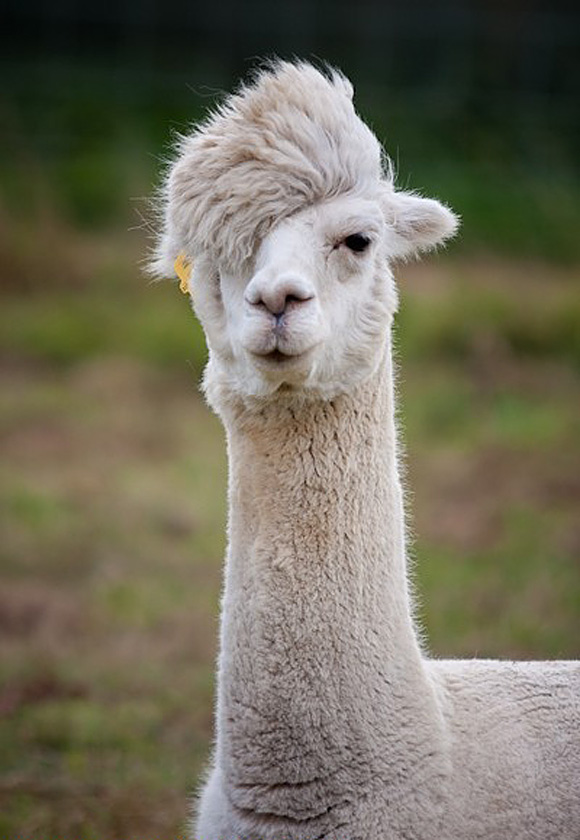
Unless I am way off base, I think this is the complex version of Bobby McFerrin’s hit ditty “Don’t Worry. Be Happy.” I hear in this poem how the world can be swirling and whirling about us, yet we can cocoon within ourselves and remain blissfully at peace.  I prefer the happy llama mode: humming along in life.

Post Navigation