There’s a guy I know, laid back, long hair, beard, comfy clothes, a man of few words—yeah, kind of that hippie vibe—and when you greet him he says, “You know it” with a smile. Yup, Charlie is pretty chill.
So with the vibe of relaxed, here are some chill “u” clichés”:
Under her/his thumb: subservient (beware of a boss who is considered all thumbs)
image:BBC Learning English
Under a microscope: close scrutiny (nothing like being pinned between glass slides with an eyeball staring at you)
Under the table:receiving payment without notifying the IRS as income (I don’t know what you are talking about)
Up for grabs: available (it is polite to ask first, I would think)
Ugly as a mud fence: very unattractive (can’t imagine such a fence making the pages of Better Homes and Gardens)
image: Citizen Times
Up in the air: no decision made (it’s up in the air whether it’s more popular to say up in the clouds instead)
Until the cows come home: waiting expectantly (cows are time conscious and will return to the barn when they are ready)
Up in arms: to become upset (referring to when soldiers when prepare for a fight by grabbing their weapons)
Up the ante: increase the odds or compensation
Up the creek without a paddle: to be in trouble or in possible peril
If you identify with parent of school age children, then I commiserate with you for the back-to-school shopping marathon. Well, yes, it is exciting getting the kiddos ready for another (or their first) foray into the classroom routine. But it is tiring and expensive.
If you are a student, you are either bummed or excited, or perhaps a bit of both, since it means put a pause on summer fun in order to focus on the mojo needed to get into the school routine.
As a teacher, you are no doubt either already back in the classroom (depending on where you teach) or bum-weary from having to sit through endless admin-led meetings while you would rather be preparing your room.
None of the above? You are probably then retired or an empty-nester or perhaps neither a parent or teacher, although you vaguely remember your September back-to-school days.
This marks my fourth September I will not be returning as a teacher, yet I found myself back on campus anyway. My retirement days are centered around books: I’m either reading them, writing them, or doing something with them that is library related. Today I dropped off a box of donated of books to a couple of schools, one of which was where I formerly taught English.
Yes, it was strange.
No, I didn’t miss it.
Yes, I briefly said “howdy” to some former compadres. And yes, I delivered my usual line of “I highly recommend it!” when asked how I like being retired.
Okay, fine–I do miss some aspects of being a teacher, such as getting to know my students, watching them catch the spark of appreciating literature, lunch time sessions with teacher chums, and staff meetings (just kidding on that one).
So, here is hoping your back-to-school blues aren’t severe, and hoping the school year is fabulous, whether you are in a school desk, behind the teacher’s desk, or planning a cruise since everyone else is back in school.
Which three letter word sports the current title of having the most definitions?
A. lie
B. set
C. run
Lie?
Sorry—only two : to tell something that is untrue or to assume a horizontal position.
I’m not lying about not taking word knowledge lying down
Set?
Previously the champ, the Oxford English Dictionary (OED—THE leading dictionary) tagged it with 200 meanings, starting with the expected “put or lay something down” and then running on for another 32 pages with various meaning. Speaking of run—
Run?
Congratulations on this pick as the OED folk have determined that this little word carries a whopping 645 definitions. Impressive, right?
Here’s a sample (taken from RD.com)
When you run a fever, for example, those three letters have a very different meaning than when you run a bath to treat it, or when your bathwater subsequently runs over and drenches your cotton bath runner, forcing you to run out to the store and buy a new one. There, you run up a bill of $85 because besides a rug and some cold medicine, you also need some thread to fix the run in your stockings and some tissue for your runny nose and a carton of milk because you’ve run through your supply at home, and all this makes dread run through your soul because your value-club membership runs out at the end of the month and you’ve already run over your budget on last week’s grocery run when you ran over a nail in the parking lot and now your car won’t even run properly because whatever idiot runs that Walmart apparently lets his custodial staff run amok and you know you’re letting your inner monologue run on and on but, gosh—you’d do things differently if you ran the world. (And breathe). Maybe you should run for office.
And I have run the course on this post. Until next time.
Teacher Appreciation Day happened this week and I silently salute my former colleagues since I am now a teacher in the past tense.
A funny thing happened on the way to the classroom…
I started out my career with an AA in Early Childhood Education. The two year program held in a brand new interactive classroom was an amazing experience. I learned so incredibly much about little tykes and I also learned it would be difficult to make a sustainable living watching other people’s preschoolers since wages were barely above minimum wage. Hmm, that says something about how society values the care and feeding of our children. Let’s move on.
From there I enrolled in the university’s speech therapy program (having somehow been convinced by my dentist and mother to do so because he wanted to include a speech therapist in his practice and my mother probably liked the prestige of her daughter going into the medical field). I transferred out at the end of the year. Less said the better. Let’s move on.
Another university, another program. This time it’s Outdoor Education(officially dubbed Leisure Studies—I know. Outdoor Education is better for the resume). A BA later and an internship helped me understand this too was not a sustainable career since a camp director lives on site meaning time away from family and most camps are seasonal. Let’s move on.
I like to write. I like the outdoors. How about Environmental Writing? This university needed warm bodies for their new MA in the Teaching of Writing? Okay, I’ll switch. This one had possibilities providing I got hired on at a community college. One local CC with no openings. The library is hiring.
Twelve years later, a big move with a family now in tow I apply for the local high school library position. What? I need a teaching certificate to be a school librarian? More school. What? Budget cuts? The school district can afford a certified librarian? Options?
All those different paths helped me become an English teacher. An ECE degree definitely helped with classroom management (preschoolers and teenagers share distinct similarities), teaching outside the classroom when applicable thanks to Outdoor Education, and an MA in the Teaching of Writing absolutely came in handy. All that library time? What better place to apply literary knowledge than in AP English.
I didn’t intend on being a teacher because given my druthers I would have thoroughly relished being a long term librarian. I did appreciate my time in the classroom and do miss it (at times).
So happy Teacher Appreciation Day to those dedicated to educating our youth.
Having taught high school English for twenty years one of the biggest complaints my students voiced (besides writing essays) dealt with grammar rules. Well, as Bob Dylan sings, the times they are a-changing.
According to a recent Reader’s Digest article here are some grammar rules that are soon to be or are already changing going from missed to being acceptable (or is that mythed?).
Image: Tatiana Amazon/rd.com
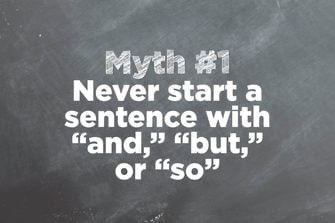
According to the grammar experts at the Chicago Manual of Style, there is no actual rule that states it’s an error to start a sentence with a conjunction. And I believe them.
Image: Tatiana Amazon/rd.com
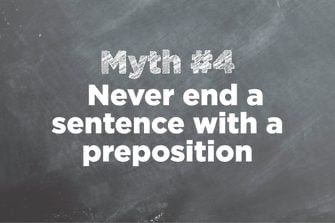
That age old rule of not ending a sentence with a preposition creates strange sentences such as, “What city from where did he travel?” instead of “What city did he come from?” Sometimes a sentence just has end naturally, like it’s supposed to.
Image: Tatiana Amazon/rd.com
Ah, the old discussion about splitting infinitives. First off know what an infinitive is before considering the need to split it. Says Wikipedia: An infinitive is a verb form that is used as a non-finite verb.
An example would be the well known tag line: “to boldly go where no one has gone before.” “To go” is the infinitive, and “boldly” splits it. No harm, no foul.
Image: Tatiana Amazon/rd.com
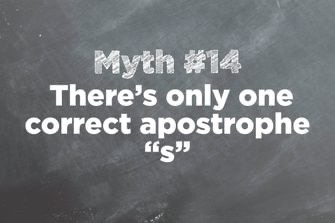
What to do when faced with the dilemma of adding that apostrophe “s” to a word ending in “s”? Which way is the write way (see what I did there?)
I’m going to go over to see Mr. James’s new car.
I’m going to go over to see Mr. James’ new car.
Trick question. They are both correct. It comes down to preferred style and consistency, using the same form throughout the writing is essential. Or it can be confusing to all those readers’ understanding of what your style is all about.
The day after Labor Day is traditionally when school starts. It signifies for most the end of summer and the beginning of nine long months of spending daylight hours in the classroom occasionally, and mostly wistfully, glancing out the window, anticipating being released from the four walls of education.
I imagine students feel the same way.
Is it June yet?
Before I retired from teaching I did look forward to the first day of school—kind of. Truth be told the first day of teaching, at least at the high school level, can be awkward for both students and teachers. Getting names right, going over expectations, trying to establish a rapport, returning to a scheduled routine of bells dictating the day week after week.
Wait—
Sounds a bit despondent, doesn’t it? Don’t get me wrong. I enjoyed being a teacher. I just enjoy being a retired teacher so much more. I’m in good company.
Recently I gathered with around 25 other retired teachers from our local high school for our annual get together. It’s always scheduled on the day teachers have to report to school for in-service meetings. I think that’s it meant to be a wink and a nod that we don’t have to be there anymore. We all agreed being retired is better than being tired again and again, something that occurred when teaching.
This will be the third year I will not be returning to school. People have been asking me if I miss teaching and are often surprised when I quickly say, “Nope.” Teaching is hard work. And teaching became harder because of Covid. In fact, talking to friends who still teach, Covid is still impacting teaching. It’s probably not going to get any easier.
So while I don’t miss teaching, I do miss being a teacher. Then again while I might not be currently teaching I will always be a teacher. You know the saying: You can take the teacher out of the classroom but she will kindly decline offers to return once retired.
Oh, there’s a different saying?
Happy Tuesday-after-Labor Day to students and staff. Hope your year is pleasant and enriching.
Excuse me while I plunk myself in my hammock and read another book in my retirement.
Summer events that create a more memorable season start with graduation ceremonies. Toss in at least one wedding or a wedding reception along with a church picnic, add in the county fair, include a bit of company to round it all out.
While those events add some pizazz to the summer months, I do count on Shakespeare in the Park. The one day performance arrives in the middle of August and I stop, drop whatever I’ve planned, and position my camp chair on the lawn at the designated park venue and for two hours I revel in Shakespeare.
This year The Montana Shakespeare in the Parks presented their two hour adaptation of Hamlet. Their version focused on what seemed to be Edwardian costume style adding a reserved aspect which offset the emphasis on pulling in the comedic components of the play. I never considered Hamlet a comedy; then again some of lines are quite witty when said with panache.
All the world’s a stage or at least a park is for a summer evening
I didn’t become aware of Hamlet until I began teaching high school English. In fact, I wasn’t aware of Shakespeare until I began teaching his plays. That’s right. Somehow twelve years of public schooling and six years of college and no Shakespeare classes. Shocking, I know.
Once I discovered the tragic Dane there was no turning back. Not only did I teach Hamlet, I set out to watch every version available (still trying to find Jude Law’s Broadway version). One year I flew back to Washington DC to join 29 other teachers for a week of Hamlet Academy at the Folger Library. I then went on to write a choose-your-own path Hamlet, and created the play as a contemporary murder mystery.
Yes, I have become Hamletized and I am okay with that.
Which Shakespeare play has grabbed your attention to the point of almost unreasonable fascination?
Thanks for the reader feedback on how you are enjoying the word selections. I enjoy finding them almost as much as I enjoy sharing them with you all. This past week has consisted of a multitude of words that cause me to say “There is a word for that?”
Splooting: a behavior that some animals use to cool their body temperature. Squirrels are finding cool surfaces and lying on their stomachs, legs spread, to cool off. For awhile we had a winsome little squirrel that would visit us and eat peanuts from our hand. In the summer she would come up to the patio and hang out. I thought she was being a companionable squirrel when she was actually seeking some relief from the heat by splooting.
image: NY Parks and Recreation
parapraxis: when you say one thing and mean another, especially when the words are close sounding. Would you care to call your mother—I mean brother?
catachresis: using what is thought to be the correct word because it sounds like the word you meant to say. “She was reticent about going to lunch.” Umm, she was reluctant about going to lunch? Or perhaps in her reluctance she wasn’t talking about it.
spoonerism: credit Reverend Spooner for the slip of the tongue that causes the transposition of consonants in a sentence. “Go hush your brat” is not the same as “Go brush your hat.” One directive will definitely cause a stir.
solecism: accidental or intentional misuse of grammar. “I am what I say I am; I is what I say I is.”
malapropism: close to a catachresis, this word is attributed to a character, Mrs. Malaprop, in a 1775 play, who unknowingly inserted incorrect words in her utterances. “She was the pineapple (pinnacle) of perfection.”
mondegreen : coined by writer Sylvia Wright who misheard a line in a poem as “Lady Mondegreen” instead of “laying him on the green”, the word refers to mishearing lines or words or lyrics. My nemesis mondegreen was Clearance Clearwater Revival’s line about a “bad moon rising” which I heard as “bathroom on the right” which made sense to me because knowing where the nearest bathroom is located is handy.
eggcorn: similar to mondegreen, an eggcorn replaces the original word, yet it still makes senses since the new meaning hasn’t rendered the original intent incorrect.
free reign” for “free rein”
“in one foul swoop” for “in one fell swoop”
“jar-dropping” for “jaw-dropping”
“old-timers’ disease” for “Alzheimer’s disease”
“on the spurt of the moment” for “on the spur of the moment”
mumpsimus: an insistent use of an eggcorn, being attributed to a monk Erasmus once knew who would say “mumpsimus” instead of the correct “sumpsimus” when reciting the liturgy.
“they’ve got another thing coming” —sorry Obama, that should be another “think” coming
“it’s a doggy dog world”—yeah, it can be ruff out there, but it’s actually “it’s a dog eat dog world”—ooh, it’s ruffer than we thought
“nip it in the …bud”—not the other (thinking gardening, not corporal punishment)
“first come, first serve”—not a Sunday buffet sign because it is supposed to be “first come, first served” (grammar can be tense, I know)
Cacology: when it’s said and done it’s how you said that could do you in—those Spoonerisms, malapropisms, solecisms—all those above, including incorrect pronunciation, could lead to a faux pa, a big mistake.
Splooting has nothing to do with speaking correctly, yet the next time you spot a squirrel doing the hot day sprawl you will know what you are talking about.
Shakespeare is known for his wordplay. He is less acknowledged for his swordplay. He could act, direct, write, and he could wave a sword quite well. Shakespeare’s audiences liked to be entertained and the Bard aimed to please. His plays had a combination of drama, comedy, and action. One audience pleaser was a swordfight.
These days theatre doesn’t depend on one brilliant person to create play wonderment. There are many essential components such as costume and set design, directors, producers, actors, sound, and choreography. Choreography usually involves dancing. It can also mean another kind of fancy footwork: sword fighting. A fight director’s goal is to make the audiences believe the characters are trying to smite one another. The smiting has to be convincing without injury. This is tricky stuff, as I learned.
When I studied Hamlet at the Folger Shakespeare Summer Academy a few years back, we, of course, studied the play’s text, and we also studied the great duel in the last act by studying how to fight with swords. Actually we fought with wooden dowels. And yes, it was lots of fun and really cool.
We stopped traffic in Washington DC. That’s saying something.
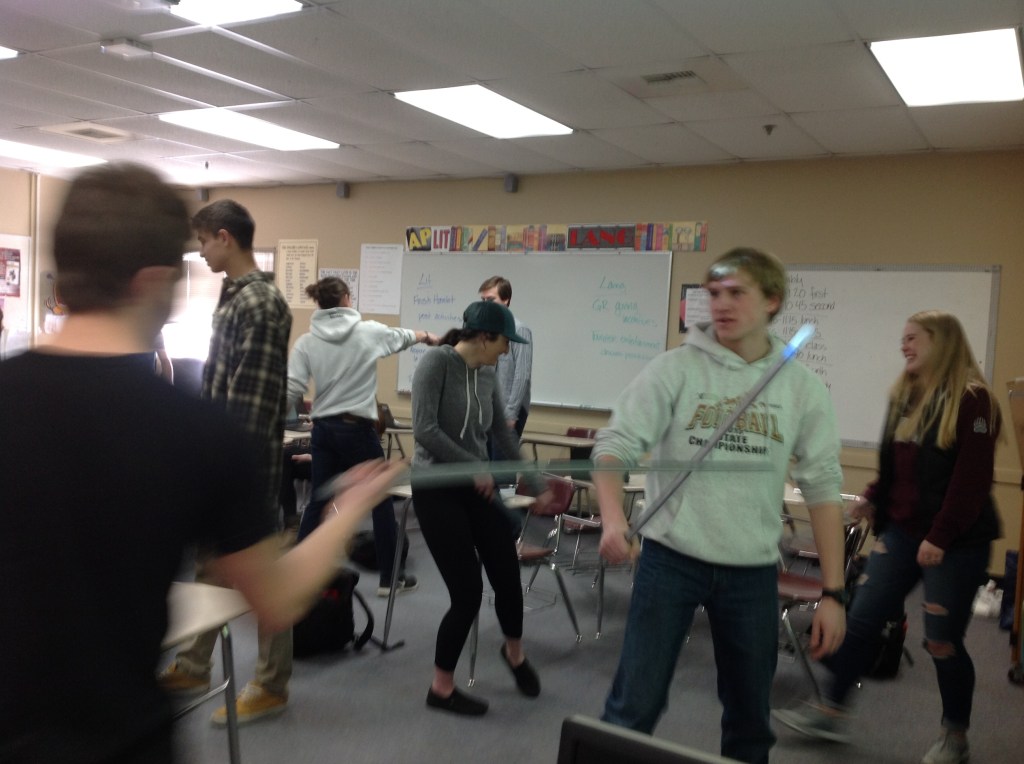
When I brought my new understanding of Hamlet to the classroom I brought back how to stage fight. It became a high point to the curriculum. There was a rumor that my AP students signed up for my class because of the opportunity to bash one another with my duck taped yardsticks. I tend to think it was because of my other teacherly attributes. Nevertheless, those who signed up earned the caveat of learning how to stage fight.
At the end of the unit students would pair off and after demonstrating the basic five moves they would create their own routine. Swordplay helped students understand how Shakespeare created tension in the last act of Hamlet, at least that’s how I justified the inclusion into the curriculum.
No injuries during our sword fights. Can’t say the same for the swords. A few causalities. Thank goodness for duct tape.
After learning the basics of stage fight students readily joined in and were invited to show off their “homework” to the rest of the class. For myself, I better appreciate fight scenes, especially sword duels, having somewhat been there, done that. Shakespeare knew how to keep his audiences interested by throwing in some action to the plot. And I learned that getting students up moving about (bashing each other under supervision) goes a long way into keeping my classroom audience interested in the curriculum.
Shakespeare knew how to get to the point of his stories–keep them on the edge of their seat. Same goes for teaching.
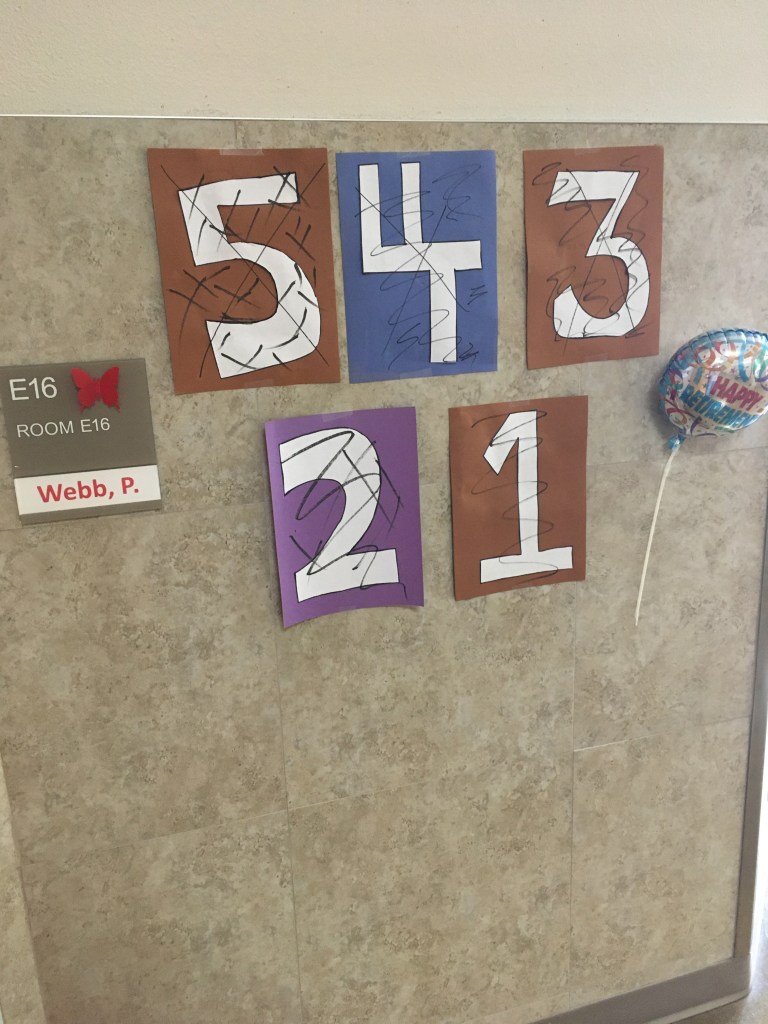
Monday marked the closure of my teaching career. A rounded off twenty years of teaching: 19 in the classroom with 1 year as the credit recovery coordinator.
Our school holds a retirement breakfast and each principal or supervisor says a few words about their retiring staff member before handing over a handsome plaque. My principal did say a few nice words then stumped me with an obscure Shakespeare quote. With a reputation as the resident Bardinator he must have thought I would be able to quote what play it hailed from. If I had known there was going to be a pop quiz I would have studied the night before.
WHEREOF WHAT’S PAST IS PROLOGUE; WHAT TO COME, IN YOURS AND MY DISCHARGE. —The Tempest, 2.1 (missed this one, so distracted by Ariel and Caliban)
Our vice-principal, who handles most of the disciplinary issues, decided a mild roasting was in order. He declared me the most prolific behavior referral writer among the staff, keeping him busy (isn’t this called job security?) and handed me “Webb’s Greatest Hits”—a thirteen page document of all my discipline referrals over my classroom tenure. (Isn’t this just doing my job with dedicated zeal for behavior modification?)
Post breakfast meant turning in my phone, keys, and final farewells. Being homeless, since another teacher was moving into room with gusto, I left. Basically my teaching career ended before 10 am. That’s a ponderful thought: you can take away a teacher’s room but there is always room for teachers.
I spent the rest of the day reading, napping, finding a place to put away my accumulation of classroom stuff acquired over 20 years. That’s a very different post.
Over the past week people kept asking how it felt to be retiring. I had a different reply depending on the day. After all, it wasn’t over until my grades and keys were turned in. On this last day, the reality of leaving the career I inadvertently was herded into washed over me when a former student, now our study hall supervisor found me after the breakfast and said, “I’m sad you’re leaving. I’m happy for your retirement, but sad you’re leaving.” Yes, that’s exactly how I feel as well.
As how to spend the first day of retirement? It’s my birthday—so I’ll do whatever I want. It’s Flag Day to boot!














 Pam Webb