Yup, I’m a Shakespeare fan. I even reference my appreciation as a Bardinator, meaning I’ll be back for more in a determined manner (sans the accent).
Some use the term Bardolator, but I can’t say I idealize Shakespeare. I’m still learning about him, hence my given term, since I keep coming back for more.
Really real or not so real—that used to be my question
But I used to think WS was a phoney baloney.
*Gasp*
I know.
I fault my public education’s failure to introduce me to Shakespeare. Nothing in elementary or middle school and just a squeak of a mention in high school. Okay, I did watch Zefferelli’s R&J in the theater and was caught up in the drama, although understanding the dialogue was challenging. That Renaissance English floated over my adolescent head.
I didn’t fully understand Shakespeare beyond I knew he wrote some famous plays and had some poetry creds.
Then I got my teaching gig and realizing Romeo and Juliet was in the curriculum I quickly got myself up to speed.
Long story short I became known as the Shakespeare Lady at school. And over the years have had a fine time getting to know more about the Bard of Avon.
I even visited the Folger Library, which brings me to the important point: even though Shakespeare is such an incredible influence why is there so little known about him?
That niggling doubt of “Was Bill for real?” pops up. Which brings me to the discovery of this article.
It makes sense doesn’t it? Why haven’t historians done the CSI thing sooner and dust for prints or his DNA before?
To think a bit of William might be found cozied in books he could have read is fairly cool. It makes me rethink how much of me is left behind in all those books I’ve read.
I’m with David Tennant on the question of whether or not of Bill. I don’t really care. I simply enjoy his works. And I’ll be back for more.
When the Montana Shakespeare Troupe arrives in August to our fair town, it is a generally accepted acknowledgement that summer is on the wane. Pleasant weather still lingers, although it is a bit chill in the early morn and evening. There remains the essence of summer.
And then the calendar chimes out its equinoxal announcement that summer is past and autumn is now upon us. I’m not quite ready to bring in the patio furniture yet.
Shakespeare eloquently presents a metaphorical passing of one’s age in his often quoted Sonnet 73:
That time of year thou mayst in me behold
When yellow leaves, or none, or few, do hang
Upon those boughs which shake against the cold,
Bare ruin’d choirs, where late the sweet birds sang.
In me thou see’st the twilight of such day
As after sunset fadeth in the west,
Which by and by black night doth take away,
Death’s second self, that seals up all in rest.
In me thou see’st the glowing of such fire
That on the ashes of his youth doth lie,
As the death-bed whereon it must expire,
Consum’d with that which it was nourish’d by.
This thou perceiv’st, which makes thy love more strong,
To love that well which thou must leave ere long.
Back when in my AP teaching days, this was a poem we studied for its rich imagery and underlying message of mortality. However, bypassing an analysis (I hear that sigh of relief), I do want to focus on the last two the lines, the ending couplet. In the previous lines the speaker has expressed his concern how he is aging to his lover (maybe even a child–oops, that’s analysis) and in the ending couplet we see the volta, or turn, that indicates a change of mood. Here the speaker interposes the thought that though he might be aging in his own eyes, and in perhaps his lover’s eyes, it is this very state of aging that should initiate an even deeper love for the narrator. In other words, though summer (his youthfulness) is diminishing and hints of winter are coming (touches of grey in hair), this season of in between, autumn, should be even more cherished as it is the in between time before winter is fully realized.
Yeah, what Shakespeare said.
I welcome spring, enjoy summer, and embrace fall. Fall or autumn still has the warmth of summer, yet it ushers in harvest and nature’s graceful transition into a foliage showcase of beauty. Since retirement I am taking advantage of the gentle warmth of September afternoons. Previously (20 years worth) I wouldn’t get home until after the shadows filled my backyard and I would mourn having missed out on the sunshine having been inside a building all day (okay, mourn is a bit extreme, but I really disliked having to wait until the weekend to enjoy the fall sunshine).
If you identify with parent of school age children, then I commiserate with you for the back-to-school shopping marathon. Well, yes, it is exciting getting the kiddos ready for another (or their first) foray into the classroom routine. But it is tiring and expensive.
If you are a student, you are either bummed or excited, or perhaps a bit of both, since it means put a pause on summer fun in order to focus on the mojo needed to get into the school routine.
As a teacher, you are no doubt either already back in the classroom (depending on where you teach) or bum-weary from having to sit through endless admin-led meetings while you would rather be preparing your room.
None of the above? You are probably then retired or an empty-nester or perhaps neither a parent or teacher, although you vaguely remember your September back-to-school days.
This marks my fourth September I will not be returning as a teacher, yet I found myself back on campus anyway. My retirement days are centered around books: I’m either reading them, writing them, or doing something with them that is library related. Today I dropped off a box of donated of books to a couple of schools, one of which was where I formerly taught English.
Yes, it was strange.
No, I didn’t miss it.
Yes, I briefly said “howdy” to some former compadres. And yes, I delivered my usual line of “I highly recommend it!” when asked how I like being retired.
Okay, fine–I do miss some aspects of being a teacher, such as getting to know my students, watching them catch the spark of appreciating literature, lunch time sessions with teacher chums, and staff meetings (just kidding on that one).
So, here is hoping your back-to-school blues aren’t severe, and hoping the school year is fabulous, whether you are in a school desk, behind the teacher’s desk, or planning a cruise since everyone else is back in school.
I have been a library fan since elementary school. I think my high school year book proclaims I wanted to be a librarian when I grew up. Although my degree ended up as a writing teacher I was a librarian for the first half of my work career and when I switched into the classroom reading and library skills were part of the curriculum.
Now that I am retired I’m a Friends of the Library volunteer and I’m there two-three times a week working with donations.
When I go on vacation I always check out the library. Hawaii, Washington DC, Seattle, Okinawa—I visited all of them.
So, I’m combining National Library Week with National Poetry Month with a POM (Poem of the Month). Emily D recognizes how books are like a ship that sails us to different shores.
There is no Frigate like a Book To take us Lands away, Nor any Coursers like a Page Of prancing Poetry – This Traverse may the poorest take Without oppress of Toll – How frugal is the Chariot That bears a Human soul.
I once worked in a Petri dish. Working in a school there is always the possibility getting infected with something–simple stuff, like a cold to gross stuff like pink eye. In twenty years teaching I managed to avoid the worst of it: Covid.
BC: Before Covid there was the usual dealing with colds, flu, even walking pneumonia, yet knowing recovery would be around the corner helped get through those times. Sick days taken, taking time to get healthy–all a given.
Then–2019. Masks, disinfectant, isolation, on-line education, tests kits, and other aspects became de rigueur.
Going back into the classroom amidst a pandemic compounded the usual stress that comes with working in education. Early retirement sounded better and better.
Wait a minute, two years into retirement, essentially living like a hermit, picking and choosing which places and opportunities to go and participate in, living a careful preventative life (get a booster, wear a mask if feeling sniffly) just how did Covid arrive on my doorstep, especially having avoided it all that time surrounded by it when teaching?
Well, it began with that little back of the throat tickle, the one that says “Hey, a cold might be coming–take care.” Not being sick for two years (funny how getting away from that Petri dish almost guarantees better health), I thought, “I guess I can handle a cold. Three days tops.”
It wasn’t a cold.
DC: There was that niggling suspicion something was amiss. The next day I woke feeling miserable. The yuck truck slammed into me with a fever, aches, and the need for a constant supply of tissues. Deciding to finally make use of that little government kit that’s been up on the shelf gave me that dreaded indicator: Covid.
The shock hits because of all the horrible stories come to the surface: losing smell and taste, getting hospitalized, even dying. It’s almost akin to getting snakebit. I absolutely did not seeing it coming.
Sparing details. I did cancel appointments (even one that took four months to get and now it’s pushed back to February) and isolated. Awkward and inconvenient in a small house. I immediately put a request into our church prayer chain and hunkered down. Three weeks later the symptoms are abated although stamina is not quite 100%, I am feeling better each day. No fever for over two weeks and so I hustled over to my pharmacy and got both my Covid booster and my flu shot. I’ve lost five pounds (no complaints) and my appetite is severely reduced. That could be a positive.
AC: After Covid? I’m cautious about being caught in close crowds. While I did not wear my mask as much once getting my initial booster I do now, learning that getting a booster helps reinfection is possible.
Exactly how I felt
What’s really strange is my son called to check on me, unbelieving I had never had Covid considering I was teaching during the height of the pandemic. He had already gone one round with it (living in a large city has its disadvantages) and the next day he texted to let me know he had woke with a fever and tested positive. Can Covid be transmitted by phone call? Yikes.
So–stay well and do what you need to do to stay healthy. That yuck truck is a reckless driver.
The day after Labor Day is traditionally when school starts. It signifies for most the end of summer and the beginning of nine long months of spending daylight hours in the classroom occasionally, and mostly wistfully, glancing out the window, anticipating being released from the four walls of education.
I imagine students feel the same way.
Is it June yet?
Before I retired from teaching I did look forward to the first day of school—kind of. Truth be told the first day of teaching, at least at the high school level, can be awkward for both students and teachers. Getting names right, going over expectations, trying to establish a rapport, returning to a scheduled routine of bells dictating the day week after week.
Wait—
Sounds a bit despondent, doesn’t it? Don’t get me wrong. I enjoyed being a teacher. I just enjoy being a retired teacher so much more. I’m in good company.
Recently I gathered with around 25 other retired teachers from our local high school for our annual get together. It’s always scheduled on the day teachers have to report to school for in-service meetings. I think that’s it meant to be a wink and a nod that we don’t have to be there anymore. We all agreed being retired is better than being tired again and again, something that occurred when teaching.
This will be the third year I will not be returning to school. People have been asking me if I miss teaching and are often surprised when I quickly say, “Nope.” Teaching is hard work. And teaching became harder because of Covid. In fact, talking to friends who still teach, Covid is still impacting teaching. It’s probably not going to get any easier.
So while I don’t miss teaching, I do miss being a teacher. Then again while I might not be currently teaching I will always be a teacher. You know the saying: You can take the teacher out of the classroom but she will kindly decline offers to return once retired.
Oh, there’s a different saying?
Happy Tuesday-after-Labor Day to students and staff. Hope your year is pleasant and enriching.
Excuse me while I plunk myself in my hammock and read another book in my retirement.
Summer events that create a more memorable season start with graduation ceremonies. Toss in at least one wedding or a wedding reception along with a church picnic, add in the county fair, include a bit of company to round it all out.
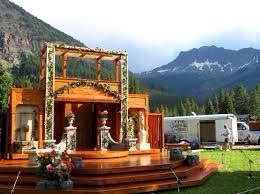
While those events add some pizazz to the summer months, I do count on Shakespeare in the Park. The one day performance arrives in the middle of August and I stop, drop whatever I’ve planned, and position my camp chair on the lawn at the designated park venue and for two hours I revel in Shakespeare.
This year The Montana Shakespeare in the Parks presented their two hour adaptation of Hamlet. Their version focused on what seemed to be Edwardian costume style adding a reserved aspect which offset the emphasis on pulling in the comedic components of the play. I never considered Hamlet a comedy; then again some of lines are quite witty when said with panache.
All the world’s a stage or at least a park is for a summer evening
I didn’t become aware of Hamlet until I began teaching high school English. In fact, I wasn’t aware of Shakespeare until I began teaching his plays. That’s right. Somehow twelve years of public schooling and six years of college and no Shakespeare classes. Shocking, I know.
Once I discovered the tragic Dane there was no turning back. Not only did I teach Hamlet, I set out to watch every version available (still trying to find Jude Law’s Broadway version). One year I flew back to Washington DC to join 29 other teachers for a week of Hamlet Academy at the Folger Library. I then went on to write a choose-your-own path Hamlet, and created the play as a contemporary murder mystery.
Yes, I have become Hamletized and I am okay with that.
Which Shakespeare play has grabbed your attention to the point of almost unreasonable fascination?
This marks my 1000th post with WordPress. Wow! That snuck up fast.
I began a blog a few years back (2012?!?)as a means of diving into the social media pool, which was a strong suggestion from an editor at a writer’s conference. After some initial research WordPress seemed to be the best format to go with and I joined up creating my Cricket Muse persona. I wrote about life as a teacher, writer, reader, and reviewer. I’m sticking with the same routine, and have added monthly posts: Bard Bits (all about Shakespeare), How Cliché, (those overdone everyday sayings we use), and Word Nerds (awesome vocabulary choices). Although I am now retired, I still reference my days as a teacher. You know the saying–You can take the teacher out of the classroom but you can’t take the classroom out of the teacher.
Up until 2020 I wrote as Cricket Muse and then when my debut picture book hit the bookstores (timed around when bookstores, libraries, and schools shut down for the Pandemic–so much for a live book launch) I revealed my true identity as Pam Webb. I really did like that alter ego anonymity, but I had made a promise to myself that I would create a professional website once I became published. Here I am three years into being a published author and so far so good.
The perfect gift for grandparents and grandkids!
Along the way as a blogger I made some friends, bloggy pals, Mike Allegra ‘s term. To me a bloggy pal is someone who leaves commentary, going beyond just liking a post. Mike has plenty to say and is a longtime bloggy pal. He and I even had a fun little exchange for awhile called Debateables, where we debated on topics related to children’s literature. Check out this lively season-related Debateable concerning reindeer versus penguins.
Other bloggy pals collected along the way are Chelsea Owens, who runs a bad poetry contest–her term, not mine (and thank you for being a Someday supporter, Chel), Mitch Teemley, who is creative, prolific, and funny (thanks for featuring my blog, Mitch!), Tref, provider of unique perspective in his blog Trefology (thanks for popping in now and then with your punnery, Tref), Pete Springer, fellow retired teacher who keeps me posted about Humboldt life (thanks for your genuine insights, Pete), Jilanne Hoffmann, who shares a love of kid lit (thanks for the author support, Jilanne!).
Sadly, there are many posters who have disappeared over the years–supposedly the average life span of a blog is 100 days. I guess I’m just tenacious or I am not ready to give in to being a statistic. To those former bloggy pals, you are missed. On the other hand I have seen an uptick in new commentators, like Boo, Kimber Templin, Becky Ross Michael, Gary Anderson, Cathy Native Cain, Damyanti Biswas, Amy of Hearthridge, Tish Farrell, Rachel Mankowitz, Book Loving Grandma, and a few others.
I look forward to contributing at least another 1,000 blog posts. Thanks for stopping by and hope to add you to the bloggy pal list.
Shakespeare is known for his wordplay. He is less acknowledged for his swordplay. He could act, direct, write, and he could wave a sword quite well. Shakespeare’s audiences liked to be entertained and the Bard aimed to please. His plays had a combination of drama, comedy, and action. One audience pleaser was a swordfight.
These days theatre doesn’t depend on one brilliant person to create play wonderment. There are many essential components such as costume and set design, directors, producers, actors, sound, and choreography. Choreography usually involves dancing. It can also mean another kind of fancy footwork: sword fighting. A fight director’s goal is to make the audiences believe the characters are trying to smite one another. The smiting has to be convincing without injury. This is tricky stuff, as I learned.
When I studied Hamlet at the Folger Shakespeare Summer Academy a few years back, we, of course, studied the play’s text, and we also studied the great duel in the last act by studying how to fight with swords. Actually we fought with wooden dowels. And yes, it was lots of fun and really cool.
We stopped traffic in Washington DC. That’s saying something.
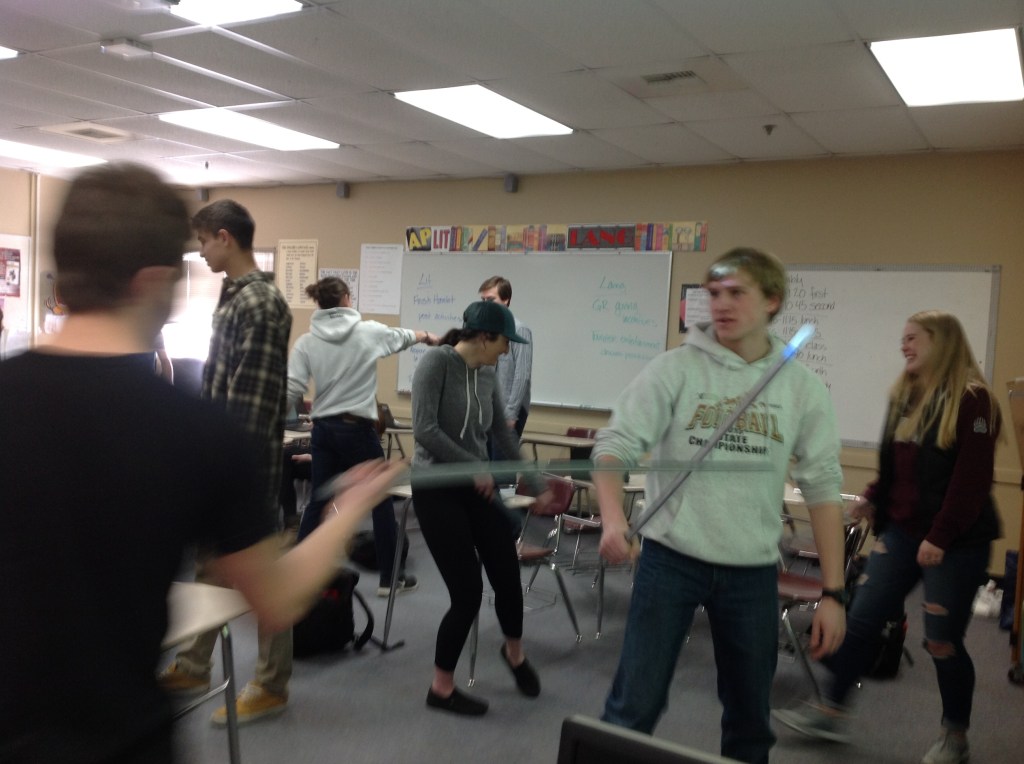
When I brought my new understanding of Hamlet to the classroom I brought back how to stage fight. It became a high point to the curriculum. There was a rumor that my AP students signed up for my class because of the opportunity to bash one another with my duck taped yardsticks. I tend to think it was because of my other teacherly attributes. Nevertheless, those who signed up earned the caveat of learning how to stage fight.
At the end of the unit students would pair off and after demonstrating the basic five moves they would create their own routine. Swordplay helped students understand how Shakespeare created tension in the last act of Hamlet, at least that’s how I justified the inclusion into the curriculum.
No injuries during our sword fights. Can’t say the same for the swords. A few causalities. Thank goodness for duct tape.
After learning the basics of stage fight students readily joined in and were invited to show off their “homework” to the rest of the class. For myself, I better appreciate fight scenes, especially sword duels, having somewhat been there, done that. Shakespeare knew how to keep his audiences interested by throwing in some action to the plot. And I learned that getting students up moving about (bashing each other under supervision) goes a long way into keeping my classroom audience interested in the curriculum.
Shakespeare knew how to get to the point of his stories–keep them on the edge of their seat. Same goes for teaching.
Though school had a smidge more to go, I was already in vacation mode. And this June marked the beginning of an endless vacation as I shut the door to my 20 years of teaching and embarked on retirement.
Summer has always been my read, read, read season. No lesson plans, no assignments to grade, no researching to add sparkle and sizzle to standards and their expectations, and of course, there is the lounging in bed early and late with a good book. *
Summer is a great big “Aah!”
Any hammock aficionados out there?
Starting out strong with nine books, I bogged down in the middle of June when I took on Lorna Doone, which took the rest of June and into July—but it was worth all 700+ pages.
Two ⭐️ ⭐️ ⭐️ ⭐️ ⭐️ reads:
The Wanderer by Sharon Creech
5 star read
Sharon Creech’s novels continually provide riveting portraits of family dynamics. The Wanderer is another exploration into a family mystery. Like Walk Two Moons, a young girl is a captive narrator with family members delving into her past while journeying towards her future. In this story, Sophie is part of a crew sailing to England to visit with her grandfather “Bompie.” Although adopted, she sees herself immersed with the lives of her two cousins and three uncles, yet the closer they sail to England the more she realizes she has a past family that must be acknowledged. Sophie’s lyrical journaling is intertwined with her cousin Cody’s off-the-cuff observations creating a unique journey story.
Pardonable Lies by Jacqueline Winspear
5 star read
The third book in the Maisie Dobbs series finds Maisie taking on three cases that push her to her limits of emotional, physical, and personal belief capabilities. Two of the cases lead her back to her war years, causing her to revisit France, forcing her to face past “dragons.” She relies on Billy, her valued assistant, to sleuth the London case as her investigations take her deeper into her own past while searching the past of two former soldiers. A layered plot, surprise twists, and full characterization create a more than satisfying read.
Four star ⭐️ ⭐️ ⭐️ ⭐️ reads of note:
The Clearing by Heather Davis
4 star read
For fans of Tuck Everlasting and The Time Traveler’s Wife. A book that flirts with the possibilities and impossibilities of time pockets. Amy moves in with her great aunt Mae in order to restart her life. Moving from Seattle to a small town takes adjusting, especially when there is mist in the clearing beyond her aunt’s house that divides the time between the 21st century and 1944. An interesting premise that works fairly well, although the ending is a bit muddled.
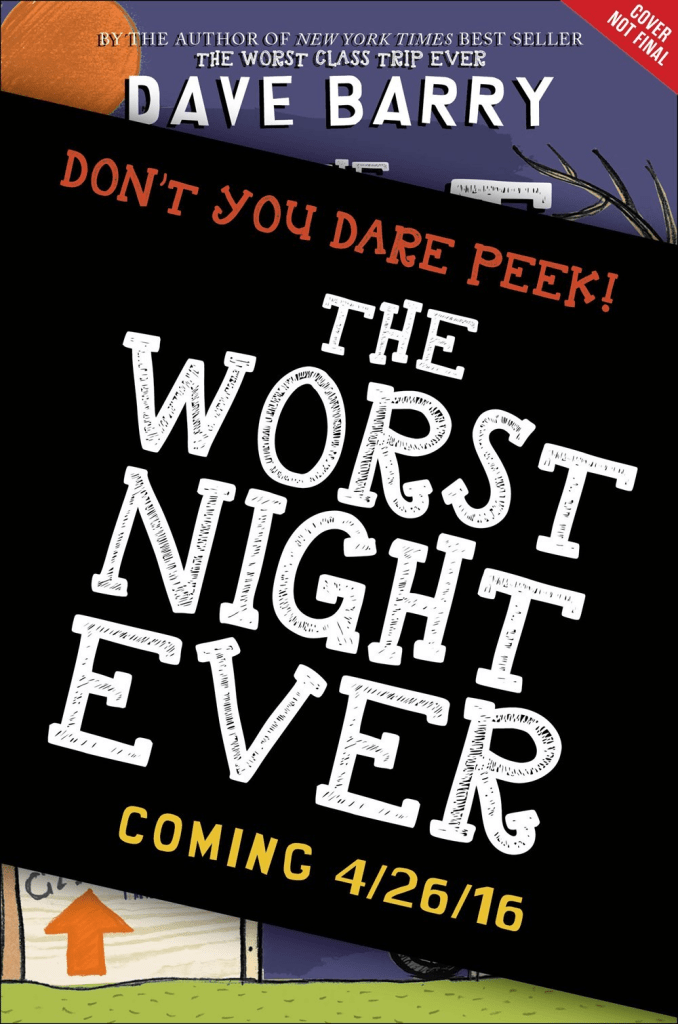
The Worst Night Ever by Dave Barry
4 star read
If Dave Barry wrote a book for the juvie crowd it would be funny, right? It would be implausibly plotted, right? Hyperbolic humor, right? That is exactly what is found in The Worst Night Ever. Although the second in his “Worst” series it reads as a standalone. It begins with Wyatt becoming a target for the menacing Blevin twins and moves toward an espionage recon rescue of a ferret to thwarting an evil plot involving killer critters. At times darn right silly, often times snortfully funny, Barry writes a fun story for the middle school set.
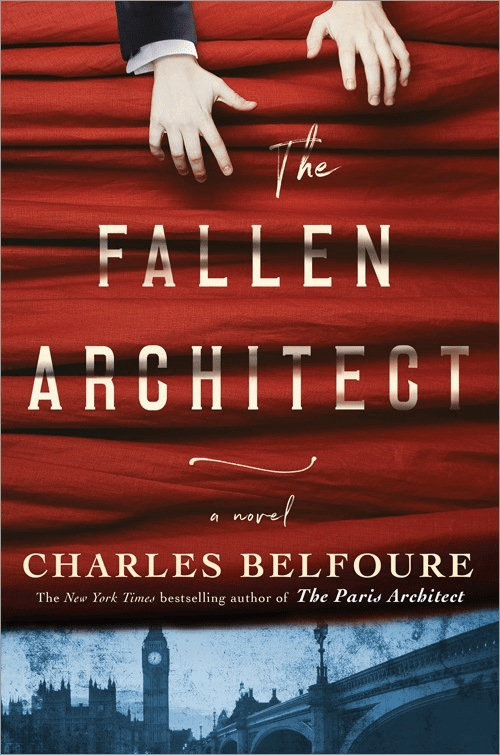
The Fallen Architect by Charles Belfoure
4 star read
This murder mystery comes from the angle of a architectural point of view. A prominent architect is blamed for the collapse of a theatre’s balcony which kills over a dozen people. After serving a prison term of five years he tries to rebuild his life after everything has been taken from him: status, family, home. Plus, he is reviled by the public causing him to change his name, appearance and occupation. A unique and somewhat refreshing approach to the murder mystery genre. A bit heavy on the emphasis of the variety theatre history, which slowed the plot down at times; however, plenty of colorful characterization and plot twists make for a satisfying enough read to seek out the other titles.
The Eyes of the Amaryllis by Natalie Babbitt
4 star read
With magical realism leaning towards a fairy tale, Babbitt creates a thoughtful story of everlasting love. When the Amaryllis disappears mysteriously during a storm, the young captain’s wife and son grieve differently. The son runs from his grief to live inland while his mother grows old in her seaside cottage watching for a sign from her beloved captain. Enter in a visit from the granddaughter who is pulled into the grandmother’s need to know whether her true love, her lost-at-sea captain-husband still thinks of her. The grandmother believes nothing is impossible, and once again Babbitt spins a story that makes readers willing to believe the unbelievable, just as she did in her classic children’s tale, Tuck Everlasting.
*This feeling usually lasts through July, until Staples, Target, Wal-Mart and the consumer world decides its time to get ready for school–while it’s still clearly summer vacation for most of America. Minor panic begins to set in as I align and adjust and realign and readjust my curriculum, class website, and start diving into district emails. August sees a big dip in reading.**
**Not this year. The <delete> button is a marvelous coping mechanism for retired school teachers. I look forward to bypassing back-to-school frenzy and continuing on in my Book Bingo adventure.
















 Pam Webb