Pam Webb

a writer's journey as a reader

Archive for the category “Writing”

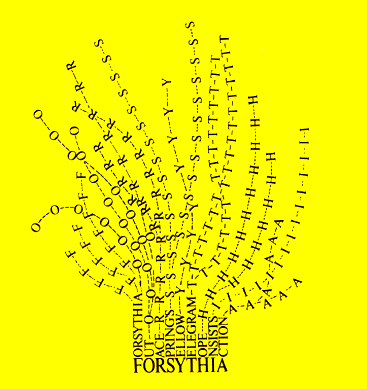
Shaping Up Poetry: Concrete Poems


One thing I truly enjoy about poetry is its diversity when it comes to form.  This week I’ll be featuring a variety of poem forms.  First up is concrete poetry.  Take it away Wikipedia:

George Herbert‘s “Easter Wings”, printed in 1633 on two facing pages (one stanza per page), sideways, so that the lines would call to mind birds flying up with outstretched wings.

Concrete poetry or shape poetry is poetry in which the typographical arrangement of words is as important in conveying the intended effect as the conventional elements of the poem, such as meaning of words, rhythm, rhyme and so on.

It is sometimes referred to as visual poetry, a term that has evolved to have distinct meaning of its own, but which shares the distinction of being poetry in which the visual elements are as important as the text.

Now that the definition is out of the way here are some examples.  Enjoy!

My students adore this form due to its playful nature, and I can often coax a poem out of them through shaping the words.  I encourage you to experiment or at least to look up more examples.

Happy Poetry Month!

Put a Poem In Your Pocket


Poem In Your Pocket Day

Although it’s National Poetry Month and poetry is being celebrated all month long, there is one special day of celebration:  Poem in Your Pocket Day on Thursday, April 18, 2013.

Simply select a special poem, one you enjoy or has a special meaning and share with co-workers, family, friends, and maybe even strangers. For those who  Twitter  share with the hashtag #pocketpoem.

Go to Poets.org to find out about special events planned around the day or how to organize your own.

Check out this amazing community event:

A Triptych of Daffodils


The Poem

The Daffodils (I Wandered Lonely As A Cloud)

by William Wordsworth

Portrait of William Wordsworth, by William Shu...

Portrait of William Wordsworth, by William Shuter, 1798. (Photo credit: Wikipedia)

I wandered lonely as a cloud
That floats on high o’er vales and hills,
When all at once I saw a crowd,
A host, of golden daffodils;
Beside the lake, beneath the trees,
Fluttering and dancing in the breeze.

Continuous as the stars that shine
And twinkle on the Milky Way,
They stretched in never-ending line
Along the margin of a bay:
Ten thousand saw I at a glance,
Tossing their heads in sprightly dance.
The waves beside them danced, but they
Out-did the sparkling waves in glee:
A Poet could not but be gay,
In such a jocund company:
I gazed—and gazed—but little thought
What wealth the show to me had brought:

For oft, when on my couch I lie
In vacant or in pensive mood,
They flash upon that inward eye
Which is the bliss of solitude;
And then my heart with pleasure fills,
And dances with the daffodils.

The Parody

http://www.youtube.com/watch?v=cv1L-8f2erg


The Possibility*

       JOY

Multicolored splendor
that’s just how my day has been
Confetti bits of happiness
round about me swirling
filled with
Dancing Bright Lights
of promise
Like spring after
a tedious winter–
a golden day filled
with pristine greens
The release of dark days
and the renewing
of earth’s
bounty
Liberating–
like the  spangle sparkle
of firecracker flickers punctuating
the night sky
Free–
grass blades shimmer emerald
tree leaves bud pink
robin song chuckle eloquent
Bright light points of promise
that dance out from the earth
tingling and jingling
into
smile
eyes
all in reach
catch that feeling
of delicious buoyant
bounce of new
and they, too
will become
Joyous like a chartreuse star
Confetti

Confetti (Photo credit: DuracellDirect)

*from the collection The Dance of Color (an exploration of synesthesia)

Imagery of Poetry


Poetry and imagery are synonymous. For fun I pulled a variety of images that celebrate National Poetry Month.

poetry

http://cabell.lib.wv.us/pages/bb-poetry09.html

Visit www.poets.ca to find out more about the League of Canadian Poets and National Poetry Month

http://lcpnationalpoetrymonth2013.wordpress.com/

From Poets.org poster gallery:

2012 Poster, designed by Chin-Yee Lai    2008 Poster  2006 Poster   2005 Poster

2004 Poster

2002 Poster                           2001 Poster

1998 Poster

1996 Poster   1997 Poster

I ordered my poster for this year, did you?

The Epicness of Poetry part two


Today we look at Homer.

This one:

Not this one:

Homer wrote The Iliad and The Odyssey, but you knew that.

These are both considered epic poems and boy, oh boy are they epic in the sense of BIG.  They are big in size (The Iliad is nearly 16,000 lines and The Odyssey is about 12,000), big on adventure, and have big heroes as well.  These two poems have also made a big impact on literature, culture, and on Hollywood.

Quick rundown:
The Iliad is mainly about Achilles and his fighting in the Trojan War (yes, think Brad Pitt in Troy), while The Odyssey is mainly about Odysseus and his adventures trying to get home from the Trojan War.

Cover of "Troy - The Director's Cut [Blu-...

Cover of Troy – The Director’s Cut [Blu-ray]

Why should you care about these really, really old poems (besides them being so incredibly epic)?  I’ll let the PhD expert analysis people at Shmoop explain all that:

The Iliad
You want large scale clashing armies? You’ve come to the right place. Even matched duels or obviously unmatched duels? Check out the long one-on-one combat descriptions, or that crazy nonsense between Paris and Menelaus. Spy thriller? Odysseus’s nighttime raid totally fits the bill. Nail-biting special ops missions? The Trojan Horse ruse has your name written all over it. Swords-and-sorcerers magic adventure? Try anything with the gods busting in on the action, like, say, that whole Laocoon fiasco. Snakes—yikes. In short, anything exciting you’ve ever seen or heard or read started right here.But that’s not all. Not only does the Iliad put the act into action, but it puts the philosophy in there, too. This isn’t just a reductive Good Guys versus Bad Guys bit of disposable nothing. Instead, what’s behind all that fighting is a whole lot of thinking about what the fighting means.
The Odyssey
Do you like stories full of adventure, danger, and suspense? How about stories set in fantastic worlds full of strange creatures like Cyclopses, witches, sirens, and gods? If so, then you’re in luck, because Homer’s Odyssey is Western literature’s original adventure story, and its first foray into the fantasy genre. If you need any proof of how much Homer’s poem defined this genre, just consider the fact that we now use the word “odyssey” simply to mean adventure.

Beowulf, The Iliad, and The Odyssey are old, or classic, epic poems.  We now move on to contemporary, or considerably younger epic poems.

Next Post: Lost in Paradise is not the same thing as Paradise Lost

NPM FAQ


We are going into our second week of poetry celebration and some of you might not be aware of the why, hows, and whats of National Poetry Month.  And because I didn’t know much about its background I looked it up and thought y’all might like some elucidation on the matter. For even more information I suggest the site (from whence I borrowed these).

National Poetry Month Frequently Asked Questions or NPM FAQ:

  • What is National Poetry Month? National Poetry Month is a month-long, national celebration of poetry established by the Academy of American Poets. The concept is to widen the attention of individuals and the media—to the art of poetry, to living poets, to our complex poetic heritage, and to poetry books and journals of wide aesthetic range and concern. We hope to increase the visibility and availability of poetry in popular culture while acknowledging and celebrating poetry’s ability to sustain itself in the many places where it is practiced and appreciated.
  • Who started it? The Academy of American Poets has led this initiative from its inception in 1996 and along the way has enlisted a variety of government agencies and officials, educational leaders, publishers, sponsors, poets, and arts organizations to help.
  • When is National Poetry Month? April. Every year since 1996.
  • Why was April chosen for National Poetry Month? In coordination with poets, booksellers, librarians, and teachers, the Academy chose a month when poetry could be celebrated with the highest level of participation. Inspired by the successful celebrations of Black History Month (February) and Women’s History Month (March), and on the advice of teachers and librarians, April seemed the best time within the year to turn attention toward the art of poetry—in an ultimate effort to encourage poetry readership year-round. <!—-T. S. Eliot wrote, “April is the cruelest month.” It is our hope that National Poetry Month lessens that effect.On a lighter note, Chaucer wrote:

    Whan that April with his showres soote The droughte of March hath perced to the roote, And bathed every veine in swich licour, Of which vertu engendred is the flowr

    Finally, Edna St. Vincent Millay asked, “To what purpose, April, do you return again?” For National Poetry Month, of course!—>

  • What are the goals of National Poetry Month? The goals of National Poetry Month are to:
    • Highlight the extraordinary legacy and ongoing achievement of American poets
    • Introduce more Americans to the pleasures of reading poetry
    • Bring poets and poetry to the public in immediate and innovative ways
    • Make poetry a more important part of the school curriculum
    • Increase the attention paid to poetry by national and local media
    • Encourage increased publication, distribution, and sales of poetry books
    • Increase public and private philanthropic support for poets and poetry
  • Shouldn’t we celebrate poetry all year round, not just in April? By all means, yes! We encourage the year-round, life-long reading of poetry. National Poetry Month is just one of the many programs of the Academy of American Poets. To keep the celebration going, consider becoming a member of the Academy and receive special benefits and privileges year round. You can also subscribe to receive daily poems by email for free, all year long.
  • How does the Academy celebrate National Poetry Month?
    • Posters: Each year the Academy creates and distributes nearly 200,000 official NPM posters, which are mailed for free to teachers, librarians, and booksellers nationwide.
    • Events: The Academy presents several special events and readings in April, including our star-studded annual Poetry & The Creative Mind.
    • Publicity: To ensure that poetry gains national attention in the media each April, the Academy sends press releases to editors and journalists across the country. As a result, thousands of articles about poetry appear in newspapers, magazines, and online media outlets. The Academy also acts as the official clearing house for news and information about National Poetry Month.
    • Inspiration & Guidance: The Academy offers a plethora of practical resources for celebrating NPM, including tips for teaching poetry during April, creating a poetry book display in your bookstore or library, presenting a poetry reading or contest, and much more.

I feel much more informed having read through all of these.  Frankly, I though April was chosen to offset the sting of taxes and because April is when spring begins to do its thing more clearly. Goes to show, how much I didn’t know. Can’t stop rhymanizing my sentences–must have to do with all the poetrizing I’m doing these last few days.

Happy National Poetry Month!

(not)

Frost Covered Spring


Robert Frost. My first meaningful encounter with poetry occurred in fifth grade when Mr. C (still my favorite teacher) had us memorize “Stopping By Woods” and then we chalked our impressions of the poem onto dark blue construction paper. These were then pinned all around the classroom as the border above the chalkboard. As I teach this poem to my students I learn more and more from it. Frost does that with his poetry. It appears so deceptively simple at first and then there is a realization of its depth. It can be almost embarrassing at times once the analytical epiphany hits.

But I can’t imagine Frost laughing at my denseness–no, he would probably only chuckle. I imagine he might even be amused at the fuss we make analyzing his commentaries on birches, walls, and the snowy woods.

Frost is one of my faves and thought it very appropriate to feature him first among the many poets I hope to spotlight this month.

Here are a smattering of favorite poems:
“Mending Walls”
“Acquainted With The Night”
“The Road Not Taken”
“Fire and Ice”
“Nothing Gold Can Stay”

What are your favorite Frost verses? For some reason whenever spring arrives I tend to think of Robert Frost. Maybe this is fitting–a bit of Frost helps us appreciate the warmth of spring. I think he realized that as well.

Happy Poetry Month!

20130401-215741.jpg

Playing Around with Words


The Script Frenzy logo

The Script Frenzy logo (Photo credit: Wikipedia)

Writing is what I do.  I teach it. I read it. I aspire to it.  I’ve tried all forms of writing: picture books, poetry, novels (middle readers, YA, adult), non-fiction (essays, informational, reviews), oh yeah–blogs.  My latest foray into wordsmithing is plays.  I gave up on screenplays since the format and competition didn’t work for me.  Then I switched to stage plays.  Oooh, I do very much like them.  NaNoWriMo used to run Script Frenzy, a spring version of novel writing in a month that involved writing a play in 30 days.  I tried it and definitely find a new niche.

Even though Script Frenzy retired, I got inspired. So far I have created a contemporary version of Julius Caesar and the school’s drama teacher showed interest in it, as did one of my students who called the role of Anthony.  I’ll keep you posted of the world premiere. I also morphed Hamlet and Alice in Wonderland, mixing in a bit Wizard of Oz. It’s definitely a work in progress, as they say.

Since screenplays didn’t pan out for me, I am converting them into stageplays.  I hope to dive into my languishing pile of manuscripts and toss them around in my Celtx program and see if they Presto! into plays.

Gosh! I  love writing!  There is such a variety and formats to try out and play with.  It’s like dress up with words.

Any of you try out a new writing form with success?

Pondering Poetry


1848 Daguerreotype of Edgar Allan Poe at 39, a...

1848 Daguerreotype of Edgar Allan Poe at 39, a year before his death (Photo credit: Wikipedia)

Poetry.  I sometimes hate to admit I love it.  It is misunderstood, mishandled, and would be missed should it ever be absent from our midst. As I teach AP I delve ever deeper in poetry and realize with some asperity I know nothing and have so much to learn.  Learning from the masters is a place to start.  May you also find solace and inspiration in these quotes found.

Poetry is serious business; literature is the apparatus through which the world tries to keep intact its important ideas and feelings.–Mary Oliver

I would define, in brief, the Poetry of words as the Rhythmical Creation of Beauty.
Its sole arbiter is Taste.
Edgar Allan Poe

A short poem need not be small.–Marvin Bell

A poem…begins as a lump in the throat, a sense of wrong, a home-sickness, a love-sickness…It finds the thought and the thought finds the words.–Robert Frost

Robert Frost NYWTS.jpg

image: Wikipedia.org


Genuine poetry can communicate before it is understood.–T.S. Eliot

For a man to become a poet…
he must be in love or miserable.
George Gordon, Lord Byron

I think like a poet, and behave like a poet.
Occasionally I need to sit in the corner for bad behavior.–Gary Soto

There is nothing wrong with a poetry that is entertaining and easy to understand.
Charles Bukowski

Poems reveal secrets when they are analyzed.
The poet’s pleasure in finding ingenious ways to enclose her secrets should be matched by the reader’s pleasure in unlocking and revealing secrets.
Diane Wakoski

A Quiver of Quotes


perusing through a recently acquired preview AP textbook, I couldn’t help but appreciate the assortment of writerly quotes sprinkled throughout the book.  A collector of words, I knew I had to gather them, and words, like arrows, fly straight, cleaving the mark true and fair when the marksman is skilled and the aim is practiced.  (ooh, maybe that will end up in a textbook someday…)

Never mistake motion for action–Ernest Hemingway


 It is not necessary to portray many characters. The center of gravity should be in two persons:  him and her. —Anton Chekov

Anton Chekhov

Anton Chekhov (Photo credit: blue_paper_cranium)

To produce a mighty book, you must choose a mighty theme.–Herman Melville

It is the writer’s privilege to help man endure by lifting his heart.–William Faulkner

For me, fiction is life transformed and fueled by imagination.–Dagoberto Gilb

A ration of failures is built into the process of writing. The wastebasket has evolved for a reason.–Margaret Atwood

When I’m asked what made me into a writer, I point to the watershed experience of coming to this country. Not understanding the language, I had to pay close attention to each word–great training for a writer. —Julia Alvarez

English: Photo of Julia Alvarez from Interview...

English: Photo of Julia Alvarez from Interview with LaBloga. (Photo credit: Wikipedia)

Not all things are to be discovered; many are better concealed.–Sophocles

Great literature is simply language charged with meaning to the utmost possible degree.–Ezra Pound

You must write.  It’s not enough to start by thinking. You become a writer by writing.–R.K. Narayan

Between my finger and my thumb
The squat pen rests.
I’ll dig with it.
Seamus Heaney


Post Navigation