Pam Webb

a writer's journey as a reader

Archive for the category “writers”

A Little Birdie Told Me


One aspect of blogging that is a definite benefit is finding new titles to read. Goldfinch by Donna Tarrt is one of those titles. Considering it received the Pulitzer and had so many varied reviews–Loved it!” “Hated it!” I had to decide for myself. I will never truly know how I might have liked it. It’s been relegated to my rare “didn’t finish” designation on my Goodreads tab.  Why?  Admittedly, it takes quite a bit for me to *gasp* abandon reading a book.

image: nytimes.com


Here are my impressions:

  • Plot interesting although contrived. I work with teenagers and I have yet to come across any who talk like they are fourteen going on thirty-four.  I know. I know. It’s a novel and there are liberties called artistic license.
  • I’ve read BIG books; however, the story needs to justify the length. Melville or Dickens, this is not. Instead, I found myself getting more and more irritated as  Theo, the protagonist, reveled in TMI (too much information). It’s like being caught in a conversation with someone who keeps adding on instead of continuing on with their story.  I didn’t find all the extra detail to be that significant to moving the plot along.
  • I also found the stereotypes disappointing: the out-of-touch adults trying to counsel Theo; the genius, yet nerdy friend; the dysfunctional wealthy family; the unconventional adult who becomes Theo’s island of solace.
  • Here is the real clincher. I could have continued with the reading. There is enough intrigue and character investment that I had a desire to keep giving it a go, then the dreaded birdie kept flipping up unexpectedly. The boid, the random explosion of f-bombs finally annoyed me enough to say “done” and moving on. I understand profanity adds a certain aspect of verisimilitude; however, certain words remind me of pepper–sprinkle too much on and it actually hinders the flavor instead of enhancing.  The random f-bomb turned into a regular blasting zone and I began to wince. Here’s the deal: “Hey, Theo–you’re a nice enough kid, and you have a great vocabulary, so why the potty  mouth?”
  • I also wondered if this wasn’t  really a dressed out YA. A large portion of the book centers on Theo’s teen years. Then again, I didn’t mind reading Hunger Games; on the other hand, that IS considered YA.

Overall, I would have kept going to read the 700+ pages. It takes several elements for me to finally pull my bookmark and move on. I have way too many books I want to read to keep going with one that wears on me.

Twofold commentary requests here:

1. Anyone agree or disagree with my Goldfinch assessment?

2. How do you handle books that don’t live up to your expectations?  Do you continue or do you move on?

Remaining the Orphaned Narrator


It is always exciting to discover a new-to-me author. In this case it’s Kazuo Ishiguro. I know, I know. I’m a bit late in my discovering; however, better late than never in finding an author of mesmerizing style.


I knew the movie Remains of the Day, before finding the novel and didn’t realize the movie was the adaptation.
How could I possibly pass up a film starring Anthony Hopkins and Emma Thompson?
Flash forward five years later and I’m perusing the AP Literature list (“read that one, will never read this one, not reading this one again”), when I recognized the title Remains of the Day and connected it to the movie. Then I read the author’s name and I must admit I expected something like Adrian Smythe or Winston Greene, not Kazuo Ishiguro. After all, the novel is about a very proper English butler and his reflections of what it takes to become the best of English butlers. Wouldn’t one need to be English to understand that sort of nationalistic pride? I’m not getting points here for narrow-minded thinking, am I?

It turns out Ishiguro is quite well-suited to the task of writing about the English since he moved to England when he was around six years old. This gives him the ability to have an insider’s view with a somewhat detached perspective. The result is  basically a stream-of-consciousness narrative concerning the tunnel vision of a man’s quest for the unattainable. Trying to live a life that is beyond reproach, to achieve a status of perfection, requires sacrifice. Can sacrifice be made without regret? This is the hidden truth Stevens, the butler is searching for, except he does not realize it.
A quest novel of notice did not go unnoticed, for Ishiguro’s debut garnered him the Man Booker Prize and set a bar. Would he be a one shot wonder or would this be the first work of a noteworthy word smith?

image: goodreads.com This cover indicates the layers found within the story.

My literary taste buds curious for more, I trotted down to the library. Grabbing any title of his that caught my eye on the  shelf, I opened up his fifth novel When We Were Orphans. I immersed myself in reading it to the point the MEPA queried, “Still a good book?” Yes, thank you. Prognosis? After reading two novels, indications are Ishiguro is wordsmithing wonder.

Here are some bio facts and  stats:

  • Two novels have been adapted to the screen, Remains of the Day, and the more recent Never Let Me Go. Both have been received well, considering Ishiguro’s stories are mainly first person narratives, making them difficult to translate into a cinematic plot.
  • His novels are historical in nature, with attention to detail.
  • The stylistic viewpoint is that of the unreliable first-person narrator, one who is flawed in outlook.
  • Although born in Japan, he did not return until thirty years later.
  • He has received four Man Booker Prize nominations
  • The Times ranked him 32 on the list of the 50 most influential British writers since 1945.

As for an actual review of When We Were Orphans, I leave it to the more qualified:
New York Times
 review:

I plan on continuing my course of exploring Ishiguro’s work and look forward to introducing a contemporary author to my APters, who, I’m sure, would like a break from dead white folk now and then.

Any thoughts on Ishiguro’s writing? Any suggestions for the next title I should read of his?

Wrap Up or Fall Flat


After five years of stop and go writing on my historical novel I’m nearing the end chapters. It’s rather intimidating. The ending involves the reuniting of a homestead mother with her family. The way I have presented the conflict is that there is some ambiguity of whether the mother left the family due to the grind of daily life as a pioneer women or if she wandered away due to fever delirium.
Here’s what I need to figure out:
-Is the husband readily accepting her leaving the family and not returning once she was better? (He’s a good guy overall, but was left with six children ages 3-15 to raise in her absence)
-How will the daughter (her POV) feel about her mama at this point? Anger, relief? This girl took on the task of raising her three ornery brothers and packed up her petticoats and put on pants to do so in order up keep up with them.

The right grab really counts… image: bodyresults.com


Reaching the end chapters is a lot like rock climbing. A cadence is developed in both–the reach and pull up towards progress. Just when the top is in sight, flat is sometimes hit, meaning no handholds and no way to go up. Finding a new path is sometimes the only direction left. Then again a risky move can be tried and what a sensation of exhilaration when it leads to success and pulling over the top.

Write now? I’m at that looking for a move that will pull me over the top.

So, writers–what do you do when you hit flat when the top ledge is in sight? Do you press on or look for a new route?

Poetry Workshop: Sestina


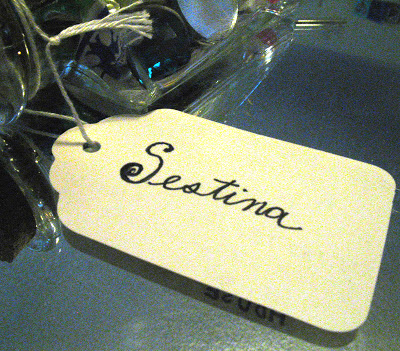
I thought there has been enough recovery time since the last workshop, which focused on the villanelle.  So, let’s move on to the sestina.


The image above intimates that the sestina can be neatly labeled.  Hmm, perhaps not.  Below is a famous example by Elizabeth Bishop.  I do like her work, if I haven’t mentioned that before.  This offering is simply called, “Sestina.”

September rain falls on the house.
In the failing light, the old grandmother
sits in the kitchen with the child
beside the Little Marvel Stove,
reading the jokes from the almanac,
laughing and talking to hide her tears.

She thinks that her equinoctial tears
and the rain that beats on the roof of the house
were both foretold by the almanac,
but only known to a grandmother.
The iron kettle sings on the stove.
She cuts some bread and says to the child,

It’s time for tea now; but the child
is watching the teakettle’s small hard tears
dance like mad on the hot black stove,
the way the rain must dance on the house.
Tidying up, the old grandmother
hangs up the clever almanac

on its string. Birdlike, the almanac
hovers half open above the child,
hovers above the old grandmother
and her teacup full of dark brown tears.
She shivers and says she thinks the house
feels chilly, and puts more wood in the stove.

It was to be, says the Marvel Stove.
I know what I know, says the almanac.
With crayons the child draws a rigid house
and a winding pathway. Then the child
puts in a man with buttons like tears
and shows it proudly to the grandmother.

But secretly, while the grandmother
busies herself about the stove,
the little moons fall down like tears
from between the pages of the almanac
into the flower bed the child
has carefully placed in the front of the house.

Time to plant tears, says the almanac.
The grandmother sings to the marvelous stove
and the child draws another inscrutable house

Anything standout? Anything noticeable?  Yes, there are repeating words. Six of them. Nicely done. Sestina–six: yup, there is a definite connection.

A sestina according to the Bing dictionary:

  1. Definition of sestina (n)

    Bing Dictionary
    • ses·ti·na
    • [ se stéenə ]
    1. form of poem: a poem of six six-line stanzas and a three-line envoy or, with the last words of the first six lines repeated, in different order, at the ends of the other lines

Using Bishop’s model, let’s explore how that really works.

Oh, by the way–if you are one of those who groove on numbers more than poetry, you will really like sestinas, because it’s all about patterns.

Okay. Here we go:

The structure of a sestina, in this case, Bishop’s “Sestina,” is six stanzas of six lines with a three line envoy (the conclusion of the literary work). The pattern is: 123456; 615243; 364125; 532614; 451362; 246531 with the envoy as 531 or 135.  Return to the poem and decide which six words repeat throughout the poem.

If you really want to see how a sestina works without all the extra word wading go check out “Six Words” by Lloyd Schwartz. Very, very clever.


Well, that wraps up another National Poetry Month. Thanks for stopping by. I hope you learned a bit along the way, and appreciated new-to-you poets and their poetry.


Poet Appreciation #10: Abraham Lincoln


We associate Abraham Lincoln with the Civil War, tall silk hats, a famous speech, a humble man with a distinctive beard, a day off in February, and the sadness that comes when great people are struck down too soon. Connecting our sixteenth president to poetry doesn’t usually pop up in the usual sixty-second classroom brainstorm activity.  And yet, here is proof Honest Abe had so much more to him than we give him credit for.

image: history.com

My Childhood Home I See Again
by Abraham Lincoln

My childhood home I see again,

And sadden with the view;

And still, as memory crowds my brain,

There’s pleasure in it too.

O Memory! thou midway world

‘Twixt earth and paradise,

Where things decayed and loved ones lost

In dreamy shadows rise, 


And, freed from all that’s earthly vile, 

Seem hallowed, pure, and bright, 

Like scenes in some enchanted isle 

All bathed in liquid light. 


As dusky mountains please the eye 

When twilight chases day; 

As bugle-notes that, passing by, 

In distance die away; 


As leaving some grand waterfall, 

We, lingering, list its roar– 

So memory will hallow all 

We’ve known, but know no more. 


Near twenty years have passed away 

Since here I bid farewell 

To woods and fields, and scenes of play, 

And playmates loved so well. 


Where many were, but few remain 

Of old familiar things; 

But seeing them, to mind again 

The lost and absent brings. 


The friends I left that parting day, 

How changed, as time has sped! 

Young childhood grown, strong manhood gray, 

And half of all are dead. 


I hear the loved survivors tell 

How nought from death could save, 

Poet Appreciation #9: Wallace Stevens


World War I affected the world in a way that changed forever our outlook on life. Losing 50,000 young men in one day alone, is a travesty of waste. Lost lives, lost dreams, lost generations have a profound impact. One section of the world culture which was touched was that of the artist in all forms. In poetry, the Modernist movement began with its focus on looking at how this brave new world affects us. T.S. Eliot is most frequented with modernist poetry with his offerings such as The Wasteland and The Lovesong ofJ. AlfredPrufrock.

Wallace Stevens

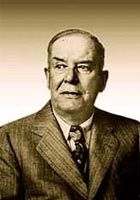
Another poet of that time, Wallace Stevens, is as important as Eliot in his contributions to Modernist poetry, although Eliot seems to pop up first in Modernist contribution conversations. Bio facts of note for Wallace:

  • didn’t get published until he 44
  • attended Harvard, but had to leave due to lack of funds
  • Editor for both of Harvard’s publications
  • His wife the model for the Liberty dime and half-dollar
  • Career primarily as an insurance lawyer
  • Won the Pulitzer Prize and National Book Award
  • His poetry collection, Harmonium, ignored by critics when first published, is now highly regarded
  • His home town of Hartford, Connecticut has a walk devoted to his blackbird poem with signs of each section along the way
  • Connoisseur of Asian art

Disillusionment of Ten O’Clock

The houses are haunted
By white night-gowns.
None are green,
Or purple with green rings,
Or green with yellow rings,
Or yellow with blue rings.
None of them are strange,
With socks of lace
And beaded ceintures.
People are not going
To dream of baboons and periwinkles.
Only, here and there, an old sailor,
Drunk and asleep in his boots,
Catches Tigers
In red weather.

Poet Appreciation #8: William Shakespeare


*Gasp* Billy Bard is celebrating his 450th birthday on the 23rd. I advise those attending the birthday party to stick to the crumpets and steer clear of the kippers, as they didn’t do ol’ William any good at his own birthday din celeb.

Would William be surprised to know how many Bardinators there are coasting about due to his most marvelous ability with words, wit, and retrofitting old tales into something more appealing?  Probably.  Ben Jonson knew his contemporary, and somewhat rival was “a man for all time.”

What better way to say “Happy Birthday, Bill!” than with a couple of his sonnets.

First, the Mona Lisa of his career:

SONNET 18

Shall I compare thee to a summer’s day? 
Thou art more lovely and more temperate:
Rough winds do shake the darling buds of May,
And summer’s lease hath all too short a date: 
Sometime too hot the eye of heaven shines,
And often is his gold complexion dimm’d; 
And every fair from fair sometime declines,
By chance, or nature’s changing course, untrimm’d;
But thy eternal summer shall not fade
Nor lose possession of that fair thou ow’st;
Nor shall Death brag thou wander’st in his shade,
When in eternal lines to time thou grow’st; 
So long as men can breathe or eyes can see,
So long lives this, and this gives life to thee


Who hasn’t heard this lovely tribute of admiration? No matter how many years I’ve taught it to high school students they still “get it” and appreciate the trick ending of the couplet.  That’s what I like about Wm’s wit: it’s subtle and winking.  I think he’s winking right now as it’s being read. I’ll let Michael York recite it for you.  He gets it for sure, this is a loving tribute (don’t get shook up about it being for a man, like my freshmen do–this was supposedly to William S.’s patron, the guy who paid the bills so Wm could keep writing. Is that any different from dedicating a song or book to an agent, sibling, parent, or editor?)

Another tribute sonnet is perhaps not as complimentary, yet I think it showcases Shakespeare’s ability to take the accepted medium and poke fun at how poets tended to extol too vigorously the glories of a person, thus rendering him or her to be removed from humanity–it’s difficult to climb down off a pedestal that’s built too high. This particular sonnet at first sounds like a bash session; however, after a step back moment, it’s clear to see Shakespeare extols the real beauty of his love.  He loves this woman, warts–that is, frizzy hair, and all.

SONNET 130

My mistress’ eyes are nothing like the sun;
Coral is far more red than her lips’ red;
If snow be white, why then her breasts are dun;
If hairs be wires, black wires grow on her head.
I have seen roses damask’d, red and white,
But no such roses see I in her cheeks; 
And in some perfumes is there more delight
Than in the breath that from my mistress reeks.
I love to hear her speak, yet well I know
That music hath a far more pleasing sound;
I grant I never saw a goddess go;
My mistress, when she walks, treads on the ground:
   And yet, by heaven, I think my love as rare
   As any she belied with false compare.

This video captures the satire of those mushy sonnets while intones the general attitude of love.  Alan Rickman and typography mash up at its best.  Wouldn’t you want Alan Rickman reciting a sonnet to you?  Check yes.


These are only a drop in the sonnet bucket.  Wills wrote 150 sonnets, far more than the 38 plays we know to be roaming about.  So why do we mostly associate him with being a playwright than a poet?  According to many historical sources, he considered himself to be more of a poet than a playwriter. Hmm, it’s easier to turn a play into a film than a sonnet, I suppose.

Once again, Happy Birthday, William!

image: facebook.com


Poet Appreciation #7: William Cullen Bryant


Are you a New Yorker? If so, then you know that William Bryant helped establish Central Park and the Metropolitan Museum of Art and that Bryant Park is named for him. He was also long time editor of the New York Evening Post. Of course you knew . More importantly, Bryant was part of the Romantics. While the Brits reveled in Wordsworth, Keats, and Shelley, America had its own Romanticist in the form of William Cullen Bryant.

William Cullen Bryant Cabinet Card by Mora-crop.jpg William Cullen Bryant: November 3, 1794 – June 12, 1878 (Wikipedia image)

November
by William Cullen Bryant

Yet one smile more, departing, distant sun!
One mellow smile through the soft vapoury air,
Ere, o’er the frozen earth, the loud winds ran,
Or snows are sifted o’er the meadows bare.
One smile on the brown hills and naked trees,
And the dark rocks whose summer wreaths are cast,
And the blue Gentian flower, that, in the breeze,
Nods lonely, of her beauteous race the last.
Yet a few sunny days, in which the bee
Shall murmur by the hedge that skim the way,
The cricket chirp upon the russet lea,
And man delight to linger in thy ray.
Yet one rich smile, and we will try to bear
The piercing winter frost, and winds, and darkened air.    

I do like fall. Each month has its own cadence. September has its drowsy warm days drifting into chilly nights, and then there is October with its brisk mornings rewarded with a gift of sun before rescinding into frost-quickened nights. Bryant has captured November with its bright, lingering colors mixed into the descending browns, graced with slights of snowfall. November is truly a mixture of seasons with its bits of summer mingling with the foreshadowing of winter. I added “gentian” to my imagery entries. Lovely word. Wonderful poem of images.

Poet Appreciation #6: Eliza Lee Follen


While it’s grand to dig away at meaning, symbolism, and theme, it can refreshing to simply enjoy a poem for its bouncy rhythm and rhyme and wit.  This is the case for Eliza Lee Follen’s “Lines on Nonsense.”

Edward Lear renders an appropriate complement for today’s poem.

Lines on Nonsense

Yes, nonsense is a treasure!
I love it from my heart;
The only earthly pleasure
That never will depart.

But, as for stupid reason,
That stalking, ten-foot rule,
She’s always out of season,
A tedious, testy fool.

She’s like a walking steeple,
With a clock for face and eyes,
Still bawling to all people,
Time bids us to be wise.

While nonsense on the spire
A weathercock you’ll find,
Than reason soaring higher,
And changing with the wind.

The clock too oft deceives,
Says what it cannot prove;
While every one believes
The vane that turns above.

Reason oft speaks unbidden,
And chides us to our face;
For which she should be chidden,
And taught to know her place.

While nonsense smiles and chatters,
And says such charming things,
Like youthful hope she flatters;
And like a syren sings.

Her charm’s from fancy borrowed,
For she is fancy’s pet;
Her name is on her forehead,
In rainbow colors set.

Then, nonsense let us cherish,
Far, far from reason’s light;
Lest in her light she perish,
And vanish from our sight.

Eliza Lee Follen (1787-1860), was ten in a family of thirteen children. Born into an affluent Boston family she became a poet, children’s author, editor, and abolitionist. Her children’s verse offerings posed light and nonsensical images in contrast to the more serious ones of her time. She and her husband, Charles Follen had one son.

Poet Appreciation: #5 Guest Poet


How do I love thee? Let me count the ways.
I love thee to the depth and breadth and height
My soul can reach, when feeling out of sight
For the ends of Being and ideal Grace.
I love thee to the level of everyday’s
Most quiet need, by sun and candle-light.
I love thee freely, as men strive for Right;
I love thee purely, as they turn from Praise.
I love thee with the passion put to use
In my old griefs, and with my childhood’s faith.
I love thee with a love I seemed to lose
With my lost saints – I love thee with the breath,
Smiles, tears, of all my life! – and, if God choose,
I shall but love thee better after death.

Three guess on today’s most appropriate poem:

  • Nope, not Shakespeare–although it is Sonnet 43, it’s not his.
  • Nada–Dickinson has dashes, but not so much mush
  • Yup, Elizabeth Barrett Browning. And I know it’s almost cliché to have her famous Sonnet 43 as today’s poem (yes, though February was a couple of months ago, the 14th can still be a factor in choice), her love story is soooo romantic that it bears repeating–especially if you don’t know it.

ONCE upon a time, long ago, a young girl by the name of Elizabeth Barrett grew up with a very possessive and controlling father who had strange ideas about his children going off and getting married–like in “Not by the hair of my chinny chin chin!” Even though the young Elizabeth was pretty much imprisoned in her house by her father (shades of princess needing a prince) she became a famous poet.

One day a dashing younger man by the name of Robert Browning read one of Miss Barrett’s books of poetry and wrote her a letter. She wrote back. He wrote back. Well, before you know it they became pen pals with a serious romance brewing.

Big, bad, Dad Barrett would not let Elizabeth and Robert marry, at least he did not give his consent. So, of course Robert, a prince of a fellow, rescues the lovely princess of poetry, and they elope off to Italy. And yes, they DID live happily ever after. Big, bad, Dad Barrett never forgave them, but the Brownings remained blissfully happy in their famous marriage of pen and passion.

Now, that’s a great literary romance tale. So let’s celebrate with some good old Peanuts:

Post Navigation