Pam Webb

a writer's journey as a reader

Archive for the category “writers”

Writerly Wisdom: Quotes on Setting


One reason I read books is because I dread ever so much to travel. I do like the “here I am” of arriving. It’s all that packing, squishing into miniscule airline seats, fretting about schedules, realizing I brought the entirely wrong things to wear, that make traveling drearisome. I do like the exploring, discovering, reveling that is part of going somewhere new. This is a big reason why I read novels. Reading, especially fiction, takes me places that doesn’t involve packing a bag. This month’s Writerly Wisdom set of quotes focuses on that aspect of writing involving place: setting. How does a writer put me in the “there” of their writing?

“The house smelled musty and damp, and a little sweet, as if it were haunted by the ghosts of long-dead cookies.”
Neil Gaiman, American Gods

“An author knows his landscape best; he can stand around, smell the wind, get a feel for his place.”
Tony Hillerman

Eudora Welty said, “Every story would be another story, and unrecognizable if it took up its characters and plot and happened somewhere else… Fiction depends for its life on place. Place is the crossroads of circumstance, the proving ground of, What happened? Who’s here? Who’s coming?…”

“Don’t tell me the moon is shining; show me the glint of light on broken glass.” –Anton Chekov

How important is setting for you when reading? Is it more important than visualizing the character? What memorable settings have you discovered in reading–which authors are able to transport you to that place in the writing?

August POMs


The subtle theme that ties these three poems together is the intertwining of nature as the speaker reflects upon his or her circumstance.

Summer Rain

Amy Lowell

All night our room was outer-walled with rain.
Drops fell and flattened on the tin roof,
And rang like little disks of metal.
Ping!—Ping!—and there was not a pin-point of silence between them.
The rain rattled and clashed,
And the slats of the shutters danced and glittered.
But to me the darkness was red-gold and crocus-colored
With your brightness,
And the words you whispered to me
Sprang up and flamed—orange torches against the rain.
Torches against the wall of cool, silver rain!
——

The Thaw by Henry David Thoreau
I saw the civil sun drying earth’s tears —

Her tears of joy that only faster flowed,

 Fain would I stretch me by the highway side,

To thaw and trickle with the melting snow,

That mingled soul and body with the tide,

I too may through the pores of nature flow.

 But I alas nor tinkle can nor fume,

One jot to forward the great work of Time,

‘Tis mine to hearken while these ply the loom,

So shall my silence with their music chime.
———–

Summer Morn in New Hampshire

 by Claude McKay

All yesterday it poured, and all night long
I could not sleep; the rain unceasing beat

Upon the shingled roof like a weird song,

    Upon the grass like running children’s feet.

And down the mountains by the dark cloud kissed,

    Like a strange shape in filmy veiling dressed,

Slid slowly, silently, the wraith-like mist,

    And nestled soft against the earth’s wet breast.

But lo, there was a miracle at dawn!

    The still air stirred at touch of the faint breeze,

The sun a sheet of gold bequeathed the lawn,

    The songsters twittered in the rustling trees.

And all things were transfigured in the day,

    But me whom radiant beauty could not move;

For you, more wonderful, were far away,

    And I was blind with hunger for your love.

—–

Fantastical Realms 


I shall always harbor a bit of fascination for worlds of make believe; however, my reading choices sometimes perplexes my family. It’s as if I’m not willing to accept this present planet, or my head is in the clouds, or maybe I just refuse to grow up. Most of my reading is solid enough with my Austen-like tendencies towards classics.  I do like a dip into fantasy from time to time. 

Though it’s been awhile, I do relish a really fun fantasy, one without the usual overindulgence in magic, drugs, sex, and rock n roll. Yes, I am that discerning. Picky is acceptable, but I prefer discerning.

C.S. Lewis and his Narnia series remains a favorite, and I look forward to passing my Lion, Witch, and the Wardrobe on to the grandkiddo when the appropriate time arrives. I was introduced to the series in high school and found Perelanda in college.

One childhood remembrance is Wrinkle in Time, although I really need to finish the series because I recently discovered there was more beyond the first one, just as I realized there was more to The Giver. These two fall more closely into science fiction. Lately, I haven’t find a (grown up)novel that features a world that is relatively different enough for my particular tastes in fantasy.

My search for fantastical realms is hit or miss. I have developed a penchant for Jasper Fforde and his Thursday Next series, but didn’t care much for his Nursery Crimes books. His Last Dragonslayer series is quite engaging, and I am patiently awaiting the sequel to his Grey series (*amended title do to that other “gray” book out there–one of the prodigy was duly shocked upon seeing the cover thinking I had grievously lapsed in my usual conservative reading selection).

  image: amazon.com


image: wikipedia

I haven’t been too impressed with Terry Pratchett’s Disc World, although I understand it’s a matter of finding the right one. I did enjoy the Going Postal film adaptation.

I have yet to really give Douglas Adams and his Hitchhiker series a dedicated run. I might have to be satisfied with the movie instead.

Just recently I gave Walter Boer a try. Not knowing exactly where to start I began with The City of Dreaming Books, which turns out to be #4 in the series, but it actually stood well on its own. His books, from what other reviewers are saying, tend to  be large in scope, pagewise and content. I had a difficult time warming up to a lizardish dinosaur for a protagonist, though there were moments of appreciation for a creature desirous of becoming a great author.

image: amazon

Any other fantasical readers out there? What am I missing that I should look up?

Getting a Handle on Hamlet


Now that there is a little distance between my journey to DC for Hamlet Academy, I am in a very good place to reflect upon just how I will present the play to my students.

I have discovered exploring scenes through various reading techniques, paired with a cinematic clip, helps with clarity. But which film version to use? There is such a range.

For instance, when we study Hamlet’s quintessential  “To Be” speech, I can show the minimal setting of the stage with either Richard Burton or Kevin Kline. Then again, I might show it as the singular contemporary soliloquy of Ethan Hawke as he internalizes his inaction while walking through the action movie aisles of Blockbuster. There is also Branagh’s stylized mirrored reflection which contrasts with David Tennant’s sedate approach. I primarily feature Mel Gibson’s version because of its Renaissance setting. I am patiently waiting for Jude Law’s Broadway version to come out as a DVD. And then there is Benedict C’s London stage version, which I anticipate to be more than marvelous and hope it makes it onto DVD in the future. Because taking my students to London to see it, well–that would be an involved field trip request. For fun, I show Ahnold delivering the lines with swagger and CGI.

Yet with all these versions to select from, each has its own set of considerations when it comes which one to showcase in its entirety. Sir Larry’s is BW and my students aren’t keen on arcane classic. Tennant is clever, yet the juxtaposition of modern setting and classic Bard doesn’t always find favor. Ethan Hawk’s has a couple of awkward-in-the-classroom scenes. Branagh’s is way too long, and that leaves Mel, the popular choice, but with that problematic mother and son chat in her closet.

Every year I wrestle with the “which one” question. This year there is one more option. I recently discovered an amazing version I had no idea existed. A big thanks to LoMo, super Hamlet Academy mentor teacher, for the heads up on this new-to-me Hamlet.

Campbell Scott, son of George C. Scott, of Patton fame, might not be on everyone’s radar of well-known actors, but he definitely should be. I am looking into his other films, as I was quite impressed with his performance. In his version of Hamlet, which he co-directed, he sets the play in an Edwardian era that could either be east coast upper crust or Reconstruction South. This Hamlet family is one of tradition, power, wealth, and of course, one that has definite family issues.

There are many pluses to this version. For one, Scott’s Hamlet is of the appropriate age, many Hamlets are often pushing the 40 mark, which about 10 years older than the play age. The setting also lends credibility with the historical grandeur complementing the eloquence of the Bard’s language. Scott plays his Hamlet with intelligence without having to be eccentric, although there are moments that oddities pop up, such as wearing his mourning band as head band. His introspective interpretation helps the audience to feel the pain of indecision, as he flirts with madness, as he works out the conundrum of his avenge task: how crazy should crazy go?

Here’s a clip. What are your thoughts on Scott’s version? And while we are at it, which Hamlet version is your favorite?

A Bit About (perceived) Failure


 I sometimes get frustrated about the process of becoming published. Or more to the point the lack of actual progress.

I thought when I got my first story published by Highlights, which earned me their Author of the Month award, and having same story selected as the title-lead for a Boyds Mill Press anthology, I was well on the way. Twenty-five years later I am still waiting for that stand-alone published book, that sought after accomplishment to become a reality. 

When I get yet another rejection notice or (worse) no notice at all, I wonder if that  indelible moment of “Kirkus reviewed it, Amazon carries it, found it at Barnes and Nobles moment” will actually happen. It’s not fame so much as leaving a noticable contribution. *sigh* It’s taking ever so long, and I might be collecting social security before I ever start collecting any royalty checks.

I take solace in the fact that Laura Wilder didn’t start publishing until she was past fifty. That helps. Coming across this poem that deals with failure, helps even more:

August in Waterton, Alberta
by Bill Holm

Above me, wind does its best

to blow leaves off

the aspen tree a month too soon.

No use wind. All you succeed

in doing is making music, the noise

of failure growing beautiful.


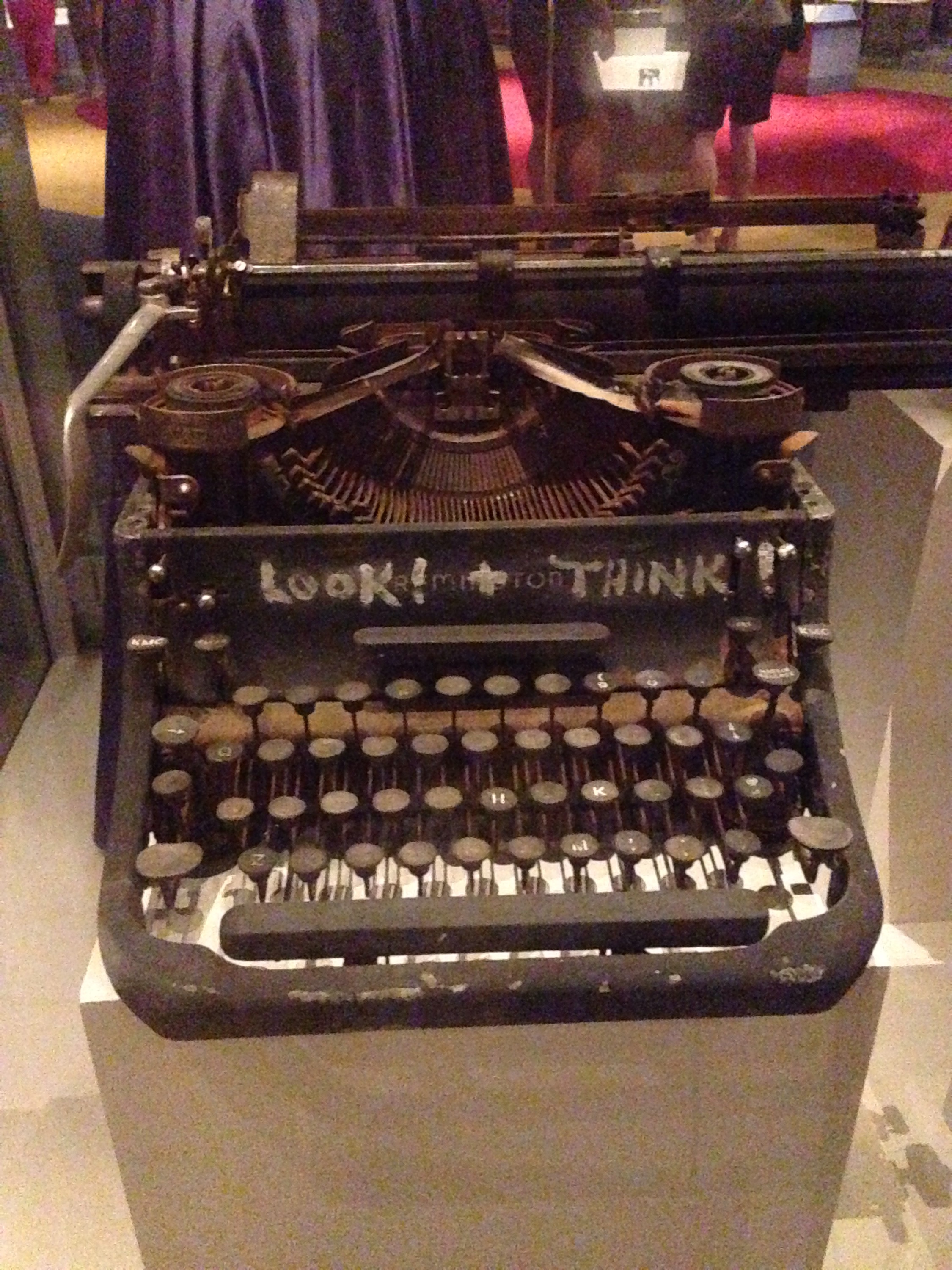
a typewriter at the Smithsonian. American History. Museum–it reminds to look and think about the writing process

 
So–failure, the winds of defeat, no longer  blow as noisily, the rattling of branches mocking my defeat, nay instead the sound is merely the tapping  of the conductor’s baton warming the orchestra’s performance.

Reading Challenge #37: Bird by Bird


Reading Anne Lamott’s Bird by Bird is a bit like listening to a marathon of Billy Crystal’s SNL routines as the complainer character: “Don’t you just hate it when…” His character’s kvetching is both comical and annoying, at least to me. And that’s where I stand with Lamott’s book on her approach to writing. Granted, she has reached a measure  of success, yet, the process seems to be so painful for her I wonder if she should try another line of work, one that doesn’t require copious amounts of emotional disarray and therapy. Then again, maybe she likes the worry, grief, angst, and drama that occurs when writing. Actually, if she didn’t have anything to complain about she wouldn’t have anything to write about. 

image: Amazon.com The story behind the title is a life lesson of taking a big task bit by bit.

For me the introduction resonated the best. The rest of the book was more of the same sardonic humor and illuminating bits of epiphanies. I did stick with the entirety and did find several take aways, ones that resonated with me in how I approach writing:

  • “I understood immediately the thrill of seeing oneself in print. It provides some sort of primal verification: you are in print; therefore you exist.” (introduction xiv))
  • “The act of writing turns out to be its own reward.”(intro xxvi)
  • This one really got to me since I am a bovine believer: “Writing…is a little like milking a cow: the milk is so rich and delicious, ad the the cow is so glad you did it.” (intro xxxi)
  • “…putting an octopus to bed [is like the final draft]. You get a bunch of the octopus’s arms neatly tucked under the covers–that is, you’ve come up with a plot, resolved the conflict between the two main characters, gotten the tone down pat–but two arms are still flailing around…you finally get those arms under the sheets, too, and are about to turn off the lights when another long sucking arm breaks free.” (p. 94)
  • “The writer is a person who is standing apart, like the cheese in “The Farmer in the Dell” standing there alone but deciding to take a few notes.” (p. 97)
  • “Writers are like vacuum cleaners, sucking up all that we can see and hear and read and think and feel and articulate, and everything that everyone else within earshot can hear and see and think and feel.” (p. 177)

I do feel like the cheese sometimes. I notice stuff other people don’t and when I point these observations out to them they usually respond with that patronizing smile, you know, the one that indicates that you’re cute or crazy or annoying for noticing what seems mundane.* I also feel like a vacuum cleaner, sucking up sensory matters. Anne missed one analogy though–writers storing all that information are like the back room of an understaffed post office. The information is there but stored in a box, bag, or slot waiting patiently to be delivered.

One chapter I especially related to was “Calling Around.” For her it was tracking down the name of the wire thingy that is part of the champagne bottle. Wire thingy wasn’t working for her and she couldn’t move on in the story until she discovered the name. After calling around she learned it’s simply referred to as a metal hood. Kind of takes the romance out of the champagne experience. For me, I needed to know the name of the clothing ancient Chinese warriors wore. Should be an easy search–right? No. And no again. I wanted to show the character in my story that pants haven’t always been part of fighting garb (who can forget Mel in his Braveheart kilt?). After some searching around I came up with a possibility. I’m still confirming it. It’s not even that crucial to the story, yet I couldn’t move on either until I had put that flailing octopus to rest.

Overall, I was entertained while learning that writing and writers are definitely the cheesiest people around. We are on the outside, capturing how everyone feels on the inside. And that’s a good thing. It makes us a bit crazy but crazy is the new sane. Heigh ho, the dairy-oh….

*NOTE: A spider busily working its weaving web wonder is significant because it is oblivious that its achievement is going to be seen not as a marvel but as a mess needing to be swept away. My mind goes scampering towards metaphors and greater analysis. It’s not just a spider. Maybe that’s the title of a book I need to write about how writers write.

June POM: nice whether


June is an interesting month around my parts. In the time it takes to say “what’s it gonna do today?” the weather changes, so we don’t know whether it will be chilly or hot. At the beginning of the month it has been known to be cold enough to have a frosty wake up, so we light a chill-breaker in the morning, only to run the air conditioner by mid-afternoon due to the surge in temperature. It makes for the school’s outdoor graduation an interesting guess. I’m glad I don’t have to make that call of inside or outside.

This radical rolling of temperature swings causes some bodacious storms at times. The sudden swirl of wind, rattling of angry rain, that tempers out into penitent miffs of drips as the sky clears into blue and friendly puffy clouds  once again. Oh I do enjoy those brief summer storms. I hide out under the back porch to witness these summer snits. I guess they reflect the ocassional temper tantrum I might have tossed about in my younger days ( I’m not admitting anything).

Leonara Speyer captures well that brief snit fit found in summer:

Squall by Leonora Speyer

The squall sweeps gray-winged across the obliterated hills,

And the startled lake seems to run before it;

From the wood comes a clamor of leaves,

Tugging at the twigs,

Pouring from the branches,

And suddenly the birds are still.
Thunder crumples the sky,

Lightning tears at it.
And now the rain!

The rain—thudding—implacable—

The wind, reveling in the confusion of great pines!
And a silver sifting of light,

A coolness;

A sense of summer anger passing,

Of summer gentleness creeping nearer—

Penitent, tearful,

Forgiven!


I would be remiss if I did not include a poem that reflects the current situation of June: IT IS REALLY, REALLY HOT, and way too early for such heat–at least in our parts. So here is another side of summer that reminds us that while summer is mostly lovely it can be hot as riding into battle.

To Summer by William Blake

O thou who passest thro’ our valleys in
Thy strength, curb thy fierce steeds, allay the heat
That flames from their large nostrils! thou, O Summer,
Oft pitched’st here thy golden tent, and oft
Beneath our oaks hast slept, while we beheld
With joy thy ruddy limbs and flourishing hair.
Beneath our thickest shades we oft have heard
Thy voice, when noon upon his fervid car
Rode o’er the deep of heaven; beside our springs
Sit down, and in our mossy valleys, on

Some bank beside a river clear, throw thy
Silk draperies off, and rush into the stream:
Our valleys love the Summer in his pride.

Our bards are fam’d who strike the silver wire:
Our youth are bolder than the southern swains:
Our maidens fairer in the sprightly dance:
We lack not songs, nor instruments of joy,
Nor echoes sweet, nor waters clear as heaven,
Nor laurel wreaths against the sultry heat.

For an interesting commentary on the poem, check out this link.


Reading Challenge: #20–My Salinger Year


Joanna Rakoff has provided that rarity, a memoir that reads like a novel. She does admit she needed to fill in some gaps, which is totally understandable and quite forgivable. The point is that Ms. Rakoff allows her readers to peek behind the curtain where most plebeians are barred when it comes to the world of lit deals. We are given glimpses of when one of the old venerable literary agency’s began to roll out of the Stone Age of carbon copies and Dictaphones into the pacings of the WWW. This is the agency that represented J.D. Salinger. The title is both misleading and essential to understanding the book. Salinger plays his part in Rakoff’s memoir like he did in real life for so many: an enigma of reverberation. He left a lasting impression on Rakoff long after her encounters with him, and she is able to pass that enduring awe to her readers.

Front Cover

The following is a passage, which, for me, serves as the book’s metaphor. How so many freshly degreed lit majors hope to “make good” in NYC as an assistant  at a publishing house or agency and live beyond their means by believing in their facade, to almost succumb to disaster only to recover and continue in the momentum of living as a twenty-something.

 My shoe, with its narrow heel, caught on the thick carpet, and for a moment I thought–I knew, my heart beating faster–that I was going to trip and fall down that small flight of stairs, the world around me rotating, but then I simply laid my hand on the railing, steadied myself, and continued down. p.139

If you are looking at the reminiscent or retro view of the book world, a bit of Mad Men of the literary scene, then I urge you to find My Salinger Year. It’s a bit of The Devil Wears Prada peek of publishing. I wonder if Emily Blunt is busy for this one because I do see a film in the making. Heck, I could see Meryl Streep as an agency queen. Oh yeah–

NPM: #25–the Poe in poetry


Most of Poe is a favorite. I don’t care for the macabre aspect, the chop-him-up-cause-I-loved-him-so stuff. Makes me nervous walking across floorboards when he does that kind of writing. My students like Poe because they like the scary aspect of his writing, although they don’t always understand his diction, they get his intent of setting people offside with mixing real with horror. So, it is with surprise that I’ve come across a Poe poem that is actually upbeat. Which Poe are you most familiar with–the scary guy or the dreamer?

Dreams

Edgar Allan Poe, 18091849
Oh! that my young life were a lasting dream!
My spirit not awakening, till the beam
Of an Eternity should bring the morrow.
Yes! tho’ that long dream were of hopeless sorrow,
’Twere better than the cold reality
Of waking life, to him whose heart must be,
And hath been still, upon the lovely earth,
A chaos of deep passion, from his birth.
But should it be—that dream eternally
Continuing—as dreams have been to me
In my young boyhood—should it thus be given,
’Twere folly still to hope for higher Heaven.
For I have revell’d when the sun was bright
I’ the summer sky, in dreams of living light,
And loveliness,—have left my very heart
In climes of mine imagining, apart
From mine own home, with beings that have been
Of mine own thought—what more could I have seen?
’Twas once—and only once—and the wild hour
From my remembrance shall not pass—some power
Or spell had bound me—’twas the chilly wind
Came o’er me in the night, and left behind
Its image on my spirit—or the moon
Shone on my slumbers in her lofty noon
Too coldly—or the stars—howe’er it was
That dream was as that night-wind—let it pass.
I have been happy, tho’ [but] in a dream.
I have been happy—and I love the theme:
Dreams! in their vivid colouring of life
As in that fleeting, shadowy, misty strife
Of semblance with reality which brings
To the delirious eye, more lovely things
Of Paradise and Love—and all our own!
Than young Hope in his sunniest hour hath known.
Edgar Allan Poe

Eddie, do you need a hug?

image: Academy of American Poets

NPM: #15–Longfellow’s Children


“The Children’s Hour” was first published in the September 1860 edition of The Atlantic Monthly.

Henry Wadsworth Longfellow was probably one of the first poets encountered as a child. Who hasn’t encountered his “Song of Hiawatha?” He is well known for many poems, and one of my favorites is his tribute to his children. I can imagine his little “banditti” sneaking up on him and him gathering them up all shrieks and giggles.

The Children’s Hour

Henry Wadsworth Longfellow, 18071882
Between the dark and the daylight,
   When the night is beginning to lower,
Comes a pause in the day’s occupations,
   That is known as the Children’s Hour.

I hear in the chamber above me
   The patter of little feet,
The sound of a door that is opened,
   And voices soft and sweet.

From my study I see in the lamplight,
   Descending the broad hall stair,
Grave Alice, and laughing Allegra,
   And Edith with golden hair.

A whisper, and then a silence:
   Yet I know by their merry eyes
They are plotting and planning together
   To take me by surprise.

A sudden rush from the stairway,
   A sudden raid from the hall!
By three doors left unguarded
   They enter my castle wall!

They climb up into my turret
   O’er the arms and back of my chair;
If I try to escape, they surround me;
   They seem to be everywhere.

They almost devour me with kisses,
   Their arms about me entwine,
Till I think of the Bishop of Bingen
   In his Mouse-Tower on the Rhine!

Do you think, O blue-eyed banditti,
   Because you have scaled the wall,
Such an old mustache as I am
   Is not a match for you all!

I have you fast in my fortress,
   And will not let you depart,
But put you down into the dungeon
   In the round-tower of my heart.

And there will I keep you forever,
   Yes, forever and a day,
Till the walls shall crumble to ruin,
   And moulder in dust away!

Post Navigation