Pam Webb

a writer's journey as a reader

Archive for the category “Words”

Why We Say: #13


Today we learn about earning our salt, eating humble pie, and listening in on conversations.

“He’s worth his salt.”
“Oh, she earned her salt today, that’s for sure.”

Hear of these expressions? If so, then you know it’s in reference to someone who is worth the amount of money they are being paid. In fact, the word “salary” is derived from the Latin word “salarium” which refers to the old Roman practice of providing soldiers their daily salt allowance. A soldier earning his salt ration was earning his keep.

This soldier is looking forward to his salting his paycheck away for a rainy day.image: morguefile


Have you ever had to eat humble pie? You know what I’m talking about–that moment when you’ve been humiliated or had to admit you were wrong. Not a great feeling, but it beats having to eat real humble pie, which is actually the “umbles” or the liver and organs of deer. Yummy–right? Yup, back in the day when English noblemen trotted around bagging deer while hunting, they saved the best for themselves and left the less desirable umbles for the servants. The servants wanting to make their leftovers a bit more tasty would pack the dear bits of deer into a pie. I suppose it would be rather humbling to eat this culinary fare.

“I wonder if Radio would be saying ‘Where my pie?'” on this flavor of the day?” image:morguefile


Eavesdropping has taken on a more sophisticated form of listening these days due to the Internet and its penchant for hacking in on conversations. Yet, in the way old days, going back to England, a law existed where houses had to have enough room for the eaves to drip on the owner’s property. It was quite easy to stand in these spaces under the eaves to listen in on inside conversations. People got the inside scoop by being outsiders. Not much has changed, has it?

Not everyone is interested in the wayward tidbit that comes floating by. image: morguefile


Why We Say #12


Continuing on with our foray into unveiling the meaning behind those idioms we know (or not know) so well…


Jimmy Cagney voice: “You’ll never take me alive, copper.”

Gotta love those vintage gangster movies. Tommy guns blazing, trench coats, peroxide gun molls, and the dedicated police officers. “Copper” or “cop” an Americanism for police officers, actually owes it origins to London. Police uniforms of London’s finest were once adorned with large copper buttons–I wonder are they still?

I’m looking to get a cord of wood to bolster against winter’s chill. Red fir is the preferred wood by the MEPA’s standards and it has to be cut an irregular 14″ due to our small stove. Wait–what exactly is a cord? At one time a cord or string was used to measure a stack of wood to make it equal _____ feet long, _____ feet wide, and ______ feet deep. Got the answers? Try 8, 4, 4.

However, I still have to round up the wood before I can measure and it might be a wee late in the season to secure my snap, crackle, and poppers for the long winter nights. Presto logs just don’t lend the same ambiance.

Now, this is what I call combining a bit of fun with a full day’s work. Image: http://www.lumberjocks.com

“Oh, don’t give me those crocodile tears. You’re not really hurt.”

Crocodile tears–fake crying–insincere remorse–hypocritical sadness. We attribute that empty crying to being as empty as crocodiles shedding tears as they chomp down their victims. Wait–do crocodiles really cry? Apparently it’s been witnessed that these primitive reptilian cry when they are snacking? Try out this link. It’s more complicated than my little Why We Say book explained. Crocodile tears do make for some great social commentary:

image:kmuw.org


Walking Our Pet Words


image: tsc.uk.net

An embarrassing story from teen years: I’m napping hard in my tent, exhausted from the grueling schedule of cycling up and down hills, navigating narrow country roads, and trying to avoid the fate of unfortunate roadside distraction. What normal 17-year-old girl signs herself up for a cycling tour around the Olympic Peninsula? Anyway, I was so exhausted I forgot all about our usual afternoon agenda meeting. When I finally woke up with that awful White Rabbit yelp of “I’m late! I’m late!” I knew I would not be able to sneak in unobtrusively. My embarrassment was doubled when the group all paused, turned to face me, gleefully shouting, “Terrific!” It was then I knew they were calling me out on my pet word.

Pet words. Admit it–you have at least one.  Maybe you have several on a leash and you walk them out and about without realizing it.

I happened upon Matthew J.X. Malady’s article “You Have A Word That You Constantly Use Without Realizing It — Here’s Where You Got It.” Personally I prefer the email forward title of “How ‘Signature Words Spread.”

As I read the article I began to better understand why I latch on to certain words. Here’s a snippet:

Diane Boxer, a professor at the University of Florida who specializes in sociolinguistics, says that when we find ourselves in a situation where someone uses language differently than we do, or words we’re unfamiliar with, we usually respond in one of two ways.

“We either start to mimic them in some way, or distinguish ourselves from their usage,” she says. “This has to do with how we want to portray our identities. If we identify with them, want to be like them, we’ll start speaking like they do.”

I can relate to that point. I may not do it consciously, although I think my brain picks up on admiration and rolls out a word or phrase associated with that person or character. However, it is embarrassing when we are called out on it. The article cites another reason we adopt pet words.


Stanford psychology professorBenoit Monin, I shouldn’t pat myself on the back too fervently. In many cases, when we decide to latch onto these sorts of words, it’s because we’re using language to put on a show. “There could be some element of language snobbery here,” says Monin, whose research focuses on self-image and social norms. “Like, ‘I’m a discriminate language user, and I use these rare words that few people use, and by using them I show that I’m educated.’ ”   

Oh dear, I don’t want to be considered a snob.  What about aficionado? I collect words. Some of them sound so cool I can’t avoid repeating them. There is also that “why order vanilla when huckleberry creme is available?” It seems so plebian to say plain words when so many variants are available. Is that snobbery  or creatively erudite?

The article goes on to mention research conducted by Duke University professor Dan Ariely and Stanford’s Jonathan Levay.

Ariely and Levav say that there exists “the desire to portray oneself as interesting and unique” when we interact with others, and that we will in some cases make irrational decisions to avoid looking like a copycat.  

I will admit I often strive to set myself apart. I often find myself grasping at ways to express myself in a memorable manner. Sometimes this works and sometimes this fails. As in Epic Failure. Note to self: check with urban dictionary before employing certain terms with teens when teaching.

This malady doesn’t cover one very prominent reason for signature or pet words: laziness. I know I fall back on certain words because I get into a habit of saying them.  When my “terrific” warning light flashes on my brain instrument panel, I know I’m close to getting a drubbing on overusage. This week I know I have to rid myself of “channeling” and “solid.” I recently purged lexicon retorts of “perfect.”

Do you have pet words you walk long and often? Is difficult for you to curb their exuberance to romp?

Why We Say: #11


Cold Feet

Maybe this falls into the TMI category, but I wear socks at night. My tootsies get cold, and cold tootsies prevent a good night’s sleep. However, having cold feet and being accused of having cold feet have two very different meanings.

The scene: Two soldiers from the 19th century are standing around on the battlefront and they are freezing cold, like most soldiers in winter.

“So, Joe, are you as cold as I am?”

“Yeah, my nose is cold, my ear lobes are cold. I think my eyelashes are frozen.”

“Mine too. I think my toes are frozen.”

“You got cold feet? You should report that. I hear they’re letting us out if we got cold feet.  Can’t fight if you’ve got cold feet, you know.”

“You’re right. Thanks for the tip. You know I could see how this could be considered an excuse for not standing your ground and fighting.”

“Yeah, I can see your point, Horace. Cold feet, cold courage. Whoa, look lively–incoming. Remind me to loan you a pair of extra socks. The missus sent me some handmade woolies in the last package.

“You’re a real buddy, Joe.”

“Don’t mention it.”


Well, maybe Joe and Horace could have had a similar conversation standing around in some frozen field as they stood around soldiering.

Cold feet. I still hear that expression today. That reluctance to do something because we are a bit nervous, or lack that needed chutzpah to grab the opportunity does seem to create a coldness in our extremities. I don’t think wool socks always is the solution either.

Why We Say #10: of Chickens and Whistles


“George, do you think we can afford to go out to dinner and maybe take in a show? Will that be too expensive?”

“Why, Martha. The expense of going out on the town with my best girl is chicken feed. Grab your hat, darling, and let’s skeddadle downtown.”

George and Martha probably enjoyed their night out because more than likely George, being a generous fellow, had made his fortune and a spending money mattered no longer to him. In fact, a few dollars was a mere pittance, like tossing crumbs to the birds.

And that’s exactly where the expression “chicken feed” comes from–tossing small bits out at a time.  Chickens don’t have the capacity to chew up their food (ever see a chicken smile?) and must peck at small amounts. Apply that idea to money and chicken feed means a small amount of spending, not enough to worry or get choked up over.

image: thedo.gs not your average chicken


“Martha, are you going to be able to get that spot of gravy out of my tie? I have to look sharp for tomorrow’s presentation.”

“No worries, George. I’ll get it clean as a whistle.”

I doubt Martha was whistling was she worked on George’s tie.  Honestly, George, don’t you know gravy is just looking for the opp to drip on ties?

As for the expression “clean as whistle”, this one is pretty much as it sounds (sorry, the pun overcame the keyboard). About the time of Huck Finn and company, boys would find reeds and poke holes in them to make their whistles. The cleaner the reed, the cleaner or clearer the sound.

image: investitureachievement.org

Six of One


Perhaps it’s because I’m basically an old-fashioned kind of girl that I tend to toss out old phrases like “don’t count your chickens,” “look before you leap,” along with one of my catch alls: “six of one, half dozen of another.” I tend to add that one in when there is a stalemate to a discussion. I can see there is more than one way to approach a matter so for argument’s sake I acknowledge we agree to disagree.

I then realized there truly is a different way to see and do a lot of things which can head up some fairly heated debates. For instance:

  • Storing glasses: rim down or rim up in the cupboard?
  • Shoes and socks: put socks on first and then shoes or one sock one shoe one at a time?
  • Chilled water: store water in the fridge or water and cubes as needed?
  • Bedsheets: pattern down or pattern up?
    Swimming: dash in or bit by bit?
  • And the age old toilet paper controversy

Over or under: click here for the definitive debate

Can you add your own “see it two ways” to the list?


Why We Say: #9–Bringing On More B


Wait! Wait! We interrupt our regular programming for this late breaking news flash: Mike Allegra is running ANOTHER free doodle contest. This is a not to be missed event. Check out the details at his WordPress site: http://www.mikeallegra.com.

We now return to our regular programming…

Last time I spotlighted the B section, concerning “Why We Say”, and I shall continue, since it is an absolute bounty to B-hold.

image: k2nblog.com Nothing like a brand new item fresh from the fires of shopping

Brand New
I like to frequent thrift shops; I don’t mind the slightly used, and often  thrill over the serendipitous find. On the other hand, I do appreciate owning the brand new. Rifting through the racks, securing a purchase, and slinging my sack home–MMM, new treasure. This little book has helped me to learn the true meaning of the phrase “brand new” and it gives me pause. I first thought it might refer to the company who makes the product, as in the type, the brand.  It seems “brand” comes from the Anglo-Saxon word for “fire.” When blacksmiths forged metal products they would stamp in their mark, their brand. However, over time the mark would fade due to use and the item would no longer be “brand new.” So when my new treasure fades away it’s time for me to fire up my card and search for another brand-new-to-me something, right?

image: colourbox.com “hey man, can you spare some bread?”

Bribery
“Quit loafing around, and get going on your homework. Get it done and you can go to the movies tomorrow.” Or some such form of bribery is said by Party B to get Party A motivated. Bribery. It’s not necessarily nestled amidst residents of the “nice” or “positive” words list. Officials caught accepting bribes make headlines. People are sometimes insulted if offers (thinly veiled “bribes”) are considered above or beneath them. Yet, you have admit bribes do serve as a motivator. Way back when, Europe perhaps, people hanging out looking for a hand out were a problem needing a solution. Wah La! Credit the French for the fix. “If you move on, you’ll receive a loaf of bread.” The French archaic term for such a form of motivator was “bribe.” So if someone is loafing around slip them some bread, presidential or whole wheat–your call.

image: fxtechnical.com Whiny brokers, in the original sense, of course, do not rock.

Broker
If you watch Hollywood movies, there is an association of stock brokers being well-versed in wining and dining to win over clients. This isn’t too far from the origin of “broker” and again we credit the French. The word “broker” once meant “one who opens wine kegs.” Later that person would sell said wine, and even act as an agent in other transactions. So when people whine to their broker about how their lackluster portfolio is, it’s all relative.

Next time we continue on with another bounty of words and origins.


Unexpected Bits of Wisdom


Lately I’ve been noticing more and more products are sporting bits of wisdom as part of the package.

Halls Defense Multi-Blend Supplement Drops, Harvest Cherry

The first notice came with my occasional binges on Dove Dark Chocolate Bites.  It took me a wrapper or two to realize pithy little “promises” hid within. For instance, “Encourage Your Sense of Daring” and “Smile Before Bed. You’ll Sleep Better” are two gems.  I started calling these my chocolate fortune cookies and began collecting them.  If you are trying to cut down on chocolate–I know I need to– *GaSp* did I really just say that?–you can unwrap a few calorie free promises at https://www.dovechocolate.com/epromise.

Recently I discovered Honest Tea and upon popping open the cap I found some great quotes.  What I really like is the variety:

“Now I know the secret of making the best persons; it is grow in the open air and eat and sleep with the earth.”–Walt Whitman

“Great spirits have always encountered violent opposition from mediocre minds.”–Albert Einstein

“The truth is a beautiful and terrible things, and should therefore be treated with caution.”–J.K. Rowling

“The world is moved along not only by the mighty shoves of its heroes but also by the aggregate of the tiny pushes of each honest worker.”–Helen Keller

“A common mistake people make when trying to design something completely foolproof is to underestimate the ingenuity of complete fools.”–Douglas Noel Adams

“In order to a realist you must believe in miracles.”–David Ben-Gurion

“You are as young as your faith, as old as your doubt.” –Samuel Ullman

Finding bits of wisdom on drink caps probably isn’t too unusual, after all you can often find prizes and such depending on the drink.  But what really surprised me was finding “A Pep Talk in Every Drop” as I popped a cough drop.  I’m not much in the habit of caring about getting inspired when my throat’s scratchy. Although it probably isn’t so bad to make people feel good when they are feeling bad.  Would these words cheer you up once your cough in under control:

“March forward!”  “Keep your chin up.” “Now you get it in you.” “Elicit a few “wows” today.”

I think when I’m done teachering I will look into wrangling up a job for some company supplying these pity bits of wisdom.  Hmm, I wonder how I find that listing at Linked In–“Wisdom generator available–light and deep bits created upon request.”

Any other bits or promises hiding out there?


Why We Say: #8 (a backstock of Bs)


Well, Well…

I haven’t run a “Why We Say” since December. Tsk. Not wanting to disappoint I will make up the lost months in a bevy of Bs. Five months equal five reasonings for “Why We Say”–


1. Springtime is April showers and May flowers and baseball!  It is appropriate we begin our first B with Baseball Fan. Back when newspaper ruled the news, there would be great competition for space. Naturally, if a longer word could be exchanged for a shorter one, or if a long one could be condensed, the switch was made.  Charles Haas, apparently is the reason we now refer to sports enthusiasts as “fans.”  He was credited as being the greatest baseball “fanatic,” which became shortened to “fan” once it hit the press pages.  And here I thought “fan” referred to the paper waving needed for those hot days in the stands.


2. “Oh quit beating around the bush, and just tell me what you think!” Have you ever been accused of holding back information? If so, this statement might be flung at you. You might not realize how foxy you’re being by holding back from your audience.  Back in the day, hunters wanting to rout foxes from their hiding spots in the bushes, would send someone to beat the bushes to scare out the tawny evaders.  Not wanting to become some ladies fur stole, the foxes would learn to keep hidden, which meant it took a long time to get a fox to pop out.  The “aha” moment with this phrase: sometimes it takes someone a long time to get to the point of the story.


3. Do you suffer from getting in tight spots? Do you sigh at the getting behind, just when you thought you had it all in order? Do you wish you could be a winner, instead of being a loser?  If you checked “yes” to any of these questions, you will then most certainly relate to the expression “Behind the Eight Ball.” This expression is derived from the pool game of rotation, where each ball is played except the eight ball. If the eight ball blocks your shot, you have basically lost the game.

4. “I would love to be in your shoes.” This one makes sense all on its own.  It’s simple, right?  It simply means we want to trade places.  That’s true and then some.  Let’s go back as far as 1834 in England. At that time children who were to be adopted would step into their new father’s shoes to stress the importance of the new connection and family ties.  “Shoes me, are you my new dad?”

image: 74211.com


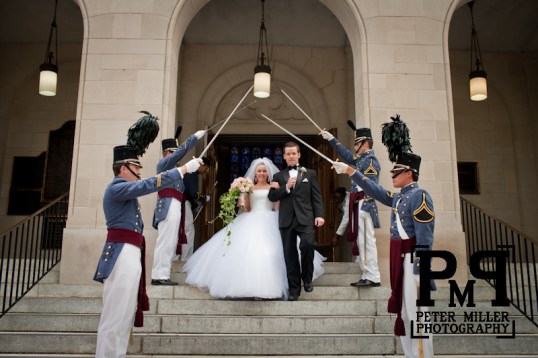
5.  With spring comes summer and with summer comes weddings.  Ooh, I love a summer wedding and I am so disappointed when I don’t get to go to at least one summer nuptial exchange.  I love the chance to actually dress up, mix and mingle with old and new acquaintances, eat, drink, and be merry and best of all I enjoy watching the bride and groom exchange their commitment to one another.  I look forward to the wedding theme and the fashions.  How many bridesmaid? Will the best man be serious? Or will he pull the old “ring, what ring?” routine.  The best man is naturally the groom’s best friend or close relation, and it’s a place of honor.  This custom stems from centuries ago (primarily in Europe) most weddings took place at night (don’t know the reason on that one–research time) and it wasn’t unheard of to have the rival come swooping in an attempt to kidnap the bride. One precaution against this shocking, and irritating practice, was to have the groom’s men stand guard during the service.  The main guard would be the groom’s most trusted or best man. Tuxedos optional with swords?


Next month B on the lookout for some more Bewildering “Why We Says.”  Until next time…

Poetry Workshop: Sestina


I thought there has been enough recovery time since the last workshop, which focused on the villanelle.  So, let’s move on to the sestina.


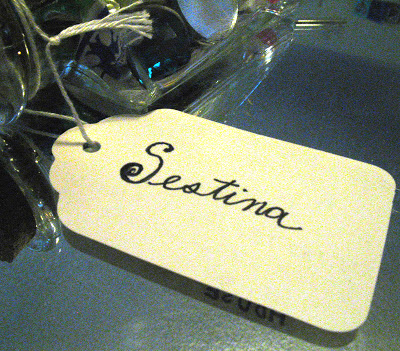
The image above intimates that the sestina can be neatly labeled.  Hmm, perhaps not.  Below is a famous example by Elizabeth Bishop.  I do like her work, if I haven’t mentioned that before.  This offering is simply called, “Sestina.”

September rain falls on the house.
In the failing light, the old grandmother
sits in the kitchen with the child
beside the Little Marvel Stove,
reading the jokes from the almanac,
laughing and talking to hide her tears.

She thinks that her equinoctial tears
and the rain that beats on the roof of the house
were both foretold by the almanac,
but only known to a grandmother.
The iron kettle sings on the stove.
She cuts some bread and says to the child,

It’s time for tea now; but the child
is watching the teakettle’s small hard tears
dance like mad on the hot black stove,
the way the rain must dance on the house.
Tidying up, the old grandmother
hangs up the clever almanac

on its string. Birdlike, the almanac
hovers half open above the child,
hovers above the old grandmother
and her teacup full of dark brown tears.
She shivers and says she thinks the house
feels chilly, and puts more wood in the stove.

It was to be, says the Marvel Stove.
I know what I know, says the almanac.
With crayons the child draws a rigid house
and a winding pathway. Then the child
puts in a man with buttons like tears
and shows it proudly to the grandmother.

But secretly, while the grandmother
busies herself about the stove,
the little moons fall down like tears
from between the pages of the almanac
into the flower bed the child
has carefully placed in the front of the house.

Time to plant tears, says the almanac.
The grandmother sings to the marvelous stove
and the child draws another inscrutable house

Anything standout? Anything noticeable?  Yes, there are repeating words. Six of them. Nicely done. Sestina–six: yup, there is a definite connection.

A sestina according to the Bing dictionary:

  1. Definition of sestina (n)

    Bing Dictionary
    • ses·ti·na
    • [ se stéenə ]
    1. form of poem: a poem of six six-line stanzas and a three-line envoy or, with the last words of the first six lines repeated, in different order, at the ends of the other lines

Using Bishop’s model, let’s explore how that really works.

Oh, by the way–if you are one of those who groove on numbers more than poetry, you will really like sestinas, because it’s all about patterns.

Okay. Here we go:

The structure of a sestina, in this case, Bishop’s “Sestina,” is six stanzas of six lines with a three line envoy (the conclusion of the literary work). The pattern is: 123456; 615243; 364125; 532614; 451362; 246531 with the envoy as 531 or 135.  Return to the poem and decide which six words repeat throughout the poem.

If you really want to see how a sestina works without all the extra word wading go check out “Six Words” by Lloyd Schwartz. Very, very clever.


Well, that wraps up another National Poetry Month. Thanks for stopping by. I hope you learned a bit along the way, and appreciated new-to-you poets and their poetry.


Post Navigation