Pam Webb

a writer's journey as a reader

Archive for the category “Literature”

Getting a Handle on Hamlet


Now that there is a little distance between my journey to DC for Hamlet Academy, I am in a very good place to reflect upon just how I will present the play to my students.

I have discovered exploring scenes through various reading techniques, paired with a cinematic clip, helps with clarity. But which film version to use? There is such a range.

For instance, when we study Hamlet’s quintessential  “To Be” speech, I can show the minimal setting of the stage with either Richard Burton or Kevin Kline. Then again, I might show it as the singular contemporary soliloquy of Ethan Hawke as he internalizes his inaction while walking through the action movie aisles of Blockbuster. There is also Branagh’s stylized mirrored reflection which contrasts with David Tennant’s sedate approach. I primarily feature Mel Gibson’s version because of its Renaissance setting. I am patiently waiting for Jude Law’s Broadway version to come out as a DVD. And then there is Benedict C’s London stage version, which I anticipate to be more than marvelous and hope it makes it onto DVD in the future. Because taking my students to London to see it, well–that would be an involved field trip request. For fun, I show Ahnold delivering the lines with swagger and CGI.

Yet with all these versions to select from, each has its own set of considerations when it comes which one to showcase in its entirety. Sir Larry’s is BW and my students aren’t keen on arcane classic. Tennant is clever, yet the juxtaposition of modern setting and classic Bard doesn’t always find favor. Ethan Hawk’s has a couple of awkward-in-the-classroom scenes. Branagh’s is way too long, and that leaves Mel, the popular choice, but with that problematic mother and son chat in her closet.

Every year I wrestle with the “which one” question. This year there is one more option. I recently discovered an amazing version I had no idea existed. A big thanks to LoMo, super Hamlet Academy mentor teacher, for the heads up on this new-to-me Hamlet.

Campbell Scott, son of George C. Scott, of Patton fame, might not be on everyone’s radar of well-known actors, but he definitely should be. I am looking into his other films, as I was quite impressed with his performance. In his version of Hamlet, which he co-directed, he sets the play in an Edwardian era that could either be east coast upper crust or Reconstruction South. This Hamlet family is one of tradition, power, wealth, and of course, one that has definite family issues.

There are many pluses to this version. For one, Scott’s Hamlet is of the appropriate age, many Hamlets are often pushing the 40 mark, which about 10 years older than the play age. The setting also lends credibility with the historical grandeur complementing the eloquence of the Bard’s language. Scott plays his Hamlet with intelligence without having to be eccentric, although there are moments that oddities pop up, such as wearing his mourning band as head band. His introspective interpretation helps the audience to feel the pain of indecision, as he flirts with madness, as he works out the conundrum of his avenge task: how crazy should crazy go?

Here’s a clip. What are your thoughts on Scott’s version? And while we are at it, which Hamlet version is your favorite?

Reading Challenge #44: Go Set a Watchman


‘Go Set a Watchman’ will land at No. 1 on USA TODAY’s Best-Selling Books list. (Photo: Joe Raedle, Getty Images)

BEWARE: UNINTENDED SPOILERS AHEAD

No matter your opinion about Harper Lee’s “latest” novel, here are some stats from USA Today that can’t be ignored:

  • Publisher HarperCollins says more than 1.1 million copies of Watchman have sold so far in print, e-book and audio formats (the audio is read by Reese Witherspoon), making it the fastest-selling book in company history.
  • Barnes & Noble says Watchman‘s first-day sales surpassed that of any other adult trade fiction title, including Dan Brown’s 2009 novel The Lost Symbol, the previous record holder. B&N said it expects Watchman to be its best-selling book of 2015. (B&N declined to provide sales figures.)
  • At Amazon, Watchman has been the No. 1 best-seller in print since its release, and is also No. 1 on the Kindle Best Sellers list. (Amazon updates its lists hourly.)

I have been following most of the media blitz on Lee’s novel, ever since the hint that a second novel was “found.” I say most, simply because saturation was reached around June. I am a devoted To Kill a Mockingbird fan, who not only reads the novel once a year (or tries to), but teaches it most enthusiastically to ninth graders (when assigned that grade), so mention of another Lee novel definitely set my little heart pitter-pat.

And then the barrage of concerns floated about in the Net:

  • it was found after Lee’s sister Alice passed away
  • Lee resides in an assisted living home, having suffered a stroke, and suffering from hearing loss and macular degeneration gives speculative thought how coherent she really is
  • lawyers, editors, publishers are not in absolute agreement in exactly how the manuscript was found
  • many longtime residents, friends, and others who know Harper Lee were concerned enough about her being possibly coerced into consent that an elder abuse complaint was filed
  • not too many of my fellow Book Boosters have blogged reviews about the book

A lot of deep hmmm-ing took place over the subsequent months as I anticipated the novel’s well-awaited debut. I kept tabs on most of the articles and opinions that surfaced, although, as stated, saturation did preclude any deep dwelling, especially as speculative opinion was fast becoming redundant.

I deliberated continually of whether or not I would read the novel. My inner dilemmas ping-ponged accordingly:

  • why risk ruining the high opinion of TKAM?
  • why not risk it?–there will forever be the wanting to know.
  • read it and determine an opinion before others ruin the reading experience.
  • why should I let others sway since they usually don’t?

And so it went, until finally in June I called up the local library and asked to be put on the waiting list. I figured it would be December before it would be my turn. I received the book two days after it became available. Okay, just because it’s on hold doesn’t mean I have to read it. As I checked it out I noticed no other date stamps.

“I’m the first one to read it!”

“We ordered a stack of them. You’re the first to read this one.” Okay, Earth to special patron status. But at least it was in my hand. I asked my library kindreds if they had read the book.

“I had it in hand, and decided not to.” A non-com shrug from the other librarian. Great. I’m really in quandary now. Then again, who knows when I will read it once school starts. Summer is my reading season. Once school starts it’s back to reading essays.

Watchman stayed on my shelf for three days before I actually started it. A conversation with a fellow TKAMer teacher prompted me to actually open the book.

“There is a chapter that will take your breath away.”

“Which chapter?”

“You’ll know it when you see it.”

I started the book at 4:30 pm and finished it by 9:30 am. I did stop to sleep. Barely. And yes, the chapter mentioned did take my breath away. I knew it when I saw it.

So, as I read Watchman I jotted down notes:

  • For those who believed Harper Lee’s gift to the literary world, actually world in general, was a one-shot wonder–then this novel proves them wrong. Lee is an amazing craftsman, especially if this was a draft and not a final manuscript.
  • this novel stands on its own merit
  • the shadows of TKAM flit about the periphery, yet are only fireflies of reminiscence and are not needed to provide the illumination to the contents of Maycomb
  • Lee’s writerly brilliance shines in mundane moments, such as the Coffee episode, where she compares the bits of conversational banter to the scales of a piano as she played hostess with refreshments
  • Lee totally had me scrambling on more than one vocabulary word and allusion reference: Asquithian? Arriviste? Childe Rostand?
  • Highlight passages include:
    • “Although it was four hours away, she could hear her aunt’s sniff of disapproval.” (in reference to wearing slacks instead of a dress when arriving to Maycomb)
    • Uncle Jack’s explanation of the Civil War as related to the bubbling pot of politics and social norms being upsided in the South during the fifties/sixties

And this brings me to the SPOILER ALERT

  • There are issues that are still relevant fifty years later which aren’t being fully understood.

Here goes:

Being a Northern girl by way of the Pacific Northwest I am clueless about the South, and from time to time have to get edumacated by the MEPA, who was raised in the South during the fifties and sixties. He doesn’t read TKAM or The Help–he lived it.

One of the biggest concerns about Watchman: Atticus is portrayed as a racist.

This is where I heartily disagree. At one point, Jean Louise, follows her father and almost-fiance into a Council meeting. It’s just short of a Ku Klux Klan gathering. Jean Louise is physically sick that the two men who are most significant in her current life are lapping up racial rantings. Her world is shaken and she just about wipes her feet of Maycomb to leave her childhood home forever. Uncle Jack sets her straight with his quick synopsis of why the South went to war.

The book is powerful in its advocacy of accepting, not just tolerating, people for being people. Jean Louise is so disillusioned by what she sees as her father being a hypocrite she can’t abide looking at him in the face. She realizes she was raised to be color blind, she sees someone, not their race. Powerful stuff.

When she finally has her showdown with her father, she verbally berates him for undoing all that she has learned from him. She upbraids Henry, her hopeful fiance, as well. What she learns, and what Lee provides us, is a peek behind the curtain when it comes to Southern way of thinking. Atticus states he attended a KKK meeting because he wanted to know who was behind the sheets. Henry says he can do more good if he garners the trust of the people who know him. Maycomb is Maycomb. Basically what is being said is the time-honored strategy of getting inside the system to change the system. While it appears as racism to Jean Louise, it’s really savvy coping strategy. 

The MEPA reiterated Henry’s explanation to Jean Louise: to live in a Southern town means getting along with the town, even if comes across as being in alignment with their opinions.

When reading all the negative reactions to the book, I think readers are missing that point. Atticus is not a racist; he is a realist. He sees what the South is and where it needs to go and how it will get there. He still believes in justice, he still believes in equality–he believes in waiting. He is still Atticus. He hasn’t changed. Jean Louise has, and she acknowledges that painful discovery.

Overall, I am impressed with Watchman. It’s a stand alone novel, and I can’t help wonder what would have happened if it had been released earlier, about fifty years earlier. I have thoughts on that, and might expand on what just might be a conspiracy theory.

If you are on the fence about reading Watchman, I suggest you jump down and get a copy and read it for yourself. If you have read it, I hope you will dialogue with me.

Do you believe Atticus comes across as a racist, or is he actually a realist?

‘Tis No Place Like Home


I learned through my Washington DC trip that seven days of Hamlet makes one weak. *ka-boom* Seriously, between the humidity, challenging schedule, walking briskly everywhere, and trying to eat healthily on a restaurant diet, I was glad to return home. I am ever so glad to have experienced Summer Academy, yet Dorothy got it right when she told Auntie Em, “Oh, there’s no place like home.” I freely admit to being a creature of known comforts such as my closet, refrigerator, and favorite health food store. 

Before I move on to my next big event of this summer–an AP Conference (no planes or time zones involved), I want to close out my Hamlet KWL chart: my What I Know, What I Want to Know, What I Learned.

What I Know

  • I already knew Hamlet was my favorite Shakespeare play, hence the  incentive to apply to the Folger Summer Academy.
  • Once I accepted, I knew there was going to be some personal discomfort ranging from dipping into the savings account to flying all by my lonesome and finding my way around megatropolis east coast city.
  • I knew I would would be pushed out of my social comfort zone. Gregarious hermits tend to exhibit coping problems at intensive social events.

What I Still Need To a Know

  • I still need to figure out how to assimilate all the wealth of information into my curriculum.
  • I need to know how I can return to the Folger Institute without having to fly there.
  • I would like to know how I can express my enthusiasm and wonder of Shakespeare to not only my students, but also to my friends and family, without appearing as a crazy English teacher. I am terming myself as a Bardinator, someone who appreciates Shakespeare to the point of edginess.

What I Learned–that’s a blog entry unto itself

  • I learned I get crazy before a big trip, worrying and anticipating about details that become trivial and insignificant in the grand plan.
  • I painfully learned when it comes to packing–go for the wheeled suitcase. The weight of a strapped bag increases significantly with each change of planes.
  • I can learn to adapt to most situations.
  • I also learned hotel pillows are never as comfortable as the ones at home.
  • I continually learn about selecting common sense over fashion sense, especially when walking in the rain.
  • I also continually learn that meeting new people and exchanging ideas is an integral component of a fulfilling life.

 For your viewing enjoyment–a wee bit of our Hamlet week: 
NOTE: thanks to the absolutely incredible staff at both the Folger Education Center and at the Folger Library for their hospitality, expertise, generosity, and impartation of how thrilling it is to live and breathe Shakespeare.

Cricket’s Hamlet Adventure: Day Two


After going to bed well after 11pm, drifting to dreamland to the continuing firecracker pops of Fourth of July celebrants and the  police sirens indicating aforementioned celebrants needed corralling, I realized my depth of tired from my very full first day. 

Second day

I slept in: 7:10 am. Jet lag, so far, proves no problem. 

Hmmm, whatever shall I do until 3 pm when I return to prepare for the welcome dinner? Since I’m walking, not being adventurous enough to attempt tour buses, taxis, or Metro buses, I fiddle with Google and determine the Smithsonian American History Museum is doable. I plug in Siri and her Google Maps expertise, and off I trot.

Forty minutes later I arrive with only five minutes until opening.

Highlights:

  • Third one in the door and I bee-line it to American Stories and gaze upon Dorothy’s Ruby Reds. 
  • I then promptly lose my school district’s iPad by leaving it on top of a display case. Great–fifteen minutes newly arrived as a tourist and visions of an angst filled day erupt. Prayer, and an angel of a docent, *shout out to Craig* my iPad and I am reunited via lost and found. The security man admonishs me to be “more careful” and I shall be.
  • Continuing on as a thankful and much more careful school teacher tourist, I return to discovering the Americana that reminds me how unique America is in its history. For instance, two favorite presidents as I’ve never seen them before:

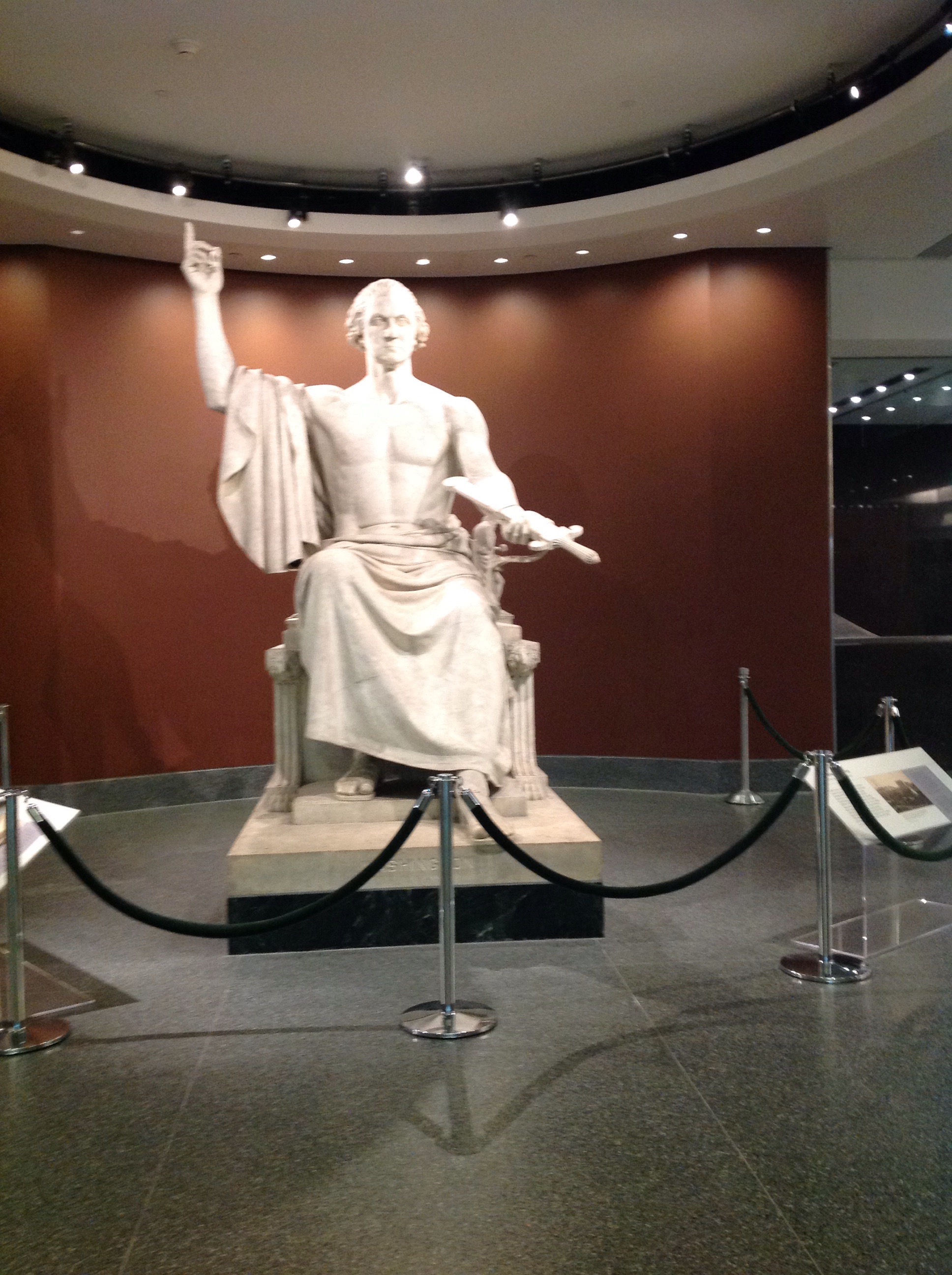
The first statue of George Washington. They had gyms back then? Pretty impessive abs, GW.

  •    

Lincoln’s life mask. A bit macabre until realizing this was first cast when he was alive in 1860. Photographs are one thing, but this impression indelibly reveals a realism photographs can’t deliver. Moving through the Civil War exhibit I come across his last known photograph. I tear up. What a great man. What a great loss. I am emotional in each of the various military exhibits, reflecting upon family members who have served or plan to serve, and those, not just family, who have sacrificed for our country. Eyes and throat swelling with emotional realization of what sacrifice means, when I entered the Star-Spangled Banner exhibit, especially viewing the Ft. McHenry flag–yes, THE flag. 

Other highlights:

  • First Ladies inaugural gowns which both caught both the personality of the First Lady and a reflection of the time period.
  • A video of a nurse who had a reunion thirty-four years later with the Vietnamese baby girl rescued and was christened Kathleen. “They said we were killing babies during the war; here’s proof we saved them,” stated the nurse.
  •  DC is amazingly clean and everyone is so nice. From docents to other tourists, everyone is polite, friendly, and helpful. This teaches me to not believe in Bruce Willis’s Die Hard movies. DC does not stand for downright corrupt. It’s clean and nice, at least in my encounters so far.
  • I briefly stopped in the National Art Gallery. The beauty of exquisite masterpieces rendered me speechless at moments. Being inches from a Rembrandt reminds me how beautiful is the creativity of the human soul. 

    one of the many paintings that I beheld


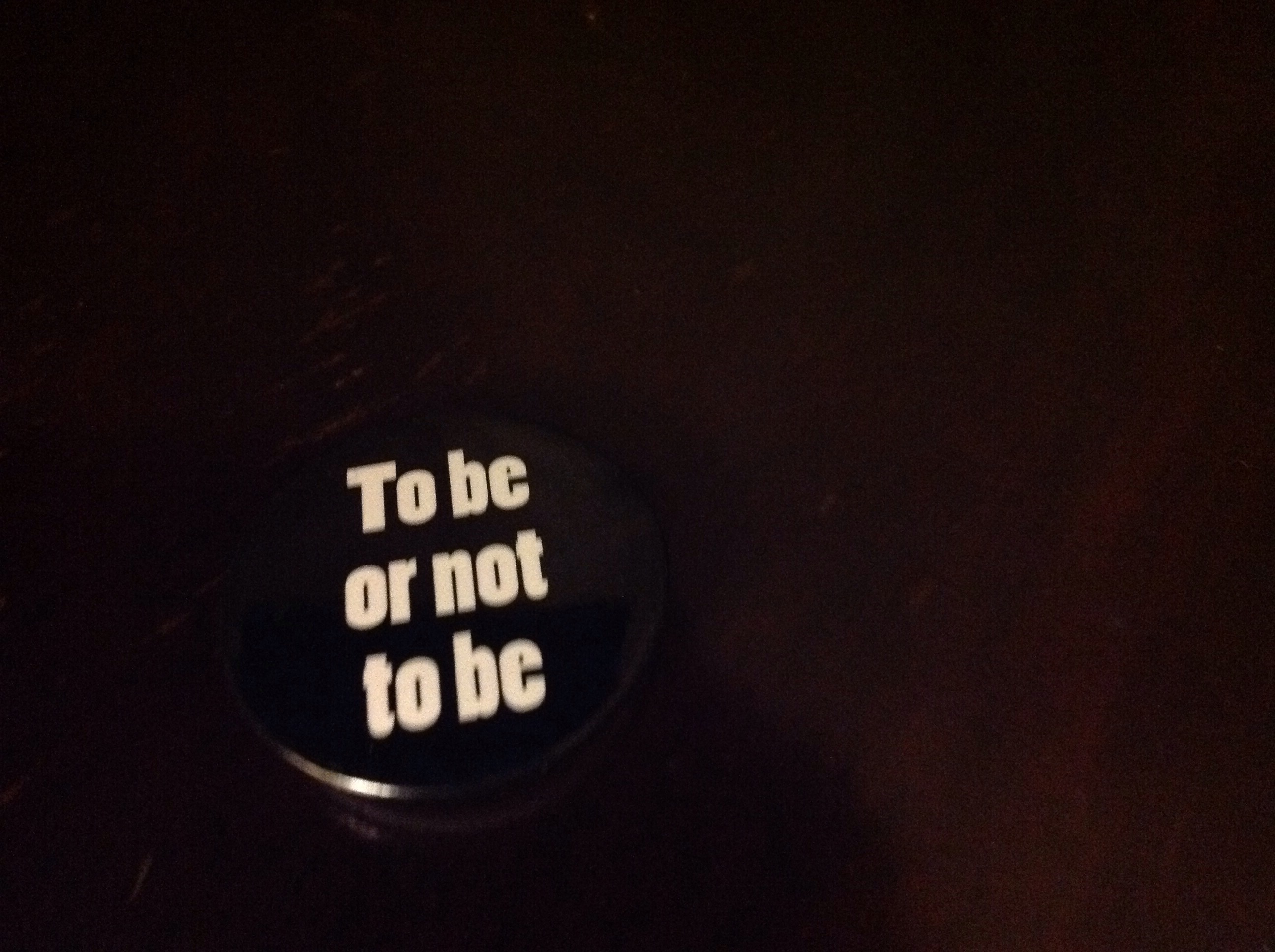
After a much needed nap, I readied to meet my Hamlet Homies. We pizza-ed, we chatted, and we were briefed on our itinerary. We shall be Hamletting from 8am to 9pm Monday through Friday. This is the reason I’m here. “This isn’t the beach,” the director gently admonished us. “There are sixty other people who would love to be where you are.” Gulp. The pins she handed out carry a new meaning: 


To be or not to be committed to giving up my personal agenda of wanting to be a DC tourist (at least more than one day) and instead immerse myself in my Shakesperean scholar potential. 

We will see what Will holds in store for me. Tomorrow, and tomorrow, and tomorrow…


    Reading Challenge #33: Lizzie and the Doors of Doom and Delight


    I recently finished yet another Jane Austen fan fiction entry: “Lost in Austen.” This is not to be confused with the witty series of the same title that featured a modern girl smitten with Darcy, who through wishful thinking, ends up trading places with Lizzie Bennett. I think Lizzie got the better deal, actually. I would rather reach for Advil than a leech any day when it comes to ridding a fever.

    Modern meets Regency image: pintrest.com

    The old “judging covers” applies here image:thefamouspix.com

    Not familiar with choose your own adventure books? Weren’t you one of those 8-10 year olds who dove in those simple, yet exciting stories that allowed you to make a choice of your plotted path? I believe they are the only example I know of where the “you” second person point-of-view is actually used in writing.

    Any of these titles sound familiar? image: pintrest.com

    They take a bit of effort since the reader must make a decision which direction the story will go. “You come to two doors. If you choose the right one, turn to page 37. If you choose left, then proceed to page 18.” The reader either experiences a nasty turn of events, like being eaten by a hungry lion or can be rewarded, as in by being discovered to be a long lost son of the neighborhood millionaire and receiving an unexpected inheritance. A person could die and live several lifestyles over the course of a reading. I think the short story “The Lady or the Tiger?” is the foundational beginnings of these books.

    As for Lost in Austen–mash up all of Jane’s books with the choose your adventure theme and you spend a day pursuing Darcy or ending up as the heroine in one of the other Austen tales of matrimony quest. Without giving away spoilers I will say this: be wary of that Caroline Bingley, especially when walking the grounds of Pemberley.

    I applaud the creativity involved in the project, yet I needed at least three bookmarks while reading. One for the Darcy plotline, one for when I had to make my decision, and one for when I died (more than once) and had to go back to my decision point because I would then have to go find chocolate to soothe my disappointment before returning to where I made the wrong choice to begin once again.

    I’m wondering–What other classics could become a Choose Your Own Adventure?

    How about Alice? “You decide drinking tea with a table of lunatics is unwise, you stay on the path.”

    Then there is Robison Crusoe. “You decide one footprint is one too many and immediately build a raft and take your chances upon the oceans towards home.”

    Maybe Scrooge? “You feel uncharacteristically generous and contribute to the various charities. After a good night’s sleep you decide to provide stock options to your employees. You live a much happier life, although prove so wonderful you become boring in your philanthropist ways that you are passed over for a Dickens protagonist.

    Whst classic adventure would you choose? What if Wendy shut the window after all and Peter found a willing Priscilla or Hortense to sew for the boys?

    Summer Reads in the Making


    Although school ended June 5th, I signed up for a workshop which prepares me for fall and pays me to be there, so I’m sticking it out until June 12. To celebrate my upcoming release into the almost endless days of summer, which for me involves LOTS of reading, I am finally sitting down to decide on my destinational course of action. I take my Reading Rainbow directive seriously “I can go anywhere. It’s in a book. Take a look…”

    My room in its vacated student mode. I’m surprised the desks weren’t more in a tangle from students bolting out the door to summer’s beckoning…  
    Here are some possibilities:

    King Lear: I’ve watched at least two different dramatizations which were powerfully presented, one with Ian Holm. I even began reading Jane Smiley’s Thousand Acres, a modern retelling (didn’t get too far due to her plot restructuring). I’m drawn to this play, being fascinated by Shakespeare’s penchant for family dynamics and the fact he has three women instead of the usual one or two. It’s weird to realize that in Shakespeare’s day male actors having to project the wounds of a daughter, of trying to capture of how a woman would react to a father’s rejection is fascinating because women had to be portrayed by men. Then again, we also have men portraying women–did anyone really believe Dustin Hoffman was a woman? My choice of Lear is one of considerable contemplation. Basically I’m trying to determine if I can switch to Lear from Hamlet in my AP curriculm. Going from a son’s agony to a daughter’s makes for interesting analysis. Maybe I’ll do a comparison. Here I go again–working on my supposed two months off…

    Of course Harper Lee’s Watchman is at the top of the list. I will request it at the library and figure my turn will come along in time for Christmas Break reading.

    I plan to browse for some middle reads, revisit some friends from childhood such as Homer Price or Henry and Ribsy. I am open to suggestions for newer middle reads, especially series. I started reading Al Capone Does My a Shirts. It has promise to continue. A kid who lived on Alcatraz?

    And I am game for trying out BIG name authors whom I have yet to make an acquaintance. Maybe Clive Cussler, or Janet Evanonich. I’m taking suggestions for commercially successful authors because I need to get out of my nineteenth century rut of classics reading. I think its healthy to read a book by someone who’s presently living.

    Then there is my TBR. Time to blow dust off the list and begin whittling down the titles. 

    And what will you be reading this summer?

    Anyone try these out yet?

    Boston Girl/Anita Diamant
    The Remorseful Day/Dexter
    Book Seller/Mark Pyor
    The Art and Craft of Writing Historical Fiction/James Thorn
    Tipping Point/Gallagher
    Bird by Bird / Anne Lamott
    Loving/Living–Henry 
    Hidden Talents-David Lubar
    Love, Nina/Nina Stibbe
    Juliet’s Nurse/Lois Leveen

    Mockingbird Winner!


    I have yet another reading quiz result. This time I explored what kind of hero I might be–I am quite pleased with the findings. Honestly, I wasn’t peeking at the choices. Yet, here it is and *tadah* I’m feeling vindicated. Ready…

    Lhwdnwcgvxwxel0txhai

    Apparently because I like to read in my spare time, fight for what I think is right, and prefer my own company I’m an Atticus kind of hero(ine). All this time I thought I was a scrappy bookworm. This time I included the link. Do tell what your results are.

    What kind of hero are you? Take the quiz!

    NPM #10: Emily and the sun


    Emily Dickinson

    National Poetry Month wouldn’t be the same without a guest appearance from Emily. Image: Academy of American Poets

    A Day

    Emily Dickinson, 18301886

    I’ll tell you how the sun rose, —
    A ribbon at a time.
    The steeples swam in amethyst,
    The news like squirrels ran.

    The hills untied their bonnets,
    The bobolinks begun.
    Then I said softly to myself,
    “That must have been the sun!”

    But how he set, I know not.
    There seemed a purple stile
    Which little yellow boys and girls
    Were climbing all the while

    Till when they reached the other side,
    A dominie in gray
    Put gently up the evening bars,
    And led the flock away.

    It will no doubt take a lifetime to read and appreciate Emily D’s some 1000+ poems. I do so delight in finding one I haven’t seen before. How does she devise these slips of images that dazzle to the point of pause? What’s interesting to me is that she didn’t capitalize “sun” although she personified it, which did have a penchant for doing.

    Have you a favorite Emily? Please share. Maybe I am not aware of it yet and I would like to make its acquaintance.

    NPM: #6–of Hardy’s leaves


    Where They Lived

    Thomas Hardy, 1840 – 1928

    Dishevelled leaves creep down
           Upon that bank to-day,
    Some green, some yellow, and some pale brown;
           The wet bents bob and sway;
    The once warm slippery turf is sodden
            Where we laughingly sat or lay.

    The summerhouse is gone,
            Leaving a weedy space;
    The bushes that veiled it once have grown.
            Gaunt trees that interlace,
    Through whose lank limbs I see too clearly
             The nakedness of the place.

    And where were hills of blue,
    Blind drifts of vapour blow,
    And the names of former dwellers few,
    If any, people know,
    And instead of a voice that called, “Come in, Dears,”
    Time calls, “Pass below!”

    As I get older, I realize autumn is replacing my favorite season of summer. The warmth is still there, the greens fading into muted colors–there is a peace, a tranquility to fall versus the frantic heat and activity summer requires. I think Hardy realized this as well.

    image: RevWarheart/Morguefile

    A Murdered Austin


    As a confessed Jane Austin fan, I find myself searching for more of her books. Yes, I know that isn’t happening. I doubt Cassandra had a “lost” manuscript squirreled away in the family bank vault like sister Alice did for Nelle.

    But one does hope for finding at least a satisfying pastiche.

    I have tried a few, and quite frankly, I find them annoying. There are liberties taken with the characters that simply aren’t at all Janish, in either style or intent. If one doesn’t live in the time period, trying to write it and pull it off successfully is about as satisfying as a diet Dove bar. Exactly. They don’t exist because what would be the point?

    Sigh. I do keep trying though.

    I’d heard PD James had tried her hand at Austin with the Death Comes to Pemberley. Not having read any of her mysteries, I still decided to add the title to my TBR list, because James is a respected author and who can resist a mystery attached to the P&P gang?

    I should have resisted.

    But it looked so promising… image: BBC


    Spying the DVD adaptation on the new release shelf I snagged it quickly. I don’t know why I sequestered it away under my arm. Perhaps I envisioned some maddened JA fan descending upon me screeching “I saw it first!” Decorum before drama. This became the byword as I settled down for an evening of what I hoped to be a lost in Austen evening, for drama versus decorum permeated Pemberley. Yes, death indeed came to Pemberley, but it wasn’t the murder in the woods that was so terrible. So much more damage had been rendered.

    I had a prepared list of all that I found oh so wrong with this BBC rendering. Taking the a Thumper path of reviewing practice instead, I will say this one nice thing: At least they used the Pemberley estate from the Kiera Knightley version.

    I now need to read James’ novel and see how badly they adapted it, because surely a respected author couldn’t have committed so many travesties to Elizabeth and crew, especially if she is the devotee she is supposed to be. The Amazon reviews aren’t promising. Any thoughts on James and her pastiche of Pemberley? Are there any decent Austin homages out there at all?

    Post Navigation